
BBMP Setbacks in Bengaluru — A 2026 Architect's Working Reference
Front, side, and rear setback rules under BBMP Building Bye-laws 2003 and the Revised Master Plan 2031, with the height-coupling formula, projection allowances, and the plinth-verification enforcement gate that catches paper-compliant designs at the slab stage.
Governing framework: BBMP Building Bye-laws 2003 + Revised Master Plan 2031 (RMP 2031)
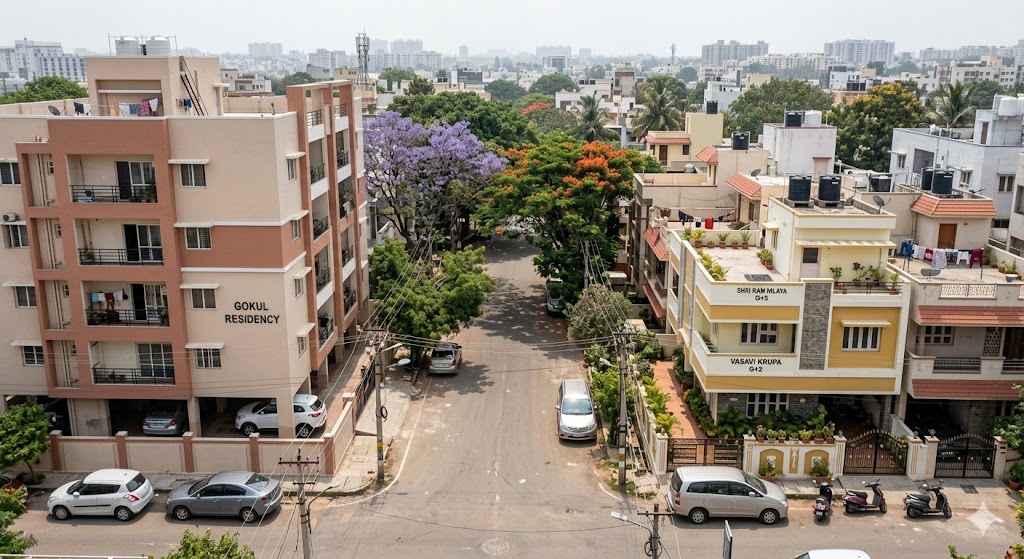
Working reference tables
Print or screenshot these for the studio wall. Cross-check against the current authority notification before any specific filing.
Residential setback matrix (RMP 2031 baseline, indicative)
Front, side, and rear setbacks scale with plot size and abutting road width. These are floor values; the height-coupling supplement and overlay regulations may push them higher.
| Plot Size | Road Width | Front Setback | Side Setback | Rear Setback |
|---|---|---|---|---|
| < 240 sqm | < 9 m | 1.0 m | 0.5 m | 1.0 m |
| 240–500 sqm | 9–12 m | 1.5 m | 1.0 m | 1.5 m |
| 500–1,000 sqm | 12–18 m | 2.0 m | 1.5 m | 2.0 m |
| 1,000–2,000 sqm | 18–24 m | 3.0 m | 2.0 m | 3.0 m |
| > 2,000 sqm | > 24 m | 5.0 m+ | 3.0 m+ | 4.0 m+ |
Indicative ranges from RMP 2031 baseline tables. Specific zone categories (Residential — Main, Mixed, Special) and overlays (eco-sensitive, lake-buffer, heritage, valley zone) modify these values. Always verify against the current zonal notification at sanction.
Height-coupling supplement (RMP 2031)
For buildings above the height threshold, the supplement supersedes the road-width matrix floor whenever it computes to a larger value.
| Building Height | Height-coupled supplement | Effective minimum (illustrative) |
|---|---|---|
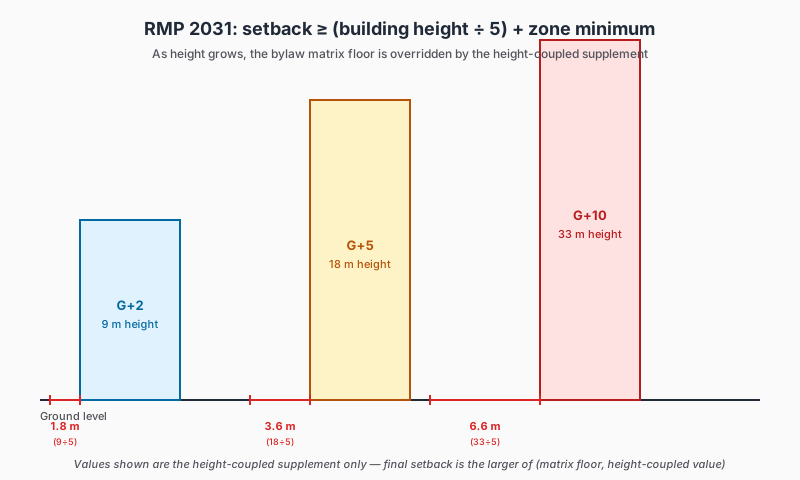
| ≤ 9 m (G+2) | (9 ÷ 5) = 1.8 m | max(matrix, 1.8 m) |
| ≤ 15 m (G+4) | (15 ÷ 5) = 3.0 m | max(matrix, 3.0 m) |
| ≤ 18 m (G+5) | (18 ÷ 5) = 3.6 m | max(matrix, 3.6 m) |
| ≤ 24 m (G+7) | (24 ÷ 5) = 4.8 m | max(matrix, 4.8 m) |
| ≤ 33 m (G+10) | (33 ÷ 5) = 6.6 m | max(matrix, 6.6 m) |
Height is measured to the highest occupied floor's slab top, not to the parapet or roof-top water tank. The supplement applies on every façade with the prescribed setback — front, side, and rear.
Projection allowances over setback (RMP 2031)
Cantilever projections may extend over the setback subject to depth and clearance limits. Setbacks are measured to the outermost overhang projection, not to the wall face.
| Projection type | Maximum projection | Minimum clear height | Notes |
|---|---|---|---|
| Sunshade / chajja | 0.6 m | 2.4 m above ground | Permitted on all setbacks |
| Balcony (residential) | 0.6 m | 2.4 m above ground | Counts against FAR per zone clause |
| Cornice / decorative band | 0.45 m | — | Architectural treatment only |
| Boundary wall / compound gate | Up to plot line | n/a | May sit on the plot line itself |
| Projection over public road / footpath | Not permitted | — | Common rejection cause |
Stilt parking columns and boundary-wall pillars are part of the building footprint for setback purposes — they cannot encroach the prescribed margin.
Lake-buffer and eco-sensitive overlay setbacks (KTCDA + BCAP)
Plots near notified lakes or within eco-sensitive zones face supplemental setbacks beyond the standard matrix. Khata documents do not flag overlays — the architect's pre-design check must include the BBMP / BDA RMP layer query.
| Distance from notified lake / sensitive feature | Construction status | Supplemental setback |
|---|---|---|
| 0–30 m from lake boundary (no-build zone) | All construction prohibited | Total non-construction |
| 30–75 m (graduated buffer) | Construction permitted | Front/side setback +1.5–3.0 m supplemental |
| Valley zone overlay | Construction permitted | FAR cut + setback supplement per RMP zone |
| Eco-sensitive zone (e.g., Bannerghatta buffer) | Subject to MoEFCC clearance | Per project-specific notification |
Karnataka Tank Conservation and Development Authority (KTCDA) maintains the lake registry. The Bengaluru Climate Action Plan (BCAP) layer informs valley-zone treatment. Verify via the BBMP Sakala portal or BDA RMP 2031 GIS before concept design.
The working reference, in full
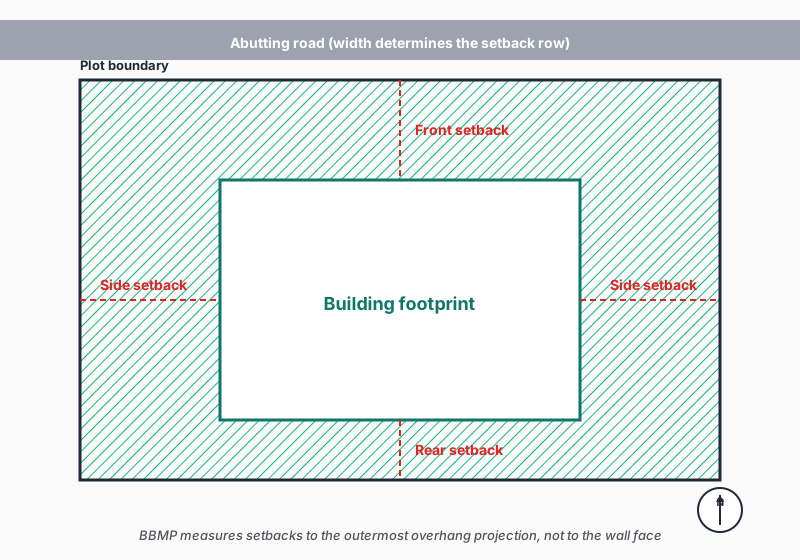
Setbacks are the no-build margins between a residential building's external walls and the plot boundaries — front, side, and rear. In Bengaluru, BBMP enforces setbacks under the BBMP Building Bye-laws 2003 and the dimensional matrices of the Revised Master Plan 2031 (RMP 2031), with statutory authority drawn from the Karnataka Town and Country Planning Act, 1961. The architect's design freedom on any Bengaluru plot is bounded by three overlapping constraints: the road-width-and-plot-size matrix, the height-coupling formula, and the overlay regulations (lake-buffer, eco-sensitive, heritage). Misjudging any one is the single most common cause of plan-sanction rejection.
The matrix — plot size, road width, and the baseline floor
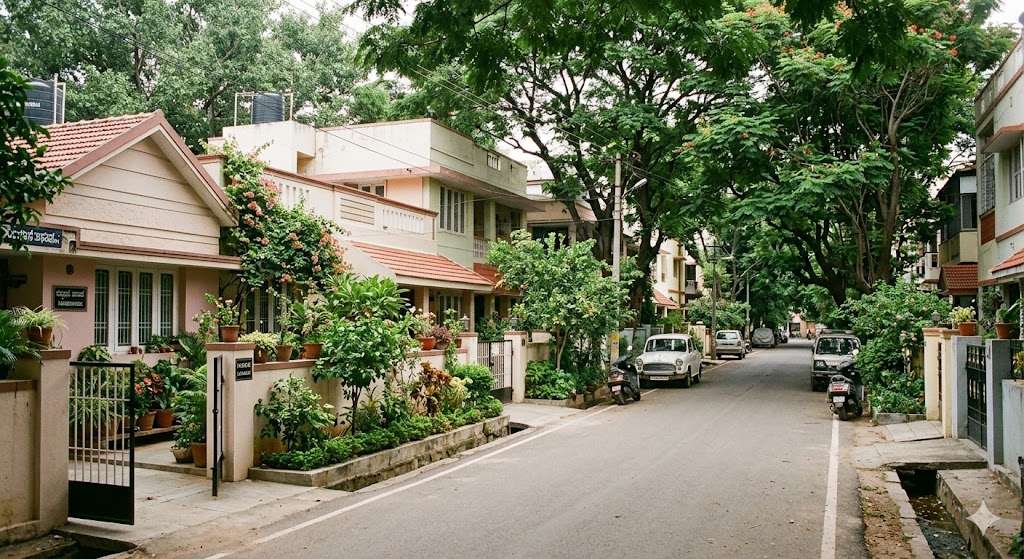
The RMP 2031 setback matrix scales with two inputs: plot size and abutting road width. Smaller plots on narrower roads (the typical 30×40 sites in older Bengaluru localities — Malleshwaram, Basavanagudi, Jayanagar) have smaller mandatory margins; larger plots on wider arterial roads (the 60×80 plots on outer ring road or in newer BDA layouts like Banashankari, RR Nagar) face progressively larger setbacks. The matrix is a floor, not a ceiling — the actual setback applicable on any plot is the larger of the matrix value and the height-coupled supplement (see below). Architects new to Bengaluru practice often submit designs that satisfy the matrix but fail the coupling — a paper-compliant rejection.
The height-coupling formula — RMP 2031's hidden binding constraint
RMP 2031 ties setback to building height through the light-and-air principle: setback ≥ (building height ÷ 5) + zone-specific minimum. The intuition is that taller buildings cast longer shadows and consume more of the neighbour's horizontal sky-view, and so must leave a proportionally larger horizontal margin. A 15-metre building (G+4) on a plot otherwise eligible for a 1.5-metre setback must, in practice, leave 3.0 metres — because the height-coupled value (15 ÷ 5 = 3.0 m) exceeds the matrix floor. For G+10 high-rise residential, the coupling alone often dictates the achievable footprint, with the road-width matrix becoming non-binding.
Eco-sensitive and lake-buffer overlays — the silent disqualifier
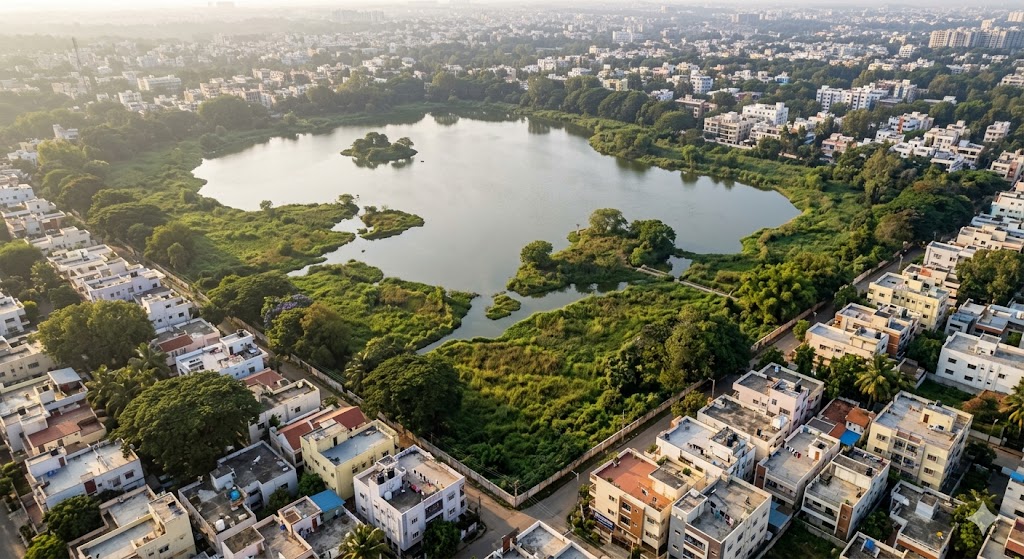
Bengaluru sits on a chain of cascading lakes, with more than 200 notified lakes and tanks within BBMP limits and a further set in the BMRDA peri-urban belt. The Karnataka Tank Conservation and Development Authority (KTCDA) prescribes a 30-metre lake-buffer no-construction zone, with a further graduated buffer of 30–75 metres where construction is permitted but with supplemental setbacks. Plots within a valley zone (the Vrishabhavathi, Hebbal, Koramangala, and Bellandur valley overlays mapped in RMP 2031) face FAR reductions of 25–50% and additional setback margins. Eco-sensitive zones — most notably the Bannerghatta National Park buffer — require Ministry of Environment, Forest and Climate Change (MoEFCC) clearance for any construction. None of these overlays are surfaced on the standard A-Khata or e-Aasthi printout that the buyer hands to the architect; the pre-design overlay check must be initiated by the architect against the BDA RMP 2031 GIS layer or the BBMP Sakala portal.
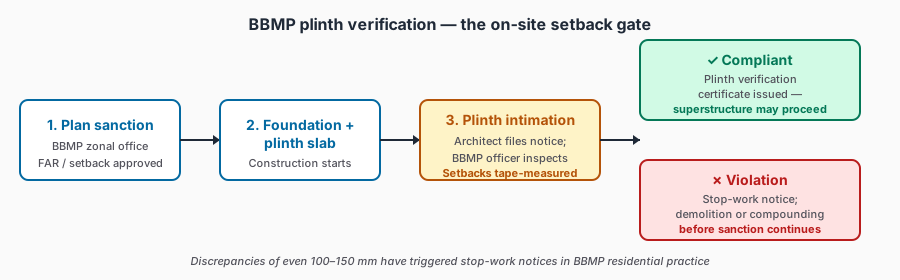
Plinth verification — where setbacks are physically enforced
Paper compliance at sanction is necessary but not sufficient. After the foundation and plinth-level slab are constructed, and before the superstructure begins, the architect must file an intimation of plinth completion with BBMP. A BBMP Town Planning officer inspects on-site, tape-measures the actual setbacks against the sanctioned drawing, verifies plinth level and footprint, and either issues a plinth verification certificate (permitting superstructure to proceed) or raises observations and a stop-work notice. Discrepancies of even 100–150 mm — a not-uncommon construction tolerance — have triggered stop-work in BBMP practice. Major violations require demolition of the offending portion and a fresh sanction round; minor violations may be regularised under the bylaw compounding-fee schedule, but only at BBMP's discretion.
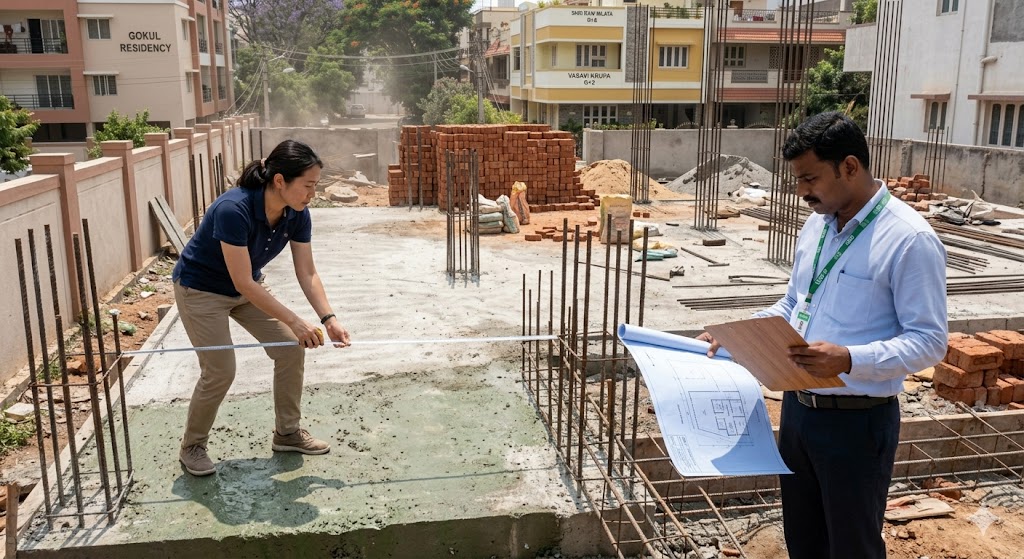
On-site reality — the inspection that decides everything
Sanction certificates and clean drawings live in offices; setbacks are decided on the slab. At plinth verification, a BBMP Town Planning officer arrives with a measuring tape and the sanctioned drawing, and physically checks the gap between the cast plinth's outermost edge and the plot boundary at the front, sides, and rear. The architect's role at this inspection is to walk the officer through the design, point to the relevant matrix row and height-coupling computation, and demonstrate compliance with the tape. A 4-metre setback that reads as 3.85 m on the tape — within construction tolerance, beyond bylaw tolerance — triggers a stop-work notice that pauses the project until either the offending wall is corrected or a compounding-fee regularisation is approved. This is the gate that catches paper-compliant designs.
Projection allowances and the wall-face vs overhang trap
Cantilever projections — sunshades, balconies, chajjas, decorative bands — may extend over the setback subject to depth and clearance limits. RMP 2031 typically permits a 0.6 m projection over the setback for sunshades and balconies, with a minimum clear height of 2.4 m above ground. However, BBMP measures the setback to the outermost overhang projection, not to the wall face. A common first-time-architect error is to design a 1.5 m setback wall with a 0.6 m balcony projecting over it — leaving an effective 0.9 m clearance to the plot line, a clear matrix violation. The compliance certificate must declare wall-face setback and projection, and the on-site plinth check measures both.
The architect's compliance certificate — the document the sanction rests on
Among the sanction-package deliverables per RMP 2031 is the architect's FAR / setback compliance certificate — a clause-by-clause signed declaration that the design conforms to BBMP Building Bye-laws and RMP 2031 dimensional rules. The certificate must enumerate the matrix row applied, the height-coupling supplement computed, projection allowances claimed, and any overlay-driven supplements. Errors in the certificate are the most common single cause of resubmission at the BBMP zonal office. The certificate is not just a paper formality — it carries the architect's professional seal and is the document on which BBMP's plan-sanction approval ultimately rests.
Common pitfalls
- Measuring setback to the wall face instead of to the outermost overhang projection — BBMP measures to the overhang at plinth verification.
- Using only the BBMP Building Bye-laws 2003 setback table without the RMP 2031 height-coupling supplement — the supplement supersedes for buildings above the height threshold.
- Missing the lake-buffer overlay on plots within 75 m of a notified lake — KTCDA records, not the Khata, are the authoritative source.
- Treating private internal-society road width as gazetted road width — only notified widths qualify for the matrix row.
- Forgetting that stilt parking columns count as building footprint for setback purposes even though the stilt floor is excluded from FAR.
- Submitting the FAR/setback compliance certificate without enumerating overlay-driven supplements — implicit overlay claims fail at BBMP zonal review.
Frequently asked questions
›Are BBMP setbacks the same across all of Bengaluru?
›Can BBMP setbacks be reduced if the neighbour agrees?
›Does stilt parking count toward setback?
›What happens if BBMP plinth verification finds a setback violation?
›Are setbacks for Bengaluru apartments different from individual houses?
›Does BBMP recognise private internal-society roads for setback purposes?
Sources & references
Karnataka Town and Country Planning Act, 1961
Act No. 11 of 1963, as amended; Sections 14A, 17, 76 governing master-plan dimensional controls
BBMP Building Bye-laws 2003
Bruhat Bengaluru Mahanagara Palike, Building Bye-laws 2003 (as amended), Schedules I–V
Revised Master Plan 2031 (RMP 2031)
Bangalore Development Authority, RMP 2031 — Volume II Zoning Regulations and Volume III Land Use Plan
Karnataka Tank Conservation and Development Authority (KTCDA) Act, 2014
Act No. 41 of 2014, governing lake-buffer and supplemental setbacks within notified tank areas
Karnataka Sakala Services Act, 2011 — plan-sanction service timelines and escalation framework
National Building Code of India (NBC) 2016
Bureau of Indian Standards, NBC 2016 — Volume 1 Part 3 Development Control Rules and General Building Requirements
Bengaluru Climate Action Plan (BCAP) — valley-zone overlay
BBMP Climate Action and Resilience Plan 2023 — valley-zone mapping and supplemental dimensional controls
Disclaimer: Regulatory rates and dimensional rules change frequently and may be modified by mid-year notifications. Values reflect the framework as of 2026-05-10; verify against the current authority notification before any specific filing. This page is informational and is not legal or planning advice — engage a registered architect and a qualified planning consultant for project-specific compliance.
Related guides from the library
The companion deep-dives that practising architects keep alongside this reference.
FSI / FAR Computation in India
A State-by-State Working Reference for Indian Architects
24 min read · Open ConstructionBuilding Plan Approval Process in India
State-Wise Guide — BBMP, BMC, CMDA, GHMC, MCD, PMC & 14 More Cities
30 min read · Open ConstructionOC, CC & Plinth Verification in India
The Architect's Submission Workflow for Statutory Completion Milestones
20 min read · Open ConstructionThe Architect's Scope of Services in India
COA Conditions of Engagement Decoded — Stages, Deliverables, Fees, and What's Actually Included
23 min read · OpenCompare across cities
The same Setbacks topic, different regulatory frameworks, different city quirks. Architects practising across metros should bookmark the adjacent reference.
Setbacks in Mumbai
Development Control and Promotion Regulations 2034 (DCPR 2034)
Open DDA · Delhi (NCT)Setbacks in Delhi
Master Plan for Delhi 2021 (MPD 2021) + Unified Building Bye-laws 2016
Open CMDA · Tamil NaduSetbacks in Chennai
Tamil Nadu Combined Development & Building Rules 2019 (TNCDBR 2019)
Open HMDA · TelanganaSetbacks in Hyderabad
Telangana Building Rules 2012 + GO Ms No. 168
OpenBuilding Setbacks Across India
A State-by-State Guide to Development Control Regulations, Plot Setbacks, Ground Coverage, and FAR — for Architects, Planners, and Developers
Read the deep-dive Bengaluru compliance mapThe Architect's Compliance Map — Bengaluru
BBMP, BDA, BMRDA, BWSSB, BESCOM, Karnataka RERA, KSPCB — the Permit Chain, Khata Disambiguation, and the Operational Workflow for Residential Practice in 2026
Read the city map