
What Makes a Home Healthy? A Homeowner's Guide
Most Indian homes are designed for how they look and for Vastu — not for the bodies living in them. This is the map of the eight levers that quietly shape your sleep, breathing, mood and your child's health.
In a Mumbai high-rise, a young couple have a beautiful flat — marble floor, imported sofa, a Vastu-correct pooja room in the north-east. They also cannot sleep past 5 a.m., the baby's nose runs all winter, and by April the bedroom is so hot they run the AC at 19°C and wake up with sore throats. Nothing is wrong with the home. It simply was never designed around the people breathing, sleeping and living inside it.
This is the quiet gap in how most Indian homes are made. We optimise hard for two things — how a home looks and whether it satisfies Vastu — and we spend almost nothing on how it makes our bodies feel over the 90,000-odd hours we'll live in it. Yet the home is the single biggest environmental exposure of your life: the air you breathe most, the light that sets your body clock, the noise that interrupts your sleep, the surfaces your children crawl on.
A healthy home is not a luxury upgrade or a wellness trend — it is the set of design decisions that quietly protect your sleep, your breathing, your mood and your child's developing brain, every single day.
1. Why your home is a health decision, not just a design one
The World Health Organization treats housing as a core determinant of health, linking dampness, poor ventilation, indoor smoke, noise and overheating directly to respiratory disease, cardiovascular strain, poor sleep and mental ill-health. In India those risks are sharper than the global average: Delhi-NCR winters push outdoor PM2.5 far past WHO limits, the monsoon breeds mould on north walls, and summer indoor temperatures in poorly shaded flats routinely cross what the body can comfortably handle at night.
"The home environment is one of the most important settings for health. Inadequate housing causes or contributes to many preventable diseases and injuries." — WHO, Housing and Health Guidelines (2018)
The good news is that almost every one of these problems is a design problem, which means it is fixable — often without spending more, only by choosing differently. This guide is the map. It breaks a healthy home into eight levers, tells you in two lines what each one does to your body, and points you to a dedicated deep-dive for each. Think of it as the table of contents for your own home's health.
This is the holistic overview. If you specifically want the psychology of how good architecture lowers stress — the design-education angle — read how good architecture reduces stress alongside this. Here we tie all eight strands together.
2. The eight levers of a healthy home
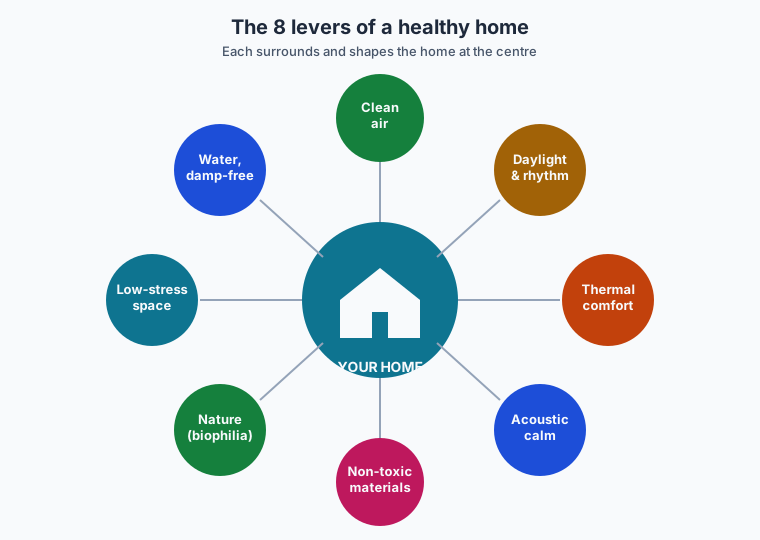
Figure 1: A healthy home is the sum of eight overlapping levers — pull on any one and the others move too. No single fix makes a home healthy; the combination does.
Here is the whole series at a glance. Each lever gets one line on what it is and why your body cares, then a link to its dedicated guide.
| # | Lever | What it is & why your body cares | Go deeper |
|---|---|---|---|
| 1 | Clean air | The air indoors is often 2–5× more polluted than outside; clean air protects lungs, heart and a child's growth | Indoor air quality |
| 2 | Natural ventilation | Moving air flushes out CO₂, cooking fumes and damp; stale rooms make you foggy and breed mould | Natural ventilation · Cross-ventilation |
| 3 | Daylight & circadian light | Bright morning light sets your body clock for alertness by day and sleep at night; dim homes flatten mood | Daylighting · Circadian lighting |
| 4 | Thermal comfort | A body that is too hot at night cannot reach deep sleep; overheating also strains the heart | Better sleep |
| 5 | Acoustic calm | Unwanted noise spikes stress hormones and fragments sleep even when you don't fully wake | Acoustic comfort |
| 6 | Non-toxic materials | Paints, boards and adhesives can off-gas VOCs and formaldehyde for months, irritating airways | Healthy materials |
| 7 | Connection to nature | A green view and daylight measurably speed stress recovery and restore attention | Mental wellbeing |
| 8 | Low-stress, legible space | A home you can read at a glance, with a corner to retreat to, lowers the daily cognitive load | Low-stress spaces |
If you want to score your own home's biophilic content — daylight, views, greenery and natural materials together — run the biophilic score tool before and after any change.
3. Air, ventilation and the breath you take 20,000 times a day
You take roughly 20,000 breaths a day, the vast majority of them indoors. In an Indian home the air is loaded from three sides: outdoor PM2.5 leaking in (catastrophic in a Delhi winter), cooking emissions from gas and frying, and indoor sources like agarbatti, mosquito coils and off-gassing furniture. A sealed, AC-only flat traps all of it; a well-ventilated one dilutes it.
The two levers work as a pair. Clean air is about what is in the air — particulates, CO₂, VOCs, humidity. Natural ventilation is about moving that air out and fresh air in, ideally without a power bill. A home with cross-breeze across opposite walls can change its entire air volume several times an hour for free.
| Air problem | Common Indian cause | First design move |
|---|---|---|
| Stuffy, foggy rooms | Single-sided windows, no cross-breeze | Openings on opposite/adjacent walls |
| Winter PM2.5 indoors | Open windows during Delhi smog | Filter air on bad-AQI days, ventilate on good ones |
| Kitchen smoke lingering | Weak/no exhaust, recirculating chimney | Ducted exhaust to outside, near the hob |
| Damp, musty smell | Poor airflow + monsoon humidity | Ventilate bathrooms; keep north walls breathing |
For the engineering detail — opening sizes, NBC and IS guidance, wind angles — use the cross-ventilation analyzer and the technical reference on cross-ventilation in Indian homes. For the air-quality fundamentals, see how ventilation changes home quality.
4. Light, time and your body clock
Light is not just for seeing — it is the master signal for your circadian rhythm. Bright light in the morning (ideally daylight near a window) tells your brain it is day, sharpening alertness and, crucially, setting the timer that releases melatonin about 14–16 hours later so you can sleep. A home that is dim by day and bright with cool white LEDs at night sends your body the exact wrong signals.
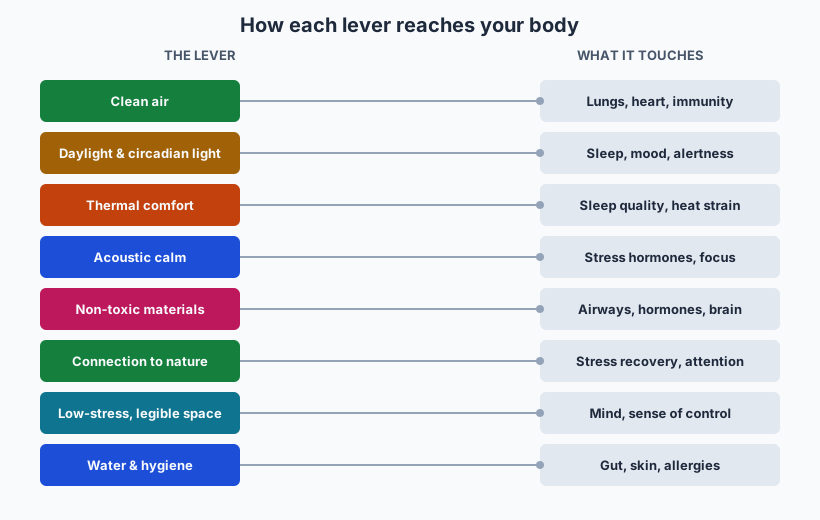
Figure 2: Every lever has a body-level destination. The home is not abstract wellness — it lands on your lungs, your sleep, your stress hormones and your attention.
"Light is the most important environmental input, after food, in controlling bodily function." — Stephen R. Kellert, Biophilic Design
Two siblings cover this: daylighting is about getting good natural light into rooms by day; circadian lighting is about choosing the right artificial light by time of day — warm and dim in the evening, brighter and cooler in the morning. To plan daylight, use the sun-path analyzer and, for designers, the daylight factor and circadian light meter. The technical planning detail lives in daylight factor and natural-light planning; how light interacts with your specific site orientation is in orientation, light and views.
5. Quiet, calm and the nervous system
Noise is the most underrated health hazard in Indian apartments. Traffic, neighbours' renovations, the lift motor, a generator — even when it doesn't wake you, night-time noise nudges up cortisol and blood pressure and shaves the depth off your sleep. The WHO's environmental-noise guidance is explicit that chronic noise exposure is linked to cardiovascular and sleep effects, not merely annoyance.
Acoustic calm is the lever here, and it is mostly about separation and absorption: distance between noise and bedroom, mass in walls, soft surfaces to soak up echo, and quiet retreat zones. You don't need a recording studio — you need the bedroom not to share a wall with the lift shaft, and a soft, layered living room instead of an echoing hard-floored box.
For the problem-solving playbook — what to do about a noisy neighbour or a roadside flat — see noise-reduction strategies for apartments and the health-first treatment in acoustic comfort in homes. Designers can visualise sound paths with the acoustic privacy visualizer.
6. Heat, comfort and sleep
A body needs its core temperature to drop slightly to fall and stay asleep. In an un-shaded west-facing Chennai or Nagpur bedroom that radiates stored heat all night, that drop never happens — which is why so many families are hostage to the AC. The fix is upstream: shade the glass before the sun hits it, use mass and ventilation to flush heat at night, and orient sleeping rooms away from the harshest afternoon sun.
| Thermal issue | What it does to sleep | Design lever |
|---|---|---|
| West glazing, no shading | Bedroom radiates heat till midnight | Brise-soleil, deep chajja, trees |
| Concrete roof, top floor | Whole flat overheats by evening | Roof insulation / reflective finish |
| AC at 19°C all night | Dry throat, broken sleep, high bills | Shade + night-flush, set 24–26°C |
Thermal comfort and clean cool air are both inputs to sleep, so this lever lives mostly inside designing homes for better sleep. For shading geometry, designers can use the brise-soleil visualizer.
7. Materials, water and the home's hidden chemistry
The surfaces in your home are not inert. Fresh paint, laminates, plywood and MDF, adhesives and some flooring quietly release volatile organic compounds (VOCs) and formaldehyde — that "new furniture smell" — which irritate airways and, at higher exposures over time, are a genuine health concern. Children, who breathe faster relative to body size and live closer to the floor, are most exposed.
The non-toxic materials lever is about choosing low-VOC paints, formaldehyde-rated boards, and finishes that stop off-gassing in days rather than months. The closely related water and hygiene lever is about keeping the home dry — because the single biggest material-health problem in India is monsoon damp, which feeds mould and dust mites and triggers allergies and asthma. Stains, peeling paint and a musty smell on a north wall are early warnings.
For the buyer's guide to low-emission paints, boards and finishes, see healthy materials for interiors; for the broader materials landscape, modern construction materials.
8. Nature, calm space and the mind
The last two levers are about the mind. Connection to nature — a green view, daylight, plants, natural materials, even the sound of water — is one of the most robustly evidenced wellbeing inputs in architecture. Roger Ulrich's landmark hospital study found patients with a view of trees recovered faster and needed fewer painkillers than those facing a brick wall.
"Patients with a window view of a natural setting had shorter post-operative stays and took fewer analgesics than those whose windows faced a brick wall." — Roger S. Ulrich, Science (1984)
Low-stress, legible space is the quieter cousin: a home you can read at a glance, with a clear path through it, storage that hides clutter, and at least one corner to retreat to. Christopher Alexander's idea that a home should have a hierarchy of spaces — from sociable to deeply private — maps directly onto modern findings on restoration and a sense of control.
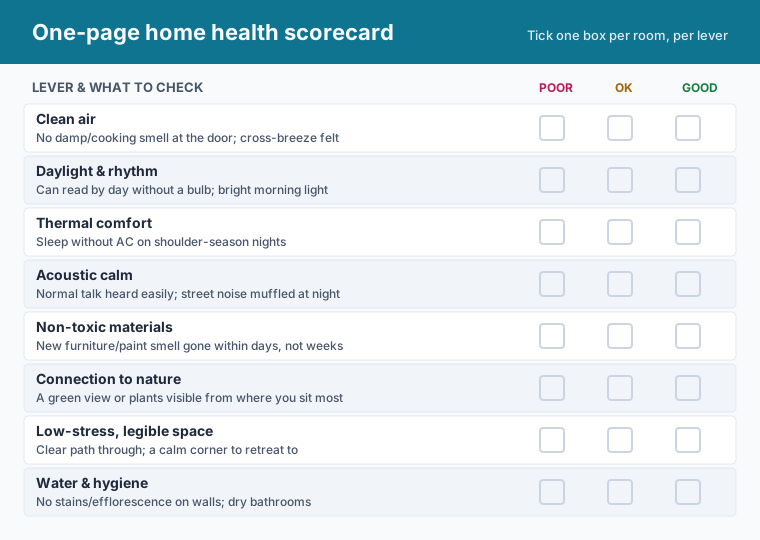
Figure 3: Print this and walk your home, room by room. Most homes score well on two or three levers and have one weak link that's easy to miss until you look for it.
These two land in homes that improve mental wellbeing and designing low-stress living spaces. For the retreat-and-privacy angle specifically, see zones of retreat, rest and privacy, and to put numbers on a green view, the healing-view impact calculator.
9. Your quick healthy-home audit
You don't need instruments to start. Walk your home at three times — early morning, mid-afternoon, and 10 p.m. — and check this list honestly. A "no" is not a failure; it's a pointer to which sibling guide to read next.
| Lever | Quick check (yes / no) |
|---|---|
| Clean air | Does the air smell fresh, not musty or smoky, when you walk in? |
| Ventilation | Is there a felt cross-breeze in living areas with windows open? |
| Daylight | Can you read comfortably by daylight alone at noon? |
| Circadian | Is your evening lighting warm and dimmable, not cold and glaring? |
| Thermal | Can you sleep without AC on a mild (non-peak-summer) night? |
| Acoustic | Is night-time street/neighbour noise muffled in the bedroom? |
| Materials | Has new furniture/paint smell faded within a few days? |
| Nature | Can you see greenery or plants from where you sit most? |
| Low-stress space | Is there a clear path through and a calm corner to retreat to? |
| Water/hygiene | Are walls free of damp stains, and bathrooms drying out properly? |
If most answers are "yes," your home is already doing its quiet work. If three or more are "no," pick the lever that bothers you most day-to-day — usually sleep, air or noise — and start there.
Sources & further reading
- World Health Organization — WHO Housing and Health Guidelines (2018)
- World Health Organization — Environmental Noise Guidelines for the European Region (2018)
- Roger S. Ulrich — "View Through a Window May Influence Recovery from Surgery," Science, 224 (1984)
- Stephen R. Kellert, Judith Heerwagen & Martin Mador — Biophilic Design: The Theory, Science and Practice of Bringing Buildings to Life (2008)
- Christopher Alexander et al. — A Pattern Language: Towns, Buildings, Construction (1977)
- Bureau of Indian Standards / NBC — National Building Code of India (ventilation, lighting and habitability provisions)
This is the map of the whole series. Once you know which lever matters most for you, go deep: most homeowners start with designing homes for better sleep, indoor air quality explained, or daylighting principles for homes — then work outward through the other seven.
Export this guide
Related Guides — Deep-dive reading
Homes That Improve Mental Wellbeing
The whole-home, indoor-biophilia approach to calm — how plants, light, air, quiet and the right balance of togetherness and retreat make an Indian home restorative.
Healthy HomesHow Good Architecture Reduces Stress
The measurable ways your home calms or strains your nervous system — and how to design for calm
Design EducationOrientation, Light & Views: Designing With Your Space, Not Against It
How reading your plot's sun, breeze and views — and placing each room on the right face — gives an Indian home that is cooler, brighter and quietly right, instead of one that fights its site forever.
Design PrinciplesRelated Tools — Try Free
Circadian Light Meter
Patient-centric circadian lighting visualizer for Indian healthcare design — time-of-day × intensity → CCT, melanopic lux (EML / mEDI), melatonin suppression, and an alertness curve. Calibrated against WELL v2 L03 Circadian Lighting Design, CIE S 026:2018, Brainard 2001, and Lucas et al. 2014.
Circadian ToolHealing View Impact Calculator
Evidence-Based Design dashboard quantifying the recovery impact of nature view + daylight factor on analgesic use, length of stay, and HCAHPS patient-experience uplift. Calibrated against Ulrich 1984 (Science), Park & Mattson 2008, and the CHD EBD evidence base.
EBD CalculatorBrise-Soleil Visualizer
Interactive horizontal-louvre cut-off angle calculator — sun altitude, louvre depth, and spacing inputs with a live shadow preview. Computes θ = arctan(spacing/depth) for façade shading, ECBC envelope compliance, hospital daylight design, and tropical sun-control detailing.
Sun Shading Tool