
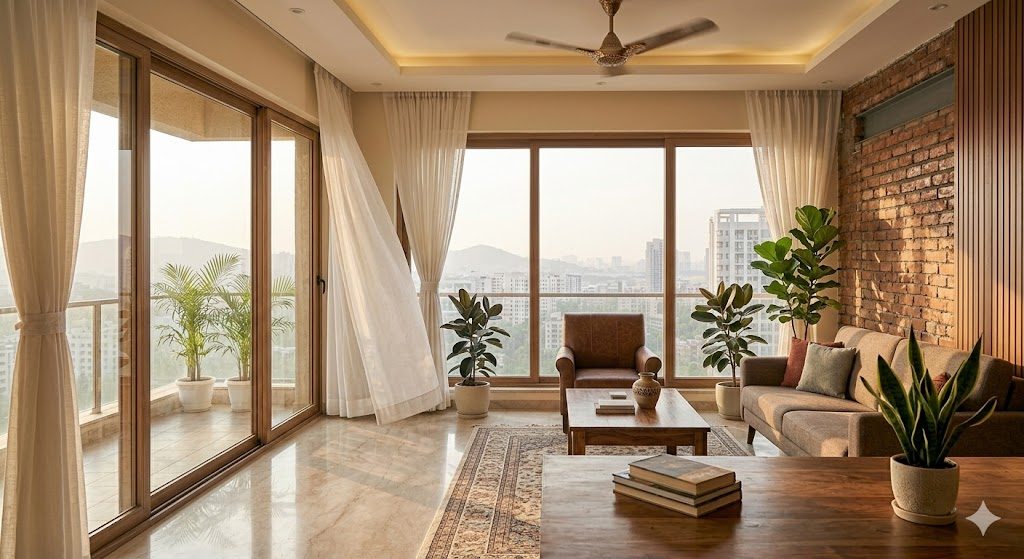
How Ventilation Changes Home Quality
The invisible factor behind health, comfort, smell and freshness in your home
You walk into a friend's flat and within ten seconds your body has formed an opinion. One home feels fresh — there is a faint movement of air, the smell is neutral, your shoulders drop. Another, identical on paper, feels close and heavy: last night's tadka still hangs in the air, the bedroom smells of sleep, and somewhere behind the cupboard there is the sweetish note of damp. You have not measured anything. Your lungs and nose did the measuring for you.
This guide is about that invisible factor — ventilation — and why it does more for how a home actually feels, and for the health of the people inside it, than almost any finish you can buy. We will look at what is really in the air of an Indian home, what those pollutants do to your body and your concentration, and the full menu of ways to move air through a house: not just opening two windows, but stack effect, exhaust fans, and the filtered fresh-air systems that are quietly becoming essential in our most polluted cities.
The core idea is simple: a home is not a sealed box you decorate, it is a set of lungs you live inside. Air comes in, gets used and contaminated, and must leave. Ventilation is the rate at which that exchange happens — and when it is too slow, every other quality of the home quietly degrades. If you want the practical layout craft of getting wind across a room, read the companion piece on cross-ventilation in Indian homes; this guide is the why beneath it.
Why ventilation is the most underrated factor in home quality
Walk through any home-improvement conversation in India and you will hear about tiles, modular kitchens, false ceilings, paint shades. You will almost never hear "what is the air-change rate of this bedroom?" Yet ventilation touches everything the other choices only decorate.
It governs smell — a poorly ventilated home accumulates the odours of cooking, bodies, shoes, and pets because nothing carries them away. It governs humidity, and therefore whether your cupboards smell musty and your walls grow black mould in the monsoon. It governs temperature comfort, because moving air over skin can feel 2–3°C cooler than still air at the same thermometer reading. And most importantly, it governs the air you actually breathe — roughly 11,000 to 15,000 litres of it a day, the overwhelming majority of it indoors.
The reason it stays invisible is precisely that it is invisible. You cannot photograph fresh air. It does not appear in a moodboard. It has no showroom. So it gets value-engineered out: the window that should have been on the opposite wall becomes a wardrobe, the bathroom exhaust never gets wired, the new flat is sealed tight for the air-conditioner and nobody asks where the stale air goes. The result is a category of home that looks expensive and feels wrong, and the owners cannot name why.
What is actually in your indoor air
Indoor air is not "outdoor air, but inside." It is a distinct, often worse, mixture — because the home both traps outdoor pollutants and manufactures its own. The WHO has long flagged indoor air pollution as a major health burden, and in Indian homes the sources stack up in a recognisable pattern.
The pollutant sources, and where they come from
| Pollutant | Where it comes from in an Indian home | What it does to you |
|---|---|---|
| PM2.5 (fine particles) | Gas-flame cooking, frying and tadka, agarbatti and diyas, candles, outdoor ingress | Penetrates deep into the lungs; triggers asthma, irritates airways, linked to heart and lung disease |
| VOCs (volatile organic compounds) | Fresh paint, new plywood and MDF, laminate and PU adhesives, foam mattresses, cleaning sprays, perfumes | Headaches, dizziness, eye and throat irritation; formaldehyde from cheap ply is a known irritant and long-term concern |
| CO2 (carbon dioxide) | Exhaled by everyone in the room — worst in a closed AC bedroom at night | Above ~1,000 ppm: drowsiness, poor sleep quality, measurably duller thinking |
| Humidity & mould | Cooking and bathing steam, drying clothes indoors, monsoon air, poor cross-flow | Damp triggers allergies and cough; mould spores worsen asthma; musty smell and spoiled cupboards |
| Dust & allergens | Street dust, textiles, dust mites in bedding, pet dander | Sneezing, congestion, allergic rhinitis — very common in Indian cities |
| Radon | Seeps from certain soils and granite into ground-floor and basement rooms | Colourless, odourless; a recognised long-term lung-cancer risk where it accumulates unventilated |
| Outdoor pollution ingress | City PM2.5 and NO2 from traffic, construction dust, crop-burning haze, diesel generators | On bad-AQI days the outdoor air entering through open windows is itself the main hazard |
The cruel twist for Indian homes is the kitchen. Cooking on an open gas flame, especially frying, is a significant indoor PM2.5 source — and the kitchen is usually the room with the least thought given to extraction. A chimney that only recirculates, or an exhaust fan that was never installed, means the cook breathes the worst air in the house, daily, for years.
Your home is not polluted because something went wrong. It is polluted because people live, cook, breathe and paint inside it — and that is exactly why it must be ventilated, continuously, by design.
What stale air does to your body and your mind
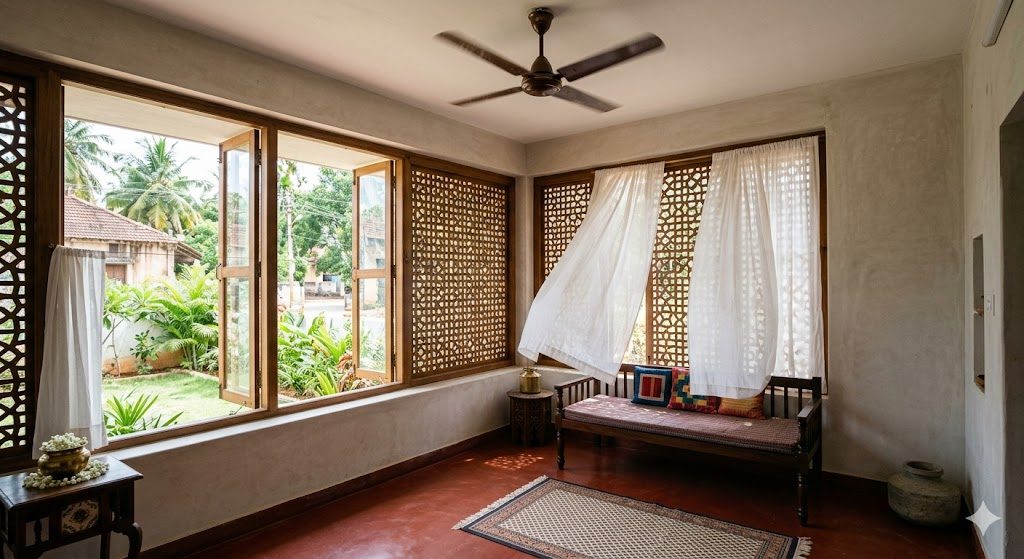
It is easy to treat "stuffy" as a comfort complaint. It is closer to a health and performance one.
CO2 and your brain. This is the most striking and least-known finding. Controlled studies — including well-cited work from Lawrence Berkeley National Laboratory and Harvard's School of Public Health — have shown that as indoor CO2 rises from a fresh ~600 ppm towards 1,400–2,500 ppm, measures of decision-making, concentration and "crisis response" thinking decline significantly. A closed bedroom with two adults and the AC running overnight routinely crosses 1,500–2,000 ppm by morning. That heavy, un-rested feeling on waking is not always poor sleep hygiene — sometimes it is simply that you spent eight hours re-breathing your own exhaust.
Damp and your lungs. Persistent indoor humidity above ~60% relative humidity is the breeding condition for mould and dust mites. The link between damp homes and respiratory symptoms — wheeze, cough, asthma exacerbation — is one of the better-established findings in building-health research. In an Indian monsoon, a flat with no cross-flow can sit at 75–85% RH for weeks, and the black bloom behind the wardrobe is the visible tip of a much larger spore load.
Particles and your airways. PM2.5 is the pollutant with the clearest hard-health link — it is fine enough to reach the deepest part of the lung and enter the bloodstream. Cooking-generated particles spike sharply and, without extraction, linger and spread through the home rather than leaving it.
The pattern across all of these is the same: the harm is not from a single dramatic exposure but from the slow, daily, cumulative dose of air that was never refreshed. Ventilation is the dilution that keeps that dose low.
The ventilation modes: your full menu
Most people's mental model of ventilation is "open a window." That is one mode of several. Understanding the full set lets you pick the right tool for your home, your floor, and your city's air.

Natural ventilation (free, passive)
- Cross-ventilation — the workhorse. Openings on opposite or adjacent walls let wind enter one side and leave the other, sweeping the room. It needs an inlet and an outlet; a single window only ventilates a shallow zone near it. The full layout craft — opening sizes, room depth, wind orientation — is covered in the cross-ventilation guide.
- Stack (chimney) effect — warm air rises and escapes high, drawing cool air in low. It works without wind, which makes it precious on still, humid evenings. More on this below.
- Single-sided ventilation — one wall of openings. Weak, effective only to a depth of about 2 to 2.5 times the room height, but better than a sealed box.
- Wind-driven ventilators and jaali — clerestory vents, roof turbines, ventilator panels above doors, and perforated jaali screens that let a home breathe while keeping privacy and harsh sun out. A staple of vernacular and courtyard homes.
Mechanical ventilation (powered)
- Exhaust fans — the simplest: a fan that pulls foul air out of a kitchen or bathroom and dumps it outside, letting replacement air seep in elsewhere.
- Mechanical extract ventilation (MEV) — a continuous, low-level version of the same idea, extracting from wet rooms whole-house.
- MVHR / ERV (heat- or energy-recovery ventilation) — the sophisticated end. A unit pulls stale air out and fresh air in through a heat exchanger, so incoming air is pre-conditioned by the outgoing air. Crucially, the fresh air is filtered — which is why these are rising fast in Delhi-NCR and other high-pollution cities, where opening a window simply lets the smog in.
Hybrid (the realistic answer)
Most well-designed Indian homes are hybrid. They lean on free natural air-flow whenever the outdoor air and weather allow, and switch to mechanical extract or filtered fresh-air when they do not — a closed kitchen exhaust while cooking, a fresh-air unit on a bad-AQI day, windows thrown open on a clean post-monsoon morning. The skill is in designing a home that can do both.
How the modes compare
| Mode | Powered? | Best for | Limitation |
|---|---|---|---|
| Cross-ventilation | No | General comfort, any breezy site | Needs opposite openings; useless in dead-calm air |
| Stack effect | No | Still humid evenings, double-height spaces | Needs height difference and warm interior |
| Exhaust fan / MEV | Yes | Kitchens, bathrooms, removing the source | Localised; uses some energy |
| MVHR / ERV fresh-air | Yes | Polluted cities, sealed AC homes | Higher cost, filters need servicing |
The numbers: ACH, CFM and what the standards say
To move ventilation from feeling to design, you need a metric. The key one is air changes per hour (ACH) — how many times the entire volume of air in a room is replaced in an hour. One ACH means all the air is exchanged once an hour; a stuffy sealed bedroom might be below 0.5, a breezy verandah effectively dozens.
For point extraction — kitchens and bathrooms — the metric is CFM (cubic feet per minute), the volume of air a fan or chimney moves.
The governing references in India and internationally are the National Building Code of India (NBC) 2016, Part 8 (building services), the ASHRAE 62.1 standard for general buildings and 62.2 for low-rise residential ventilation, and the WHO indoor air quality guidelines for the pollutant targets those rates are meant to achieve. The CPCB sets the outdoor air-quality benchmarks that tell you whether to open up or seal and filter.
| Space / metric | Practical target | Source / basis |
|---|---|---|
| Living rooms, bedrooms | ~0.5 to 1 air change per hour minimum, more when occupied | ASHRAE 62.2 / NBC 2016 |
| Kitchen exhaust (chimney) | ~10 to 15 air changes per hour; a typical home chimney rated 600 to 1,200 m³/hr | NBC 2016 Part 8 / manufacturer |
| Bathroom exhaust | ~6 to 8 air changes per hour; small fan 80 to 120 CFM | ASHRAE 62.2 |
| CO2 ceiling (occupied room) | keep below ~1,000 ppm for clear thinking | WHO / ASHRAE comfort basis |
| Relative humidity comfort band | 40 to 60% RH | ASHRAE comfort / mould control |
| Openable window area | NBC: at least ~1/10 of floor area openable for natural ventilation | NBC 2016 (varies by occupancy) |
The openable-area rule is the one most worth remembering as a homeowner, because it is checkable with a tape. NBC 2016 expects habitable rooms to have an openable area on the order of one-tenth of the floor area for natural ventilation (with daylighting provisions alongside). A 12 m² bedroom therefore wants at least ~1.2 m² that genuinely opens — not a sealed picture window, not a glass pane painted shut, but an aperture air can pass through.
The stack effect, and how to actually use it
The stack effect deserves its own section because it is the closest thing to free cooling and ventilation that physics offers, and Indian builders used it for centuries before it had an acronym.
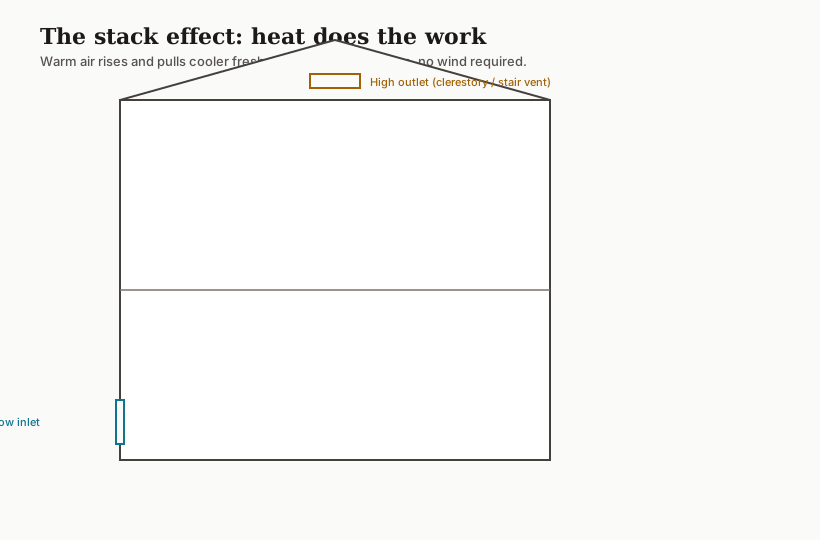
The mechanism: warm air is less dense, so it rises. If you give the warm, stale air near the ceiling a high-level way out — a clerestory window, a vent at the top of a stairwell, a jaali band under the roof, an open courtyard acting as a chimney — it leaves. As it leaves, it pulls cooler, denser air in through low-level openings to replace it. The home breathes upward, continuously, even when there is not a breath of wind outside.
Two things make it stronger: a bigger height difference between the low inlet and the high outlet, and a hotter interior relative to outside. That is why double-height living halls, stairwell voids and traditional courtyards work so well — they are tall thermal chimneys. The havelis of Rajasthan and the wada houses of Maharashtra cooled themselves this way for generations.
What this means for your home: if you have any double-height space, a staircase, or a terrace, look for a way to let air escape at the very top. A single high-level openable vent over a stairwell can transform the night-time comfort of the rooms below it — pulling the day's trapped heat up and out. This is the heart of several passive cooling strategies for Indian homes.
The two rooms that need it most: kitchen and bathroom
If you do nothing else, get extraction right in the two rooms that generate the most pollution.
The kitchen. This is ground zero for indoor PM2.5. A good chimney should be ducted to the outside, not merely recirculating through a carbon filter. Size it to the cooking: a typical Indian kitchen with heavy frying wants suction in the 1,000 to 1,200 m³/hr range, sited close above the hob so it captures the plume before it spreads. A recirculating chimney that returns filtered air into the same room does little for particles and nothing for heat and moisture — it is the most common false economy in Indian kitchens.
The bathroom. Steam plus poor extraction equals mould, peeling paint and that permanent damp smell. A small exhaust fan of 80 to 120 CFM, vented outside and left running a few minutes after a shower, keeps relative humidity down and the room dry. In flats with internal "dry-area" bathrooms and no external wall, mechanical extraction is not optional — it is the only path the moisture has out.
The city dilemma: open the windows, or seal and filter?
For a generation of Indians, "ventilation" meant "open the window." In Delhi-NCR, large parts of the Gangetic plain, and increasingly other metros, that advice has inverted for months of the year.
When the outdoor AQI is good, natural ventilation is unbeatable — free, generous, and it dilutes everything. But when outdoor PM2.5 is hazardous, opening a window pumps the single worst pollutant straight into your living room. On those days the right move is the opposite: seal the envelope and run filtered fresh-air mechanically. A fresh-air handling unit or ERV with a HEPA-grade filter delivers oxygen-rich, particle-stripped air without inviting the smog in. This is exactly why MVHR/ERV systems — long a European energy measure — are being adopted in Indian cities for a completely different reason: air quality, not heat recovery.
The design implication is that a modern Indian home should be able to switch modes. Generous openings for the clean days; a sealable, filterable path for the bad ones. Watch the CPCB / local AQI, and let the building do what the air outside demands.
Humidity: the quiet half of air quality
Ventilation is not only about pollutants; it is about moisture. The comfort band is roughly 40 to 60% relative humidity. Below it, throats and skin dry out. Above it — the default in coastal and monsoon India — air feels heavier, sweat will not evaporate, and mould thrives.
Moving air is the first and cheapest dehumidifier. Cross-flow and ceiling fans carry moisture-laden air out and help sweat evaporate, which is why a breezy room at 32°C and 60% RH can feel more comfortable than a still room at 30°C and 80%. Where air movement alone cannot cope — sealed AC bedrooms, internal bathrooms, the deep monsoon — a dehumidifier or the dry-mode of an air-conditioner does the rest. But ventilation is what keeps the load manageable in the first place.
How to diagnose a poorly ventilated home
You can read a home's ventilation without instruments. The tells are consistent:
- The smell test. Walk in from outside. If yesterday's cooking, sleep, or damp greets you, the air is not being exchanged.
- The single-window room. Any habitable room with openings on only one wall, or with the only window blocked by a wardrobe, is under-ventilated by layout.
- Black spots and peeling. Mould blooms in corners, behind furniture and around bathrooms mean humidity has nowhere to go.
- Morning heaviness. Waking groggy in a closed, AC-sealed bedroom is the CO2 signature.
- The painted-shut window. Apertures that look like windows but do not actually open are a classic builder shortcut — count openable area, not glass area.
- Condensation on glass and cold walls. A sign moist indoor air is meeting cold surfaces and has no exit.
A more rigorous read uses a cheap CO2 monitor (target under 1,000 ppm) and a humidity meter (target 40–60% RH). To test cross-ventilation paths and openable area against the rules, the cross-ventilation analyzer is a quick starting point, and a healthy, well-ventilated home tends to score better on the biophilic score too — fresh air is a core biophilic quality.
What this means for your home
Ventilation is also deeply tied to how a space feels psychologically — fresh, alive, restorative space is a recurring theme in architectural psychology for comfortable spaces. Here is how to act on it, in order.
1. Find the dead rooms. Walk the home and mark every habitable room with openings on only one wall, or with a window blocked. These are your priorities.
2. Create a path, not just an opening. For each dead room, find a second opening on another wall — a window, a ventilator over the door, a louvred panel — so air can flow through, not just sit.
3. Get the kitchen chimney ducted outside and sized to your cooking (≈1,000–1,200 m³/hr for heavy frying). Recirculating-only is a false economy.
4. Wire a real bathroom exhaust (80–120 CFM), vented outdoors, and run it past every shower.
5. Use height for free cooling. If you have a stairwell, double-height space or terrace, add a high-level openable vent to let trapped heat escape — let the stack effect work.
6. Plan for bad-air days. In a polluted city, design at least one sealable, filterable fresh-air path (an ERV or fresh-air unit) so you are not forced to choose between stale air and smog.
7. Keep humidity in the 40–60% band with air movement first, a dehumidifier or AC dry-mode where flow cannot reach.
8. Verify, do not assume. A ₹3,000 CO2-and-humidity monitor tells you in a week what your home's air is actually doing — and where to focus.
Designing a home that breathes well is a layout decision, made early, room by room — where openings face, how deep the rooms run, where air enters and where it leaves. DesignAI can help you test ventilation paths, openable-area ratios and orientation against your plot and climate zone before a single wall is built, so fresh air is engineered into your home rather than missed and regretted later.
References
1. National Building Code of India (NBC) 2016, Part 8 — Building Services and Part 11, Bureau of Indian Standards — natural and mechanical ventilation provisions, openable-area and exhaust requirements.
2. ASHRAE Standard 62.1 and 62.2 — Ventilation for Acceptable Indoor Air Quality (commercial) and Ventilation and Acceptable Indoor Air Quality in Residential Buildings.
3. World Health Organization — WHO Guidelines for Indoor Air Quality (selected pollutants; dampness and mould), Geneva.
4. Central Pollution Control Board (CPCB) — National Ambient Air Quality Standards and the National Air Quality Index, Government of India.
5. Allen, J. G. et al. (Harvard T. H. Chan School of Public Health) and Satish, U. et al. (Lawrence Berkeley National Laboratory) — research on elevated CO2 and cognitive function in indoor environments.
6. Givoni, B., "Man, Climate and Architecture" — foundational text on natural ventilation, stack effect and passive cooling.
7. Christopher Alexander et al., "A Pattern Language" — patterns on breezes, indoor sunlight and openings on opposite walls.
Keep reading the Design Education series: passive cooling strategies for Indian homes, why your home feels dark, and the how-to companion, cross-ventilation in Indian homes.
Export this guide
Related Guides — Deep-dive reading
Understanding Cross Ventilation
The single most important everyday way to keep an Indian home fresh, cool and healthy — explained plainly: air in one opening, out another, and the layout that makes or breaks it.
Healthy HomesNatural Bathroom Ventilation India: Windows, Ventilators, Jaali, Cross-Ventilation & the Stack Effect
How to ventilate an Indian bathroom with air and daylight instead of only a fan — sizing the openable window to NBC, using top-hung ventilators, louvres and jaali, driving airflow with the stack effect and cross-ventilation, keeping privacy, and knowing exactly where the monsoon forces you to add a fan.
BathroomsUnderstanding Wind Analysis for a Comfortable Home
How to read your site's breeze and design openings that keep an Indian home naturally cool — long before you switch on an air-conditioner.
Site PlanningRelated Tools — Try Free
Cross-Ventilation Analyzer
Estimate airflow and air changes per hour (ACH) from room size, window areas, layout, and local wind — with NBC 2016 Part 8 compliance check.
Ventilation CalculatorBrise-Soleil Visualizer
Interactive horizontal-louvre cut-off angle calculator — sun altitude, louvre depth, and spacing inputs with a live shadow preview. Computes θ = arctan(spacing/depth) for façade shading, ECBC envelope compliance, hospital daylight design, and tropical sun-control detailing.
Sun Shading ToolFalse Ceiling Cost Estimator
Live ₹/sqft across 8 ceiling types — POP, gypsum, designer, metal, PVC, wooden — with cove and spot lighting for 20 Indian cities.
Cost Calculator