

Healthy Materials for Interiors
The hidden chemistry behind your new flat smell — VOCs, formaldehyde, foams and glues — and how to choose low-emission, breathable, mould-resistant materials for Indian homes.
The handover is done, the keys are yours, and the smell hits you the moment the door opens — that sharp, almost sweet "new flat" smell off the fresh paint, the just-fitted modular wardrobe, the laminate floor, the new sofa. Most families in India read that smell as newness, even cleanliness. It is the opposite. That smell is a cocktail of solvents and formaldehyde lifting off the very materials that were supposed to make the home feel finished and modern.
Picture a young couple in a 2BHK in Pune who move in the weekend the painters leave. By the third night both have a dull headache and scratchy throats; their toddler's nose runs constantly. They blame the dust, run the AC harder, keep the windows shut against the noise — and unknowingly trap the off-gassing inside with them. Nobody told them that the wardrobe glue, the wall paint and the foam sofa would keep breathing chemicals into the air for weeks.
The materials you choose for finishes and furniture are not just an aesthetic or budget decision. They quietly set the chemical baseline of the air your family breathes every day, especially in a tightly shut, air-conditioned flat.
The healthiest interior is not the one that looks most finished on day one — it is the one whose materials have the least to off-gas and the most ability to dry out and resist mould.
1. The hidden chemistry: what "new flat smell" actually is
Two families of indoor pollutants come almost entirely from materials and finishes: volatile organic compounds (VOCs) and formaldehyde (itself a VOC, but worth naming separately because it has its own sources and limits).
VOCs are carbon-based chemicals that evaporate at room temperature — the solvents in paints, varnishes, adhesives and sealants. Formaldehyde is the gas that drifts off the urea-formaldehyde (UF) resins gluing together most engineered wood: MDF, particleboard, the core of cheap plywood, and the laminates pressed onto them. When a product "off-gasses", it is slowly releasing these compounds into your room air long after the work looks finished.
Why it bites harder in Indian homes:
- New flats concentrate many fresh sources at once — paint, full modular kitchen and wardrobes, laminate floor, new sofa, curtains and rugs all installed in the same fortnight.
- We shut up our homes. To beat heat, dust and street noise we run AC with windows closed, so there is little fresh air to dilute and flush the emissions.
- Heat and humidity speed off-gassing. A 38°C Nagpur summer or a sticky Kochi monsoon pushes more gas out of the same board than a cool European room would.
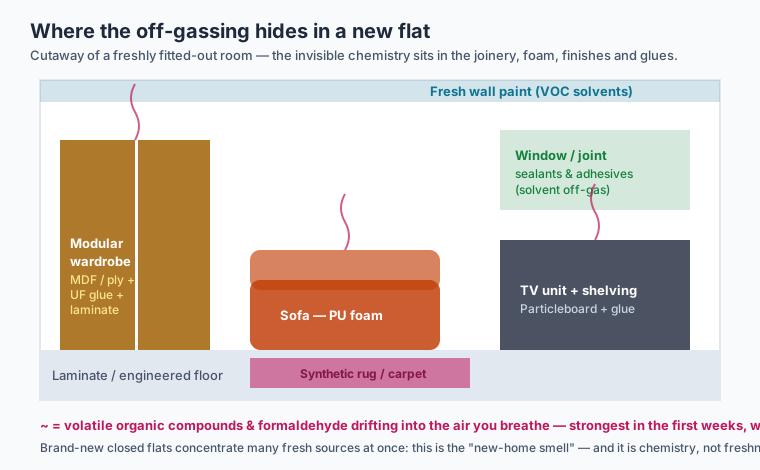
Figure 1: In a newly fitted-out flat the off-gassing is spread across the joinery, foam, finishes and glues — many small sources adding up in a closed room.
The World Health Organization's Guidelines for Indoor Air Quality: Selected Pollutants sets a formaldehyde guideline of 0.1 mg/m³ (30-minute average) to protect against sensory irritation, and treats it as a known human carcinogen at higher chronic exposures. Cheap UF boards in a closed room are exactly the scenario those limits exist for.
The health effects are not exotic. Short-term, off-gassing causes the headaches, stinging eyes, scratchy throat, blocked nose and tiredness that so many families dismiss as "settling in". For asthmatics, allergy sufferers and small children it can trigger or worsen symptoms. Formaldehyde specifically is a respiratory irritant and a recognised carcinogen at sustained high exposure. If the air-quality consequence is what worries you, the sibling guide on indoor air quality maps how these emissions sit alongside dust, PM2.5 and damp.
2. The usual suspects, source by source
It helps to know which everyday materials carry which risk, so you can spend your attention where it matters.
| Material / finish | Main health risk | Healthier alternative | What to ask the contractor for |
|---|---|---|---|
| Solvent / enamel "oil" paint | High VOCs; headaches, irritation | Water-based low- or zero-VOC emulsion; lime wash | "Low-VOC" or "zero-VOC", VOC g/L printed on tin |
| MDF / particleboard joinery (UF glue) | Formaldehyde off-gassing | E0 / NAF board, solid wood, bamboo ply | Emission grade E1 or E0; CARB Phase 2; sealed edges |
| Cheap plywood (commercial / low MR grade) | Formaldehyde from core glue | BWP / E1-graded ply from a reputable mill | IS 303 / IS 710 marking + low-emission grade |
| High-pressure laminate + contact glue | VOCs from the bonding adhesive | Pre-laminated E0 board; water-based glue | Solvent-free / water-based laminating adhesive |
| PU foam sofas, mattresses, cushions | VOCs, flame-retardant residues | Natural latex, coir, wool; air out before use | Certified foam or natural fill |
| Wall-to-wall synthetic carpet | Traps dust/mites; backing & glue VOCs | Stone/tile + washable wool or jute rug | Low-emission rug; avoid glued broadloom |
| Solvent adhesives & sealants | Sharp fumes for days | Water-based / solvent-free, low-VOC sealants | "Low-VOC", "solvent-free" on the cartridge |
| Vinyl wallpaper on damp walls | Mould growth behind it | Breathable paint, lime/clay plaster | Mould-resistant finish; fix damp first |
Notice the pattern: the cheapest version of each item is usually the worst off-gasser, because manufacturers economise on the resin and solvent chemistry first. You are often paying a small premium for less of something invisible.
3. Read the label: certifications and grades worth knowing
You cannot smell-test your way to a healthy fit-out — by the time a board smells faint it has already dosed your air for weeks. The shortcut is to specify products by their emission grade and certification, in writing, before work starts.
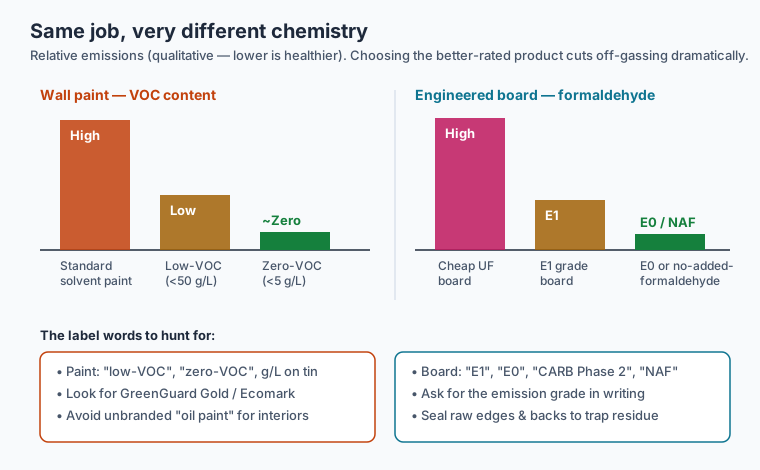
Figure 2: The same wall, the same wardrobe — but the better-rated product emits a fraction of the chemistry. The label words are the whole game.
| Look for | Applies to | What it broadly means |
|---|---|---|
| E1 / E0 grade | Engineered boards, plywood | Formaldehyde emission class; E0 is far lower than E1, both better than ungraded UF |
| NAF (No Added Formaldehyde) | Premium boards, ply | Made without formaldehyde-based resin altogether |
| CARB Phase 2 | Composite wood | California's strict formaldehyde limit; a strong global benchmark |
| GreenGuard / GreenGuard Gold | Paints, boards, furniture, adhesives | Independently tested for low chemical emissions; Gold is the stricter, child/healthcare-grade tier |
| Low-VOC / Zero-VOC (g/L) | Paints, sealants, adhesives | The VOC content by volume; the lower the number, the less it off-gasses |
| Ecomark (BIS) | Indian eco-labelled products | India's environmental label for lower-impact goods |
| IGBC / GRIHA credits | Whole-home / green projects | Green-building rating systems that reward low-emitting materials |
India's National Building Code (NBC 2016) and the rating systems run by the Indian Green Building Council (IGBC) increasingly reference low-emitting materials and adequate ventilation as part of healthy, sustainable construction — a useful lever when briefing a builder.
A practical rule: ask the carpenter and painter to show you the tin and the board edge-band stamp. Branded emulsions now print VOC content; reputable board makers stamp the emission grade. If a supplier cannot tell you the grade, treat it as the worst case.
4. The naturally healthy materials
Some materials are healthy not because of a clever certificate but because of what they simply are — low-emission, breathable, and often better in our climate.
- Solid wood (teak, sheesham, mango, rubberwood): no resin core to off-gas; ages beautifully. Mind the finish — use a low-VOC water-based polish rather than a solvent melamine.
- Bamboo: fast-renewing, strong; choose bamboo products made with low-formaldehyde adhesive.
- Lime and clay plasters: breathable, they let walls absorb and release moisture, which discourages mould — a real advantage on humid coasts and in monsoon-prone flats.
- Natural stone and ceramic/vitrified tile: inert, wipe-clean, cool underfoot in summer — far healthier than glued broadloom carpet.
- Natural-fibre rugs and textiles: wool, jute, cotton, coir — washable or beatable, and free of synthetic carpet's glue and microfibre shedding.
These materials also tend to feel good — a documented part of biophilic design, where natural materials and textures support calm and lower stress. You can sanity-check how nature-connected a room is with the biophilic scoring tool, and read the wider case in what is biophilic architecture; the materials angle here is the indoor, tactile complement to those mostly-outdoor pieces.
5. Mould-friendly vs mould-resistant: the monsoon test
In much of India the bigger long-run health risk is not a one-off paint smell but mould. Damp Mumbai monsoons, leaky bathrooms, condensation behind wardrobes on north walls — mould spores are a potent trigger for allergies and asthma, and they thrive on the wrong materials.
Mould-friendly choices to avoid in damp zones: vinyl wallpaper (traps moisture behind it), paper-faced gypsum in splash areas, MDF skirting near floors that get wet-mopped, and impermeable plastic-emulsion sealed tight over a wall that needs to dry out.
Mould-resistant choices: breathable lime or clay plaster, mould-resistant or anti-fungal paints in bathrooms and kitchens, tile or stone where water lands, and moisture-resistant (MR/BWR) grade ply for any joinery near wet areas. Crucially, materials cannot beat a wet wall alone — fix the leak and ventilate. How airflow and ventilation change the damp picture is covered in the natural ventilation and cross-ventilation guides, and you can model your own airflow with the cross-ventilation analyzer.
6. The "let it off-gas, then ventilate" rule
Even with good materials, fresh products emit most heavily in their first days and weeks. The single most powerful, free health move at handover is to not move in immediately into a sealed box.
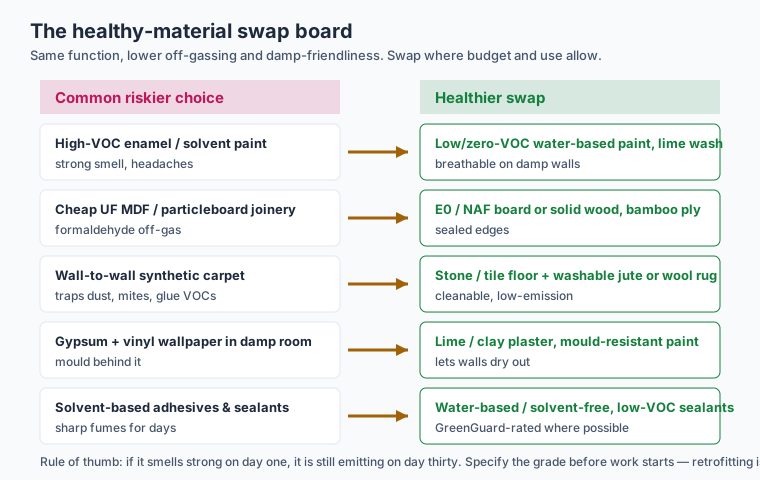
Figure 3: Same function, lower off-gassing — the swaps worth making while the budget is still on paper.
A workable handover routine:
| Step | What to do | Why it helps |
|---|---|---|
| Before furniture goes in | Open all windows; run fans; air the empty rooms for several days | Flushes the heaviest early off-gassing |
| Unwrap new furniture | Unpack joinery, mattresses, foam and air them out — ideally on a balcony/spare room | Lets the worst emit before it is in your bedroom |
| First weeks of living | Cross-ventilate daily; avoid sleeping in a freshly painted closed room | Cuts your exposure during the peak emission window |
| Damp season | Keep wet rooms ventilated; run exhaust fans | Stops moisture feeding mould on new finishes |
| If you must shut up for AC | Air out thoroughly each morning; consider a HEPA + carbon purifier early on | Dilutes accumulated VOCs and formaldehyde |
WHO's indoor air guidance is blunt on the principle: many indoor pollutants come from indoor sources and building materials, and ventilation to dilute and remove them is a primary control. Better materials reduce the load; ventilation removes what is left.
Plan the sequence into your renovation: schedule painting and joinery to finish a week or two before move-in, not the night before, and you convert the most dangerous exposure window into harmless empty-room time.
7. A homeowner's brief: how to specify health into the contract
You do not need to become a chemist — you need to put a few lines into the brief and hold the contractor to them.
- Paints: specify low-VOC or zero-VOC water-based emulsion for all interior walls and ceilings; avoid solvent enamels indoors.
- Boards & ply: specify E1 minimum (E0 / NAF for bedrooms and children's rooms); insist edges and backs are sealed.
- Adhesives & sealants: specify water-based / solvent-free, low-VOC products.
- Wet areas: mould-resistant paint, tile/stone, MR-grade ply; fix any damp first.
- Sequencing: finishing work to complete with buffer days for off-gassing and airing before move-in.
- Proof: ask to see tins, edge-band stamps and certificates; keep them.
Spend the premium where exposure is highest and most prolonged — the bedrooms where you sleep eight hours a night, and any child's room — and economise on rarely-used or well-ventilated spaces if budget is tight.
Sources & further reading
- World Health Organization — WHO Guidelines for Indoor Air Quality: Selected Pollutants (2010), formaldehyde and VOC sections.
- Bureau of Indian Standards — National Building Code of India (NBC 2016), provisions on ventilation, materials and the indoor environment.
- Indian Green Building Council (IGBC) — green homes & interiors rating criteria on low-emitting materials and indoor environmental quality.
- US Environmental Protection Agency — Volatile Organic Compounds' Impact on Indoor Air Quality.
- UL GreenGuard Certification — emissions criteria for building materials, finishes and furnishings.
- California Air Resources Board (CARB) — Composite Wood Products Airborne Toxic Control Measure (formaldehyde Phase 2 limits).
- Stephen R. Kellert & Elizabeth Calabrese — The Practice of Biophilic Design (on natural materials and wellbeing).
To follow the thread: read indoor air quality explained for the air-quality consequence of these emissions, what makes a home healthy for the pillar view of all the elements together, and modern construction materials for Indian homes for the broader materials picture that this health lens sits inside.
Export this guide
Related Guides — Deep-dive reading
Low VOC Bathroom Materials India: Healthy Paints, Sealants & Boards for Better Indoor Air
An India-first guide to low-VOC and formaldehyde-free bathroom materials — paints, sealants and adhesives whose fumes matter in a small unventilated room, E1/E0 boards for vanities, recycled and natural finishes, and the GreenPro, IGBC and GRIHA certifications worth checking before you buy.
BathroomsWhat Makes a Home Healthy? A Homeowner's Guide
Most Indian homes are designed for how they look and for Vastu — not for the bodies living in them. This is the map of the eight levers that quietly shape your sleep, breathing, mood and your child's health.
Healthy HomesBathroom Fire Safety India: NBC 2016 Part 4, Fire-Rated Materials & Electrical Ignition
The bathroom is rarely thought of as a fire risk, yet it hides several: a leaky geyser element, an over-run exhaust-fan motor, cheap flammable PVC panels overhead, and aerosol cans stored beside a heat source. This is an honest, practical reference to fire and life safety in the Indian bathroom — the NBC 2016 Part 4 context that actually applies to homes, the real ignition sources, self-extinguishing false-ceiling and PVC materials, earth-leakage protection as fire prevention, escape considerations, and the carbon-monoxide danger of gas geysers.
BathroomsRelated Tools — Try Free
Cross-Ventilation Analyzer
Estimate airflow and air changes per hour (ACH) from room size, window areas, layout, and local wind — with NBC 2016 Part 8 compliance check.
Ventilation CalculatorAcoustic Privacy (STC) Visualizer
Indian healthcare acoustic visualizer — compare wall assemblies and noise sources, see received SPL after STC attenuation, and check FGI 2018 / IS 1950 / NABH speech-privacy compliance with live dual-canvas waveform.
Acoustic ToolMaterial Schedule Generator
Generate a room-wise finish schedule — walls, floors, ceilings, trim, and joinery by location.
Material Schedule