
Circadian Lighting for Homes
Light is the master cue for your body clock. Here is how to design a home's electric lighting — colour temperature, brightness and layers through the day — so it supports sleep, mood and energy instead of quietly wrecking them.
A family in a Pune apartment did everything the showroom suggested. Bright white 6500 K panels in every room, recessed downlights on a single switch, the same crisp daylight-white glow from the kitchen to the bedroom. The flat looked sharp at handover. Six months later the parents could not understand why they felt wired at midnight, why their daughter took an hour to fall asleep after homework, why mornings felt sluggish despite eight hours in bed. Nothing was wrong with the home's air, its plan or its view. The problem was the light — specifically, that the light never changed.
Most Indian homes are lit for the catalogue, not for the human nervous system. We pick fittings for brightness and finish, flip them all on at full power, and switch them off at bedtime. But the human eye is not only a camera; it is also a clock-setter. A special class of cells in the retina — sensitive to bright, blue-rich light — reports to the brain's master clock whether it is day or night. That signal tunes alertness, hormone release, body temperature and the timing of sleep. When the light in a home is bright and blue at 10 pm, the body is told it is still noon.
Good circadian lighting is not about more light or less light — it is about the right light at the right time: bright and cool by day to keep you alert, warm and dim by evening to let your body prepare for sleep.
1. Why light is the master switch for your body clock
Every cell in your body runs on a roughly 24-hour rhythm — the circadian rhythm — coordinated by a master clock in the brain. Left in a cave with no light cues, that clock drifts. What keeps it anchored to the real day is light hitting the eye. Morning light advances and steadies the clock; bright light at night pushes it later and suppresses melatonin, the hormone that signals "time to sleep".
The trigger is not brightness alone but the colour and intensity of light. The clock-setting retinal cells respond most strongly to short-wavelength, blue-rich light — exactly the spectrum that dominates cool white LEDs, phone screens and overcast midday sky. This is why a cool, bright room feels energising at 9 am and faintly oppressive at 10 pm: the same light that helps you focus in the morning is, after dark, a chemical message that delays sleep.
The World Health Organization, in its guidance on light and shift work, recognises that exposure to bright light at night disrupts the circadian system and melatonin production. The design lesson for homes is direct: protect the evening.
Daylight remains the gold standard — it is brighter and richer than any bulb, and getting it right is a whole subject of its own. We cover the architectural side in daylighting principles for homes and the planning side in natural light planning for Indian homes. This guide is about the other twelve-plus hours: the electric light you control, and how to make it work with daylight rather than against it.
2. Two dials you can actually turn: colour temperature and brightness
Electric lighting gives you two levers. Learn them and you can tune almost any room.
Colour temperature, measured in kelvin (K), describes how warm or cool a light looks. Counter-intuitively, lower numbers are warmer (orange, like a flame or a sunset) and higher numbers are cooler (blue-white, like midday sky). A candle is around 1800 K; a classic warm bulb 2700 K; a neutral "office" white 4000 K; harsh "daylight" LEDs 5000–6500 K. For circadian health, the rule of thumb is simple: high kelvin early, low kelvin late.
Brightness, measured in lux at the surface you care about (a desk, the floor, the counter), determines both how well you see and how strong the alerting signal is. You need plenty for a kitchen knife or a child's homework; you want very little for a bedroom at 10 pm.
| Time of day | Colour temp (K) | Approx. lux | Rooms in play |
|---|---|---|---|
| Early morning (6–8 am) | 2700–3000 K, rising | 150–300 | Bedroom, bathroom (gentle wake-up) |
| Mid-morning to afternoon | 4000–5000 K | 300–750 (task) | Kitchen, study, home office, daylight everywhere |
| Late afternoon (4–6 pm) | 3000–3500 K | 200–400 | Living, dining, kitchen winding down |
| Evening (6–9 pm) | 2700 K | 100–200 | Living, dining — warm and lower |
| Pre-sleep (after 9 pm) | ≤2200 K | <50, pooled | Bedroom, corridors — very warm, very dim |
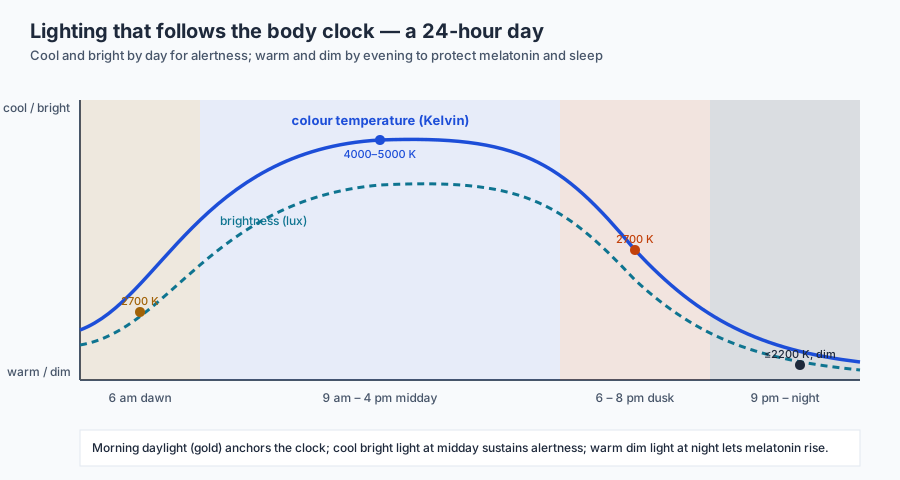
Figure 1: Across a day, both the colour temperature and the brightness of a healthy home should rise toward a cool, bright midday and fall toward warm, dim night — the opposite of a single 6500 K setting left on from morning to midnight.
The numbers above are targets to aim near, not laboratory thresholds. The shape of the day matters more than any single figure: cooler and brighter when you want to be alert, warmer and dimmer as you head toward sleep. You can check your own rooms against a curve like this with the circadian light meter.
3. Bright cool mornings, warm dim evenings — the daily arc
Think of your home's lighting as a slow dimmer across the day rather than a set of on/off switches.
Morning is when light does the most good. A burst of bright, cool-ish light within an hour of waking — ideally daylight at a window, supplemented by electric light on dark monsoon mornings — sharpens alertness and sets the clock for the night ahead. This is the one time blue-rich light is your friend. North-light and east-facing rooms get this almost for free; if your bedroom is dark, a brighter cool fitting on a timer can stand in.
Daytime wants steady, generous light. Kitchens, studies and work-from-home desks should be cool and bright (4000–5000 K, 300–750 lux at the surface) so the eye and brain stay switched on. Pair electric light with daylight wherever you can — a desk by a window needs far less artificial help.
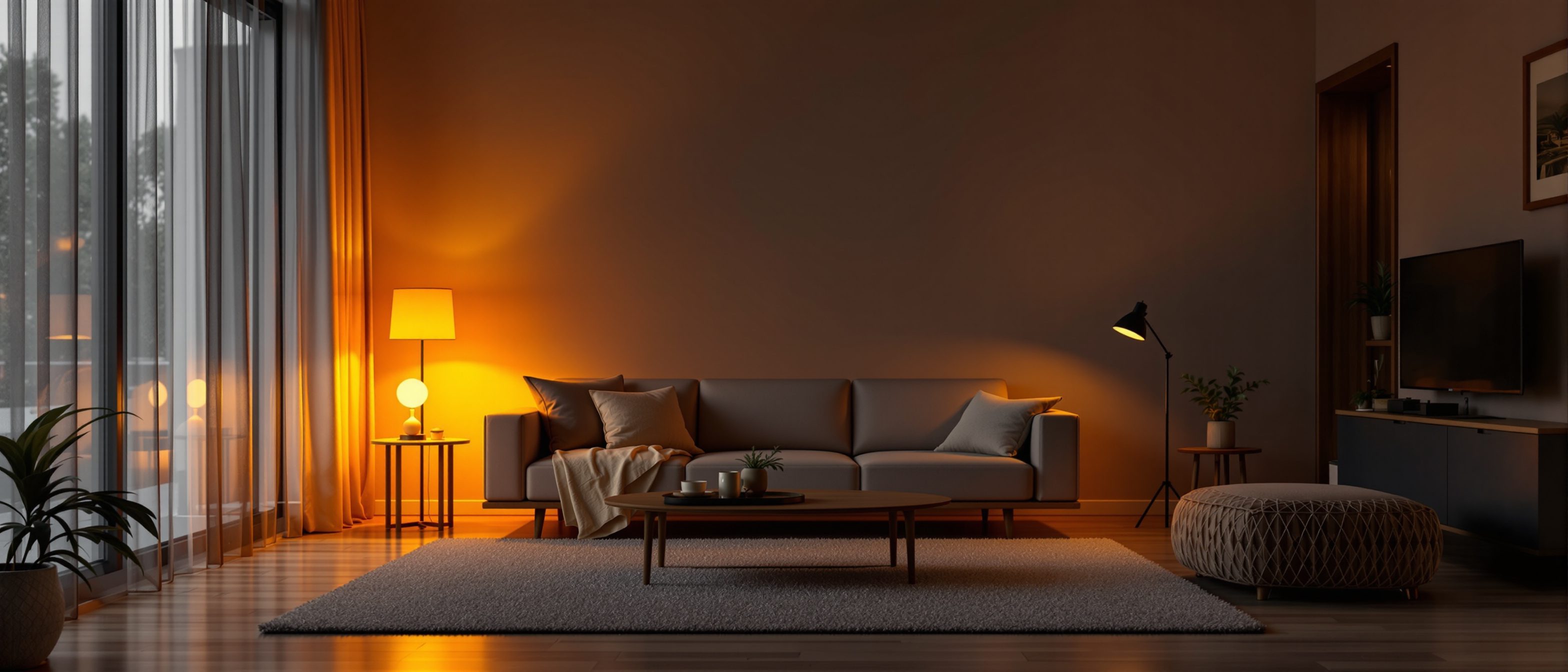
Late afternoon into evening is the turning point. As the sun reddens and drops, your home should follow: shift to 3000 K, then 2700 K, and bring brightness down. Treat the living and dining rooms like a sunset.
Pre-sleep, the last hour or two, should feel almost like firelight: very warm (≤2200 K), very dim, pooled around where you sit rather than blasting from the ceiling. This is when blue light is the enemy. The aim is to let melatonin rise undisturbed so sleep comes easily — the bedroom side of this is covered in depth in designing homes for better sleep.
4. Layer the light: ambient, task and accent
The single biggest mistake in Indian homes is one bright source per room on one switch. It makes evenings impossible — you are stuck choosing between glaring overhead light and total darkness. The fix is layers, each on its own control.
- Ambient is the soft general wash that lets you move safely — a dimmable ceiling fitting, a cove, or uplighters bouncing off the ceiling. Keep it gentle in the evening.
- Task is focused light where you do something demanding — an under-cabinet strip over the kitchen counter, an adjustable reading lamp by the bed or sofa, a desk lamp at the study. Task light lets you have enough light for the job in a small pool while the rest of the room stays dim.
- Accent is the mood and depth layer — a picture light, a niche, a shelf strip. It adds warmth and interest at low brightness, which is exactly what evenings need.
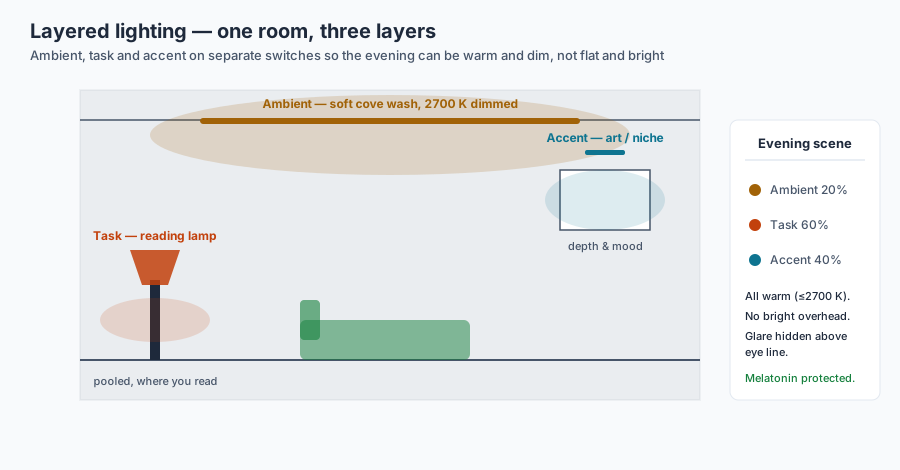
Figure 3: Three layers on separate switches mean an evening can be warm, low and pooled — task light where you read, soft ambient and accent for everything else — instead of one flat, bright, alerting wash.
With layers, a single room serves the whole day. Morning: ambient up, cool if tunable. Working: task layer on, bright. Evening: ambient dimmed to 20 per cent, task and accent doing the work, everything warm. This is the heart of low-glare, low-stress evenings — and it dovetails with the broader argument in designing low-stress living spaces.
5. Tunable bulbs, dimmers and scenes — what is actually worth buying
You do not need a smart home to get this right, but the technology makes it easier.
Dimmers are the highest-value, lowest-tech upgrade. A simple dimmable LED on a compatible dimmer lets you drop brightness in the evening. Confirm the bulb is marked dimmable and the dimmer is rated for LEDs (older incandescent dimmers cause flicker and buzz).
Tunable-white bulbs change colour temperature from warm to cool on demand — one fitting that is 4000 K for morning study and 2700 K for evening reading. These earn their place in the rooms that serve double duty: the study that becomes an evening room, the multipurpose living-dining.
Smart bulbs and scenes add automation: a "morning" scene that comes on cool and bright, an "evening" scene that is warm and dim, and a schedule that shifts colour temperature automatically as the day goes — so you do not have to remember. For most homeowners, two or three good scenes (Day, Evening, Night-light) beat a hundred colour options nobody uses.
| Lighting do (for sleep & energy) | Lighting don't |
|---|---|
| Get bright light — ideally daylight — within an hour of waking | Leave 6500 K "daylight" LEDs on after dark |
| Use 2700 K or lower in bedrooms and evening living rooms | Light bedrooms with a single bright overhead |
| Put dimmers on living, dining and bedroom circuits | Rely on the phone or TV as your only evening light |
| Keep a very dim, warm path light for night-time bathroom trips | Use bright white motion lights in night corridors |
| Position lamps so the bulb is hidden from your seated eye line | Buy non-dimmable bulbs for any living space |
| Pair task light with low ambient for evening reading | Mix wildly different colour temperatures in one room |
One caution for India: cheap LEDs often flicker, especially when dimmed, and a high flicker rate can cause eye strain and headaches even if you do not consciously see it. Buy from reputable brands, check that dimmable models are genuinely dimmer-rated, and test before fitting a whole room.
6. A room-by-room circadian scheme
Different rooms have different jobs, so each gets its own light story across the day.
Kitchen. A working room — bright and cool (4000 K, 500+ lux at the counter) for safe chopping and morning energy. Under-cabinet task strips matter more than a central light. In the evening, if the kitchen opens onto a living area, dim it or switch to a warmer setting so it does not blast cool light into the relaxing zone.
Study / home office. Cool and bright by day (4000–5000 K, ~500 lux on the desk) to support focus — this is where tunable white shines. Avoid working under bright cool light late at night; if you must, warm it down and dim it, and accept that it will cost you some sleep.
Living and dining. The social heart, and the room most ruined by a single bright source. Layer it, dim it, and let it warm through the evening to 2700 K. This is also the room where daylight and view do the most for mood — worth pairing with the principles in orientation, light and views.
Bedroom. The strictest room. Daytime: open and bright with daylight. Evening and night: very warm (≤2200 K), very dim, ideally bedside lamps rather than a ceiling light, so the last hour before sleep is almost firelit. No bright overhead, no cool light, and keep screens out where you can.
Bathroom and corridors at night. The classic sleep-wrecker is a bright white bathroom light at 3 am that wakes you fully. Fit a dim, very warm night-light or a low motion light near the floor so a night trip does not reset your clock.
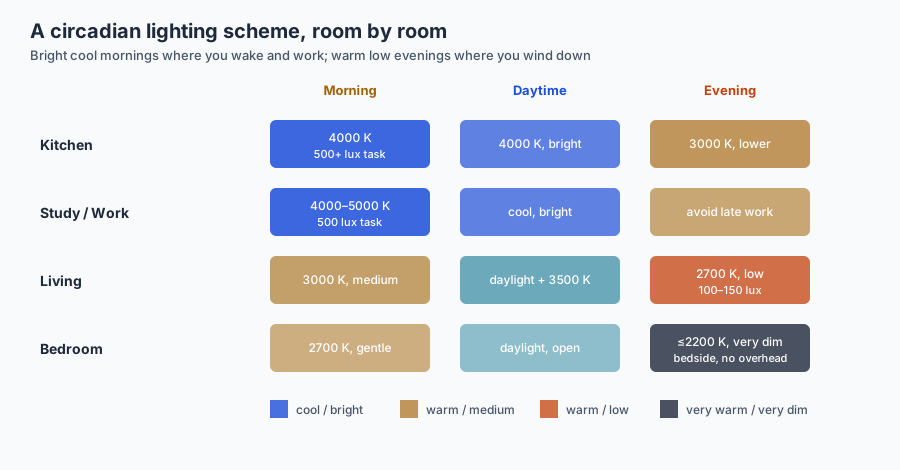
Figure 2: The same home, read across the day — working rooms stay cool and bright when you need them, social and sleeping rooms warm down and dim as evening comes, so the building itself helps your body keep time.
7. Pair electric light with daylight — and avoid glare and screens at night
Electric lighting is the supporting act; daylight is the lead. A home full of good windows needs far less artificial help and gives you the strong morning signal for free. Design for daylight first — the calculation side is in daylight factor for India and you can model it with the daylight factor tool — then layer electric light to fill the gaps, especially on dark monsoon mornings and through the evening.
Two evening enemies deserve a final word.
Glare. A bare bright bulb in your field of view is both uncomfortable and alerting. Hide sources above the eye line, use shades and diffusers, and bounce light off ceilings and walls. Soft, indirect, warm light reads as "evening" to the nervous system; a hard point source reads as "daytime".
Screens. Phones, tablets and TVs are bright, blue-rich light held close to the face — the most concentrated circadian disruptor in a modern home. Night-mode and warm-shift settings help a little, but distance and dimming help more. A genuinely dim, warm room in the last hour before bed, with screens down, does more for sleep than any single fitting.
Lighting engineers' bodies such as the Illuminating Engineering Society (IES) and CIBSE now publish guidance on the non-visual, circadian effects of light — recognising that the timing and spectrum of light, not just its quantity, shape human health. Designing a home around that arc is no longer a luxury; it is basic building biology.
Get the arc right and the home does quiet work for you all day: it wakes you, sharpens you, settles you and finally lets you go. You can audit any room against a healthy daily curve with the circadian light meter, and see how lighting fits the bigger wellbeing picture in what makes a home healthy.
Sources & further reading
- World Health Organization — guidance and reviews on light, shift work and circadian disruption.
- Illuminating Engineering Society (IES) — recommended practice and reports on light and the circadian system.
- Chartered Institution of Building Services Engineers (CIBSE) — Lighting Guides and material on lighting for wellbeing.
- National Building Code of India (NBC), Part 8 — lighting and illumination provisions for buildings.
- Czeisler, C. A. & colleagues — research on light, melatonin and the human circadian clock.
- Bureau of Energy Efficiency (India) — guidance on efficient LED lighting and the Standards & Labelling programme.
This guide is part of Studio Matrx's Healthy Homes series. For the architecture of the windows that feed your mornings, read daylighting principles for homes; to carry the warm, dim evening all the way into rest, see designing homes for better sleep; and for how all of these threads weave together, start with the pillar, what makes a home healthy.
Export this guide
Related Guides — Deep-dive reading
Daylighting Principles for Homes
Why good daylight is a health intervention, not a luxury — and the handful of design rules that decide whether your Indian home feels alive or perpetually switched-on.
Healthy HomesLighting Controls & Dimming Design: Zones, Scenes & Switches (2026)
How to plan lighting control so an Indian home's light is flexible — split each room's layers onto separate switches, choose dimmers that actually work with LEDs, add two-way switching where you need it, and layer scenes on top. The design decisions you must settle before the electrician wires.
LightingBedroom Lighting Design for Indian Homes: Calm, Layered & Dimmable (2026)
How to light an Indian bedroom for rest first and function second — why the harsh central tube light in your eyeline is the classic mistake, how to layer soft ambient, bedside reading task, accent and a low night light, and how to specify warm 2700K, dimming and two-way switching so the room winds down with you.
LightingRelated Tools — Try Free
Circadian Light Meter
Patient-centric circadian lighting visualizer for Indian healthcare design — time-of-day × intensity → CCT, melanopic lux (EML / mEDI), melatonin suppression, and an alertness curve. Calibrated against WELL v2 L03 Circadian Lighting Design, CIE S 026:2018, Brainard 2001, and Lucas et al. 2014.
Circadian ToolCross-Ventilation Analyzer
Estimate airflow and air changes per hour (ACH) from room size, window areas, layout, and local wind — with NBC 2016 Part 8 compliance check.
Ventilation CalculatorMaterial Schedule Generator
Generate a room-wise finish schedule — walls, floors, ceilings, trim, and joinery by location.
Material Schedule