
How Good Architecture Reduces Stress
The measurable ways your home calms or strains your nervous system — and how to design for calm
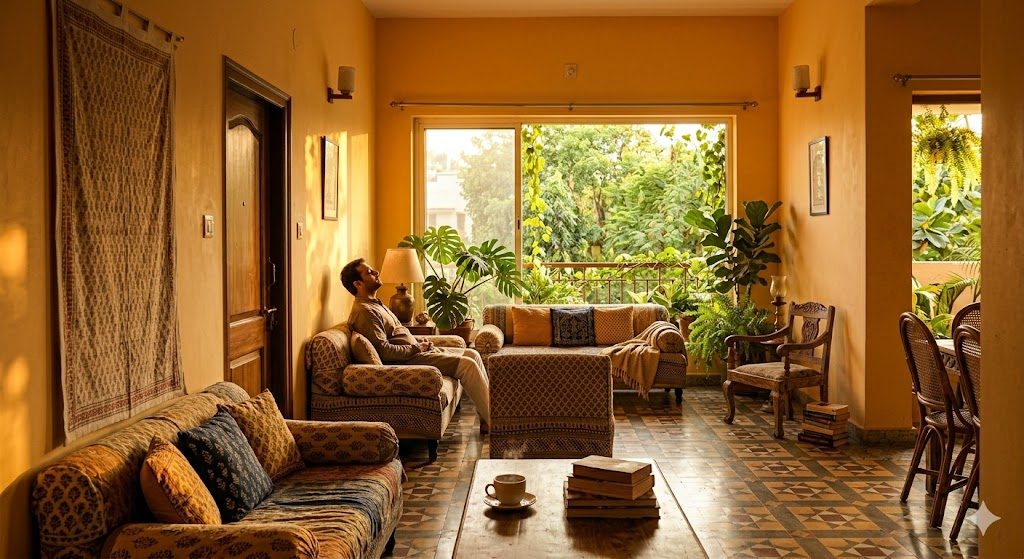
You walk in after a brutal day in Bengaluru traffic. In one home, your shoulders drop the moment the door closes: the light is soft, a plant catches the last sun at the window, the street noise fades to a hum, and there is a corner that is yours to sink into. In another home — same square footage, same budget — the shoulders stay up. A tube light glares off bare walls, the TV blares because someone left it on, shoes and bags spill across the floor, and there is nowhere to be alone. Both are "houses". Only one of them is helping you recover.
This guide explains the second thing your home is quietly doing all day — not just sheltering you, but acting on your nervous system. There is now decades of careful research showing that the built environment measurably changes our stress hormones, blood pressure, sleep, mood and attention. Good architecture is not a luxury or a vibe; it is a set of design moves that reliably lower the body's stress load, and the science behind them is surprisingly specific.
The core idea is this: stress is not only in your head — it is partly in your walls. A room is a continuous, low-level input to your body. Tune the inputs — light, sound, air, nature, order, privacy — toward calm, and your physiology follows. This is the difference between a house that drains you and a home that restores you, and almost all of it is designable.
The evidence: your surroundings change your body chemistry
For a long time "a calming home" was treated as taste — pleasant but unscientific. That changed in 1984, when environmental psychologist Roger Ulrich published a now-famous study in the journal Science. He looked at patients recovering from gallbladder surgery in a Pennsylvania hospital. The only difference between two sets of rooms was the window: some looked out on a small stand of trees, others on a brick wall. The patients with the view of nature recovered faster, needed fewer strong painkillers, and were described by nurses in more positive terms. Nothing about their treatment changed — only what they could see.
That single finding cracked open a field. If a view through a window can change how much morphine a body needs, then the spaces we live in every day are doing something to us continuously. Since then, researchers have measured the effect directly: cortisol (the main stress hormone) in saliva, blood pressure, heart-rate variability, skin conductance, sleep quality and self-reported mood all shift in response to features of a room. This is the same mechanism explored in our guide to architectural psychology and comfortable spaces — the conceptual anchor for everything below — which goes deeper into why certain rooms simply feel right.
The key word is measurable. We are not talking about a fuzzy sense of "cosiness". We are talking about a body that, in a hostile room, sits in a mild but chronic state of alert — heart rate a little high, cortisol a little elevated, sleep a little broken — and in a well-designed room, lets that alert state subside.
Four landmark findings — and what each one tells you to do
The research is broad, but four threads matter most for a home. The map below pairs each with the single design move it implies.

The window view (Ulrich, 1984). A view of nature speeds recovery and reduces the need for pain relief. The home lesson is blunt: the chairs and beds you use most should look at something living — a tree, a balcony garden, even a single well-placed plant — not at a blank wall or a parking lot.
Attention Restoration Theory (Rachel and Stephen Kaplan). The Kaplans argued that the focused, effortful attention we use at work and on screens fatigues like a muscle. Natural scenes engage a softer, effortless kind of attention that lets the directed kind recover. This is why ten minutes looking at a garden resets you in a way that ten minutes scrolling does not. At home, it means building at least one spot designed for that soft attention — a window seat, a balcony chair, a green corner with no screen in view.
Daylight and the body clock. Bright morning light sets your circadian rhythm, lifts mood and improves night-time sleep; bright blue-rich light late at night suppresses melatonin and does the reverse. The home version: get strong daylight into the rooms you use in the morning, and make evening light warm and dimmable. We unpack the daylight side fully in natural light planning for Indian homes.
Noise and cortisol (WHO). The World Health Organization's environmental-noise guidance is built on evidence that chronic noise raises stress hormones and blood pressure and fragments sleep — even after you consciously stop noticing it. Your brain keeps monitoring it. The home lesson is to defend at least the bedroom acoustically, and to soften hard, echoey rooms.
A house keeps the rain off. A home keeps the stress off. The second job is the harder one — and the more designable.
The stressors and the calmers
Strip the science down and a home pushes on your nervous system through a handful of channels. Most rooms carry a mix of both. The work of calm design is to move each room rightward — reducing the stressors, strengthening the calmers.

| Stressor (raises the alarm) | Calmer (settles the system) |
|---|---|
| Noise and hard, echoey surfaces | Acoustic softening; a quiet bedroom < 30 dB at night |
| Glare from bare bright fittings, or gloom | Daylight by day, warm dimmable light by night |
| Clutter and visual chaos competing for attention | Closed storage, visual order, a clear surface |
| Crowding with no privacy or retreat | A refuge space you can withdraw to and control |
| Stale air, heat and humidity | Cross-ventilation, shade, thermal comfort |
| No nature in sight | A green view, plants, real natural materials |
| Disorder forcing constant micro-decisions | Things with a place — less decision fatigue |
| Friction in the flow — bumping, backtracking | Easy, legible movement through the home |
A few of these deserve unpacking, because they are the ones most homes get wrong.
Noise is the silent tax. Indian cities are loud — dense traffic, horns, construction, neighbours, generators. The WHO recommends night-time bedroom levels below about 30 dB for undisturbed sleep; a window onto a busy road can sit at 60–70 dB. Your body treats sustained noise as a threat signal whether or not you are "used to it". Hard rooms make it worse: bare tile floors and plaster walls bounce sound around. Soft surfaces — a rug, curtains, an upholstered headboard, a bookshelf — absorb it.
Clutter is a stress input, not just a mess. Visual disorder forces the brain into a low hum of decision-making: where does this go, what is that, what have I forgotten. Studies of household clutter have linked it to elevated cortisol and lower life satisfaction, especially for the person who feels responsible for the home. Order is not about minimalism for its own sake — it is about giving the eye and the mind somewhere to rest.
No retreat is its own stressor. Humans need both prospect (an open outlook, a sense of the wider room) and refuge (a protected spot to withdraw to). A home with no private corner — where every space is shared and exposed — denies people the ability to regulate their own state. This matters enormously in Indian joint-family homes, where the absence of a single door you can close is a daily strain.
How this maps to the Indian home
The stress-and-calm science is universal, but the way it lands is specific to how we actually live here.
The city is loud and hot. Most urban Indian homes sit in dense, noisy, warm contexts. That puts two stressors — noise and thermal discomfort — at the top of the list before you even decorate. Acoustic defence of the bedroom and genuine cross-ventilation and passive cooling are not refinements; they are the foundation of a calm home in an Indian climate. A room that is 33 °C and stuffy will keep your body restless no matter how lovely it looks.
The joint family needs designed retreat. Multi-generational living is a strength — and it makes private refuge harder and more precious. The calm move is to make sure every adult, and ideally every child, has at least one space they control: a bedroom that closes, a reading nook, a corner of the terrace. Even a curtained alcove signals "this is mine for now", and that sense of control is itself a powerful stress reducer.
Our tradition already encodes the calmers. The courtyard, the verandah, the balcony, the pooja corner — vernacular Indian architecture is full of devices that do exactly what the research recommends. The courtyard pulls in light, air and sky and gives a green, contemplative centre. The verandah is a graded threshold between the loud outside and the calm inside. The pooja corner is a designed refuge — a small, ordered, sensory-rich place to pause and reset, which is precisely the "restorative micro-environment" environmental psychologists describe. We are not importing a foreign idea of wellness; we are recovering one we already had.
Plants come naturally to us. The Indian home's instinct for tulsi at the threshold, money plants in the kitchen window, a balcony crowded with pots — this is biophilia in practice. The 14 Patterns of Biophilic Design (Browning and the Terrapin Bright Green team) catalogue exactly why these work: a visual connection to nature, the presence of greenery, natural materials and dappled light all measurably lower stress. You can pressure-test your own home against that framework with our biophilic score tool.
The calm room, designed
What does a low-stress room actually contain? Not expensive things — specific moves. The anatomy below labels six, each tied to one of the evidence threads above.
1. A green view in the line of sight. Orient the seat you use most toward a window with something living in it — a tree, a planted balcony, a row of pots on the sill. If the view is bad, build the view: a tall plant or a green wall changes what your eye lands on. This is the Ulrich finding, applied at home.
2. Light that follows the day. Bright, daylit space in the morning; warm (2700 K or lower), dimmable, layered light at night — table and floor lamps rather than a single overhead tube. Glare and darkness are both stressors; the cure is control. Plan the daylight side using a sun-path analysis so you know where the morning light actually lands.
3. Soft acoustics. Add absorption: a wool or cotton rug, full-length curtains, an upholstered headboard, a few books on open shelves. Aim to make the bedroom the quietest room — seal the window gaps, hang heavy curtains, and keep it below roughly 30 dB at night. Sound is the stressor people tolerate longest and benefit most from fixing.
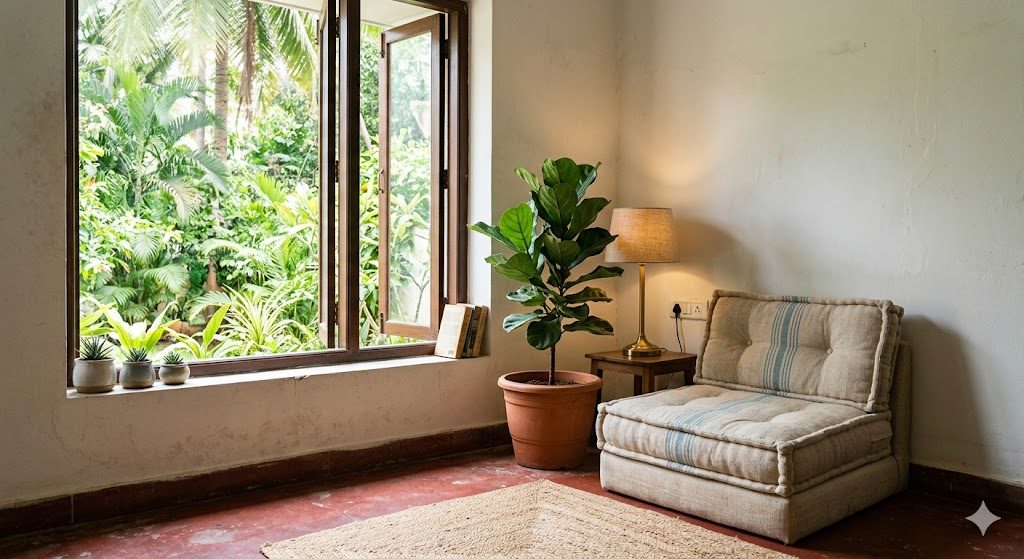
4. A retreat nook. Carve out one protected spot — a window seat, a corner chair with a high back, a curtained reading alcove. It needs a sense of enclosure behind you and an outlook in front. This is the refuge the nervous system needs to power down.
5. Order, held by storage. Give everything a closed home. Decluttered does not mean bare; it means the eye is not constantly snagging on stuff. Generous, closed storage is the single biggest lever against visual chaos and the decision fatigue it causes.
6. Natural materials. Wood, stone, cotton, cane, lime plaster, clay. Natural materials and their textures read as non-threatening to the nervous system in a way that hard synthetics do not — part of the biophilic effect. Underfoot, on the table, in the textiles: real materials calm.
This is also where good spatial flow does quiet work. A home where movement is easy and legible — no bumping past furniture, no backtracking, no friction at thresholds — removes a steady drip of low-level irritation you rarely name. The way air moves through a home matters just as much; how ventilation changes home quality shows how fresh, moving air is itself a calmer, not just a comfort.
Salutogenic design: building for health, not just against illness
There is a useful word for all of this: salutogenic design. Coined from the work of sociologist Aaron Antonovsky, salutogenesis asks not "what makes people sick?" but "what actively makes people well?" Applied to buildings, it means a home should not merely avoid harm (no damp, no glare, no toxic finishes) but positively generate health — calm, restoration, connection, a sense of control.
This is the same logic that now drives wellness-focused architecture and healthcare design, where the evidence base is strongest. Hospitals that give patients nature views, daylight and quiet measurably improve outcomes — explored in our companion piece on biophilic healing environments in healthcare. The striking thing is that the moves which heal patients are the same moves that help a tired adult recover at home: light, nature, quiet, order, refuge, control. The home is just a hospital you never leave — so it is worth designing as one.
The Finnish architect Juhani Pallasmaa makes the deeper point: we experience buildings not as images but with the whole body — through touch, sound, temperature, the feel of light on skin. A home that ignores those senses, however photogenic, will quietly strain the body. A home that tends to them settles it. Stress reduction, in the end, is not a feature you bolt on. It is what happens when the whole sensory environment is on your side.
A quick stress-audit of your home
Walk through your home once, slowly, and ask of each main room:
- Sound: Can you hold a quiet conversation without raising your voice? Does the bedroom go quiet at night, or does the road come in?
- Light: Is there strong daylight where you spend mornings? Can you dim and warm the light at night, or is it one harsh switch?
- Nature: From your main seat, can you see something living? Are there plants in the rooms you use most?
- Order: Is there a clear, calm surface in each room, or does the eye snag everywhere?
- Retreat: Does each person have at least one spot that is theirs to control and close off?
- Air and heat: Does air move through? Are the hot rooms shaded and ventilated, or stuffy?
- Flow: Can you move through the home without bumping, squeezing or backtracking?
Every "no" is a stressor you can design out.
What this means for your home
1. Fix the bedroom acoustics first. Heavy curtains, a rug, sealed window gaps, an upholstered headboard. Get night-time sound toward 30 dB. Sleep is where stress either resolves or compounds.
2. Frame one green view. Reorient your main seat toward a window with greenery, or build the green with a tall plant. Make nature the thing your eye rests on.
3. Layer and warm your light. Replace single overhead tubes with table and floor lamps on warm, dimmable bulbs; keep mornings bright and evenings low.
4. Carve a retreat. Claim one enclosed, outlook-facing nook per person — a window seat, a corner chair, a curtained alcove.
5. Buy order with storage. Add closed storage so everything has a home; clear one surface in each room and keep it clear.
6. Bring in real materials and plants. Wood, cotton, cane, stone underfoot and in reach; greenery in the rooms you use most.
7. Defend thermal comfort and airflow. Shade west windows, open cross-paths for breeze, and treat a stuffy 33 °C room as the stressor it is.
8. Smooth the flow. Clear the pinch points so moving through the home costs no friction.
Designing a home around calm is exactly the kind of problem DesignAI is built to help with — testing how light reaches your rooms, where a retreat nook could sit, and how a layout flows, before you commit money to it. Use it to see the calm version of your home before you build it.
References
- Ulrich, R. S. (1984). "View through a window may influence recovery from surgery." Science, 224(4647), 420–421.
- Kaplan, R. & Kaplan, S. (1989). The Experience of Nature: A Psychological Perspective. Cambridge University Press. (Attention Restoration Theory.)
- Browning, W., Ryan, C. & Clancy, J. (2014). 14 Patterns of Biophilic Design. Terrapin Bright Green.
- World Health Organization (2018). Environmental Noise Guidelines for the European Region. WHO Regional Office for Europe.
- Pallasmaa, J. (2005). The Eyes of the Skin: Architecture and the Senses. Wiley.
- Antonovsky, A. (1979). Health, Stress and Coping. Jossey-Bass. (Foundations of salutogenesis.)
- Bureau of Indian Standards / National Building Code of India (NBC 2016) — daylight, ventilation and habitable-room provisions.
Keep reading in the Design Education cluster: architectural psychology and comfortable spaces, how ventilation changes home quality, and passive cooling strategies for Indian homes.
Export this guide
Related Guides — Deep-dive reading
Homes That Improve Mental Wellbeing
The whole-home, indoor-biophilia approach to calm — how plants, light, air, quiet and the right balance of togetherness and retreat make an Indian home restorative.
Healthy HomesThe Architectural Psychology of Comfortable Spaces
Why some rooms feel right and others never do — the science of space and the human mind
Design EducationZones of Retreat: Designing Spaces for Rest and Privacy
Why every Indian home needs protected nooks for solitude, focus and recovery — and how prospect-refuge theory helps you carve them from shared, crowded flats.
Design PrinciplesRelated Tools — Try Free
Healing View Impact Calculator
Evidence-Based Design dashboard quantifying the recovery impact of nature view + daylight factor on analgesic use, length of stay, and HCAHPS patient-experience uplift. Calibrated against Ulrich 1984 (Science), Park & Mattson 2008, and the CHD EBD evidence base.
EBD CalculatorCross-Ventilation Analyzer
Estimate airflow and air changes per hour (ACH) from room size, window areas, layout, and local wind — with NBC 2016 Part 8 compliance check.
Ventilation CalculatorAcoustic Privacy (STC) Visualizer
Indian healthcare acoustic visualizer — compare wall assemblies and noise sources, see received SPL after STC attenuation, and check FGI 2018 / IS 1950 / NABH speech-privacy compliance with live dual-canvas waveform.
Acoustic Tool