
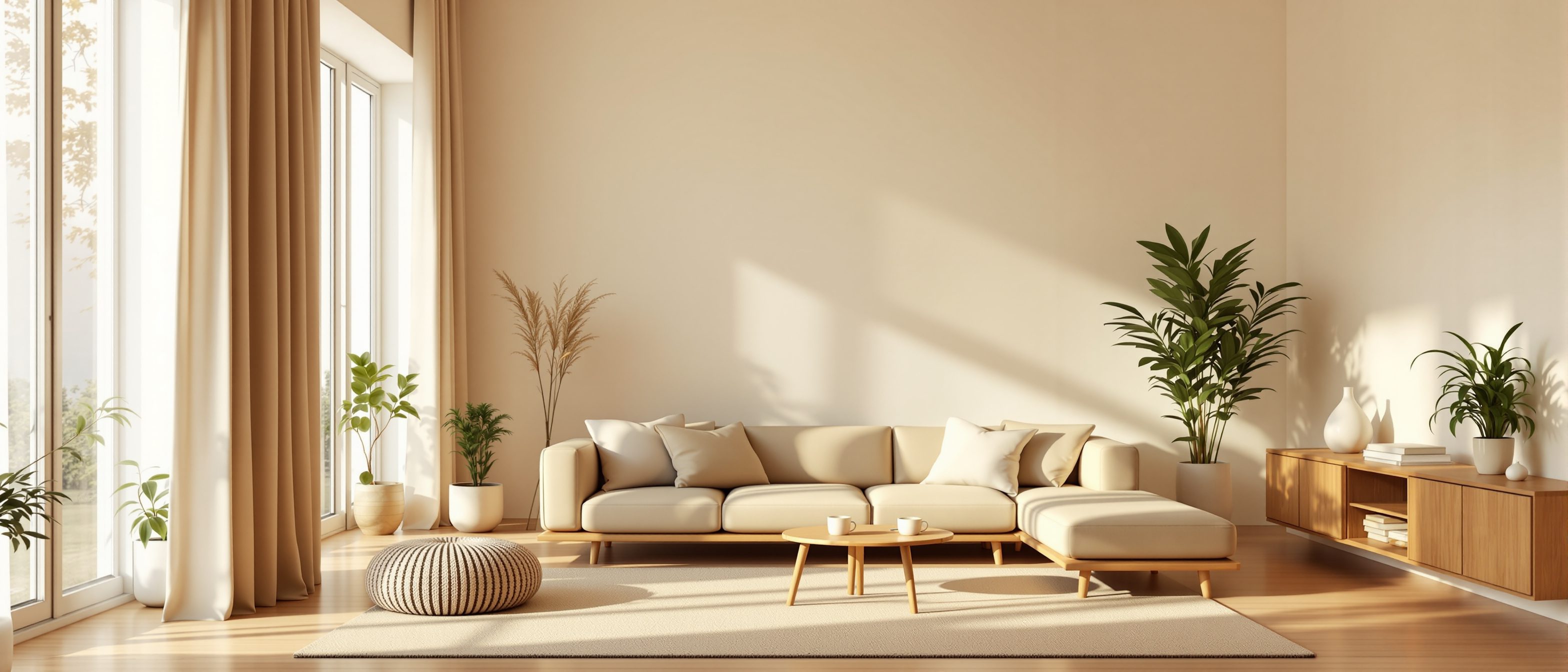
Designing Low-Stress Living Spaces
The practical design moves that lower everyday stress at home — from hidden storage and a restrained palette to acoustic calm, soft light and a place to retreat — tuned for Indian flats, joint families and multi-use rooms.
It is 7:30 on a weekday morning in a two-bedroom flat in Pune. Three generations share roughly 750 square feet. The children are looking for school shoes that are somewhere under the sofa; a grandmother is trying to watch the news at full volume in the same room where someone is on a work call; the dining table is buried under post, medicines, a half-finished craft project and last week's festival decorations that never went back into a box. Nobody in this home is in danger. And yet, by 8 a.m., everyone feels frayed.
This is the texture of everyday stress in an Indian home — rarely a single dramatic problem, almost always a hundred small frictions stacked on top of each other in too little space. The encouraging news is that a surprising amount of that load is set by design choices rather than by personality or money. The arrangement of storage, the colour of the walls, where sound travels, whether anyone has a single place to retreat, how light falls across the day — each of these is a dial, and most of them can be turned without renovation.
A low-stress home is not a minimalist showroom; it is a space engineered so that your nervous system has less to process and more chances to recover — fewer decisions, less visual and acoustic noise, and a clear sense of control.
This guide is the practical companion to two others. If you want the evidence for why this matters — the cortisol studies, the architecture-and-stress research — read how good architecture reduces stress. If you want to go deep on the single most important move, a place to retreat, read zones of retreat, rest and privacy. Here we stay in the workshop: the specific, do-it-this-weekend design moves that lower the daily load.
1. Start by naming the stressors, then match each to a fix
Stress at home is cumulative and mostly invisible until you name it. The most useful first step is not to buy anything — it is to walk through your home at the busiest hour and notice where you tense up, hesitate, raise your voice, or step over something. Almost every one of those moments maps to a design lever you can move.
| Stressor at home | What it does to you | Practical design fix |
|---|---|---|
| Visual clutter on every surface | Constant low-level "to-do" signalling; harder to focus, harder to relax | Closed storage where the mess is generated; one clear surface per room kept empty as a rule |
| Too many colours and busy patterns | Raises visual complexity, so the room never feels "settled" | Restrained palette — pick 3–4 tones; let texture, not colour, add interest |
| No single quiet place | Nowhere for the nervous system to down-regulate | Carve out one small retreat — even a corner with a chair, soft light and a door or curtain |
| Echoey, noisy rooms; TV bleeding everywhere | Chronic noise raises stress hormones and wrecks rest | Soft surfaces (rugs, curtains, upholstery); separate the loud zone from the quiet one |
| One harsh overhead tube-light, on all day | Glare by day, alerting blue-white light at night | Layer light: soft daylight by day, warm low pools of light in the evening |
| No view, no green, no breeze | Removes the natural cues that calm us | A plant cluster, a framed view kept clear, an openable window on the cross-breeze |
| Things have no fixed home | Every search is a small decision and a small failure | A designated spot for keys, shoes, medicines, bills, festival decor |
| Squeezing past furniture; tripping hazards | Daily micro-friction and irritation | Widen the main path; keep circulation legible and unobstructed |
Notice that almost none of these require demolition. They require decisions — and decisions made once, by design, are decisions your household no longer has to make a hundred times a day.
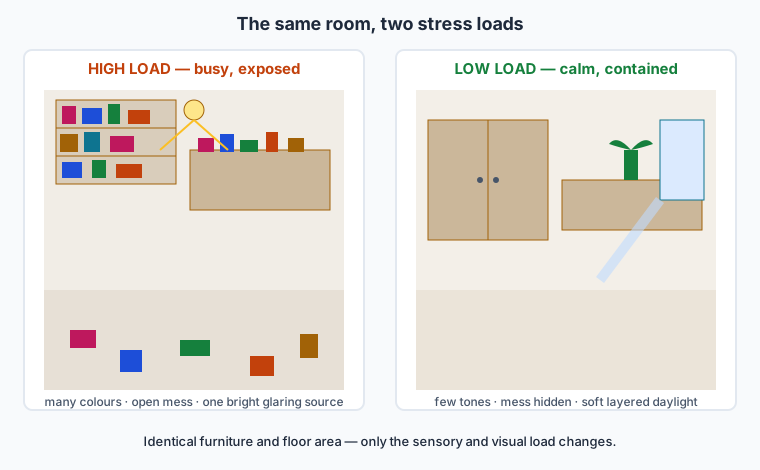
Figure 1: The same room, the same furniture and floor area — only the sensory and visual load has changed. Lowering the load is rarely about owning less; it is about what is on display, how many tones compete, and how the light arrives.
2. Reduce the sensory and visual load
Your eyes and ears are always working, and a busy room never lets them rest. The single highest-leverage move in most Indian homes is to reduce what is on display without necessarily owning less.
Hide the mess where it is made
Open shelves look lovely in catalogues and become anxiety machines in real life, because everything on them reads as visual "noise" and as a chore. Favour closed storage placed exactly where the mess is generated — a cabinet by the entry for shoes and keys, a drawer in the living room for remotes and chargers, a deep cupboard for the suitcase-loads of festival decor that otherwise live on top of the wardrobe for eleven months a year. The principle is simple: the easier it is to put something away near where you used it, the less it accumulates in the open.
Restrain the palette
A calm room usually has only three or four tones doing the talking. This is not about beige minimalism — warm woods, terracotta, deep greens and off-whites are all calm. The discipline is fewer competing colours, so the eye settles. Let interest come from natural texture — a jute rug, a stone surface, a handloom throw — rather than from a riot of hues.
Keep sightlines clear
Where your eye lands when you enter a room sets the tone. A clear sightline to a window, a plant, or a single considered object feels restful; a sightline straight into a pile of laundry does the opposite. Arrange the room around the calm view.
"Visual order, in the sense of legible, uncluttered, coherent surroundings, is one of the conditions under which people report feeling least stressed." — paraphrasing the design pattern argument in Christopher Alexander, A Pattern Language.
3. Make the space legible and easy to move through
A home that is hard to read — where you cannot tell where to go, where things live, or how to get from A to B without squeezing — generates a steady drip of stress that nobody names. Spatial legibility and easy flow are quietly among the strongest contributors to a low-stress home.
In a small Indian flat the goal is a clear primary route — entry to living to kitchen to retreat — kept wide and unobstructed, with storage tucked to the sides so it never narrows the path. Avoid the common trap of pushing all the furniture against the walls and then filling the centre with low tables and stools you must constantly navigate around.
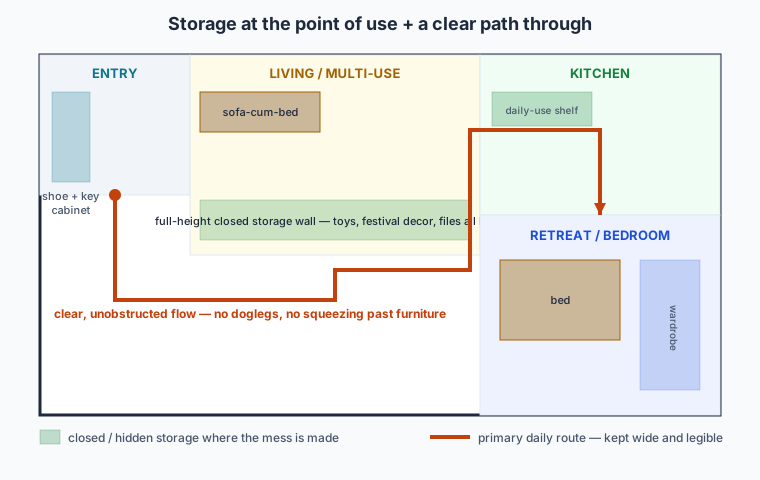
Figure 2: Storage placed at the point of use, and a single clear path threaded between zones. The friction-reducing idea is that the route you walk twenty times a day should never make you turn sideways or step over anything.
Multi-use rooms need a reset, not more furniture
Most Indian rooms work hard — the living room is also a study, a guest bedroom and a puja space. The stress comes not from multi-use itself but from transitions that take effort. Design for the switch: a sofa-cum-bed with the bedding stored inside it; a folding study table that disappears; a console that becomes a dining table. When converting a room from one mode to another takes thirty seconds and no hunting, the multi-use room stops feeling like a battle.
4. Give everyone a clear place to retreat
In a joint-family flat, the scarcest resource is not space — it is being unobserved. The ability to withdraw, even briefly, is one of the deepest predictors of how stressful a home feels, and it is the subject of its own detailed guide on zones of retreat, rest and privacy. The practical headline: every person needs at least one place where they can be alone with the door (or curtain) closed, however small.
That retreat need not be a whole room. A reading chair in a quiet corner with its own soft lamp, a window seat behind a curtain, a screened-off nook of the bedroom — any of these gives the nervous system the signal that it is safe to stand down. In acoustically and visually busy households, this single provision often does more for everyday calm than any amount of decluttering.
5. Design for acoustic calm
Noise is the stressor families most often endure silently and least often design around. Chronic noise — traffic through thin windows, a television bleeding into every room, the hard echo of tiled-and-bare interiors — keeps the body subtly alert and undermines both rest and concentration. The full toolkit lives in our siblings on acoustic comfort in homes and noise-reduction strategies for apartments; the low-stress essentials are short.
| Acoustic problem | Low-stress fix |
|---|---|
| Echoey, hard rooms (tile, glass, bare plaster) | Add soft mass — rugs, curtains, upholstered seating, a fabric headboard, even bookshelves full of books |
| Outside traffic and street noise | Heavier curtains, well-sealed windows; the quiet retreat placed on the calm side of the home |
| Sound bleeding between rooms | Separate loud (TV, kitchen) from quiet (sleep, study) by distance and a door; a tall storage wall doubles as a buffer |
| One TV dominating a shared room | Define a quiet zone with its own seating and lighting, away from the screen |
The World Health Organization treats environmental noise as a genuine health burden, not a mere nuisance — chronic exposure is linked to disturbed sleep and cardiovascular stress — which is exactly why acoustic calm belongs in any low-stress design plan rather than being filed under "comfort".
"Environmental noise is one of the most important environmental risks to health... effects include sleep disturbance, annoyance and stress responses." — World Health Organization, Environmental Noise Guidelines for the European Region.
6. Use soft, well-timed natural light
Light is a powerful and under-used stress dial. Harsh, single-source overhead lighting — the lone bright tube-light common in Indian homes — produces glare by day and floods the room with alerting blue-white light at night, working directly against the body's wind-down. Soft, layered, well-timed light does the opposite.
By day, aim for diffuse daylight rather than direct glare: light bounced off a wall, filtered through a sheer curtain, or arriving from a shaded window feels calm; a hard shaft across a screen or a glaring window does not. After dark, switch to warm, low pools of light — a couple of lamps rather than one ceiling fixture — to signal to the body that the day is ending. For the deeper science of light and the daily clock, see our siblings on circadian lighting for homes and daylighting principles for homes, and for orienting your rooms to the sun, orientation, light and views.
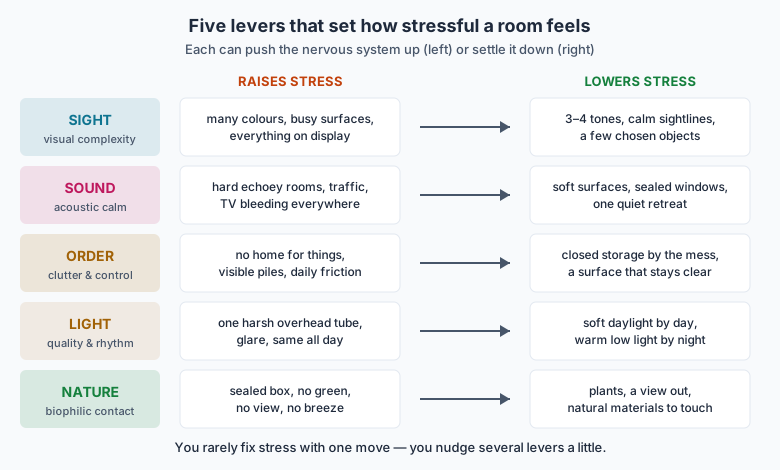
Figure 3: Five levers — sight, sound, order, light and nature. You rarely fix stress with one heroic move; you nudge several levers a little, and the cumulative effect is a room the nervous system can finally relax in.
7. Bring in nature and tactile, natural materials
Contact with nature is one of the most reliable ways we know to lower physiological stress, and you do not need a garden to get it. Indoors, the levers are a cluster of plants, a clear framed view to greenery or sky, natural light, and materials you actually touch — wood, cane, cotton, jute, stone, terracotta. These warm, tactile surfaces register as calming in a way that hard plastics and high-gloss laminates do not, and they age gracefully rather than looking tired.
The classic finding from Roger Ulrich's hospital study — that patients with a view of trees recovered faster and needed less pain medication than those facing a brick wall — is really a finding about how powerfully the sight of nature settles the nervous system, and it applies at home too. You can put a rough number on the biophilic richness of your own space with our biophilic score tool, and read the wider thinking in what is biophilic architecture. For materials specifically, our sibling guide on healthy materials for interiors covers the air-quality side of the same choice.
"The visual presence of nature, even in modest doses, supports stress recovery and a sense of restoration." — paraphrasing Roger Ulrich's view-and-recovery research and the synthesis in Stephen Kellert, Biophilic Design.
8. Give people control over their own space
The final, often-missed lever is agency. A space you can adjust to suit yourself is far less stressful than one you must simply endure. The research on stress is consistent on this point: perceived control buffers the impact of almost every other stressor.
In practice this means designing-in adjustability and ownership: a dimmable or two-step lamp instead of one fixed bright light; a window and fan each person can open or close; a chair that moves; a personal shelf or corner that belongs to one family member and to no one else. In joint households especially, even small, defined zones of personal control — "this is my corner" — reduce friction and resentment far out of proportion to their size.
A room-by-room visual-calm checklist
Use this as a weekend walk-through. Each line is a "decide once" move.
| Room | Visual-calm move | Sensory / control move |
|---|---|---|
| Entry | A closed cabinet for shoes, keys and bags so the threshold stays clear | A hook and a tray per person — everyone's daily things have a home |
| Living / multi-use | Closed storage wall; one surface kept empty; 3–4 tones | Define a quiet zone away from the TV; a lamp on a dimmer |
| Kitchen | Daily-use items on one shelf, everything else closed away | Task light over the counter; an openable window for fumes and heat |
| Bedroom / retreat | Clear the floor and the bedside; restrained, warm palette | Blackout option; a warm low lamp; the calm side of the home — see bedroom as retreat |
| Study / work corner | One clear desk surface; cables managed and hidden | A door or screen for focus; daylight from the side, not behind the screen |
| Puja / festival storage | A dedicated, closed cupboard so seasonal decor never lives in the open | Plan the once-a-year reset so it takes minutes, not a day |
A realistic order of operations
You cannot do everything at once, and you should not try. In most Indian homes the highest-return sequence is: first, declutter and add closed storage where the mess is made (immediate, cheap, transformative); second, clear the main path and reset the multi-use furniture so transitions are effortless; third, fix the light — break the single-tube habit with a couple of warm lamps and softer daylight; fourth, soften the sound with rugs, curtains and a defined quiet zone; and finally, add nature and carve a retreat. Each step lowers the load a little; together they turn a frayed 8 a.m. into a manageable one.
A low-stress home, in the end, is not about having less life in it. Indian homes are full — of people, festivals, generations, food, noise and love — and that fullness is the point. The work of design is simply to make sure all that life has somewhere to go, a clear way through, a place to be quiet, and light that knows the time of day.
Sources & further reading
- World Health Organization. Environmental Noise Guidelines for the European Region (2018) — noise as a health risk including sleep disturbance and stress responses.
- World Health Organization. WHO Housing and Health Guidelines (2018) — housing conditions, crowding and mental wellbeing.
- Roger S. Ulrich. "View Through a Window May Influence Recovery from Surgery." Science, 1984 — the view-and-recovery study underpinning biophilic stress recovery.
- Stephen R. Kellert, Judith Heerwagen & Martin Mador (eds.). Biophilic Design: The Theory, Science and Practice of Bringing Buildings to Life (2008).
- Christopher Alexander et al. A Pattern Language: Towns, Buildings, Construction (1977) — patterns for legible, calming domestic space.
- Bureau of Indian Standards / National Building Code of India (NBC 2016) — ventilation, light and acoustic provisions for dwellings.
If this guide helped, read its siblings in the Healthy Homes series: homes that improve mental wellbeing for the broader picture, acoustic comfort in homes for the quiet a calm home needs, and the pillar what makes a home healthy for how stress fits alongside air, light and sleep.
Export this guide
Related Guides — Deep-dive reading
Homes That Improve Mental Wellbeing
The whole-home, indoor-biophilia approach to calm — how plants, light, air, quiet and the right balance of togetherness and retreat make an Indian home restorative.
Healthy HomesAcoustic Comfort in Homes
Why hard, echoey Indian rooms quietly tire you out — and how rugs, curtains, layout and a few smart fixes turn noise into calm for better sleep, focus and lower stress.
Healthy HomesThe Architectural Psychology of Comfortable Spaces
Why some rooms feel right and others never do — the science of space and the human mind
Design EducationRelated Tools — Try Free
Cross-Ventilation Analyzer
Estimate airflow and air changes per hour (ACH) from room size, window areas, layout, and local wind — with NBC 2016 Part 8 compliance check.
Ventilation CalculatorAcoustic Privacy (STC) Visualizer
Indian healthcare acoustic visualizer — compare wall assemblies and noise sources, see received SPL after STC attenuation, and check FGI 2018 / IS 1950 / NABH speech-privacy compliance with live dual-canvas waveform.
Acoustic ToolCircadian Light Meter
Patient-centric circadian lighting visualizer for Indian healthcare design — time-of-day × intensity → CCT, melanopic lux (EML / mEDI), melatonin suppression, and an alertness curve. Calibrated against WELL v2 L03 Circadian Lighting Design, CIE S 026:2018, Brainard 2001, and Lucas et al. 2014.
Circadian Tool