
Indoor Air Quality Explained
What is really in the air you breathe at home — from Delhi winter smog to monsoon mould — and the clear order in which to fix it.
On a January morning in Delhi, a mother wakes her seven-year-old for school and notices the same thing she has noticed every winter: a dry cough that will not settle, eyes that look tired, an inhaler that is being reached for more often. The flat is clean. The windows are shut against the cold. And yet the air inside is doing quiet harm. A few hundred kilometres away, a family in a Kochi ground-floor home is fighting a different battle — a dark bloom of mould creeping along the bathroom wall through the monsoon, and a child who sneezes every morning. In a Mumbai kitchen, a grandmother cooks three meals a day over a gas flame in a room with one small window, breathing fumes she has never thought of as pollution.
These are not unusual homes. They are ordinary Indian homes, and the air inside them is often dirtier than the air outside. We obsess over the AQI number on our phones, yet most of us spend roughly ninety per cent of our lives indoors — where the pollution is a blend of what drifts in from the street and what we generate ourselves by cooking, painting, furnishing, and simply breathing in a closed room.
Indoor air quality is not one problem but several overlapping ones — and almost every one of them can be traced to a source you can name, and fixed in a clear order: stop it, ventilate it, then filter it.
This guide is about understanding what is actually in the air you breathe at home, what it does to your body, and how to make it measurably better. It stays in the health lane — the breathing, sleep, allergies, and clear-headedness that good air buys you. For the engineering of airflow itself, we point you to the technical guides; here we are the friend who explains why it matters and what to do tonight.
1. What is actually in your indoor air
Indoor air is a soup, and the ingredients fall into a handful of recognisable groups. Once you can name them, you can hunt them down.
Outdoor particulate matter (PM2.5 and PM10) is the one most Indians have heard of. PM2.5 — particles smaller than 2.5 microns, finer than a human hair is wide — slips deep into the lungs and even into the bloodstream. In a Delhi winter, or near any busy road during the dry months, outdoor air is thick with it, and it pours indoors through gaps, windows, and every time a door opens. Closing the windows helps a little but does not seal it out; indoor PM2.5 typically tracks the outdoor level at a fraction below it.
Cooking emissions are the pollutant most Indian homes underestimate. Frying, tempering, and roasting throw out fine particles; a gas flame or chulha also produces nitrogen dioxide (NO2), an irritant gas that inflames the airways. An unvented kitchen during cooking can briefly reach particle levels that rival a smoggy street.
Volatile organic compounds (VOCs) and formaldehyde off-gas invisibly from new things: fresh paint, plywood and MDF, laminates, adhesives, foam mattresses, and many cleaning products. Formaldehyde — common in the resins that bind engineered-wood boards — is the one to watch, because a freshly furnished flat can off-gas for weeks to months. This is exactly why material choice matters so much, a subject we treat in depth in our companion guide on healthy materials.
Carbon dioxide (CO2) is not toxic at home levels, but it is the best everyday proxy for stuffiness. We exhale it constantly; in a shut bedroom with the door closed and two people sleeping, CO2 climbs through the night. High CO2 is the signature of a room that is not getting fresh air — and the same lack of fresh air that lets CO2 build also lets everything else accumulate.
Damp and mould are the monsoon and coastal curse. When relative humidity sits above roughly 70 per cent and surfaces stay wet — bathroom walls, behind cupboards, around leaking windows — mould grows and releases spores that trigger allergies and asthma. Damp also feeds dust mites, the microscopic creatures in bedding and soft furnishings whose droppings are a leading indoor allergen.
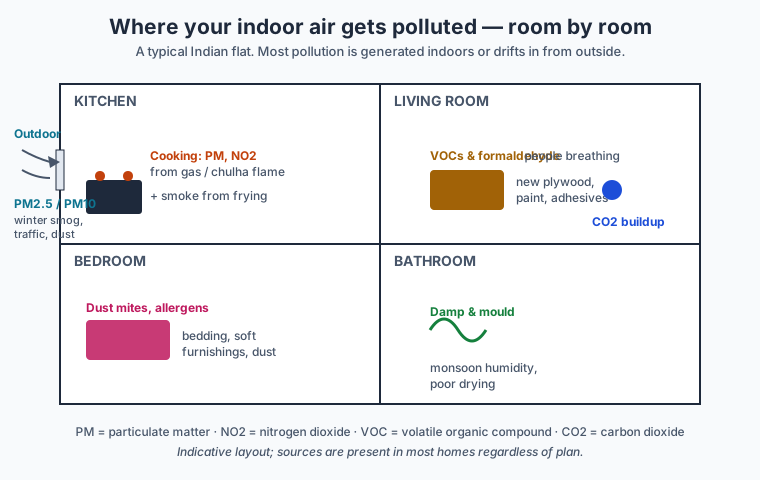
Figure 1: A typical flat, mapped by source. The kitchen makes particles and NO2; new furniture and paint off-gas VOCs; closed rooms accumulate CO2; the bathroom breeds damp and mould; outdoor smog drifts in through every opening.
2. The pollutants, mapped to source and fix
It helps to see the whole picture in one place — what each pollutant is, where it mainly comes from indoors, what it does to you, and the first thing to do about it.
| Pollutant | Main indoor source | Health effect | First fix |
|---|---|---|---|
| PM2.5 / PM10 | Outdoor smog drifting in; frying; incense; candles | Lung and heart strain, worsened asthma, reduced lung growth in children | HEPA filtration when outdoor air is bad; reduce indoor burning |
| NO2 | Gas stove / chulha flame | Airway irritation, more wheeze in children | Vent the kitchen to outside; chimney or exhaust fan |
| VOCs & formaldehyde | Fresh paint, plywood, MDF, laminates, adhesives, foam | Headaches, eye and throat irritation; formaldehyde is a known carcinogen | Choose low-VOC / low-formaldehyde materials; ventilate hard after fit-out |
| CO2 | People breathing in closed rooms | Stuffiness, poor sleep quality, dulled concentration | Bring in fresh air — ventilation, not filtration |
| Damp & mould | Monsoon humidity, leaks, poor drying | Allergies, asthma, persistent cough, musty smell | Dry surfaces, fix leaks, ventilate wet rooms, control RH |
| Dust mites / allergens | Bedding, carpets, soft furnishings | Allergic rhinitis, asthma flares, disturbed sleep | Hot-wash bedding, reduce clutter, keep humidity moderate |
Two things stand out from this table. First, filtration is the right answer for only some of these — chiefly outdoor particles. Second, the cheapest and most powerful interventions are almost always at the source.
3. What bad air does to a body
The reason indoor air quality belongs in a health series, not a technical one, is that the effects are real and cumulative — and they land hardest on the people we most want to protect.
The respiratory toll is the most direct. Fine particles and NO2 inflame the airways, which is why children with asthma reach for inhalers more often in smoggy weeks, and why a damp, mould-prone home keeps a cough going for months. Long-term exposure to PM2.5 is linked to slower lung development in children and to heart and lung disease in adults.
Then there is sleep. A stuffy bedroom — high CO2, the wrong humidity, dust-mite allergens in the bedding — fragments sleep without you ever waking fully. Many people who think they simply "sleep badly" are sleeping in poor air. We treat the bedroom environment in detail in the sleep guide; the air is one of its biggest levers.
There is also a quieter effect on the mind. Research on office and classroom air has repeatedly found that as CO2 and pollutants rise, concentration, decision-making, and reaction times fall. A child studying in a closed, stuffy room is working against the air. The same dull, headachy feeling many of us get by evening in an unventilated flat is partly chemistry, not just tiredness.
The World Health Organization's air quality guidelines treat fine particulate matter as one of the most significant environmental risks to health, and set the recommended PM2.5 24-hour level at 15 µg/m³ — a target Indian winter air routinely exceeds many times over, indoors as well as out.
For families with elders, infants, or anyone with asthma or allergies, this is not abstract. The home is where they spend the most hours, and so the home is where the air matters most.
4. The control hierarchy: source, ventilation, filtration
If you remember one idea from this guide, make it this: clean air follows an order of operations. Skip to the last step and you spend money treating problems you could have prevented.
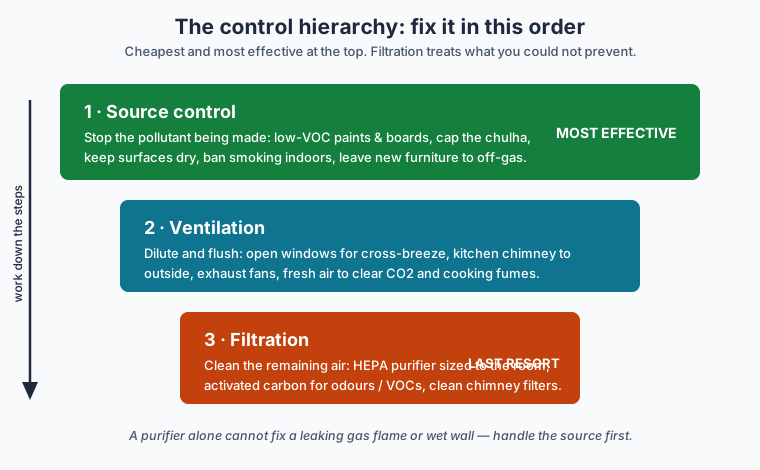
Figure 2: Work from the top down. Source control is cheapest and most effective; ventilation dilutes what remains; filtration is the last resort for what you could not prevent.
Source control first
Stop the pollutant being made or brought in. Choose low-VOC paints and low-formaldehyde boards when you furnish — this single decision shapes your air for years, and it is the heart of our healthy-materials guide. Never smoke indoors. Keep incense and candle use modest. Let new furniture air out, ideally before it comes inside. Fix the leak that is feeding the mould rather than scrubbing the mould forever. Source control costs little and lasts; everything below it is managing a problem you allowed in.
Ventilation second
Once a pollutant exists — CO2 from your own breath, fumes from cooking — the answer is fresh air to dilute and flush it. This is where opening the right windows for a cross-breeze, running a kitchen chimney that vents outside (not the recirculating kind), and using bathroom exhaust fans do their work. Ventilation is the only real fix for CO2 and the primary fix for cooking emissions. The catch in Indian cities is that during a bad-air spell, the outdoor air you are letting in is itself polluted — which is when the third step takes over. For the engineering of airflow paths, opening sizes, and the NBC and IS code basis, see our technical cross-ventilation reference; you can also sketch your own home's airflow with the cross-ventilation analyzer.
Filtration third
When the source cannot be removed and the outdoor air is too dirty to ventilate with — a Delhi winter night, for instance — you filter. A HEPA purifier sized to the room captures fine particles, including PM2.5; an activated-carbon stage helps with odours and some VOCs. Filtration is genuinely useful, but it is the last line, not the first. A purifier humming in a room with a leaking gas flame and a wet wall is treating a symptom while two sources keep running.
5. The numbers a healthy home aims for
You cannot manage what you do not measure. Three numbers tell you most of what you need to know, and inexpensive monitors now put them within reach of any home.
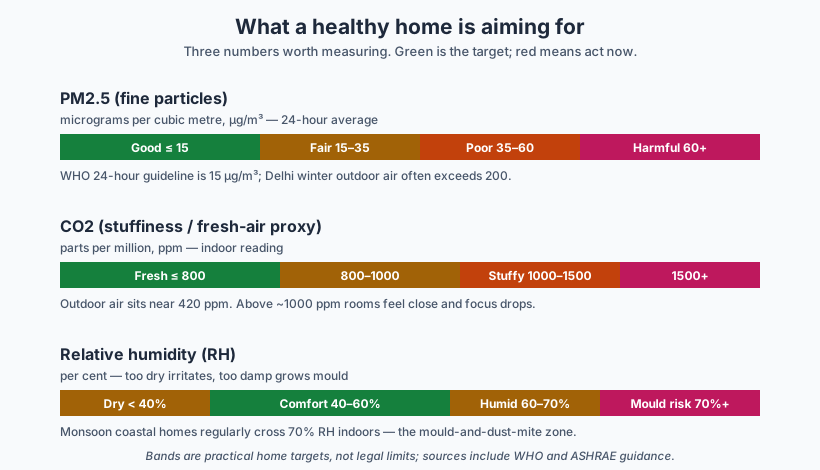
Figure 3: Practical home targets. Green is the goal, red means act now. Bands are guidance, not legal limits.
| What to measure | Healthy target | Warning sign | What it tells you |
|---|---|---|---|
| PM2.5 | ≤ 15 µg/m³ (24-hr) | Above ~35 µg/m³ | Fine-particle load — outdoor smog plus indoor burning |
| CO2 | ≤ 800 ppm | Above ~1000 ppm | Stuffiness; whether the room is getting fresh air |
| Relative humidity | 40–60% | Below 40% or above 70% | Comfort, and mould / dust-mite risk |
A few practical notes on measuring. AQI is the headline number your weather app shows — useful for deciding whether to ventilate or filter, but it describes outdoor air. For indoor decisions, a small PM2.5 monitor placed in the living room or bedroom tells you what you are actually breathing. A CO2 monitor is the single most revealing gadget for stuffiness: watch it climb in a closed bedroom overnight and you will never doubt the value of a cracked window again. A cheap hygrometer for humidity rounds out the set. None of these need to be expensive to be useful — the value is in seeing the trend and reacting to it.
6. A room-by-room plan you can act on this week
Knowing the theory is one thing; here is where to put it to work, room by room, in priority order.
The kitchen is usually the biggest indoor source, so start there. Use a chimney or exhaust that vents to the outside whenever you cook, open a window for cross-draught, and never let a gas flame run in a sealed room. If you still cook on a chulha, ventilation here is not optional — it is a health priority for whoever does the cooking.
The bedroom is where air quality and sleep meet. Aim for a little fresh air through the night — even a slightly open window or a trickle vent keeps CO2 down — hot-wash bedding regularly to control dust mites, and reduce soft clutter that traps allergens. If you live where outdoor nights are smoggy, run a HEPA purifier in the bedroom rather than opening up to the haze.
The bathroom and any damp-prone corner is the mould front. Run the exhaust fan during and after showers, dry surfaces, and chase leaks early. Keep an eye on humidity through the monsoon; if it sits above 70 per cent indoors, you are in the mould-and-mite zone and need to dry and ventilate harder.
The living room is mostly about VOCs from furnishings and the slow off-gassing of anything new. Ventilate generously after any painting or fit-out, and prefer low-emission materials from the start. This is where your earlier material choices quietly pay you back, day after day.
| Room | The main risk | Do this | Don't do this |
|---|---|---|---|
| Kitchen | Cooking PM & NO2 | Vent to outside every time you cook | Cook with the kitchen sealed |
| Bedroom | CO2, dust mites | Trickle of fresh air; wash bedding hot | Sleep in a fully sealed room nightly |
| Bathroom | Damp & mould | Run exhaust, dry surfaces, fix leaks | Let walls stay wet through monsoon |
| Living room | VOCs, off-gassing | Low-VOC materials; ventilate after fit-out | Move into a freshly painted, shut flat |
The National Building Code of India and IS ventilation guidance set minimum fresh-air and openable-area provisions precisely because diluting indoor pollutants is a building-level health function, not an afterthought — the technical cross-ventilation guide unpacks how those provisions translate into window and opening sizes.
The pattern across every room is the same three steps: remove the source where you can, bring in fresh air to dilute what remains, and filter only what is left. Do them in that order and a measurably healthier home is well within reach — for the breathing, the sleep, and the clear heads of everyone living in it.
Sources & further reading
- World Health Organization — WHO global air quality guidelines: particulate matter, ozone, nitrogen dioxide, sulfur dioxide and carbon monoxide (2021).
- World Health Organization — WHO guidelines for indoor air quality: dampness and mould and selected pollutants.
- Bureau of Indian Standards & National Building Code of India (NBC 2016), Part 8 — ventilation and indoor environment provisions.
- ASHRAE Standard 62.1 — Ventilation for Acceptable Indoor Air Quality (reference for fresh-air and humidity ranges).
- Allen, J. et al., Harvard T.H. Chan School of Public Health — research on CO2, ventilation and cognitive function (the "COGfx" studies).
- Central Pollution Control Board (CPCB), India — National Air Quality Index methodology and PM2.5 reporting.
If this opened your eyes to your own air, read its siblings next: Natural Ventilation Strategies for Indian Homes for the fresh-air half of the equation, Healthy Materials for Interiors in India to stop VOCs at the source, and How Ventilation Changes Home Air Quality for the mechanics of moving air through your home.
Export this guide
Related Guides — Deep-dive reading
How Ventilation Changes Home Quality
The invisible factor behind health, comfort, smell and freshness in your home
Design EducationSmart Air Purifiers for Indian Homes: Beating PM2.5
Across Delhi-NCR winters and year-round urban haze, indoor air is often worse than the street. This guide explains what actually makes a purifier smart, how CADR and room sizing work, what HEPA and activated carbon really remove, honest running costs on filters and power, and which brands earn their price in Indian conditions.
Smart HomeNatural Bathroom Ventilation India: Windows, Ventilators, Jaali, Cross-Ventilation & the Stack Effect
How to ventilate an Indian bathroom with air and daylight instead of only a fan — sizing the openable window to NBC, using top-hung ventilators, louvres and jaali, driving airflow with the stack effect and cross-ventilation, keeping privacy, and knowing exactly where the monsoon forces you to add a fan.
BathroomsRelated Tools — Try Free
Cross-Ventilation Analyzer
Estimate airflow and air changes per hour (ACH) from room size, window areas, layout, and local wind — with NBC 2016 Part 8 compliance check.
Ventilation CalculatorFull-Room BOQ — Living, Bedroom, Kitchen, Bath
Room-wise BOQ across living, bedrooms, kitchen, utility, and bathrooms with line-item pricing.
Full-Room BOQHome Building & Interior Cost Calculator — 20 Cities
Construction + interior costs for 20 Indian cities across kitchen, wardrobes, flooring, painting, ceiling.
Cost Calculator