
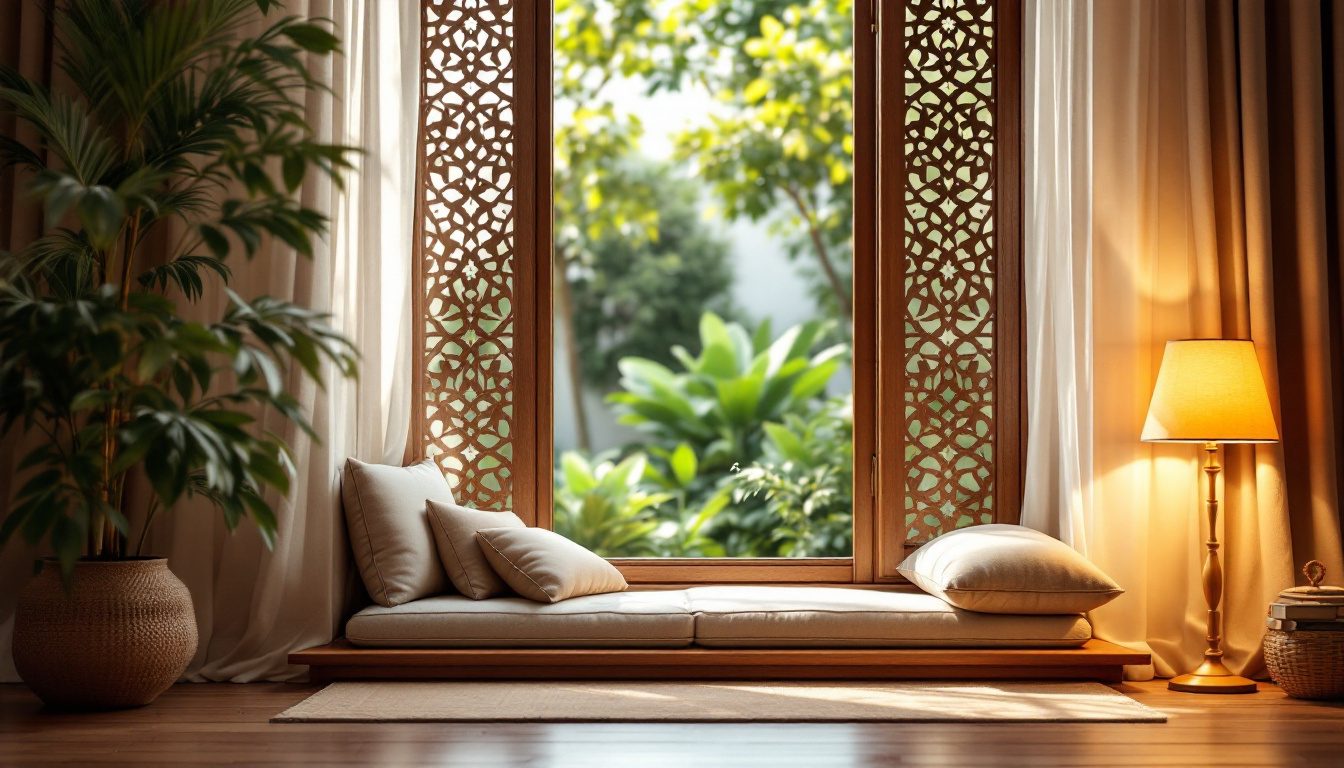
Zones of Retreat: Designing Spaces for Rest and Privacy
Why every Indian home needs protected nooks for solitude, focus and recovery — and how prospect-refuge theory helps you carve them from shared, crowded flats.
There is a particular relief that arrives when you finally sit down with your back to a wall, a cup of tea in hand, looking out across a room or a garden, with no one able to approach you from behind. You may never have named the feeling, but your body knows it instantly. It is the feeling of being safe enough to relax. The same body tenses in the opposite arrangement — back to an open door, facing a blank wall, exposed — and no amount of soft cushioning fixes it.
Most Indian homes are designed around gathering: the big living room, the open kitchen, the dining table that seats ten at a festival. Gathering is wonderful. But a home that is all gathering and no retreat slowly wears people down, because the nervous system needs somewhere to stand down from alertness. This guide is about the other half of dwelling — the corners, alcoves, window seats and quiet rooms where a person can withdraw to rest, to focus, to grieve, to pray, or simply to be unobserved for an hour.
Every home needs places to withdraw, not as a luxury but as a basic psychological requirement — and in dense Indian flats and joint-family households, where private space is scarce, designing for retreat is less about adding rooms and more about carving small, protected, see-without-being-seen pockets into the space you already have.
Prospect and refuge: the oldest comfort
The most useful idea for understanding retreat comes not from interior design but from a geographer. In 1975, Jay Appleton published The Experience of Landscape and proposed prospect-refuge theory: that human beings feel most at ease in places that offer both prospect — a clear, open view of the surroundings — and refuge — a sense of enclosure and protection at the back. We are, in evolutionary terms, an animal that wanted to see without being seen: to watch the plain for opportunity and danger while staying hidden and shielded ourselves. Places that supply both signals feel deeply, almost inexplicably, satisfying.
This is why the window seat is one of the most beloved features in any home that has one. It is prospect-refuge made furniture: walls or a deep reveal hug you on three sides (refuge), while a window opens the fourth to light and view (prospect). It is why a high-backed armchair in a corner feels better than the same chair in the middle of a room; why people in a restaurant fill the booth and wall-edge seats long before the exposed centre; why a child builds a fort under the table. The pattern is universal, and once you see it you cannot un-see it.
The lesson for the home is not "build window seats." It is that retreat spaces work when they satisfy both halves. A nook with your back exposed is not a refuge — it is a trap that feels like one. A sealed cupboard of a room with no outlook is not restful — it is a cell. The art is the combination: a protected back, a contained body, and an outlet for the eye and the breath. Get those three and almost any corner becomes a place a person will return to.
The refuge palette: alcoves, nooks and the architecture of withdrawal
Long before psychology gave it a name, builders knew how to make refuge. Christopher Alexander's A Pattern Language (1977) catalogues the moves with unusual tenderness. Pattern 179, Alcoves, argues that no group room is complete without small recesses off it where one or two people can withdraw yet remain part of the larger life of the room. Pattern 180, Window Place, insists that every room people use for long stretches needs at least one spot that is both a place to sit and a window — and warns that a room without one leaves people in a permanent low-level conflict between the pull of the light and the comfort of a seat. Pattern 141, A Room of One's Own, claims that no one can be fully themselves without a territory that is unmistakably theirs.
These patterns describe a palette of refuge elements, each with a different intensity of withdrawal. They are worth knowing by name because each one solves a slightly different problem in a real Indian home.
| Refuge element | What it offers | Indian application |
|---|---|---|
| The alcove | Partial withdrawal, still in the room | A recessed seat off the living room for a phone call |
| The window seat / window place | Refuge plus prospect, light and view | A bay or balcony-edge seat looking out, with cushions |
| The high-backed chair | Portable, instant refuge | A wing chair in a corner facing the room, back to wall |
| The reading nook | Quiet solo zone, soft and lit | A padded corner under the stair or by a window |
| The room of one's own | Full privacy, a defensible territory | A study, a sewing room, a small bedroom that is truly someone's |
| The contemplative corner | Stillness, ritual, inward focus | The pooja corner, a meditation mat by a window |
| The threshold escape | Temporary exit from the household | The balcony, the terrace, the verandah at dawn |
A refuge is not a room you lock; it is a corner that holds you. The smallest protected nook, well placed, does more for the mind than a large room left exposed.
The crucial design insight running through all of these is enclosure on three sides, opening on the fourth. A reading nook works because the corner walls do two-thirds of the sheltering and you only have to defend one direction. This is the same instinct that makes the understanding spatial flow of a home matter — circulation should flow past a refuge, never through it. The moment a path cuts across your nook, the refuge collapses, because anyone may appear from any side.
The gradient of retreat: from shared to solo
Retreat is not a single state. There is a spectrum that runs from the fully shared and public, through semi-private buffers, to the completely solo and defensible. A well-designed home lets a person move smoothly along this gradient and choose their level of exposure for the moment — together for dinner, semi-withdrawn with a book in the alcove off the same room, fully alone behind a closed door when the day has been too much.
This is the privacy gradient that runs through good planning everywhere — it is the spatial spine of our companion guide on sequential progression of spaces, where each step inward should feel more protected than the last. The diagram below maps the gradient onto a typical Indian flat.
The problem in most contemporary flats is that the gradient has only two settings: the wide-open social zone and the bedroom door. There is nothing in between — no buffer, no semi-private perch where you can be alone together, present but not engaged. An introvert in such a home has only two choices: perform sociability in the open, or vanish behind a door and be read as antisocial. Adding even one intermediate step — an alcove, a window seat, a screened corner — transforms the household's emotional range.
| Level of retreat | Spatial form | What it is for | Privacy needed |
|---|---|---|---|
| Shared / public | Living-dining, open kitchen | Gathering, hosting, family life | None |
| Semi-private buffer | Alcove off a room, balcony, verandah | Being alone-together, a quiet call, morning tea | Visual softening, partial screen |
| Private | Bedroom, study, dressing area | Sleep, focused work, dressing | A door, acoustic separation |
| Solo refuge | Reading nook, meditation corner, terrace at dawn | Deep rest, prayer, recovery, solitude | Defensible, see-without-being-seen |
The skill of programming a home, covered in depth in programming your home around real functions and supported by the room programming worksheet, is partly the skill of making sure every level of this gradient exists somewhere — that the home offers not just rooms but degrees of withdrawal.
The two privacies: acoustic and visual
A refuge that protects your eyes but not your ears is only half a refuge. There are two distinct kinds of privacy and they fail in different ways, which is why a curtain can solve one problem and not touch the other.
Visual privacy is about sightlines: not being seen, and not having to see. It is broken by a door that faces a busy corridor, a desk whose screen is visible from the kitchen, a bed framed by an open doorway. It is repaired by orientation (turn the seat so its back is to traffic), by screening (a jaali, a bookcase, a curtain, a planter), and by level changes and reveals that break the line of sight without building a wall. Visual privacy is relatively cheap to engineer once you think in sightlines.
Acoustic privacy is harder and more often neglected. Sound passes through gaps, through thin partitions, through the slab. In a dense flat, the sounds of a joint household — the television, the pressure cooker, a phone call on speaker, children at play — fill every room because nothing stops them. A reading nook in an open corner of the living room offers visual refuge but zero acoustic refuge; you can see less but you hear everything.
| Privacy type | Broken by | Repaired by |
|---|---|---|
| Visual | Open sightlines, facing doors, glass, exposed screens | Reorienting seats, jaali / screen, bookcase, curtain, planter, level change |
| Acoustic | Gaps under doors, thin partitions, hard echoing surfaces, open plan | Soft furnishing, rugs, curtains, solid-core doors, door seals, full-height partitions, distance |
| Olfactory / sensory | Open kitchen near the rest zone | Separation, exhaust, a buffer room |
| Territorial | No clear ownership of a space | A door, a name on the room, a defensible boundary |
The practical move for acoustic refuge in a flat is layering soft mass. Rugs, curtains, upholstery and bookshelves absorb the reflections that make a hard room ring and carry voices. A solid-core door with a simple draught seal at the bottom cuts far more sound than the hollow flush doors that builders fit by default. And where a genuinely quiet room is needed — a work-from-home call zone, a music corner, a study for a child preparing for exams — the only reliable answer is a real partition that goes from slab to slab, not a half-wall that lets sound spill over the top.
Carving retreat from a shared Indian flat
Here is the situation most readers actually face. The flat is 800 to 1,100 square feet. Three generations share it, or a couple and two children, or a working professional and visiting parents. There is no spare room to convert into a study or a den. And yet the need for retreat is, if anything, more acute precisely because the home is full. So the question is not "which room shall I make private?" but "how do I carve a protected pocket out of space that is already doing other jobs?"
The good news is that refuge is small. You do not need a room; you need a corner that holds one person and faces the right way. A few reliable moves:
- Claim a corner, not the middle. Two walls give you two-thirds of your enclosure for free. A 1.2-metre-square corner with a low seat, a lamp and a window or a screen becomes a genuine refuge. The middle of a room can never be one.
- Build the third wall from furniture. An L of low bookshelves, a tall plant, a folding jaali screen or a sofa back turned to the room completes the enclosure without masonry. This is the single most powerful trick in a small flat.
- Orient for prospect. Point the seat toward a window, a balcony or even a long view across the room — never at a blank wall a metre away. The eye needs an outlet or refuge becomes claustrophobia.
- Route the path around it. Place the nook where no one needs to walk through it to reach anything. Refuge dies the instant it becomes a thoroughfare.
- Use the balcony as escape. In a packed flat, the balcony is often the only true threshold to the outside — give it a chair, a little shade and a plant, and it becomes the household's pressure-release valve, especially at dawn and dusk.
- Make the pooja corner a contemplative refuge. Beyond its ritual role, a well-placed pooja corner — quiet, screened, facing the right direction in homes that follow vastu — doubles as the home's one reliably contemplative spot, a place to sit still without explanation.
Retreat for everyone: introverts, joint families and the work-from-home day
Privacy is not distributed equally in Indian homes, and good design quietly corrects that. Three groups feel the shortage most.
Introverts and the over-stimulated. A large share of people recharge through solitude rather than company, and in a busy household they are perpetually depleted. They do not need to be cured; they need a corner. A single well-placed nook lets an introvert stay present in family life without being submerged by it — the alcove that lets you be alone-together is, for them, the difference between a home that exhausts and one that restores.
Joint and multi-generational families. When three generations share a flat, personal territory is the scarcest resource of all. The grandparent often has no defensible corner, the teenager no private space to study, and the daughter-in-law frequently the least private space of anyone. Designing for retreat in a joint family is partly an act of fairness — ensuring that each member has at least one spot, however small, that is unmistakably theirs, with a door or a screen they control. Even a curtained alcove with a name attached to it changes the felt dignity of a crowded home.
The work-from-home professional. The home now routinely doubles as a workplace, usually with no room budgeted for it. A work corner needs a different refuge profile from a reading nook: a back-protected seat (no one reading your screen over your shoulder), a controllable sightline for video calls, and above all acoustic refuge so a call is not punctuated by the pressure cooker. The best home-office refuges are oriented so the wall is behind the worker and the room opens in front — prospect-refuge again, in service of focus rather than rest.
The principle uniting all three is that retreat is a need, not an indulgence, and a home that designs for it is not antisocial — it is the opposite. People who can withdraw to recover come back to the shared table more present, more patient and more themselves. A home that feels right, as we argue in our anchor guide on the home that feels right, is one that can hold you both ways: gathered and alone.
What this means for your home
1. Audit your gradient. Walk your home and ask whether it has a true intermediate setting between the open social zone and the closed bedroom. If the only two states are "exposed" or "shut away," add one buffer — an alcove, a window seat, a screened corner.
2. Find every back-to-wall, face-the-view spot. Map where a person can sit protected and look out. These are your latent refuges. Furnish at least one properly with a seat, a lamp and a soft surface.
3. Build refuge from furniture before masonry. An L of bookshelves, a turned sofa, a jaali screen or a tall plant completes a three-sided enclosure cheaply and reversibly.
4. Solve both privacies. For visual refuge, reorient seats and add screens. For acoustic refuge, layer rugs, curtains and upholstery, hang solid-core doors, and use a full partition where a quiet room is genuinely needed.
5. Give the scarce members a corner. In a joint family, ensure the grandparent, the teenager and the daughter-in-law each have at least one defensible spot of their own, with a door or curtain they control.
6. Treat the balcony and pooja corner as refuges. They are often the only escape and the only stillness a dense flat offers — furnish them as the valuable retreats they are.
7. Protect the work corner acoustically. A back-protected, sound-buffered work nook is now a basic requirement, not a luxury.
How Studio Matrx helps
Designing retreat is about placement as much as furniture — which corner, facing which way, with what behind your back. DesignAI lets you visualise a reading nook, a window seat, a screened work corner or a contemplative pooja alcove inside your actual room before you move a single piece of furniture, so you can test the see-without-being-seen geometry — protected back, contained body, outlet for the eye — and feel which corner will truly hold you. Pair it with our room programming worksheet to make sure every level of your home's retreat gradient, from shared to solo, has a place to live.
References
1. Appleton, J. (1975). The Experience of Landscape. John Wiley & Sons. — the original statement of prospect-refuge theory.
2. Alexander, C., Ishikawa, S. & Silverstein, M. (1977). A Pattern Language. Oxford University Press — patterns 141 "A Room of One's Own," 179 "Alcoves," and 180 "Window Place."
3. Hildebrand, G. (1991). The Wright Space: Pattern and Meaning in Frank Lloyd Wright's Houses — applies prospect-refuge theory to domestic interiors.
4. Kaplan, R. & Kaplan, S. (1989). The Experience of Nature: A Psychological Perspective — environmental psychology of restorative settings, including refuge and outlook.
5. Cain, S. (2012). Quiet: The Power of Introverts in a World That Can't Stop Talking — on the need for solitude and restorative withdrawal.
6. Bureau of Indian Standards. National Building Code of India 2016 (NBC 2016), Part 3 — habitable-room and privacy-related planning requirements.
7. Ulrich, R. S. (1991). "Effects of interior design on wellness," Journal of Health Care Interior Design — on enclosure, control and stress recovery in built environments.
Part of the Studio Matrx Design Principles series. Continue with the sequential progression of spaces, programming your home around real functions, the home that feels right, and the cluster anchor on designing from principles, not magazine examples.
Export this guide
Related Guides — Deep-dive reading
The Architectural Psychology of Comfortable Spaces
Why some rooms feel right and others never do — the science of space and the human mind
Design EducationDesigning Low-Stress Living Spaces
The practical design moves that lower everyday stress at home — from hidden storage and a restrained palette to acoustic calm, soft light and a place to retreat — tuned for Indian flats, joint families and multi-use rooms.
Healthy HomesHow to Plan a Home for Multi-Generational Living
Designing for grandparents, parents and children under one roof — privacy, accessibility and harmony
Home PlanningRelated Tools — Try Free
Acoustic Privacy (STC) Visualizer
Indian healthcare acoustic visualizer — compare wall assemblies and noise sources, see received SPL after STC attenuation, and check FGI 2018 / IS 1950 / NABH speech-privacy compliance with live dual-canvas waveform.
Acoustic ToolCircadian Light Meter
Patient-centric circadian lighting visualizer for Indian healthcare design — time-of-day × intensity → CCT, melanopic lux (EML / mEDI), melatonin suppression, and an alertness curve. Calibrated against WELL v2 L03 Circadian Lighting Design, CIE S 026:2018, Brainard 2001, and Lucas et al. 2014.
Circadian ToolCross-Ventilation Analyzer
Estimate airflow and air changes per hour (ACH) from room size, window areas, layout, and local wind — with NBC 2016 Part 8 compliance check.
Ventilation Calculator