
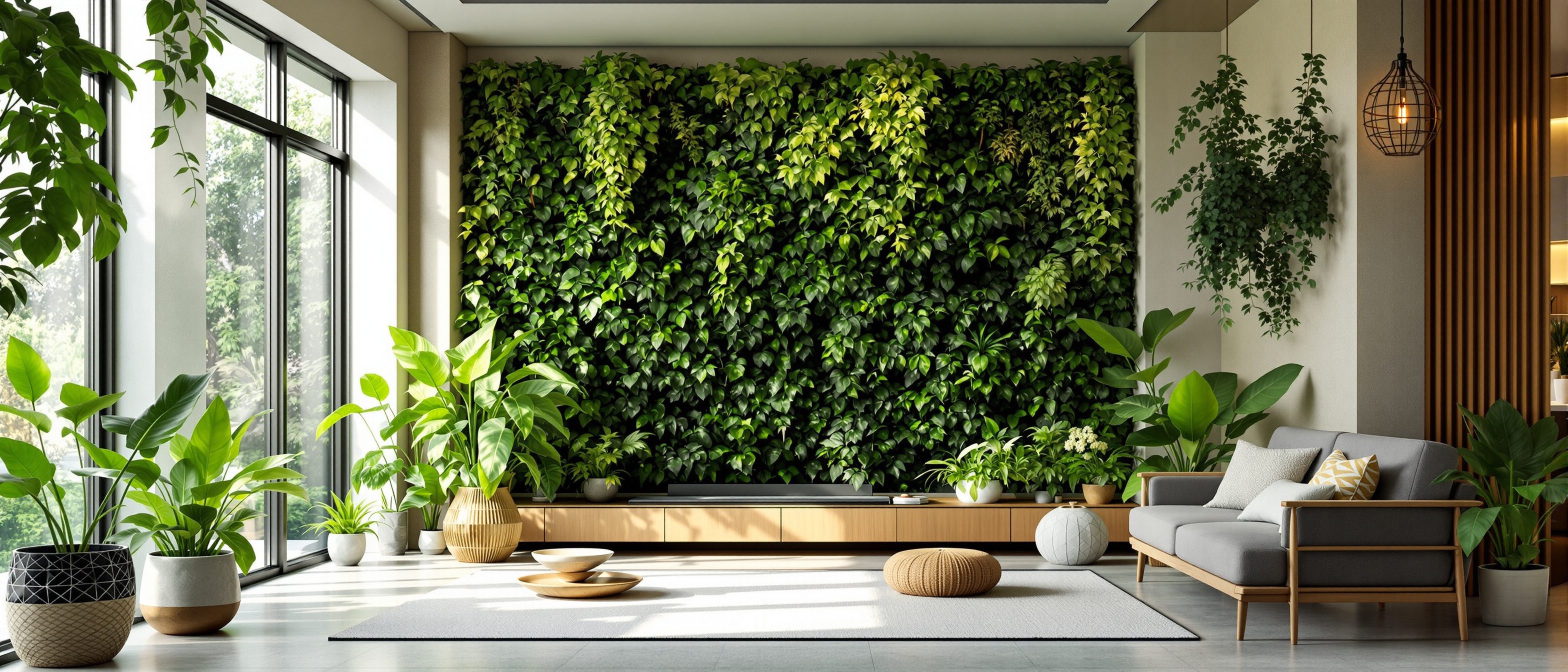
Homes That Improve Mental Wellbeing
The whole-home, indoor-biophilia approach to calm — how plants, light, air, quiet and the right balance of togetherness and retreat make an Indian home restorative.
It is a Sunday evening in a 2BHK on the eleventh floor of a Mumbai tower. The flat has everything the brochure promised — a sea-facing balcony, vitrified tiles, a modular kitchen — and yet the family living in it feels faintly, constantly frayed. The grandmother has no quiet corner away from the television; the teenager retreats to the only place that is truly his, the inside of his headphones; the mother stands at the kitchen counter looking at a blank tiled wall for two hours a day. Nothing is broken. Everyone is, in a small way, on edge. The home shelters them perfectly and restores them not at all.
This guide is about the difference between those two things. A growing body of research shows that our homes do not merely house our bodies — they continuously shape our minds: our stress, mood, focus, sense of safety and belonging. And the single most powerful, affordable lever an ordinary Indian home has for mental wellbeing is also the one our cities have quietly engineered out of daily life — contact with nature, brought indoors. Not a garden you visit, but nature woven through the rooms you actually live in: a plant in your line of sight, daylight that follows the day, a natural texture under your hand, the sound of water, a window that frames something living.
A home improves mental wellbeing when it does two things at once: it pulls nature, light, air and quiet inside the rooms you use most, and it gives each person both genuine connection and a private place to retreat — together yet able to be alone.
1. Why the home is a mental-health instrument
For most of human history we lived inside nature. In barely two generations, urban Indians have moved into sealed concrete boxes where a person can spend ninety-plus per cent of their day indoors, breathe filtered or stale air, see no green thing, and hear traffic through every wall. The mind did not evolve for this, and it registers the loss — usually not as a dramatic illness but as a low, chronic friction: poorer sleep, shorter fuses, harder concentration, a flatter mood.
The good news is that the relationship runs the other way too. Tune a home's sensory inputs toward nature and calm, and measurable things improve. The foundational evidence is now decades old. In 1984 the environmental psychologist Roger Ulrich published a study in Science showing that surgical patients whose hospital window looked onto trees recovered faster and needed less strong pain relief than identical patients facing a brick wall. Nothing about their medical care differed — only the view. If a glimpse of nature through glass can change how much morphine a body needs, then the rooms we inhabit every day are doing something to us all the time.
"Contact with nature is not a luxury but a vital component of human wellbeing." — the spirit of Stephen Kellert's case for biophilic design (Biophilic Design, 2008), which argues that buildings should be deliberately shaped to satisfy our innate affinity for living things.
This is the indoor, whole-home lane of wellbeing. Our companion guides cover the theory of biophilic architecture and the outdoor side — biophilic landscape design, healing gardens and outdoor wellness spaces. Here we stay inside the walls, because that is where Indian apartment life mostly happens, and where most homes leave the easiest gains on the table.
2. The six levers a home pulls on the mind
Strip the science down and a home acts on mental wellbeing through a handful of channels. None is sufficient alone; wellbeing is the whole wheel turning together.
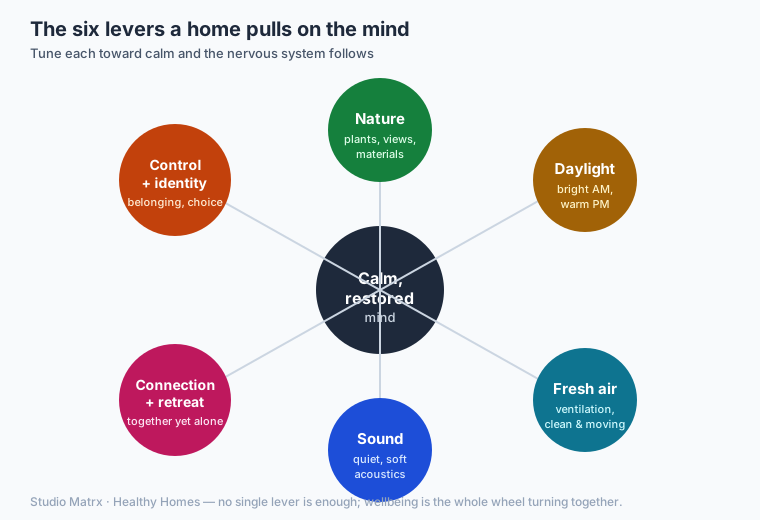
Figure 1: The six levers. Tune each toward calm and the nervous system follows; neglect one and it quietly drags on the rest.
The table below pairs each wellbeing driver with the concrete indoor design move it implies and the honest evidence behind it — described as a relationship, not an invented number.
| Wellbeing driver | Indoor design move | Evidence (honest) |
|---|---|---|
| Connection to nature | Plants, a living green wall, a framed view of a tree or sky from your main seat | Ulrich (1984): nature views speed recovery and reduce stress markers |
| Daylight on the body clock | Strong morning light into waking rooms; warm, dimmable light at night | Circadian-light research links bright AM light to better mood and sleep |
| Fresh, moving air | Cross-ventilation; low-VOC materials; indoor plants as a minor aid | WHO indoor-air guidance ties pollutants to mood, cognition and sleep |
| Acoustic calm | Soft surfaces, sealed bedrooms; quiet < 30 dB at night | WHO: chronic noise raises stress hormones and fragments sleep |
| Connection vs retreat | A warm social core plus a private nook each person can close | Refuge-and-prospect theory; control over privacy lowers strain |
| Control, identity, belonging | Personalisation, chosen objects, a space that is recognisably yours | Sense of control and place-identity are protective for mental health |
| Natural patterns & materials | Wood, stone, cane, lime; gentle fractal patterns over flat synthetics | Kellert & Kaplan: natural forms ease "directed-attention" fatigue |
You can pressure-test your own rooms against the nature side of this list with our biophilic score tool, and gauge how much a reframed window matters with the healing-view impact calculator.
3. Indoor biophilia: bringing nature into the rooms you live in
Biophilia simply means our inborn pull toward living things. Indoors, it is delivered through several distinct cues — and the richest homes layer more than one in the same room without ever becoming a jungle.
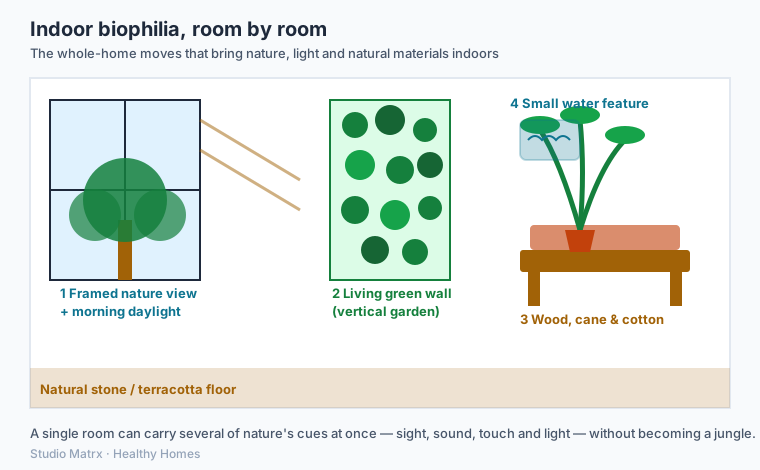
Figure 2: A single room carrying several of nature's cues at once — sight, sound, touch and light.
Plants and living walls
The most direct move. A leafy plant in your line of sight from the sofa, the bed or the work desk does the quiet work Ulrich documented. Indian homes have a head start here — the tulsi at the threshold, money plants in the kitchen window, a balcony crowded with pots — but we tend to keep them at the edges. Bring them into the rooms you sit in. A grouped cluster reads more like a habitat than a lone pot. Where floor space is tight, a vertical green wall on an otherwise blank surface turns dead wall into living view. Pick low-light-tolerant, low-maintenance species (pothos, snake plant, ZZ, areca palm) so the plant survives Indian work weeks; a dying plant is a stressor, not a calmer.
Natural materials and textures
The nervous system reads wood, stone, cane, cotton, jute, clay and lime plaster as non-threatening in a way that hard, shiny synthetics do not. This is biophilia by touch and grain rather than by greenery. In a flat where you cannot move walls, materials are often the easiest lever: a cane chair, a wooden chopping board you actually keep out, a cotton dhurrie, a stone or terrazzo top, lime-washed instead of high-gloss enamel walls. Our healthy materials for interiors guide covers the air-quality side of those same choices.
Natural patterns and fractal views
Kellert and others note that gentle, irregular natural patterns — the branching of a plant, the grain of wood, dappled light, a jaali casting a shifting shadow — engage what the Kaplans called soft fascination: effortless attention that lets the focused, fatigued kind recover. A traditional jaali, a woven cane screen, a window that throws moving leaf-shadow on a wall — these do more for a tired mind than a flat accent wall ever will.
Water and the framed view
A small indoor water feature or a tabletop fountain adds a gentle, masking sound that calms and softens harsher city noise. And the highest-value move of all costs nothing to build: orient the seats and beds you use most toward a window with something living in it — a tree, a planted balcony, sky. If the view is poor, build the view with a tall plant or a green wall on the sill. This is the Ulrich finding applied at home, and the lane our healing-view calculator is built to test.
4. Light, air, sound and nature as one calm system
Indoor biophilia does not work in a vacuum. It sits inside the same sensory envelope as daylight, fresh air and quiet — and these reinforce one another into a single feeling of calm.
Daylight sets the clock. Bright morning light steadies your circadian rhythm, lifts mood and improves that night's sleep; harsh blue-rich light late at night does the opposite. The home move is simple: get strong daylight into the rooms you use in the morning, and make evening light warm (around 2700 K or lower), layered and dimmable rather than a single glaring tube. The mechanics of getting daylight into Indian rooms are covered in daylighting principles for homes and natural light planning; the body-clock angle in circadian lighting for homes. Map where morning light actually lands with our sun-path analyser and the daylight-factor tool.
Air carries mood. Stale, polluted indoor air dulls cognition and worsens sleep — and in a Delhi winter, indoor PM2.5 can shadow the toxic air outside. Fresh, moving air is itself a calmer, not just a comfort. Cross-ventilation, low-VOC finishes and good kitchen extraction matter as much for the mind as the lungs; see indoor air quality explained and natural ventilation strategies, with the engineering of airflow in understanding cross-ventilation. Test paths with the cross-ventilation analyser.
Sound either heals or grinds. Indian cities are loud, and the brain keeps monitoring noise even after you stop noticing it — the WHO recommends bedroom levels below about 30 dB for undisturbed sleep, while a window onto a busy road can sit at 60–70 dB. Soft surfaces (rugs, curtains, an upholstered headboard, books on open shelves) absorb the harshness; a sealed, quiet bedroom protects the night. The deeper treatment is in acoustic comfort in homes and the problem-solving in noise reduction for apartments, with the acoustic-privacy visualiser to see how sound travels.
The World Health Organization's environmental-noise guidance rests on evidence that chronic noise raises stress hormones and blood pressure and breaks sleep — even when you have consciously tuned it out. Defending the bedroom acoustically is one of the highest-return moves for mental wellbeing.
The point is integration: a room with a green view but a glaring tube light and road noise is still a stressful room. Calm is the sum.
5. Connection and retreat: the social balance in an Indian home
Mental wellbeing at home is not only about nature and light — it is about people, and the delicate balance between being together and being able to be alone. Humans need both prospect (an open outlook, a sense of the wider room and the company in it) and refuge (a protected spot to withdraw to and control). Most Indian homes are generous with the first and starved of the second.
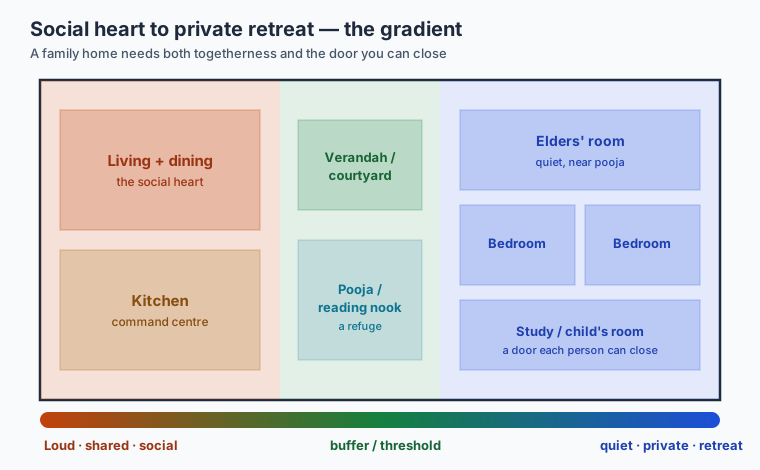
Figure 3: The gradient from social heart to private retreat — a family home needs both togetherness and the door you can close.
Design the social heart
A warm, generous shared space — living and dining flowing into the kitchen, the household's true command centre — is itself protective for mental health. Social connection is among the strongest predictors of wellbeing, and a home that makes gathering easy and pleasant (good light, comfortable seating facing each other rather than only the TV, a table large enough for everyone) quietly supports it. The Indian instinct for an open, hospitable common space is a wellbeing asset, not a thing to apologise for.
Design the retreat
The harder, more neglected half. In a joint or multi-generational household, the absence of a single door you can close is a daily strain. Each adult — and ideally each child and elder — needs at least one space they control: a bedroom that closes, a reading nook, a curtained alcove, a corner of the terrace. Even a half-height screen or a curtained alcove signals "this is mine for now", and that sense of control is itself a powerful stress reducer. This is the focus of our siblings zones of retreat, rest and privacy and designing low-stress living spaces, and the restful end of it in the bedroom-as-retreat guide.
Buffer zones do the diplomacy
The genius of vernacular Indian planning is the graded threshold — the verandah, the courtyard, the pooja corner — that sits between loud-and-shared and quiet-and-private. A buffer lets a teenager be near the family without being in the middle of it, and lets an elder rest within earshot of the household. Multi-generational harmony is largely a matter of getting this gradient right: a clear social core, defensible private rooms, and soft buffers in between so the two never collide.
6. Belonging, identity and the sense that a home is yours
A home improves mental wellbeing not only through its physics but through its meaning. A space that feels recognisably yours — that holds your objects, your family's history, your aesthetic, your gods — is psychologically protective in a way no rented-feeling showflat can be. This is place-identity: the sense that where you live is part of who you are.
In practice this means resisting the urge to make a home into a catalogue. Personalisation — the framed photographs, the inherited brass, the child's drawings, the books, the regional textiles, the pooja that anchors the day — is not clutter to be minimised away; it is the material of belonging. The design discipline is to give all of it a considered place (closed storage for the genuine mess, displayed dignity for the meaningful) so the home reads as ordered and personal rather than chaotic or sterile. Order calms; identity belongs. A home needs both.
Control matters here too. The ability to change your own environment — open a window, dim a light, move a chair, rearrange a corner — is itself good for the mind; powerlessness over your surroundings is a quiet, chronic stressor. Design for adjustability: operable windows and shades (see the brise-soleil visualiser for shading), dimmable layered light via the circadian-light meter, furniture that can be moved. A home you can tune to the day, the season and your mood is a home that supports you back.
7. A room-by-room, budget-aware plan
You do not need a renovation to start. The table below maps high-impact indoor-biophilia and wellbeing moves by room and budget — pick one per room and build from there.
| Room | Low cost (₹) | Mid (₹) | Higher (₹) |
|---|---|---|---|
| Living | A grouped cluster of plants in your sight-line; a cotton dhurrie | Cane/wood seating facing each other; warm dimmable lamps | A living green wall on the blank wall; a small water feature |
| Bedroom | Heavy curtains + a rug for quiet; one bedside plant | Sealed window gaps; 2700 K dimmable bedside light | Reorient bed to a green view; natural-fibre bedding & headboard |
| Kitchen | Herbs on the sill; a wooden board kept out | Window-side prep so you look out, not at tile | A view-framing window or jaali; better extraction |
| Work / study | A desk plant within sight; warm task lamp | Reposition desk to face a window, not a wall | Acoustic softening; a small retreat nook nearby |
| Balcony / threshold | Pots to green the edge and frame the view | A cane chair: a true retreat-with-outlook seat | Planting designed as a framed scene from indoors |
| Whole home | Declutter into closed storage; open windows daily | Swap glossy synthetics for natural materials | Plan a clear social-to-retreat gradient (Figure 3) |
A simple do / don't to close on:
| Do | Don't |
|---|---|
| Put a living thing in your main sight-line | Bank everything on one statement plant you will forget to water |
| Layer warm, dimmable light by zone | Light the whole home with one harsh overhead tube |
| Give every person a door or screen they control | Leave the household with no private corner at all |
| Use real wood, cane, cotton, stone, lime | Cover every surface in glossy, off-gassing synthetics |
| Keep a clear, calm surface in each room | Mistake bare minimalism for calm — belonging matters too |
What this means for your home
1. Frame one green view per main seat. Reorient the sofa, bed or desk toward a window with something living — or build the view with a tall plant or green wall. This is the highest-return, lowest-cost move.
2. Bring nature into the rooms, not just the balcony. Cluster plants where you sit; add real materials and a natural pattern (cane, jaali, wood grain) you can see and touch.
3. Make light follow the day. Strong morning daylight in waking rooms; warm, layered, dimmable light at night.
4. Defend the bedroom acoustically. Curtains, a rug, sealed gaps; aim for a quiet, dark, fresh-air bedroom.
5. Design both connection and retreat. A warm shared heart and a private, controllable nook for each person, with soft buffers between.
6. Let the home be recognisably yours. Personalise with intent; give meaningful things a dignified place and the mess a closed one.
7. Keep it tunable. Operable windows, movable furniture, dimmable light — control over your space is itself good for the mind.
Designing a home around mental wellbeing — testing where daylight reaches, where a retreat nook could sit, how a green view falls into your most-used seat — is exactly what DesignAI is built to help you see before you commit money to it.
Sources & further reading
- Ulrich, R. S. (1984). "View through a window may influence recovery from surgery." Science, 224(4647), 420–421.
- Kellert, S. R., Heerwagen, J. & Mador, M. (2008). Biophilic Design: The Theory, Science and Practice of Bringing Buildings to Life. Wiley.
- Kaplan, R. & Kaplan, S. (1989). The Experience of Nature: A Psychological Perspective. Cambridge University Press. (Attention Restoration Theory.)
- Browning, W., Ryan, C. & Clancy, J. (2014). 14 Patterns of Biophilic Design. Terrapin Bright Green.
- World Health Organization (2018). Environmental Noise Guidelines for the European Region; and WHO indoor air quality guidance.
- Bureau of Indian Standards / National Building Code of India (NBC 2016) — daylight, ventilation and habitable-room provisions.
Keep reading in the Healthy Homes cluster: the pillar on what makes a home healthy, designing low-stress living spaces, and the design-education view in how good architecture reduces stress.
Export this guide
Related Guides — Deep-dive reading
Zones of Retreat: Designing Spaces for Rest and Privacy
Why every Indian home needs protected nooks for solitude, focus and recovery — and how prospect-refuge theory helps you carve them from shared, crowded flats.
Design PrinciplesAcoustic Comfort in Homes
Why hard, echoey Indian rooms quietly tire you out — and how rugs, curtains, layout and a few smart fixes turn noise into calm for better sleep, focus and lower stress.
Healthy HomesHow Good Architecture Reduces Stress
The measurable ways your home calms or strains your nervous system — and how to design for calm
Design EducationRelated Tools — Try Free
Healing View Impact Calculator
Evidence-Based Design dashboard quantifying the recovery impact of nature view + daylight factor on analgesic use, length of stay, and HCAHPS patient-experience uplift. Calibrated against Ulrich 1984 (Science), Park & Mattson 2008, and the CHD EBD evidence base.
EBD CalculatorBrise-Soleil Visualizer
Interactive horizontal-louvre cut-off angle calculator — sun altitude, louvre depth, and spacing inputs with a live shadow preview. Computes θ = arctan(spacing/depth) for façade shading, ECBC envelope compliance, hospital daylight design, and tropical sun-control detailing.
Sun Shading ToolCircadian Light Meter
Patient-centric circadian lighting visualizer for Indian healthcare design — time-of-day × intensity → CCT, melanopic lux (EML / mEDI), melatonin suppression, and an alertness curve. Calibrated against WELL v2 L03 Circadian Lighting Design, CIE S 026:2018, Brainard 2001, and Lucas et al. 2014.
Circadian Tool