

Natural Ventilation Strategies for Healthy Homes
Wind, warmth and the cool of night — the full menu of ways to keep an Indian home's air fresh, dry and breathable without leaning on the AC.
It is a still April afternoon in a third-floor flat in Pune. The windows are shut against the dust, the ceiling fan is on, and yet the air feels thick and used — faintly of last night's tadka, the bathroom, and too many breaths. By evening the family switches on the AC not because it is unbearably hot, but because the air simply feels stale. They have stopped noticing that they almost never open a window.
This is one of the quiet health stories of the modern Indian home. We build tighter, deeper flats; we treat windows as views rather than as the lungs of the house; and we reach for mechanical cooling to mask air that has gone flat. The cost is not only the electricity bill. Indoor air in an unventilated home accumulates carbon dioxide, cooking fumes, moisture, and the off-gassing of furniture and paint — a mix that leaves people foggy, poorly slept, and, over years, exposed to damp and mould.
The encouraging part is that the Indian building tradition solved much of this centuries before split units existed, using nothing but openings, height, shade and water. The skill worth recovering is knowing which trick to use where.
Natural ventilation is not one technique but a small menu of forces — wind, warmth and the cool of night — and a healthy home picks the right combination for its layout and its climate before it ever leans on a machine.
1. Why ventilation is a health question, not just a comfort one
We tend to file "fresh air" under comfort, next to a nice breeze. But ventilation is doing three measurable jobs for your body around the clock.
First, it dilutes carbon dioxide. You exhale it constantly; in a closed bedroom with two sleepers, CO2 can climb through the night to levels that blunt next-day concentration and sleep quality. Fresh air keeps it near outdoor baseline. Second, it carries away moisture and pollutants — shower steam, cooking PM2.5, the formaldehyde slowly leaving new plywood — before they settle into your lungs or your walls. Third, in our climate it removes heat, so the body can shed warmth and sleep.
The World Health Organization frames the principle plainly.
"There should be no safe haven for poor indoor air... adequate ventilation is the most fundamental control for indoor air pollutants and excess humidity." — WHO, Guidelines for Indoor Air Quality (summary position)
Ventilation rate is usually described in air changes per hour (ACH) — how many times the room's full volume of air is replaced in an hour. A sealed, occupied room might sit below 0.5 ACH; a well-ventilated living space with windows open and a breeze can easily exceed 3–5 ACH. You do not need a meter to feel the difference, but the number explains why a stuffy room recovers within minutes of opening two windows on opposite walls.
This guide stays in the health-and-strategy lane. For the air-quality science behind it — what is actually in your indoor air and which pollutants matter most in India — read the sibling guide indoor-air-quality-explained-india, and for how all of this changes how a home feels and performs, how-ventilation-changes-home-quality-india.
2. The three forces that move air for free
Every natural-ventilation strategy is really one of three physical effects, or a blend of them.
Wind pressure (cross-ventilation). When wind hits the house it pushes air in on the windward side and sucks it out on the leeward side. Open a window on each, and the room flushes. This is the workhorse — strong, simple, and the technique most Indian homes can use but rarely set up well.
Buoyancy (the stack effect). Warm air is lighter and rises. If you give it a low inlet and a high outlet, hot indoor air escapes from the top and pulls cooler air in at the bottom — no wind required. This is why a double-height living room, a stairwell, a courtyard or a clerestory keeps moving air even on a dead-still afternoon.
The cool of night (night purge). In hot-dry India, days are brutal but nights drop sharply. Opening the house wide at night flushes out the day's heat and "charges" the heavy mass of floors and walls with coolth, which is then released back during the next day.
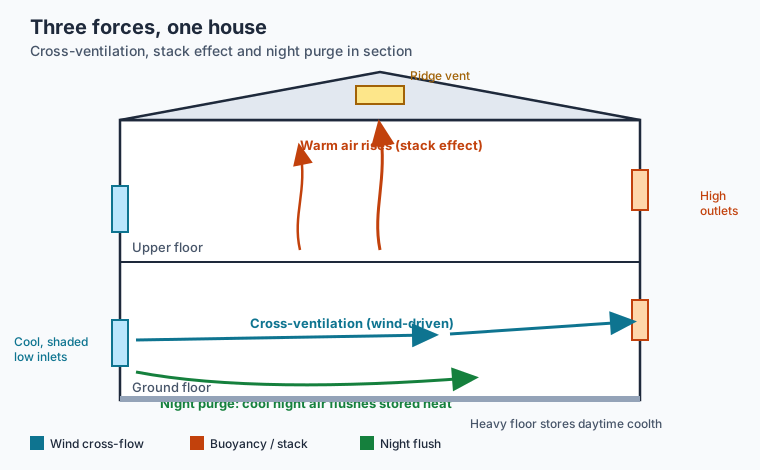
Figure 1: One house, three forces. Wind drives a horizontal cross-flow from cool, shaded low inlets to high outlets; buoyancy lifts warm air out through ridge and clerestory vents; and at night, cool air sweeps in low to flush heat stored in the slab.
The deep mechanics of the first force — sizing inlets and outlets, opening ratios, why the outlet should usually be larger — are covered in the sibling understanding-cross-ventilation-india, with the NBC and IS code numbers in cross-ventilation-indian-homes. Here we stay on the question of which force to reach for.
3. The strategy menu
The table below is the heart of this guide: the strategies, how each works, and when it earns its place.
| Strategy | How it works | Best when |
|---|---|---|
| Cross-ventilation | Wind pushes in one side, out the other | Openings exist on two opposite/adjacent walls; you have prevailing breeze |
| Stack / buoyancy | Warm air rises out a high outlet, pulls cool air in low | Still days; you have height — stairwell, double-height, courtyard, clerestory |
| Night purge / flush cooling | Cool night air sweeps out daytime heat, charges thermal mass | Hot-dry climate with a big day–night temperature swing |
| Courtyard / internal well | Central open space acts as a chimney and light/air core | Deep-plan homes, row houses, plots with neighbours on both sides |
| Jali / perforated screen | Shaded, filtered, low-velocity inflow with privacy | West/south walls, street-facing rooms, harsh sun and dust |
| Clerestory / ridge vent | High openings let hot air escape, boost the stack | Single-sided rooms, sloped roofs, top floors |
| Wind tower (vernacular) | Catches breeze high up, channels it down into the home | Hot-dry desert contexts (the badgir / jharokha tradition) |
| Single-sided ventilation | Air enters and leaves the same wall | Last resort — only effective to ~2.5× room depth |
| Mechanical assist (hybrid) | Exhaust fans, ERV/MVHR move air when nature can't | Smog days, deep flats, wet rooms, high-rise with sealed facades |
A few of these deserve unpacking, because they are the ones Indian homeowners most often get wrong or overlook.
Courtyards and internal wells
The traditional courtyard home — from the Kerala nalukettu to the Rajasthani haveli — is a ventilation machine disguised as a cultural form. The court is shaded and planted, so its air stays cooler and denser; warm air from the surrounding rooms is drawn into it and rises up the open shaft, pulling fresh air through every room on the way. In a modern context an internal light-and-air well, or even a generous double-height stairwell, does the same job for deep apartments and row houses that cannot get cross-flow.
Jali, ventilators and clerestory openings
The jali — a perforated stone, terracotta or timber screen — is one of the most intelligent openings ever devised: it shades the sun, slows hot wind into a gentle filtered breeze, keeps dust and glare down, and gives privacy, all at once. Small high-level ventilators above doors (the old roshandan) and clerestory windows tucked under the roof let the hottest, most polluted layer of air — which always collects at the ceiling — escape continuously.
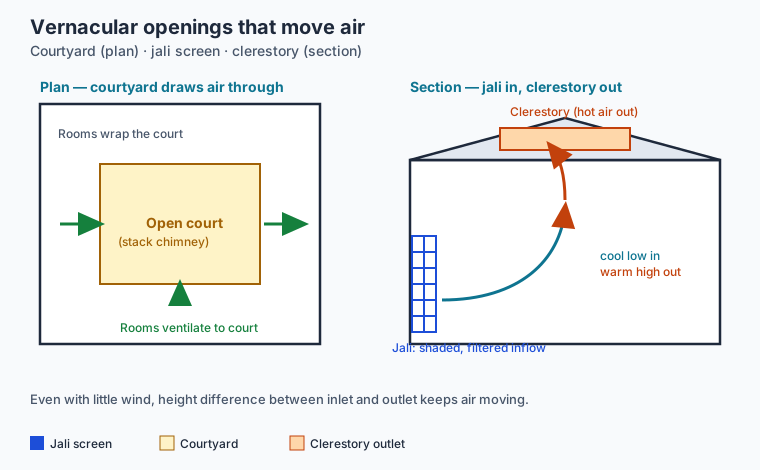
Figure 2: Two old ideas, still unbeatable. Left, in plan, rooms ventilate inward to a shaded courtyard that acts as a chimney. Right, in section, a jali admits cool, filtered air low down while a clerestory lets warm air out high — the height difference keeps air moving even with no wind.
4. Night purge: the strategy India forgets
For most of hot-dry India, the single highest-value move is also the simplest, and the most neglected: flush the house with cool night air, then shut it up before the heat returns.
Through a Delhi or Jaipur summer night the outdoor temperature can fall 12–15°C below the afternoon peak. If you throw the windows open from late evening, that cool air sweeps through and is absorbed by your floor slab, walls and furniture — the heavier (higher thermal mass) the better. Around mid-morning, before the outdoor air becomes hotter than indoors, you close the windows and draw any shades. The mass you charged overnight now releases its coolth slowly through the day, keeping the rooms several degrees below the street.
This only works where nights actually cool down. On the humid coast — Mumbai, Chennai, Kochi — nights stay warm and sticky, so the play is different: prioritise continuous gentle air movement (cross-flow and ceiling fans) over storage, because moving air helps sweat evaporate even when the temperature barely drops.
5. Matching the strategy to your climate and layout
India is not one climate, and the right ventilation recipe shifts dramatically across it.
| Climate zone (example cities) | Daytime strategy | Night strategy | Watch-outs |
|---|---|---|---|
| Hot-dry (Delhi, Jaipur, Nagpur, Ahmedabad) | Shade openings, jali, keep windows shut mid-day | Night purge + thermal mass | Dust storms; pollution-season smog |
| Warm-humid (Mumbai, Chennai, Kochi, Kolkata) | Maximise cross-flow, large openings, fans | Keep windows open if safe; air movement over storage | Monsoon damp and mould; salt corrosion |
| Composite (Pune, Bengaluru fringe, Bhopal) | Switch with the season — purge in summer, cross-flow in monsoon | Night purge in dry months | Adjust strategy through the year |
| Cold (Shimla, Leh, Gangtok) | Brief midday purge, otherwise conserve heat | Keep sealed at night | Don't over-ventilate and lose warmth |
The decision is less about the perfect house and more about reading your own. Which walls have openings? Is there height anywhere — a stairwell, a void? Does a breeze actually reach your windows, or do neighbouring towers block it? To answer the last question for a real site, the Site Planning guide understanding-wind-analysis-india shows how to find your prevailing breeze, and the cross-ventilation-analyzer tool lets you test opening positions before you commit.
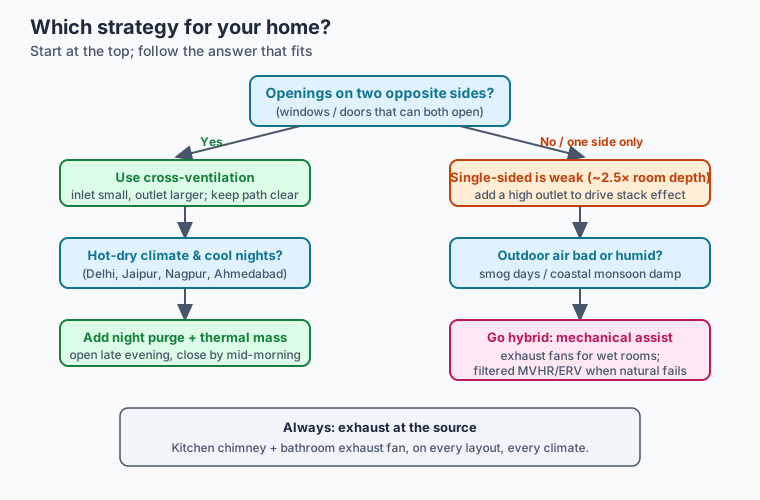
Figure 3: A simple decision path. Start with whether you can get air across the room; branch on your climate's night cooling; and fall back to mechanical assist only where outdoor air or layout defeats the natural options. One rule applies to every branch: always exhaust at the source.
6. When natural ventilation is not enough — the honest limits
It would be dishonest to pretend openings always do the job. They don't, and a healthy-homes approach is clear-eyed about three situations.
Single-sided rooms. If a room has openings on only one wall — common in deep flats — air barely circulates beyond about 2 to 2.5 times the room's depth from the window. A bedroom 5 m deep with one window will leave its far corner stale. Adding a high-level ventilator or door transom to create a stack improves this, but a single-sided deep room is the classic case for a quiet exhaust fan.
Bad outdoor air. On a Delhi winter morning at PM2.5 of 300-plus, opening the windows is not ventilation, it is letting the smog in. Here the strategy inverts: keep the home closed, run a filter, and ventilate when the outdoor air improves. The same logic applies to a coastal monsoon week when outdoor humidity is so high that opening up only feeds mould.
Wet rooms, always. No amount of clever cross-flow substitutes for pulling moisture and fumes out at the source. A kitchen needs a chimney or exhaust; every bathroom needs an exhaust fan vented outside, not into a shaft. This is non-negotiable on every layout and in every climate.
7. The hybrid approach: keep nature first, add machines wisely
The mature position is not "natural versus mechanical" but a hierarchy: design for natural ventilation first, then add the smallest, smartest mechanical help to cover the gaps.
| Need | First (natural) | Add (mechanical) |
|---|---|---|
| Everyday freshness | Cross-vent + stack | Ceiling/exhaust fans |
| Kitchen fumes | Window near hob | Chimney / exhaust |
| Bathroom moisture | Ventilator | Exhaust fan to outside |
| Smog-season air | Closed + monitor | HEPA filter / purifier |
| Deep sealed flat | Stack via stairwell | ERV / MVHR with filter |
The most elegant machine for a tight, polluted, or high-rise context is the ERV/MVHR (energy- or heat-recovery ventilator): it supplies a steady stream of filtered fresh air while extracting stale air, recovering most of the heat or coolth between the two streams so you ventilate without throwing away your cooling. It is overkill for a breezy Goa cottage and close to essential for a sealed Gurugram tower flat during smog season.
Whatever the mix, the goal is the same one the body has always wanted: air that is fresh, dry enough, moving gently, and free of what we exhale, cook and build with. The fan and the filter are there to finish the job the windows start — not to replace them.
Sources & further reading
- World Health Organization — WHO Guidelines for Indoor Air Quality: selected pollutants and dampness and mould (WHO, Geneva).
- Bureau of Indian Standards — National Building Code of India (NBC) 2016, Part 8 Building Services, Section 1: Lighting and Ventilation.
- Bureau of Indian Standards — IS 3362: Code of practice for natural ventilation of residential buildings.
- Energy Conservation Building Code (ECBC) & Eco-Niwas Samhita (residential energy code), Bureau of Energy Efficiency, Government of India.
- CIBSE — Guide A: Environmental Design and AM10: Natural ventilation in non-domestic buildings (Chartered Institution of Building Services Engineers).
- Baker, N. & Steemers, K. — Energy and Environment in Architecture: A Technical Design Guide (on stack, cross and single-sided ventilation limits).
If this is your starting point, read the technique deep-dive in understanding-cross-ventilation-india next, pair it with indoor-air-quality-explained-india to know what you are actually clearing from the air, and see how fresh air and the right light together shape rest in designing-homes-for-better-sleep-india.
Export this guide
Related Guides — Deep-dive reading
Understanding Wind Analysis for a Comfortable Home
How to read your site's breeze and design openings that keep an Indian home naturally cool — long before you switch on an air-conditioner.
Site PlanningCross Ventilation in Indian Homes
Science, Physics, and Planning — A Professional Guide for Architects
Room PlanningHow Ventilation Changes Home Quality
The invisible factor behind health, comfort, smell and freshness in your home
Design EducationRelated Tools — Try Free
Cross-Ventilation Analyzer
Estimate airflow and air changes per hour (ACH) from room size, window areas, layout, and local wind — with NBC 2016 Part 8 compliance check.
Ventilation CalculatorApartment Interior Planning Checklist
51-item checklist across structural, ceiling, lighting, furniture, storage, electrical, kitchen, bathroom.
ChecklistBrise-Soleil Visualizer
Interactive horizontal-louvre cut-off angle calculator — sun altitude, louvre depth, and spacing inputs with a live shadow preview. Computes θ = arctan(spacing/depth) for façade shading, ECBC envelope compliance, hospital daylight design, and tropical sun-control detailing.
Sun Shading Tool