
Daylighting Principles for Homes
Why good daylight is a health intervention, not a luxury — and the handful of design rules that decide whether your Indian home feels alive or perpetually switched-on.
A young couple in a Bengaluru high-rise told me their flat was "north-facing, so nice and cool" — and then admitted they switch on every light by three in the afternoon, work-from-home days included. The flat was not dark because Bengaluru lacks light. It was dark because of a few quiet decisions made on a drawing board: a deep plan, a single window wall, a low window head, and dark feature paint that swallowed what little daylight got in.
Daylight is the cheapest, most powerful wellness feature a home has, and the easiest to throw away. We treat it as a view or a mood, when it is really a biological signal. Morning light entering your eyes sets the body clock that governs sleep, alertness, appetite and mood; daylit rooms reduce eye strain and the low-grade fatigue of working under flat artificial light all day; and a well-daylit home in India can stay off the lighting circuit for eight to ten hours, shaving both your bill and your carbon. The trouble is that daylight does not behave the way most people assume: it does not "fill" a room evenly, it falls off sharply with depth, and a handful of geometric rules decide how far it reaches.
Daylight is not decoration or a calculation to outsource — it is a health input, and getting it right is mostly about proportion, position and pale surfaces, not square footage of glass.
1. Why daylight is a health input, not just a nice view
Your body runs on a roughly 24-hour clock that is set, every single day, by light. The cells in your eyes that drive this clock are most sensitive to bright, blue-rich daylight — far brighter than any normal indoor lamp. A few thousand lux of morning daylight near a window tells your brain it is daytime, anchoring your sleep-wake rhythm so you feel alert by day and sleepy at night. Spend the bright hours in a dim, lamp-lit interior and that signal weakens; people in chronically under-lit homes more often report poor sleep, flat mood and afternoon slumps.
Daylight also does ordinary, everyday good. It is the spectrum your eyes evolved for, so reading and cooking under it strain the eyes less than poorly chosen artificial light. Morning sun on skin supports vitamin D — deficiency is widespread even in our sunny cities because daily life now happens indoors and behind glass (window glass blocks most of the UV-B that makes vitamin D). And bright, daylit spaces are consistently associated with better mood and lower stress than gloomy ones.
The World Health Organization's housing and health guidance treats access to natural light as a basic determinant of healthy housing, alongside warmth, dry walls and clean air — not an optional upgrade.
This guide stays in the health and everyday wellbeing lane: how to design light that your body and eyes actually benefit from. For the maths — daylight factor percentages and how to plan window areas room by room — see our companion pieces /guides/daylight-factor-india and /guides/natural-light-planning-indian-homes. For how light works with the rest of your circadian environment after dark, read the sibling guide /guides/circadian-lighting-for-homes-india.
2. The principles, on one page
Most good daylighting comes down to a small set of rules of thumb. Internalise these and you can read any room — yours or one you are about to buy — and predict how it will feel.
| Principle | Rule of thumb | Why it matters for health & comfort |
|---|---|---|
| Enough glass | Window area ≈ 1/6 to 1/5 of the room's floor area (more in deep rooms) | Too little glass and the room is dim all day; the National Building Code uses a similar fraction as a minimum for habitable rooms |
| Window head height | Daylight reaches usefully ~2 to 2.5 × the window's head height into the room | A tall window lights a deeper room than a wide one — height beats width |
| Room depth | Keep habitable rooms no deeper than ~2 to 2.5 × head height from the window | Beyond that you have a permanently dim "core" that needs lights on by day |
| Two sides of light | Aim for dual-aspect (light from two walls) wherever possible | Even light, fewer dark corners, less glare on screens, plus cross-ventilation |
| Pale surfaces | Light ceilings/walls (high reflectance), pale floors | Surfaces do half the work — bounced light is what reaches the back of the room |
| Glare control | Diffuse and redirect; never let bare sky or sun hit the eye | Glare causes squinting, headaches and people closing curtains — killing the daylight |
| Balance with heat | Pair every opening with shading suited to its orientation | In India, uncontrolled glass means overheating; comfort, not just brightness, keeps daylight usable |
The rest of this guide unpacks the few that homeowners most often get wrong.
3. Geometry first: window height and room depth decide everything
The single most useful idea in daylighting is this: how deep daylight reaches is governed by how high the top of the window is, not how wide the window is. Light entering near the ceiling can travel across the room; light entering at sill level pools on the floor near the wall. As a working rule, usable daylight penetrates about two to two-and-a-half times the window head height. A window whose head sits 2.1 m above the floor will daylight a room roughly 4 to 5 m deep; push the room to 7 m and the far third becomes a gloomy core.
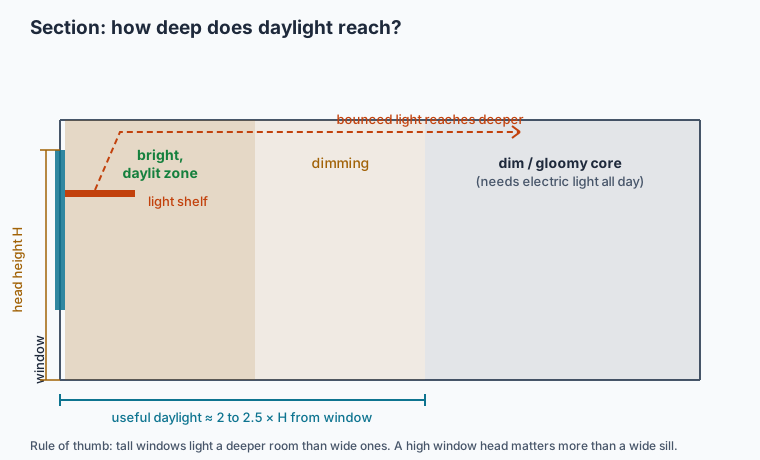
Figure 1: Daylight falls off fast with depth. Raising the window head — taller windows, or transom glazing above the door height — pushes the bright zone deeper than simply widening the window ever could.
This is why Indian flats with one glass wall but a 7-metre-deep living-and-dining feel dim even though the windows look generous: the room is simply deeper than its windows can light. Three practical moves follow:
- Make windows tall, not just wide. A transom (a band of glazing above door height) is one of the cheapest daylighting upgrades available.
- Keep habitable rooms shallow. When you can influence the plan, a 3.5–4.5 m room depth from the window is a sweet spot for naturally bright living.
- Reserve the deep, windowless zone for things that do not need daylight — circulation, storage, a powder room — rather than the desk or the reading chair.
Light shelves: a small horizontal trick
A light shelf is a horizontal projection placed across a window at roughly door height. It does two jobs at once: the upper portion of the window bounces light off its pale top surface up onto the ceiling and then deep into the room, while the shelf shades the lower window from harsh high sun. On a south or east window in India, a light shelf can meaningfully brighten the back of the room and cut glare near the glass at the same time.
4. Light from two sides: the dual-aspect advantage
A room lit from a single wall is always a compromise: dazzlingly bright by the glass, gloomy at the back, with a steep gradient between. Your eyes adapt to the bright zone, which makes the dark zone feel darker still — and screens placed against the bright window suffer veiling glare. A room lit from two different walls (dual-aspect, or bilateral daylighting) is transformed: light arrives from two directions, fills the middle, softens shadows and almost eliminates the dark core.
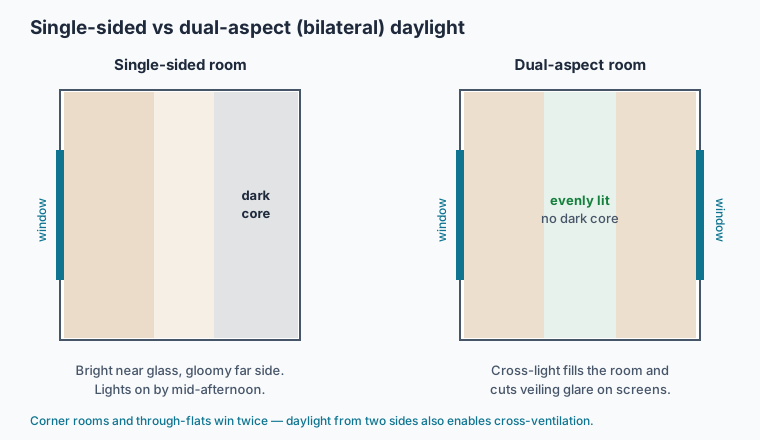
Figure 2: Single-sided light leaves a dark core; dual-aspect light fills the room evenly and tames glare. The same two openings on different walls also give you cross-ventilation — daylight and fresh air travel together.
This is the quiet superpower of corner flats, through-flats (windows front and back) and homes built around a courtyard or light well. If you are buying, a dual-aspect living space is worth paying for; if you are renovating, look for chances to borrow light from a second direction — an internal window or glazed door into a brighter adjacent room, a clerestory, or opening a service balcony. Because two-sided light also enables airflow, it ties directly to the sibling guides /guides/understanding-cross-ventilation-india and /guides/natural-ventilation-strategies-india; the engineering of cross-vent is covered in /guides/cross-ventilation-indian-homes.
5. Surfaces do half the work: pale finishes and reflectance
Daylight you can use at the back of a room is almost entirely bounced light — it has reflected off the ceiling, walls and floor at least once. That makes interior finishes a daylighting decision, not just a taste decision. A white ceiling reflects the great majority of the light hitting it; a fashionable charcoal or dark-wood ceiling can swallow most of it, and the room two metres in goes flat.
| Surface | Daylight-friendly choice | What it does |
|---|---|---|
| Ceiling | White or near-white, matt | The single most important reflector — keep it the lightest surface in the room |
| Walls | Pale, low-chroma (off-white, pale stone, soft pastels) | Carry bounced light to the back; reserve one dark feature wall, never the wall opposite the window |
| Floor | Light to mid tones where you can | A dark floor can absorb a surprising amount of usable light |
| Window reveals | Splay or paint pale | Reduces the harsh bright-edge contrast that reads as glare |
| Window glass | Clear, clean, low tint | Heavily tinted or reflective glass and grimy panes quietly steal daylight |
None of this means a clinical white box. It means choosing where your dark, moody, characterful surfaces go — feature walls, joinery, the floor of a circulation zone — so they add richness without starving the room of light. Pale, matt, slightly textured surfaces also scatter light gently, which feels calmer than glossy finishes that throw hot reflections.
6. Daylight without dazzle: getting glare control right
The commonest way a daylit home fails is not too little light but badly controlled light. Direct sun on a desk, a bright sky framed in a window opposite where you sit, a hot reflection off a glossy floor — any of these makes people squint, get headaches, and then draw the curtains and switch on the lamps. At that point the daylight is gone. Comfortable daylight is diffuse, indirect and even; harsh daylight gets curtained away. The goal is bright surfaces, not bright sources in your line of sight.
Practical glare control for Indian homes:
- Diffuse rather than block. Sheer curtains, frosted lower panes, and light-coloured blinds scatter light so it stays useful while killing the dazzle.
- Redirect with light shelves and pale reveals, as above, so light arrives via the ceiling rather than as a glaring slot.
- Use the jali — the perforated screen is a centuries-old Indian glare-and-heat filter. It turns hard sun into a soft, dappled, privacy-preserving wash (more in the next section).
- Place screens and reading chairs side-on to windows, not facing the bright sky or with the window directly behind a monitor.
- Shade west and harsh south openings so low evening sun never rakes across the room — which leads to the heat question in section 8.
7. Rescuing a deep plan: skylights, light wells and jalis
Many Indian homes — especially row houses, plotted developments and renovated old structures — have a deep core that no side window can reach. You have three classic moves, and the best designs combine them.
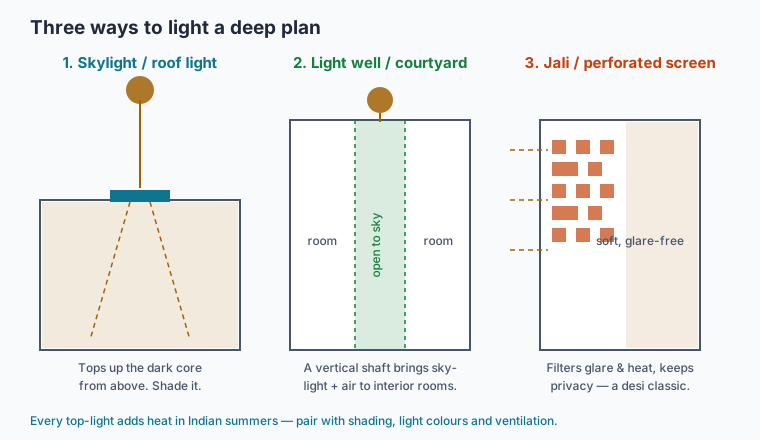
Figure 3: Skylight, light well and jali — three ways to bring daylight where a window cannot reach. Each adds heat in an Indian summer, so each must be paired with shading, pale surfaces and ventilation.
- Skylights and roof lights drop daylight straight onto the dark core from above and are extraordinarily effective for top-floor rooms, stairwells and bathrooms. The catch in India is solar heat — an unshaded glass skylight is a small greenhouse by April. Favour north-facing or shaded skylights, modest sizes, diffusing or insulated glazing, and an openable rooflight that lets hot air escape.
- Light wells and courtyards — a vertical shaft open to the sky — are the traditional Indian answer (the brahmasthan courtyard, the nalukettu of Kerala). They bring daylight and air to rooms that touch the shaft, and create a cool, calm green pocket at the heart of the home.
- Jalis and clerestories borrow and filter light. A jali between a bright veranda and a dim inner room lets soft light through while keeping privacy and cutting heat; a clerestory (high-level window band) lights a deep room from above the furniture line.
For the spatial and orientation logic behind where to put these openings, see /guides/orientation-light-views-designing-with-your-site-india.
8. Balancing daylight with India's heat — and a room-by-room checklist
In Britain you maximise glass to catch a scarce sun. In most of India the opposite instinct is safer: you want generous daylight but firmly controlled solar heat and glare. Unshaded glass facing west or south can turn a bright room into an oven, and an overheated room is an unhealthy one — poor sleep, dehydration, and the air-conditioner running to compensate. The art is to separate light from heat: bring in plenty of soft, indirect daylight while keeping direct sun off the glass.
The orientation logic in short: north light is the prize — bright, even and almost heat-free, ideal for living rooms and studies. South light is generous and easy to shade with a simple horizontal overhang because the summer sun is high. East light is gentle and welcome in bedrooms and kitchens (and great for circadian morning exposure). West light is the troublemaker — low, hot, glaring evening sun that needs vertical shading, deep reveals, jalis or trees. To see how the sun moves over your site through the year before you place the big windows, use the /utilities/sun-path-analyzer and the /for-designers/brise-soleil-visualizer for shading; /guides/understanding-sun-path-analysis-india walks through reading it. To check whether a room actually meets a daylight target, the /for-designers/daylight-factor tool does the numbers.
The Energy Conservation Building Code and NBC both encourage daylight-linked design: more glazing for light is only a net benefit when paired with shading and glare control, otherwise the cooling penalty cancels the lighting savings.
Use this as a quick room-by-room target for a healthy, daylit Indian home:
| Room | Daylight you want | Practical notes |
|---|---|---|
| Bedroom | Gentle morning light; controllable for sleep | East/north-east is ideal for waking; blackout layer for night and shift workers — see the sleep guide |
| Living / family room | Bright, even, all-day | Aim dual-aspect; tall windows; pale ceiling; shade west sun |
| Kitchen | Bright task light at the counter | East light is pleasant; daylight at the worktop reduces eye strain while cooking |
| Study / work-from-home | Even, glare-free, side-lit | North light is best; never sit with a bright window behind your screen |
| Bathroom | Daylight + ventilation | A small high window or shaded skylight keeps it dry, bright and discourages mould |
| Stairs / circulation | Some daylight for safety and life | A skylight or clerestory here transforms a dead core into a lovely moment |
Daylighting is, in the end, a quiet form of care for the people who live in a home — better sleep, sharper days, lower bills and rooms that feel alive from morning to evening. You do not need a calculator to get most of it right: tall windows, shallow rooms, light from two sides, pale ceilings, controlled glare and shading tuned to the sun. Get those, and the lights stay off until dusk.
Sources & further reading
- World Health Organization — WHO Housing and Health Guidelines (2018), on natural light and daylight as determinants of healthy housing.
- Bureau of Indian Standards / National Building Code of India (NBC 2016), Part 8 — provisions for natural lighting and ventilation of habitable rooms.
- Bureau of Energy Efficiency — Energy Conservation Building Code (ECBC), daylighting and fenestration guidance for the Indian climate.
- Chartered Institution of Building Services Engineers (CIBSE) — Lighting Guide LG10: Daylighting and SLL daylighting guidance, on room depth, window head height and daylight penetration.
- Illuminating Engineering Society (IES) & CIE — recommendations on daylight, glare control and daylight-linked wellbeing.
- Stephen R. Kellert — Biophilic Design: The Theory, Science and Practice of Bringing Buildings to Life (2008), on dynamic natural light and human wellbeing.
If this gave you a feel for designing with light, read the sibling guides /guides/circadian-lighting-for-homes-india on tuning light around your body clock, /guides/designing-homes-for-better-sleep-india for the night-time half of the story, and the cluster pillar /guides/what-makes-home-healthy-india to see where daylight sits among the other ingredients of a home that keeps you well.
Export this guide
Related Guides — Deep-dive reading
Daylighting Design Using Windows (India): Getting Light Deep Into a Room
How far daylight travels, why tall windows beat wide ones, and when to reach for light shelves, clerestories and top-light
Windows & GlazingUnderstanding Sun Path Analysis for Your Home
How the sun actually moves over an Indian site through the day and the year — and why that single fact quietly decides where your kitchen, bedroom and living room should sit.
Site PlanningWindow Design for Natural Light (India): A Brighter, Evenly Lit Home
How to size, place and glaze windows so every room is bright and evenly lit, without glare or gloom
Windows & GlazingRelated Tools — Try Free
Brise-Soleil Visualizer
Interactive horizontal-louvre cut-off angle calculator — sun altitude, louvre depth, and spacing inputs with a live shadow preview. Computes θ = arctan(spacing/depth) for façade shading, ECBC envelope compliance, hospital daylight design, and tropical sun-control detailing.
Sun Shading ToolCross-Ventilation Analyzer
Estimate airflow and air changes per hour (ACH) from room size, window areas, layout, and local wind — with NBC 2016 Part 8 compliance check.
Ventilation CalculatorCircadian Light Meter
Patient-centric circadian lighting visualizer for Indian healthcare design — time-of-day × intensity → CCT, melanopic lux (EML / mEDI), melatonin suppression, and an alertness curve. Calibrated against WELL v2 L03 Circadian Lighting Design, CIE S 026:2018, Brainard 2001, and Lucas et al. 2014.
Circadian Tool