
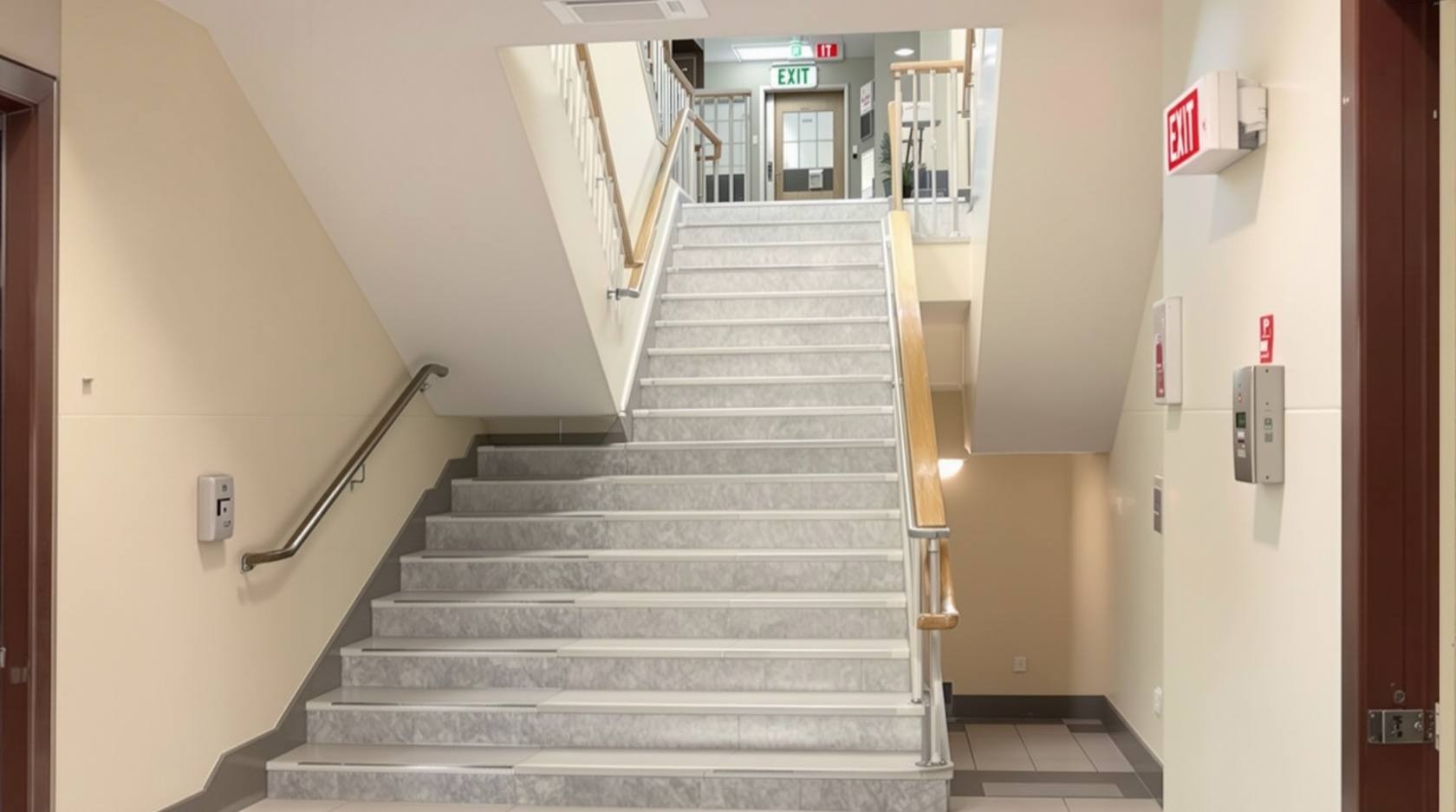
Staircase Access Control in India (2026): Securing the Stair Without Locking In Escape
How to control who can enter a stair from a floor while guaranteeing that anyone inside can always walk out - free-exit egress hardware, fail-safe locks that release on fire and power loss, monitored doors, and coordinating the whole thing with your fire officer and the NBC.
Every stair in a building is a contradiction you have to design around. It is the single most important safety feature in the place - the route everyone takes when the lift is dead and smoke is filling the corridor - and it is also an open vertical shaft that connects every floor and the terrace to every other floor. Security wants it closed. Life-safety needs it open. Staircase access control is the discipline of holding both truths at once: you control who can ENTER the stair from a floor, or re-enter a floor from the stair, while guaranteeing that anyone already inside the stair can always walk out, freely, without a key, a PIN, or any special knowledge.
This is the paradox at the centre of the whole subject, so let us say the hard part first and never soften it. You can never simply "lock the stairs." A staircase is the primary means of escape; a locked or chained escape door is not a security measure, it is a death trap, and in India it is illegal. The art here is entirely one-sided: you work only on the entry side. This guide is part of the Studio Matrx complete guide to lift and staircase security, and it assumes you have read the fire-safety companion, staircase fire safety, or will.
Scope and safety. This guide helps an owner, RWA or facility manager plan, decide and coordinate staircase access control. The door hardware, the electromagnetic lock, the fire-alarm interface and the mains wiring are a licensed job - a security integrator, an electrician and a fire-safety consultant working together, signed off by the authority. Egress always wins. Every access-controlled door on an escape route MUST open freely from the escape side at all times, MUST release on a fire-alarm signal and on power loss, and MUST carry a manual emergency release that no one is trained to defeat. A stair-egress door that stays locked in a fire is illegal and deadly - never specify one, never chain one shut. Door access logs are personal data under the Digital Personal Data Protection Act, 2023. This is educational guidance, not legal, fire-safety or engineering advice.
The one principle: control the entry, never the egress
A stair door has two faces, and they are not equal. On the floor side, the door is a boundary you may legitimately want to control - it decides who can leave a controlled area and step into the shared stair, and who can come back onto a floor from the stair. On the stair side - the escape side - the door is sacred. Anyone in that stairwell is potentially escaping, and the door must open under a single push, every time, forever.
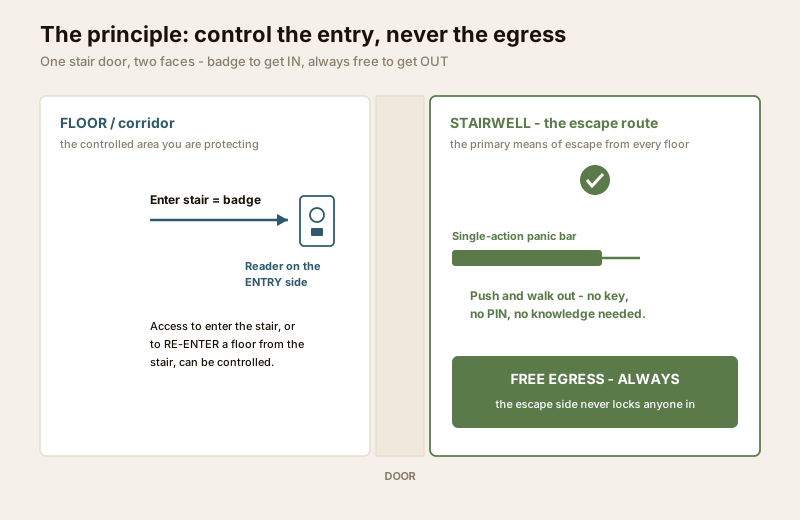
So the entire toolkit of staircase access control lives on the entry side:
- Free exit is guaranteed by the hardware itself. The escape side of the door carries single-action egress hardware - a panic bar or push pad that unlatches the door in one motion, with no thought required. This is not a policy you can forget to follow; it is a physical device that opens the door when a frightened person leans on it in the dark. It works exactly as described in the emergency door release guide, and it must be compatible with the building's fire-egress strategy.
- Entry into the stair, or re-entry onto a floor, can be badged. This is where a reader belongs. You can require a credential to pass from a controlled area into the stair, or - more commonly - to leave the stair and re-enter a floor. Neither of these controls touches a person's ability to keep going down and out.
- The escape side never carries a lock a person must operate. No thumb-turn they have to find, no second action, no key. The moment egress depends on knowing something, it has failed for the person who most needs it.
Get this one distinction right and everything else follows. Get it wrong - put the control on the escape side - and you have built the thing that kills people in Indian building fires every year.
The security problem staircase access control solves
If the stair is left as a wide-open shaft, it becomes the easiest unwatched route in the building. This is not theoretical; it is the everyday reality of Indian towers.
- The stair as a between-floors highway. A person who is past the gate and the lobby can use an open fire stair to reach any floor, or the terrace, entirely unseen - no lift camera, no lobby guard, no log. The corridor outside a family's flat, which they treat as the inside of their home, is reached by anyone who can push a stair door.
- The outsider drifting up the fire stair. Because fire stairs are quiet and rarely watched, they attract exactly the movement you do not want - someone wandering up floor by floor, trying doors.
- The terrace reached from below. The stair does not just let people up to the roof; combined with an adjacent building it becomes a way in and down. The terrace stair top is, for this reason, the most sensitive door of all.
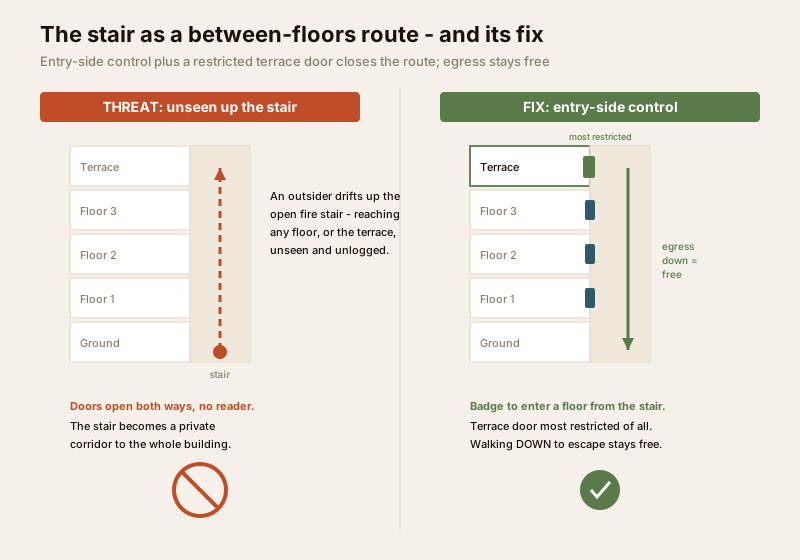
Staircase access control closes these routes without ever closing the escape. It does so by watching and controlling the entry side of the doors and by treating the terrace top as a special case. For how these blind spots are seen as well as gated, pair this with staircase blind spots, CCTV placement on staircases, and roof and terrace access security.
How it works: readers, re-entry policy and fail-safe locks
There are three moving parts, and each has a life-safety rule wrapped around it.
Readers on the entry side
An access reader sits on the side of the door you are controlling - the floor side for entering the stair, or the stair side of a floor door for re-entry. The reader decides whether the door unlocks for that direction. It never sits alone on the escape face governing exit. This is ordinary access control applied with one unbreakable constraint: the reader controls coming in, the hardware guarantees going out. In an apartment context it slots into the wider apartment access control scheme.
Stairwell re-entry policy
In a tall building you must decide, floor by floor, whether someone in the stair can get back onto that floor or must continue down to a discharge level. This is the re-entry policy, and it is a genuine safety-and-security trade-off, not a free choice.
| Re-entry model | What it means | When it fits |
|---|---|---|
| Free re-entry on every floor | Any stair door can be pushed to re-enter that floor | Simplest and safest for evacuation; weakest for security |
| Selective re-entry | Re-entry allowed only on some floors (e.g. every few floors and the discharge level) | A common compromise - someone who enters the stair is never trapped, but cannot roam onto every floor |
| Re-entry by credential | Stair doors relock behind you; a badge re-enters a floor, but a fail-safe release still lets you keep going down and out | Higher-security buildings, only where the fire strategy and authority permit |
Whatever model you choose, one rule overrides it: no one may ever be trapped in the stairwell. A person must always be able to continue down the stair and out of the building at a discharge level without any credential. Re-entry can be controlled; downward escape cannot. The choice of model belongs to the fire strategy and must be agreed with the authority, never decided by the security vendor alone.
Electromagnetic locks that fail-safe
Where a stair door is held by an electromagnetic lock (a maglock), that lock must be fail-safe: it releases and unlocks whenever it loses power, and it is wired to drop out the instant the fire-alarm panel signals. This is not a preference. A maglock is a security device only while the building is normal; the moment there is a fire or a power cut, it must become an ordinary openable door.
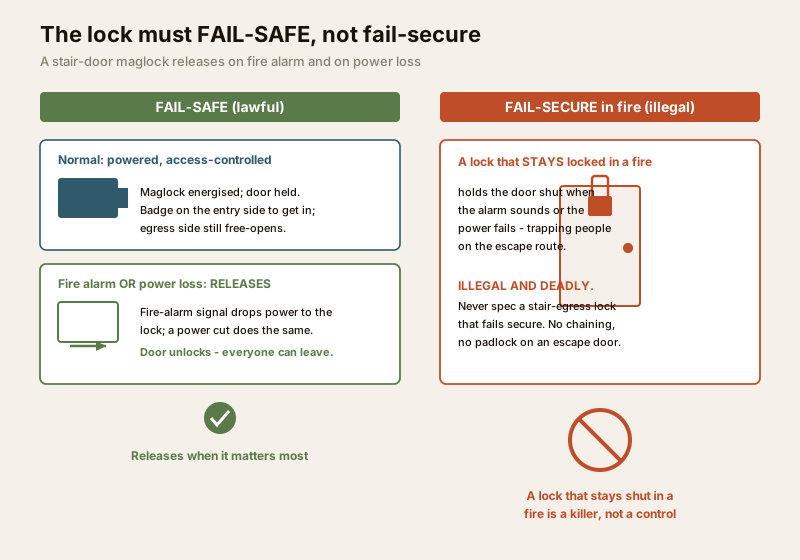
A maglock that stays locked in a fire is illegal and deadly. Never specify a fail-secure lock on a stair-egress door, never fit a padlock or chain to an escape door, and never wire out the fire-alarm release "to stop the doors dropping open." In India, where power cuts are routine, fail-safe also means the door quietly unlocks in every load-shed - which is correct: escape must not depend on the grid. The lock, its fire interface and its backup arrangements are a coordinated licensed job, described alongside the whole-building picture in the building security systems guide.
The softer alternative: monitored and alarmed doors
Locking is not the only tool, and often it is not the best one. A monitored (alarmed) door stays free to open for egress at all times - the panic bar always works - but it raises an alert if the door is used out of policy. Someone can always walk out; if they do so when they should not have, the system tells you.
This is frequently the right answer for a fire stair, because it respects escape absolutely while still giving you security:
| Locked (access-controlled) door | Monitored (alarmed) door | |
|---|---|---|
| Egress | Free from the escape side; entry badged | Always free - never held shut at all |
| Security value | Stops unauthorised entry into the area | Detects and reports out-of-policy use |
| Fire-alarm behaviour | Must release on the fire signal | Nothing to release; alerts can be suppressed during an alarm |
| Best for | Doors where you must stop entry | Pure escape doors you must not lock but want to watch |
| Typical use | Re-entry onto a controlled floor | A ground-floor fire exit, a rarely-used stair door |
A common, honest Indian pattern is: badge to enter the stair or re-enter a floor where that is genuinely needed, and simply monitor the doors that are pure escape - the ground-floor final exit, the seldom-used stair. You get an alert if a fire door is propped or used off-hours, without ever putting a lock between a person and the street. Pairing the alert with a camera, so a guard can see the door as well as hear the alarm, turns a nuisance chime into a useful control.
The terrace stair top: the most-restricted door
The one stair door that deserves the tightest control is the top - the door onto the roof or terrace. It is the least-used door in the building and the one most abused: a smokers' and lovers' spot, an unsupervised gathering place, and a way in and down for anyone who reaches the roof from next door. Restrict entry to the terrace to residents and maintenance only, watch it, and log it.
And yet - even the terrace stair door must open for escape. In a fire, the roof can be a place of refuge and a point for rescue, so the door onto it must still open from the stair side under a single action and must release on the fire signal like every other. Restricting the terrace never means chaining it. Handle the physical and procedural side with roof and terrace access security, and set the lobby-and-lift context with lift lobby security and floor-restricted lift access, which restricts the terrace on the lift the same way.
Coordinating with the fire strategy and the fire officer
This is the part that makes staircase access control different from any other access job: every door on an escape route is a life-safety element, and you do not get to decide alone what may be locked and how. The fire authority and the National Building Code govern escape routes. Before you fit a single reader or maglock to a stair door, the scheme goes to your fire-safety consultant and, where required, past the local fire officer.
- What may be locked at all - whether a given stair door may be access-controlled, or must stay free - is a fire-strategy decision, not a security one.
- How it must fail - fail-safe release on the fire panel and on power loss, plus a manual release - is mandated, not optional.
- The re-entry policy must match the escape plan the authority has approved.
- The final exit at the discharge level must never be locked against people leaving, whatever it is doing about people entering.
Bring the fire-safety consultant in at the design stage, not after install, and keep the approvals on file. See emergency access planning for how responders' needs shape these doors, and staircase fire safety for the compartmentation and pressurisation the doors also serve.
Privacy: the door log is personal data
Every badge tap on a stair door can be logged - a record of who moved between which floors and when, inside people's homes and workplaces. Under the Digital Personal Data Protection Act, 2023, that log is personal data. Tell residents and staff, in plain language, that stair-door access is logged and why; keep only what security needs; set a retention period rather than storing it forever; and limit who may view the log. In a society the RWA is effectively a data fiduciary for this record and should treat it that way.
Key takeaways
- You can never simply lock a stair - it is the primary means of escape. Staircase access control works entirely on the entry side: control who can enter the stair from a floor, or re-enter a floor from the stair, while guaranteeing free exit for anyone inside.
- Free egress is always available - the escape side of every stair door carries single-action panic hardware that opens under one push, with no key, PIN or knowledge, at all times.
- Locks must fail-safe. An electromagnetic lock on a stair door releases on power loss and drops out on the fire-alarm signal. A maglock that stays locked in a fire is illegal and deadly - never specify fail-secure hardware on an escape door, and never chain one shut.
- Decide a stairwell re-entry policy - free, selective or by credential - but no model may ever trap a person; downward escape to a discharge level is always free.
- A monitored (alarmed) door is the softer alternative: it never locks, always opens for egress, and simply alerts on out-of-policy use - often the right answer for pure escape doors.
- The terrace stair top is the most-restricted door, yet it too must open for escape and release on the fire signal.
- Every stair door is life-safety: the fire officer and the NBC govern what may be locked and how - coordinate before you install. The door log is personal data under the DPDP Act, 2023.
Where to go next
- Start with the pillar: the complete guide to lift and staircase security.
- Get the free-exit hardware right with emergency door release and fire-egress compatibility, and the compartmentation with staircase fire safety.
- Set the access-control foundations with the complete guide to access control, apartment access control, and the building security systems guide.
- Close the blind spots with staircase blind spots and CCTV placement on staircases.
- Handle the roof and lobby with roof and terrace access security, lift lobby security, and floor-restricted lift access.
- Browse the Security Hub and the lifts and staircases section, and benchmark your building with the home security risk scorecard.
References
- National Building Code of India (SP 7:2026) - Part 4, fire and life-safety and means of escape, governing escape stairs, exit doors and free egress. Verify the current edition and your local bye-laws via the Bureau of Indian Standards at https://www.services.bis.gov.in/.
- IS 14665 (Bureau of Indian Standards) - electric traction lifts, installation and maintenance, for the lift-and-lobby context these stair doors sit within. Verify the current parts and edition.
- Digital Personal Data Protection Act, 2023 (India) - lawful basis, notice, minimisation and retention for door access logs. Ministry of Electronics and Information Technology. Verify current rules and notifications.
- State fire-safety and building rules, and the local fire authority - approval of escape-route doors, what may be access-controlled and how it must fail. Verify the act, rules and directions applicable to your state and city.
- Access-control and exit-device manufacturer documentation - fail-safe locking, single-action egress hardware, fire-alarm interface and manual release behaviour. Confirm listings against the approved fire strategy.
This guide is educational and does not constitute legal, fire-safety or engineering advice; stair-door locking, egress hardware, fire-alarm interfaces and escape-route approvals must be designed and certified by licensed professionals for your specific building.
Export this guide
Related Guides — Deep-dive reading
Fail-Safe vs Fail-Secure Locks: The Guide (India 2026)
Why fail-safe vs fail-secure is the single most important access-control decision, and how to get it right for every door.
Home Doors & EntrancesFire-Stair Security in India (2026): Securing the Escape Stair Without Ever Locking People In
The fire-escape stair is the sharpest security-versus-life-safety conflict in the building: it must be instantly openable for escape, yet its very openness invites intruders, loiterers and junk. This guide sets out the lawful ways to secure it — and the one thing you must never do.
SecurityAccess Control Maintenance in India (2026): Readers, Locks and Fail-Safe Egress
How to keep a card, keypad, fingerprint or face access-control system reading reliably and locking securely — and, above everything, how to test that its doors still release on a fire alarm and on power loss, so an access-controlled door never becomes a life-safety trap.
SecurityRelated Tools — Try Free
Home Security Risk Scorecard
Score your home across six security layers — perimeter, entry points, lighting, detection, alarm and habits — and get a prioritised action plan.
Security ScorecardEmergency-Egress Checker
A life-safety self-check that access-controlled doors on escape routes still let people out in an emergency.
Egress CheckFire Door Rating Checker
See the likely fire-door rating (30/60/90/120 min) and components a location needs per IS 3614 / NBC — guidance, confirm with your architect.
Compliance Tool