
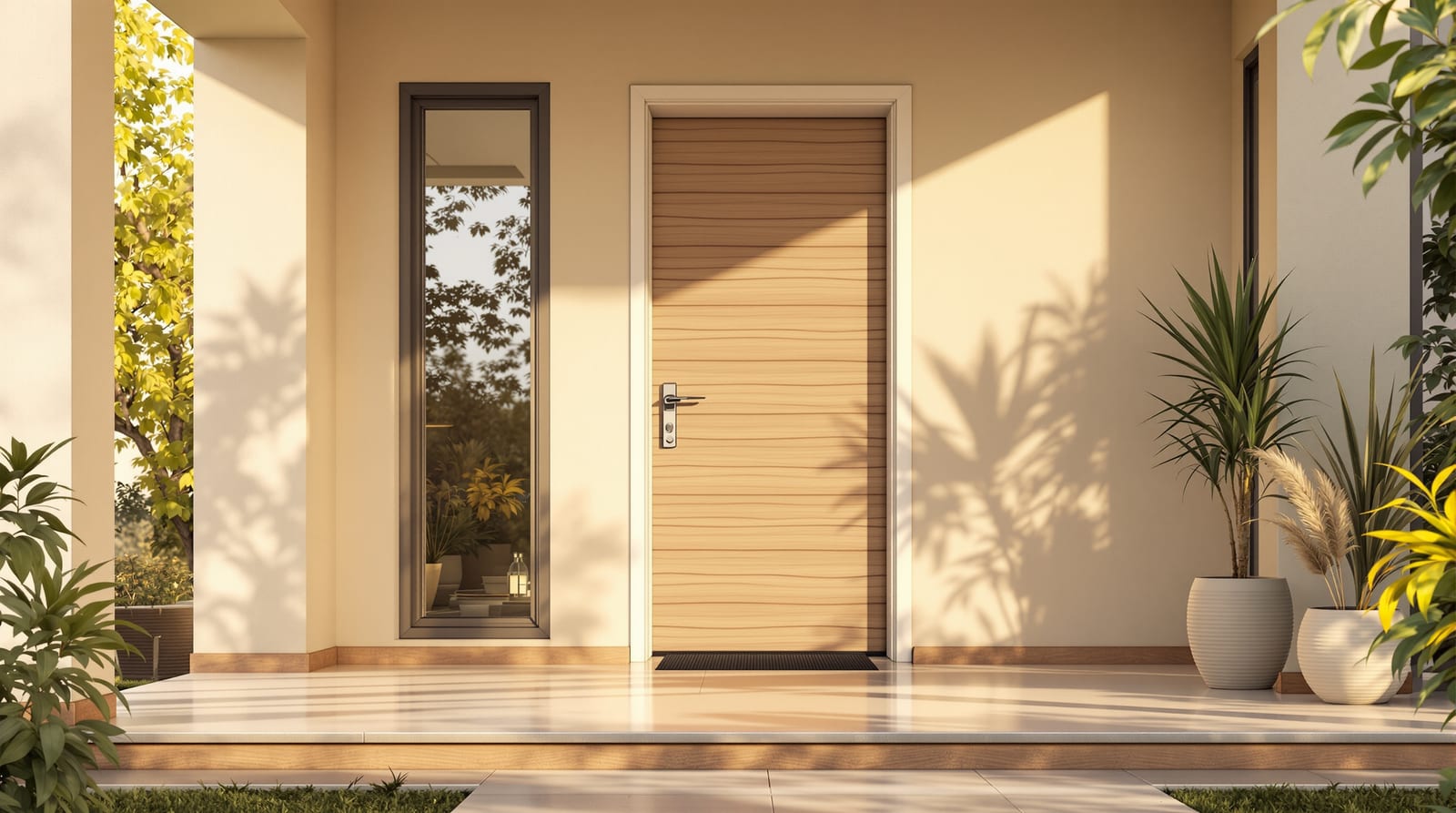
Fibreglass Doors in India (2026): Premium Woodgrain Entry & Main Doors
Why fibreglass entry doors imitate real wood, resist dents, rot, termites and monsoon warp — construction, finishes, security, ₹ costs and how they differ from the FRP bathroom door.
In North America a "fibreglass door" usually means the front door — a moulded, woodgrain-textured entry leaf that looks like oak but never rots, dents or warps. In India the same words land differently. Here, "FRP door" almost always means the cheap moulded bathroom or utility shutter, while "fibreglass door" is increasingly marketed for premium, woodgrain entry doors at the main entrance. The confusing part: it is the same base material. This guide is about that second, entry-door use of fibreglass — the heavy, insulated, security-grade main door — and how to tell it apart from the FRP bathroom shutter before you pay a premium for one.
Fibreglass and FRP are the same material — so why two names?
Fibreglass and FRP (fibre-reinforced plastic) describe the same family of material: glass fibres set in a cured resin to form a tough, light, waterproof skin. GRP (glass-reinforced plastic) is the same thing again. So technically, every FRP door is a fibreglass door and vice versa. The difference in Indian usage is about what is built behind the skin and where the door is meant to go:
- "FRP door" in the Indian market almost always means a moulded fibreglass bathroom, toilet, balcony or utility shutter — often a hollow or honeycomb-filled shell, sold from roughly ₹1,500-4,000, prized for being 100% waterproof and termite-proof. That is a different product with a different job, covered in detail in our guide to FRP doors in India.
- "Fibreglass door" is the term vendors reach for when they want to sell a premium entry or main door: a thick fibreglass skin over an insulated core inside a composite frame, finished in a convincing woodgrain and pitched as a low-maintenance alternative to a teak or steel front door.
Read that way, the two guides complement each other rather than overlap. If you are choosing a wet-area shutter, start with the FRP guide. If you want a handsome, weatherproof front door that imitates wood, stay here. And because the engineered entry build overlaps heavily with what the market also calls a "composite door," it is worth reading both this and composite doors in India before you sign — many premium fibreglass entry doors ARE composite doors under another name.
How a fibreglass entry door is built
A bathroom FRP shutter is essentially a moulded shell. A fibreglass entry door is a properly engineered, layered leaf — closer in spirit to an insulated composite door than to a hollow toilet door. The cross-section, skin to skin, typically runs:
- Fibreglass skin (both faces): a thick, moulded GRP skin pressed with a deep woodgrain texture and the colour run through the surface rather than painted on top. This skin does the weather work — it does not rot, rust, corrode, peel or fade quickly, and it resists dents, scratches and the kicks and trolley-knocks a main door takes far better than thin steel or hollow uPVC.
- Insulated core: a high-density polyurethane (PU) foam filling the cavity. This is what makes the door feel solid and "thud" shut, and what slows heat and street noise — the energy-efficiency story below.
- Composite frame / stiles and rails: a rigid perimeter, usually laminated hardwood (LVL) reinforced with uPVC or steel, running around the leaf edge. This is the structural spine that carries the locks and hinges — the dense material a mortise or multipoint lock actually bites into.
- Glazing (optional): toughened or double-glazed decorative panels bonded into moulded apertures, or a matching sidelight beside the leaf.
Bonded under heat and pressure, the finished leaf is typically 44-48 mm thick and noticeably heavier than a hollow FRP or uPVC door — much closer to a quality timber door, but without timber's habit of swelling shut every July.
Because the lock and hinges land in the dense composite frame rather than in foam or a hollow shell, a fibreglass entry door can hold a proper mortise or even a multipoint locking system — the kind that throws three to five bolts up and down the frame on one turn. That is the difference that lets a fibreglass leaf be sold as a security front door rather than just a weatherproof one.
Realistic woodgrain finishes — the whole selling point
The reason fibreglass beats steel for a main door, aesthetically, is the finish. The skin is moulded from a real wood master, so it carries actual grain depth and pore texture — run your hand across it and it feels like timber, not the flat, slightly tinny face of a pressed-steel door. Typical options in India:
- Factory woodgrain stains: teak, walnut, mahogany and oak tones, with the colour pressed through the surface so a scratch does not show a white plastic streak the way a chipped painted door does.
- Smooth painted faces: for modern flat-panel and minimalist entries (pair with our minimalist door designs thinking).
- Glazed and sidelight combinations: decorative toughened-glass panels for light without sacrificing the solid leaf.
The honest caveat: a fibreglass woodgrain reads convincingly as wood from a step or two away, but a discerning eye at arm's length can usually tell — the grain repeats and there is no genuine timber smell or movement. For buyers who specifically want the status and patina of real wood, a teak or solid-wood door is still the choice. Fibreglass wins when you want that look without the maintenance.
Where fibreglass entry doors earn their keep in India
Run a main door through one Indian year and the fibreglass build starts to justify the premium:
- Dents and daily abuse: a thick GRP skin resists the dents, dings and trolley-knocks that disfigure a thin steel door, and the colour-through finish hides minor scratches. This is a real edge over pressed-steel security doors that look beaten after a few years.
- Monsoon swelling and warp: the skin and foam do not absorb water, so the leaf does not swell, sag or jam in the rains the way an under-sealed timber or low-grade flush door does. No annual planing of the bottom edge.
- Rot and termites: the skin and core are inorganic; only the internal frame timber is organic and it is sealed inside, so there is very little for termites or fungus to attack — a genuine advantage over solid wood in humid and coastal zones. See best door material for India.
- Coastal salt: unlike a steel door, there is no exposed metal skin to rust and streak, so fibreglass suits Goa, Kerala, Chennai and Mumbai seafronts.
- Energy efficiency: the PU foam core slows heat transfer through the leaf, which matters for an AC-cooled home with a sun-baked west or south entrance. A solid, well-sealed fibreglass door with good weatherstripping cuts the heat and dust leak around a typical gappy timber main door — see energy-efficient doors.
- Noise: the dense core also damps street noise better than a hollow flush door, though it will not match a dedicated soundproof door.
The trade-offs are fire behaviour and repair: GRP and PU are plastics, so a fibreglass door is not a rated fire-check door (for a flat opening onto a common lobby you need an IS 3614 steel or timber fire door), and a deep gouge in the skin is harder to invisibly repair than a sanded-and-revarnished timber scratch.
Fibreglass vs steel vs wood vs FRP entry doors
These four cover most of the serious main-door options in India. The short comparison:
| Feature | Fibreglass entry (skin + foam + composite frame) | Steel security door | Solid wood / teak | FRP (moulded bathroom-grade) |
|---|---|---|---|---|
| Look / feel | Convincing woodgrain, solid | Industrial; can dent and look tinny | Premium, natural, repairable | Moulded, plasticky; bathroom-grade |
| Dent / impact resistance | High — thick GRP skin | Medium — thin steel dents | Medium-high (hardwood) | Low-medium — light shell |
| Security (lock holding) | High — mortise/multipoint into composite frame | Highest — solid steel + heavy locks | High — but warp can misalign locks | Low-medium — hollow shell |
| Monsoon warp / swell | Excellent — no swell | Excellent (but can rust) | Poor-good — needs sealing | Excellent |
| Rot / termite | Excellent (sealed timber only) | Excellent (rusts at coast) | Poor without treatment | Excellent |
| Energy / insulation | High — PU foam core | Low — metal conducts heat | Medium-high (mass) | Low-medium |
| Maintenance | Very low — wipe clean | Low-medium — repaint rust | High — periodic polish/varnish | Very low |
| Indicative cost (set) | ₹6,000-20,000+ | ₹8,000-25,000 | ₹10,000-25,000+ (teak far higher) | ₹1,500-4,000 |
So: choose steel when raw burglar-resistance is the only priority and looks are secondary (see steel doors in India); choose solid wood/teak when you want a genuinely natural, repairable, high-status leaf and will maintain it (see teak wood doors); choose FRP for wet, corrosive or budget locations like bathrooms and utility areas (see FRP doors); and choose a fibreglass entry door when you specifically want a low-maintenance, well-insulated, secure main door that looks like wood and shrugs off the climate. Benchmark every type against our door cost guide and the main-door design pillar.
Cost, availability and why fibreglass entry doors stay niche in India
Despite the advantages, fibreglass entry doors remain a small, premium category here — for three structural reasons. First, the market default for a main door is still solid wood or teak, which a local carpenter can fabricate on site; a fibreglass leaf has to come factory-moulded. Second, much of the stock is imported (US and Chinese GRP slabs) or supplied through premium uPVC/aluminium fabricators, so prices carry import duty and brand markup. Third, the term is not standardised — a "fibreglass door" can mean anything from a genuine insulated entry leaf down to a glorified FRP shell, which makes buyers wary. Budget roughly:
- Door set (leaf, or leaf + frame, factory-finished): about ₹6,000-20,000, with glazed, designer and imported insulated entry slabs going higher. Indicative, varies by city, vendor and import duty.
- Frame: fibreglass entry doors are usually hung in a matching composite, uPVC or steel subframe; a separate door frame adds cost if not bundled.
- Hardware: a mortise or multipoint lock, handle set and hinges add roughly ₹1,500-8,000 by grade — budget for this, since the lock holding is a key reason to go fibreglass.
- Installation: fitting labour runs ₹800-3,000 per door; an insulated entry set needs accurate frame fixing, so use a fitter who has hung them before.
- GST: add 18% on materials, typical for this category.
Standard main-door sizes apply — roughly 1000-1200 mm wide x 2100 mm tall (about 3.5' x 7'), per door size standards and NBC 2016 practice. Availability is best in metros and coastal cities through door studios, premium fabricators and a handful of online sellers; in smaller towns you may have to special-order. Always confirm the cross-section, skin thickness, core type and lock spec in writing before paying entry-door money — and compare options fast with the door material comparison tool or price a set with the door cost calculator.
Maintenance — what little there is
The maintenance pitch is the honest one: a fibreglass entry door needs only an occasional wipe with mild soap and water to clear dust and salt. There is no annual varnish, no oiling, no planing the swollen edge after the monsoon. Two things still matter over the years: re-checking the weatherstripping and door sweep so the energy and dust seal stays tight, and servicing the lock and hinges as you would on any door. A deep gouge in the skin can be filled and touched up with a fibreglass repair kit, though matching a woodgrain perfectly is fiddly — the realistic plan is to avoid impact damage rather than rely on invisible repairs.
For the main entrance, reconcile your choice with main-door security and, where it matters to the household, Vastu for the main door — fibreglass entry doors come in even-panel and single-leaf designs, open inward, and accept a threshold, so they sit comfortably within traditional preferences without you having to compromise on the build. For the bigger picture of every door in the home, start from the complete guide to home doors in India.
Frequently asked questions
What is the difference between a fibreglass door and an FRP door in India?
They are the same base material — glass fibres in cured resin. The difference is usage: in India "FRP door" usually means a cheap moulded bathroom or utility shutter (often hollow, from about ₹1,500-4,000), while "fibreglass door" is marketed for premium woodgrain entry and main doors with an insulated core and a composite frame. Always ask to see the cross-section so you know which one you are buying.
Are fibreglass doors good for the Indian main entrance?
For many homes, yes. A fibreglass entry door imitates wood, resists dents, rot, termites and monsoon warp, insulates well thanks to its foam core, and holds a proper lock in its composite frame. It is a strong low-maintenance alternative to teak or steel, the main caveats being that it is not a rated fire door and the woodgrain is convincing but not genuine timber.
How much does a fibreglass door cost in India?
Indicatively ₹6,000-20,000+ per set, with glazed, designer and imported insulated slabs at the higher end; add 18% GST, plus a lock (₹1,500-8,000) and fitting (₹800-3,000). Plain FRP bathroom shutters are far cheaper at ₹1,500-4,000. Prices vary by city, vendor and import duty, so get a written quote with the skin and core spec.
Fibreglass vs steel for a security door — which is better?
Steel wins on raw burglar-resistance and is cheaper to buy as a basic security door, but it dents, can rust at the coast and conducts heat. Fibreglass holds a multipoint lock well, looks like wood, resists dents and salt, and insulates better. Choose steel if security is the only goal; choose fibreglass if you also want looks, insulation and low maintenance.
Will a fibreglass door fade or warp in the sun?
The colour is pressed through the skin, so a fibreglass door resists fading far better than a painted door, and the GRP-and-foam build does not absorb water, so it will not swell or warp in the monsoon the way timber can. A sun-baked entrance may dull slightly over many years, but there is no annual maintenance to keep it stable.
Export this guide
Related Guides — Deep-dive reading
The Complete Home Door Guide for Indian Homes (2026): Types, Materials, Cost, Security & Vastu
Everything an Indian homeowner needs to specify the right door for every opening — from main entrance to bathroom — with real 2026 prices, IS/NBC standards and Vastu sense.
Home Doors & EntrancesReinforced Wooden Doors in India (2026): Making the Timber Main Door Actually Secure
A homeowner's decision guide to choosing or upgrading the wooden main or flat door most Indian homes actually have, so it genuinely resists a break-in, without pretending a hollow flush door is secure.
SecurityBedroom Door Design in India: Materials, Sizes, Finishes, Privacy and Cost (2026)
How to choose and design a bedroom door for Indian homes — privacy, light-noise control, finishes that match the room, the right 900x2100 internal door, locks and ₹ budget.
Home Doors & EntrancesRelated Tools — Try Free
Door Material Comparison Tool
Compare 2–4 door materials on cost, durability, maintenance, security and moisture resistance.
Comparison ToolDoor Cost Calculator
Estimate the all-in cost of a door — leaf, frame, hardware, fitting and GST — by type, material and size.
Door CalculatorWindow Material Comparison Tool
Compare uPVC, aluminium, wood, steel and composite windows on cost, life, upkeep and insulation.
Compare