
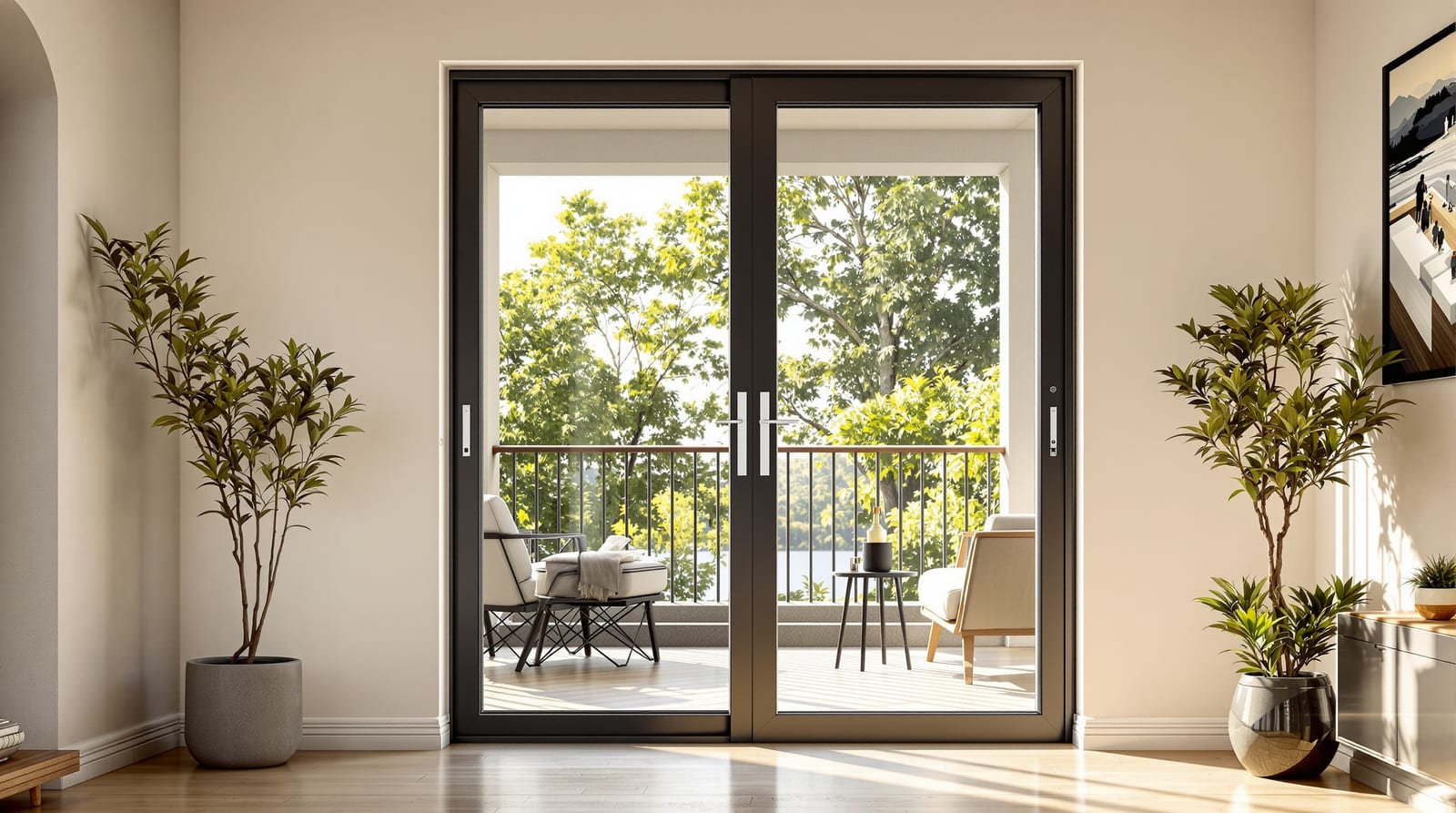
Aluminium Doors in India: Profiles, Glazing, Cost & uPVC vs Steel (2026)
Framed glazed aluminium doors — sliding, openable and French-style — for balconies, utility and modern facades: powder-coat vs anodised vs wood-finish profiles, IS 733/1285 sections, thermal-break options and ₹/sq ft costs.
Walk through almost any new flat in Mumbai, Kochi or Bengaluru and you will meet aluminium doors at the balcony, the utility yard and the living-room threshold. They are the default "framed glazed door" in modern India: a slim metal profile holding a large pane of glass, sliding sideways or swinging open to let light and air in. Aluminium earned that place honestly — it does not rust, it shrugs off coastal salt and monsoon humidity that would warp solid wood, and a powder-coated frame can go a decade without much attention. But aluminium is not the cheapest option, it conducts heat, and a soft profile dents. This guide is about choosing aluminium well: which profile system, what glass, where it beats uPVC and steel, and what you should actually pay per square foot in 2026.
For the bigger picture of which material to pick for which opening, pair this with our door materials comparison and the complete doors guide for India.
Where aluminium doors make sense in an Indian home
Aluminium is rarely the choice for a heavy carved main door — that is wood or steel security door territory. Its sweet spot is the framed glazed door: an opening where you want glass, daylight and a clean modern line.
- Balcony and deck doors — the single most common use. A two- or three-track aluminium sliding door onto a balcony gives an unobstructed view and slides out of the way.
- Utility and wash-area doors — a humid, splash-prone zone where wood rots and laminate swells. Aluminium with frosted or wired glass is rust-free and wipeable. See the utility door guide.
- French-style openable doors — two glazed leaves swinging open to a garden or terrace, a lighter alternative to timber French doors.
- Living-to-balcony and partition doors — slim sightlines, large glass, modern facade language.
Where aluminium is weaker: front entrances (it lacks the mass and warmth buyers expect), bedrooms (you usually want privacy and a solid leaf), and budget builds where uPVC does the same job for less.
Aluminium profile systems: the part that actually matters
The "door" is mostly the profile — the extruded aluminium section that forms the frame and shutter. Two profiles can look identical and perform very differently. The things that distinguish them:
Section grade and wall thickness. Profiles are extruded from aluminium alloy to IS 733 (wrought aluminium alloy bars/rods/sections) and IS 1285 (extruded sections, structural). A heavier-walled section (say 1.4–2.0 mm) is stiffer, takes thicker glass and large leaves without sagging, and resists denting. Thin builder-grade sections (under ~1.2 mm) are cheaper but flex and rattle.
Generation: conventional vs system profiles. Older "conventional" 2-track sliding sections are the cheap default. Modern system profiles (branded ranges from Jindal, Hindalco, Domal, and architectural systems like Schüco, Aluplast-type or local equivalents) have engineered interlocks, EPDM gaskets, brush-pile weatherstripping and concealed drainage — far better against monsoon water ingress and far quieter.
Finish — this is what you choose visually and it affects durability:
| Finish | How it's made | Look | Durability | Indicative cost impact |
|---|---|---|---|---|
| Powder coated | Electrostatic dry powder, oven-cured | Solid colours, matte/gloss, widest palette | Good; can chalk/fade in years of harsh UV; re-coatable | Baseline |
| Anodised | Electrochemical oxide layer | Metallic silver/champagne/bronze, natural | Excellent; oxide is integral, very corrosion- and scratch-resistant; best for coastal | +10–20% |
| Wood-finish (sublimation) | Powder base + heat-transferred wood-grain film | Convincing timber look without timber upkeep | Good; film can wear at high-touch edges over many years | +15–30% |
For a coastal home (Goa, Kerala, Chennai, Mumbai), anodised or a high-quality marine-grade powder coat is worth the premium — see best door material for India. Inland, standard powder coat is fine.
A profile in section: what you are paying for
The hidden engineering is in the cross-section — the chambers, the gasket groove and the glazing bead. Here is a simplified openable-door profile holding a glass pane:
The EPDM gaskets seal the leaf against wind-driven rain — critical in monsoon. The glazing bead clamps the glass; a deeper bead takes a double-glazed unit (IGU). In a thermal-break profile, a non-conductive polyamide strip splits the aluminium chamber so the outer and inner faces are not metal-connected — this slashes heat transfer and stops condensation. Plain aluminium conducts heat freely, so for air-conditioned rooms in Delhi/Chennai a thermal-break section materially reduces heat gain (and your AC bill).
Glazing options
The glass is half the door. Match it to the room:
- Single toughened glass (4–8 mm, IS 2553) — the default; safe, breaks into blunt granules. Frosted or stippled for bathroom and utility privacy.
- Laminated glass — a PVB interlayer holds shards; better security and acoustic damping. Worth it for ground-floor balcony doors.
- Double-glazed unit (IGU) — two panes with an air/argon gap; cuts heat and noise. Pair with a thermal-break frame or the frame becomes the weak link.
- Tinted / low-E / reflective — reduces solar gain and glare on west/south facades; useful in hot-dry zones.
For wired or grilled options where you want airflow with security, look at safety grill doors behind the aluminium leaf, or a mosquito mesh door track alongside.
Cost: what aluminium doors actually run in 2026
Aluminium doors are priced per square foot of opening, and the spread is wide because the profile grade dominates. These are indicative ranges, varies by city, vendor and glass — confirm a live quote.
| Profile grade | Typical use | Indicative cost (₹/sq ft of opening) | Notes |
|---|---|---|---|
| Builder/conventional, thin section | Low-cost utility/balcony sliders | ₹450–600 | Single toughened glass, basic powder coat; can rattle |
| Standard system profile, powder-coated | Most balcony & living-room doors | ₹600–900 | Better gaskets, EPDM, smoother slide |
| Anodised / wood-finish system | Coastal homes, premium look | ₹800–1,200 | Better corrosion + grain finish |
| Thermal-break + double glazing | AC rooms, hot zones, acoustic | ₹1,100–1,800+ | IGU + polyamide break; energy-efficient |
A typical 7 ft × 5 ft (≈35 sq ft) balcony slider therefore lands roughly ₹16,000–32,000 in a standard powder-coated system, before installation. Add +18% GST, fitting labour ~₹800–3,000 per door, and hardware (rollers, locks, handles) ~₹1,500–5,000. For a deep cost breakdown see the aluminium door cost guide, the sliding door cost guide and the master door cost benchmark. To compare your own configuration, the door cost calculator helps.
Aluminium vs uPVC vs steel vs wood
Different materials win different openings. The honest trade-off:
| Material | Cost | Durability (India) | Maintenance | Look / feel |
|---|---|---|---|---|
| Aluminium (framed glazed) | Mid–high | Rust-free, salt-proof; dents; conducts heat | Very low — wipe down | Slim, modern, metallic or wood-finish |
| uPVC (framed glazed) | Low–mid | Good; can yellow/become brittle under intense UV over years | Very low | Chunkier frame; white default, laminates available |
| Steel (pressed/security) | Mid | Very strong; rusts if coating breached | Low–moderate; repaint chips | Industrial/security; not for glazed living |
| Wood (solid/teak) | Mid–very high | Warps/swells in humidity; termite risk; great if maintained | Higher — polish, treat | Warm, premium, carve-able |
Aluminium vs uPVC is the real fight for balcony/utility glazed doors. uPVC is cheaper, a slightly better insulator and won't dent — but its frame is bulkier, large spans need steel reinforcement inside the profile, and prolonged harsh UV can yellow or embrittle it over years. Aluminium gives slimmer sightlines, a more premium metallic look, larger leaves without reinforcement, and superb coastal corrosion resistance — at higher cost and with thermal conduction unless you buy a thermal-break section. For a humid coastal home wanting big glass and a modern line, aluminium; for a budget inland flat prioritising insulation, uPVC. See door materials comparison and try the door material comparison tool.
Aluminium vs steel: steel is for security and grilles, not glazed living doors — different jobs (steel doors).
Durability, weaknesses and upkeep
What to watch over the door's life:
- Denting — aluminium is softer than steel; a thicker section resists knocks better. Keep heavy traffic away from thin builder profiles.
- Roller wear on sliders — the most common service item. Good-quality rollers and a track you actually clean of grit will last years; cheap rollers seize. Vacuum the bottom track monthly in dusty cities.
- Gasket ageing — EPDM lasts long but eventually hardens; replaceable.
- Galvanic corrosion — avoid aluminium in direct contact with dissimilar metals (especially in salt air); use the right gaskets and stainless fasteners.
- Finish care — wipe powder-coated frames with mild soapy water, never abrasive cleaners or solvents. Anodised needs even less.
Aluminium's headline weakness remains thermal conduction: a plain frame gets hot in the sun and can sweat with condensation in AC rooms. The fix is the thermal-break profile above.
Standards and a quick buying checklist
Beyond IS 733/IS 1285 for the sections, look for IS 2553 toughened glass, IS 3548 glazing workmanship, and EPDM gaskets to a recognised grade. When ordering, confirm: profile brand and wall thickness (mm), finish (powder/anodised/wood-finish) and whether it is marine grade for coast, glass type and thickness, single vs thermal-break, roller/hardware brand, and whether GST + fitting are included. Always ask for the leaf size against door size standards, and plan swing/slide clearance — our note on measuring a small room helps avoid a door that fouls furniture.
Frequently asked questions
Are aluminium doors good for coastal Indian homes?
Yes — that is their strongest case. Aluminium does not rust, so salt-laden coastal air and monsoon humidity that would corrode steel or warp wood barely affect it. Choose an anodised or marine-grade powder-coat finish and stainless fasteners for the best coastal life.
Aluminium or uPVC door — which is better?
For glazed balcony/utility doors, uPVC is cheaper and a marginally better insulator, while aluminium offers slimmer frames, larger glass leaves, a more premium look and excellent corrosion resistance. Pick uPVC on budget and insulation; pick aluminium for big glass, modern sightlines and coastal durability. See our uPVC doors guide.
Do aluminium doors make a room hot?
Plain aluminium conducts heat, so an exposed frame in direct sun warms up and can transmit heat indoors. A thermal-break profile with a polyamide strip plus double glazing largely solves this and is worth it for air-conditioned rooms in hot cities.
How much does an aluminium door cost in India?
Roughly ₹450–900 per sq ft of opening for standard powder-coated systems, rising to ₹1,100–1,800+ for thermal-break and double-glazed units. A typical 35 sq ft balcony slider is about ₹16,000–32,000 before GST, fitting and hardware. See the aluminium door cost guide.
Can aluminium doors be made to look like wood?
Yes — a sublimation (wood-finish) coating heat-transfers a convincing wood-grain film onto the powder-coated profile, giving a timber look with aluminium's low maintenance. Expect a 15–30% premium over plain powder coat.
Export this guide
Related Guides — Deep-dive reading
Aluminium Door Cost in India 2026: ₹/Sq Ft by Profile Grade, Finish, Glazing & Hardware
A focused 2026 cost guide for aluminium doors in India — ₹ per sq ft of opening by profile grade (economy domal vs branded system sections vs thermal-break), powder-coat vs anodised vs wood-finish surcharge, glazing, rollers/locks/handles, sliding vs openable, fitting and GST, with a worked balcony/utility example.
Home Doors & EntrancesFrench Doors for Indian Homes: Glazing, Security, Cost & Monsoon Sealing
The double-leaf glazed door that opens a living room to a balcony or garden - where it works, how to specify the glass, frame and seals, what it costs, and how it stacks up against sliding and bi-fold.
Home Doors & EntrancesThe Complete Home Door Guide for Indian Homes (2026): Types, Materials, Cost, Security & Vastu
Everything an Indian homeowner needs to specify the right door for every opening — from main entrance to bathroom — with real 2026 prices, IS/NBC standards and Vastu sense.
Home Doors & EntrancesRelated Tools — Try Free
Aluminium Door Cost Calculator
Estimate an aluminium door cost by opening size, profile grade, finish, glazing and type, with fitting and GST.
Door CalculatorDoor Material Comparison Tool
Compare 2–4 door materials on cost, durability, maintenance, security and moisture resistance.
Comparison ToolBrise-Soleil Visualizer
Interactive horizontal-louvre cut-off angle calculator — sun altitude, louvre depth, and spacing inputs with a live shadow preview. Computes θ = arctan(spacing/depth) for façade shading, ECBC envelope compliance, hospital daylight design, and tropical sun-control detailing.
Sun Shading Tool