
Emergency Access Planning for Indian Homes (2026): A Way In, A Way Out, Always
How to plan every way you and the people who need to can still get in or out when a battery dies, a phone is lost, a resident is locked in, or help must reach someone fast — convenient day-to-day, but never a trap.
A lock earns its keep on an ordinary day, but it is judged on a bad one. The battery dies at 11 p.m. The phone with the app is in an autorickshaw halfway across town. A grandmother has a fall inside a bolted flat and the people who love her are on the wrong side of the door. A child pulls the door shut behind a parent who stepped out for milk. None of these is a break-in. Every one of them is the same quiet failure: the people who should be able to get in or out could not.
Emergency access planning is the habit of thinking through every one of those moments before it happens, and deciding in advance how you — and the people who may need to reach you — still get in or get out safely. It is the twin of good security, not its opposite: a home should be hard for a stranger to enter and easy for the right person to reach in a crisis. This guide is part of Studio Matrx's smart locks and access control hub, and it sits alongside the smart locks pillar and the access control pillar.
Scope & safety. This guide is strictly about legitimate access and rescue — never about bypassing anyone else's security. Two rules are non-negotiable on any Indian home. First, a door on an escape route must let you out instantly by hand, without a key, code, phone or power — fire egress and any electric release are a licensed, fire-code-compliant job; see fire-egress compatibility and emergency door release. Second, always keep a mechanical key override and at least one backup way in, so a dead battery or a lost phone is an inconvenience, not a lock-out. This is educational guidance, not legal advice.
Start from the failures, not the features
Most people buy a lock for its best day — the tap-to-open, the fingerprint, the app that lets you check the door from the office. Emergency planning flips that around: list the ways the lock, the power, the network, the phone or the person can fail, and make sure each one has an answer. Do this once, write it down, and a stressful night becomes a two-minute solution instead of a locksmith at midnight.
The scenarios below cover almost every Indian household — a nuclear flat, a joint family, a home with domestic help, an elderly parent living alone, a small office, a society tower.
The get-in-anyway path: battery, power and phone
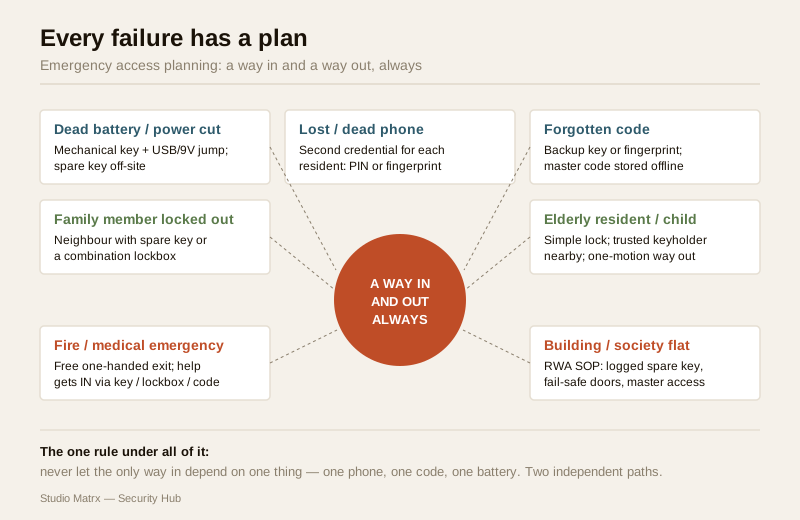
The most common lock-out in India has nothing to do with crime. It is a flat battery, a power cut that outlasts the backup, or a phone that is lost, dead or left behind.
- Dead battery or power cut. A well-designed smart lock keeps two lifelines: a mechanical key cylinder, and often a USB / 9V emergency jump contact that gives just enough power to open once. Neither helps if the key is inside the flat or you have never located the jump port. Plan both in advance — read mechanical key override and power and battery planning, and keep a spare key with the plan below.
- Lost, dead or forgotten phone. If the only way in is your phone, the phone is a single point of failure. Every household member should have a second credential — a PIN code, a fingerprint enrolled, or a physical key — so no one is stranded because a handset is missing. Guides on PIN-code locks, fingerprint locks and app-controlled locks explain the trade-offs.
- Forgotten code. Codes are forgotten most by the people who use them least — a visiting relative, an elderly parent, a child. Do not rely on memory alone: pair the code with a key or fingerprint for that person, and keep the master code recorded somewhere secure and offline, never on a note stuck to the door.
| Failure | What still gets you in | Set this up in advance |
|---|---|---|
| Battery flat overnight | Mechanical key; USB/9V jump to open once | Locate the jump port; keep a charged power bank / spare 9V; spare key off-site |
| Long power cut | Lock runs on its own battery; mechanical key | Check battery months, not weeks; keep spare cells |
| Phone lost or dead | Second credential (PIN, fingerprint, key) | Enrol every resident on two methods |
| Forgotten PIN | Backup credential; recorded master code | Store master code offline and secure; pair frail users with a key |
| Handed set to the wrong person | Revoke that credential from the app | Use per-person codes, not one shared code |
The single rule under all of this: never let the only way in depend on one thing — one phone, one code, one battery. Two independent paths, always.
The spare key, the lockbox and the shared code
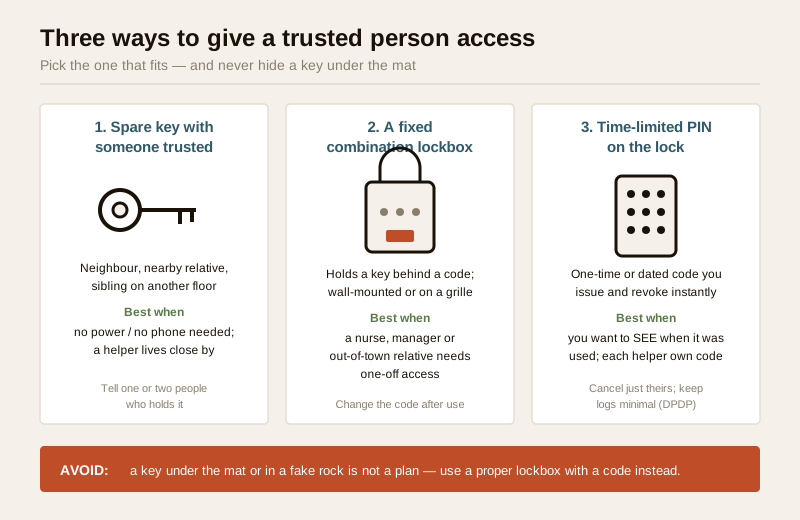
Every home needs a way for a trusted person to get in when you cannot open the door yourself — for a medical emergency, a gas leak, a burst pipe, or simply because you are travelling and a pipe bursts. There are three sane ways to arrange this, and one you should avoid.
- A spare key with someone trusted. The oldest method and still the best for many Indian families: a physical key held by a neighbour, a nearby relative, or in a joint-family home, a sibling on another floor. It needs no power and no phone. Choose someone close enough to reach the door in minutes, and tell one or two people who holds it.
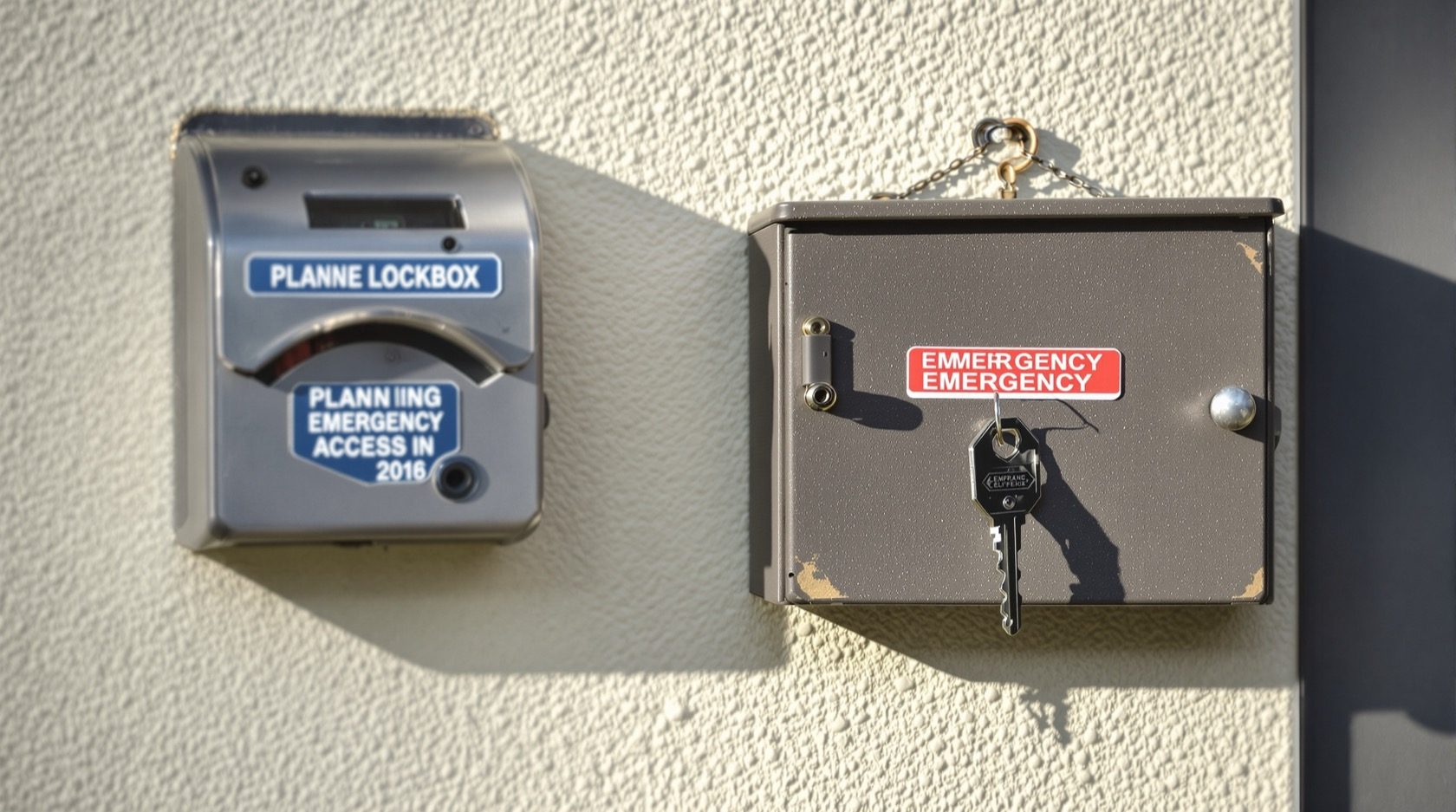
- A lockbox. A small, fixed key-safe (wall-mounted or shackled to a grille) holds a mechanical key behind its own combination. You can then give the box code to whoever needs it in a crisis — a visiting nurse, a building manager, an out-of-town relative talking a neighbour through it — without ever handing over a permanent key. Change the box code after any one-off use.
- A shared or temporary code on the lock itself. Many smart locks let you issue a time-limited or one-time PIN to a helper — the domestic help's daily code, a guest code for visiting family, a one-shot code for a plumber. This is the cleanest option because you can see when it was used and revoke it instantly. Give each person their own code so you know who came and can cancel just theirs; see app-controlled locks.
- Avoid the fake-rock / under-the-mat key. A key "hidden" in an obvious outdoor spot is not a plan; it is an open invitation. If you want an outside key, put it in a proper lockbox with a code, not under a pot.
For a joint family this is easier than it looks: the household already has trusted people on hand. The task is to make it deliberate — decide who holds what, write it down, and make sure at least one able adult can always reach the door.
Out is more important than in: free egress
Everything above is about getting in. The more serious half of emergency planning is getting out — and here the rule is absolute.
A door on an escape route must open from the inside instantly, by hand, with no key, no code, no phone and no power. In a fire or a medical emergency, a frightened or injured person, a child, or an elderly resident must be able to turn a thumb-turn or push a handle and walk out. A lock that needs a code to leave, or a deadbolt whose inside knob is disabled, is not a security feature — it is a trap.
- Free egress on the inside. Confirm your lock has a single-action inside release — one motion (turn the thumb-turn, push the lever) unlocks and opens together. Beware "double-cylinder" or key-both-sides fittings on a main door: they can lock people in.
- Never double-lock a bedroom or bathroom against a sleeper. In homes with elderly residents or children, avoid locks that can strand someone inside a room. A privacy latch should always have an outside emergency release (the small coin-slot or pin).
- Fire alarm and power interlock. On apartment escape-route doors and any electrically held door, egress hardware must fail-safe: release automatically on a fire-alarm signal and on power loss, under the National Building Code and fire regulations. This is a coordinated, licensed job — see fire-egress compatibility and emergency door release. Do not improvise it.
- Keep the escape path clear. A grille or collapsible gate across a balcony or a second exit that is padlocked shut, with the key nobody-knows-where, has killed people in Indian building fires. If you must secure it, use a quick-release the residents can operate in the dark, and keep that key on a hook right beside it.
For the whole-home picture of balancing security with escape, the ultimate guide to home security and the apartment security guide put egress in context.
Elderly residents, children and domestic help
India's households are rarely just two working adults. Planning has to fit the people who actually live there.
- An elderly parent living alone. This is the case that most needs planning. A trusted neighbour or a nearby child should hold a key or a lockbox code, so that if the parent does not answer, someone can reach them fast. Prefer a lock the parent can operate easily — a large fingerprint pad or a simple key over a fiddly app. Keep the inside egress dead simple: one turn to open.
- Children and latch-key moments. A child who comes home before the adults needs their own reliable way in — a fingerprint or a code they will not forget — and the household needs a rule that a child never bolts a door in a way an adult outside cannot open.
- Domestic help. Give household staff their own dated code or credential, never the family's, so access can be logged and revoked cleanly when arrangements change — and remember that access logs and any biometric enrolment are sensitive personal data under the DPDP Act, 2023: collect the minimum, keep it briefly, and restrict who can see it.
- Joint families. The advantage is many trusted adults; the risk is a shared code everyone knows and no one changes. Give each adult their own credential, keep one master key in a known secure place, and agree who is the "keyholder of record."
| Resident | Their reliable way in | The egress / safety must-have |
|---|---|---|
| Elderly parent alone | Simple lock they can work; neighbour holds key/lockbox code | One-motion inside release; someone can reach them fast |
| Child home early | Own fingerprint or memorable code | Never bolt so an outside adult cannot open |
| Domestic help | Own dated code, logged and revocable | No standing access after arrangement ends (DPDP) |
| Visiting relative | Time-limited guest code | Knows the one-motion way out |
| Joint-family adults | Individual credentials each | One known master key; a named keyholder |
For a building: how help reaches a flat
In an apartment or a gated society, emergency access is no longer just your problem — it is a shared policy, and the RWA should have thought it through.
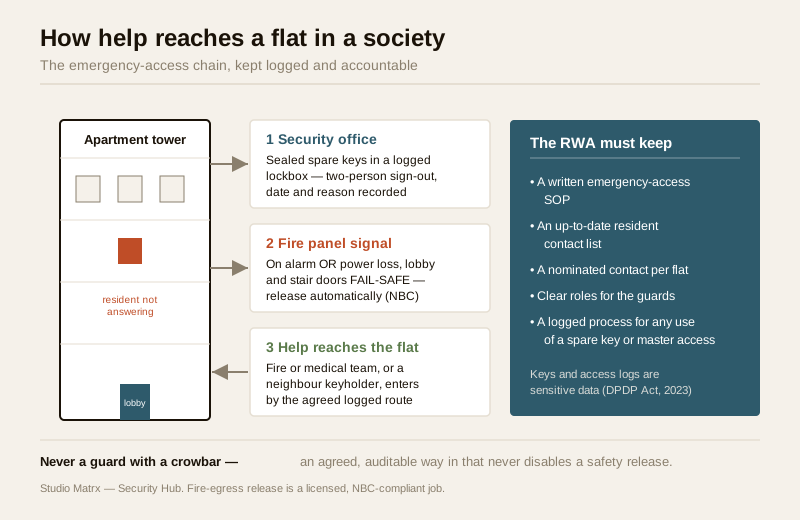
- How a guard or fire team reaches a flat. When a resident does not answer and there is smoke, or a medical call, the building needs an agreed, auditable way in — not a guard's crowbar. The common, sensible arrangements are a sealed key held in the security office (or a society lockbox) that is only opened with a logged, two-person sign-out, or a resident who has voluntarily left a key with a trusted neighbour on the floor. Whatever the method, it must be written into the society's emergency SOP.
- Master access, used carefully. Some access-control systems allow a supervised master credential for genuine emergencies. This is powerful and easily abused, so it belongs behind a logged, accountable process — see apartment access control and office access control for how master and emergency access is governed.
- The fire-egress release at the building scale. Lobby doors, stair-pressurisation doors and any electrically controlled common door must release on the fire alarm and on power failure — the emergency door release and fire-egress compatibility guides cover the hardware; a licensed fire consultant signs it off under the NBC.
- The RWA's job. A good society keeps: a written emergency-access SOP, an up-to-date resident contact list, a nominated flat contact for each unit, clear roles for the guards, and a strict, logged process for any use of a spare key or master access — because those keys and logs are sensitive and must not be misused.
Write the plan down
A plan that lives only in one person's head fails the moment that person is unreachable. Turn the decisions above into a short, shared note the household actually keeps:
1. Who holds what. Name the neighbour or relative with the spare key or lockbox code, and tell a second person.
2. Where the backups are. The mechanical key, the spare batteries or power bank for a jump, the lockbox location and its code (recorded securely, offline).
3. Each person's two ways in. Every resident's primary and backup credential.
4. The way out. Confirm every escape door opens one-handed from inside, and where any grille quick-release key hangs.
5. Who to call. Emergency numbers, the society office, the elderly parent's doctor, the regular locksmith or lock installer.
Review it when anyone moves in or out, when domestic help changes, when you re-battery the lock, and after any near-miss. For a small office, the same list becomes the access-and-egress section of your safety plan; office access control covers the workplace version.
When to bring in a professional. Plan the policy yourself — who holds keys, which credentials, where backups live. But hand the fire-egress hardware, any electrically held or magnetically locked door, the fire-alarm interlock, and the wiring to a coordinated licensed team: a fire-safety consultant, a door-hardware trade and an electrician working to the National Building Code — see the electrical hub. For a society, the RWA should have the emergency-access SOP and the fire-egress release professionally reviewed. Never disable a safety release to make a door "more secure," and never rely on a hidden outdoor key in place of a proper lockbox.
Key takeaways
- Emergency access planning means answering every failure in advance — dead battery, power cut, lost phone, forgotten code, a locked-out family member — so no bad night becomes a lock-out or a trap.
- Never let the only way in depend on one thing. Every resident needs two independent ways in (key plus PIN or fingerprint), and every home needs a mechanical key override and a backup — see mechanical key override and power and battery planning.
- Arrange trusted access deliberately: a spare key with a neighbour or relative, a combination lockbox, or a time-limited code on the lock — never a key under the mat, and give each helper their own revocable code.
- Getting out matters more than getting in. Escape-route doors must open one-handed with no key, code, phone or power, and fail-safe on fire alarm and power loss — a licensed, NBC-compliant job; see fire-egress compatibility and emergency door release.
- For a building, make it a written RWA policy: a logged spare-key or lockbox process, master access behind accountability, fail-safe common doors, and a resident contact list — see apartment access control.
References
- Digital Personal Data Protection Act, 2023 — access logs, guest codes and any biometric enrolment (fingerprints) are personal, often sensitive, data; collect the minimum, keep it briefly, restrict who can see it, and revoke access when arrangements end.
- Manufacturer specifications — verify your lock's mechanical-key override, emergency power (USB/9V) jump procedure, single-action inside egress and battery life on the maker's own datasheet before relying on any of them in a crisis.
- National Building Code of India (SP 7), Bureau of Indian Standards, and local fire-safety regulations — for fire-egress hardware, fail-safe release on escape-route and common doors, and any electrically controlled door; verify the current edition via the BIS catalogue: https://www.services.bis.gov.in/
This is an educational overview, not legal advice. Fire-egress hardware, electrically held doors, fire-alarm interlocks and any mains wiring are qualified professional tasks under the National Building Code — engage a licensed fire-safety consultant, door-hardware trade and electrician, and verify any standard's current status via the BIS catalogue before relying on it.
Export this guide
Related Guides — Deep-dive reading
Fire-Egress Compatibility for Smart Locks in India (2026): Never Trap Anyone
How to make sure a smart lock or access-controlled door on an escape route always lets people out in a fire or emergency: fail-safe hardware, free egress, fire-rated doors, and the fire-alarm interlock.
SecurityAccess Control Maintenance in India (2026): Readers, Locks and Fail-Safe Egress
How to keep a card, keypad, fingerprint or face access-control system reading reliably and locking securely — and, above everything, how to test that its doors still release on a fire alarm and on power loss, so an access-controlled door never becomes a life-safety trap.
SecurityEmergency-Evacuation Planning for a Secure Indian Home
The flip side of keeping intruders out is getting your family out. Map primary and secondary escape routes from every room, make sure your security hardware can never trap anyone, fix a muster point, and drill it — the evacuation plan every secure home needs.
SecurityRelated Tools — Try Free
Access-Control Battery-Backup Calculator
Size the standby battery so an access system keeps running through a power cut, with an egress life-safety note.
Battery BackupChild & Elder Home-Safety Audit
Room-by-room safety audit for households with children or seniors — 10 categories, 70+ checkpoints tagged by audience.
Safety AuditSmart Lock Finder
Find the right smart lock — access methods, tier and must-haves like a mechanical override — for your door and budget.
Door Tool