
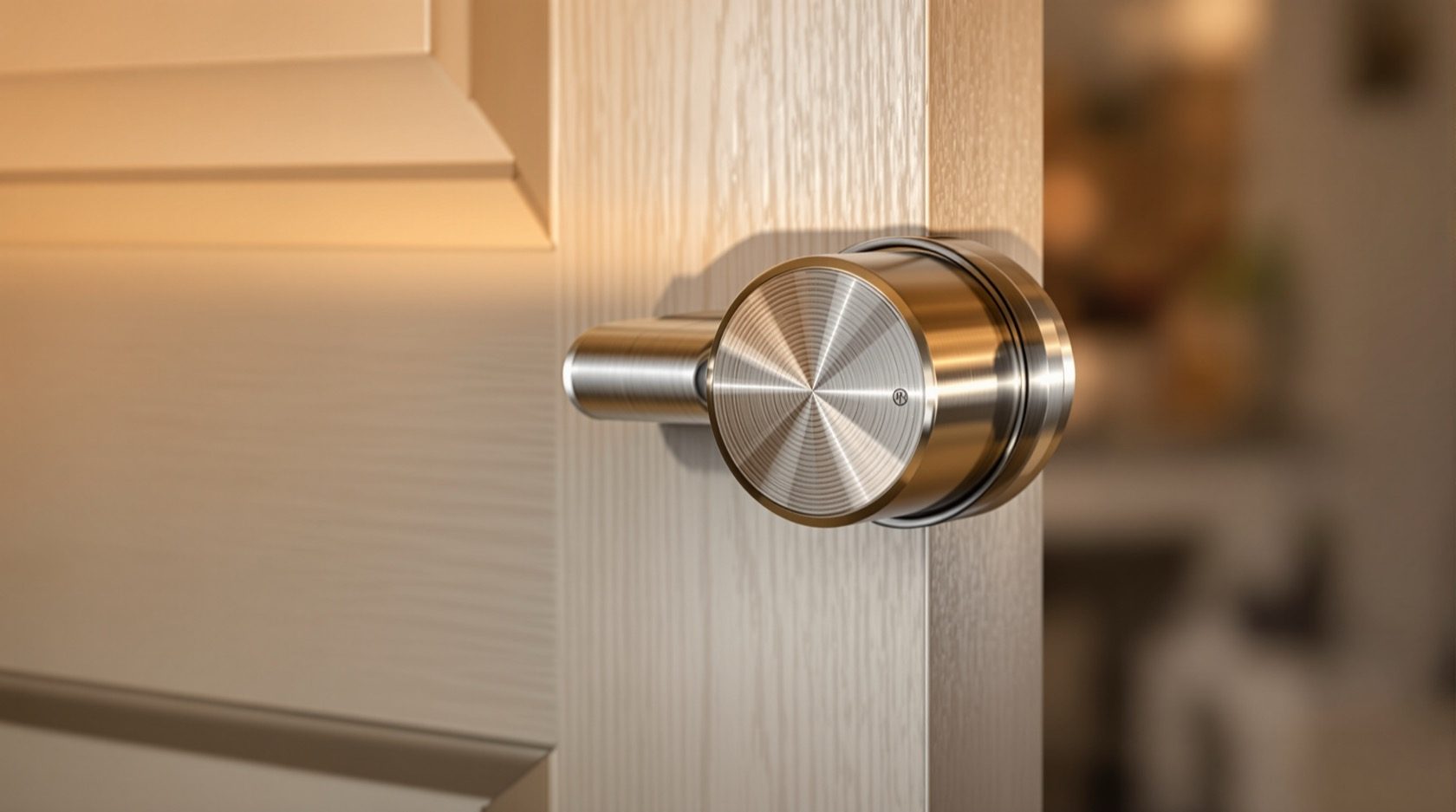
Rim Smart Locks in India (2026): The Easiest Retrofit Smart Lock
Why rim smart locks screw onto the inside face of the door instead of being cut into it, making them the simplest upgrade for renters, old doors and doors that cannot take a mortise, and where their surface-mounted design has limits.
Most guides to smart locks quietly assume you are willing to modify your door, cut a deep pocket into its edge or bore large holes through its face. For a lot of Indian homes that is a problem: the door is rented, or old, or thin, or the resident simply does not want an irreversible change. This is exactly the gap the rim lock fills.
Rim smart locks are the smart-lock form that mounts on the surface of the door rather than inside it. The lock body screws onto the inside face of the leaf, the strike screws onto the frame, and the bolt throws sideways across the gap between them. Because almost nothing is cut into the door, a rim lock is the easiest retrofit of any smart lock, which is why it suits renters, quick upgrades, older doors and doors that cannot take a mortise. This guide is part of the Studio Matrx complete guide to smart locks; its lens is the lock form, so for how each credential works we link out to the credential guides rather than repeat them.
Scope & safety. This guide helps you choose and plan. The actual fitting, and any fire-alarm or egress interlock and its wiring, are a licensed professional's job, and a door people escape through must never trap anyone inside. Always keep a mechanical key override and a backup credential so you can still get in when the battery dies, and make sure the inside can always be opened in one motion for fire egress. Access logs and any biometric credential are personal data under the Digital Personal Data Protection Act, 2023. This is educational guidance, not legal advice.
What a rim lock actually is
The name is old. On a traditional door, the "rim" is the flat surface of the leaf, and a rim lock is one that sits on that surface. The classic example is the night latch you have seen on countless doors: a box screwed onto the inside face, a knob or turn on that box, a cylinder passing through the door to a keyway on the outside, and a strike on the frame that the bolt springs into when the door closes.
A rim smart lock takes that same surface-mounted body and adds the electronics: a motor to drive the bolt, a battery, a controller, and one or more credentials — a keypad, a fingerprint reader, an app, a card. Everything lives in the box on the inside of your door. Compared with a lock that has to be buried in the door, this is a fundamentally simpler thing to install.
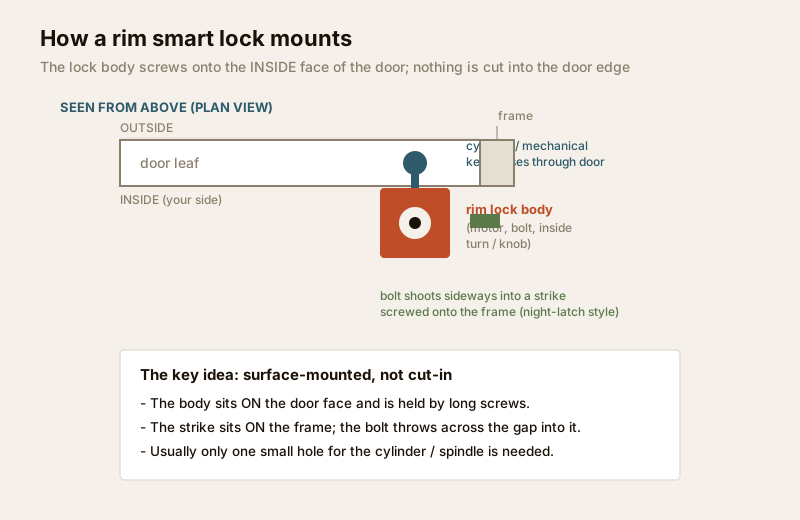
The critical detail is where the metal goes. With a rim lock, the body is held to the door by long screws through the face, and the strike is held to the frame by screws — the bolt never enters the door edge at all. Usually the only hole you make is a small one for the cylinder or spindle that links the outside credential to the inside body. That single fact is what makes the whole retrofit so easy, and it is also where the trade-offs come from, which we get to below.
Rim vs mortise vs deadbolt: the form-factor map
Smart locks come in three body types, and choosing among them is really a question of how much of your door you are willing to cut. It is worth understanding all three because the right answer depends entirely on your door.
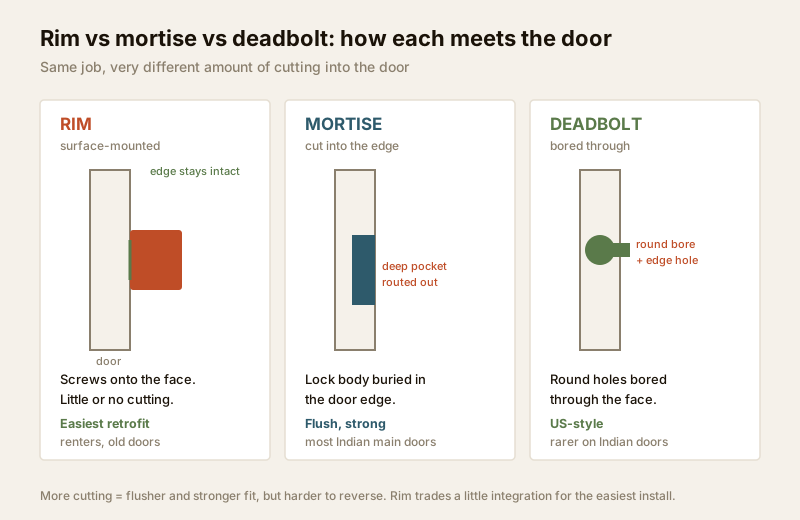
| Body type | How it fits the door | Effort to install | Best for |
|---|---|---|---|
| Rim | Screws onto the inside face; strike on the frame; edge left intact | Lowest — usually one small cylinder hole | Renters, old/thin doors, quick upgrades, inner doors |
| Mortise | Buried in a deep pocket routed into the door edge | High — needs a carpenter and a big pocket | Most Indian main doors; a flush, strong, integrated fit |
| Deadbolt | Round holes bored through the face + an edge hole | Medium — bore two holes | US-style doors; less common on Indian leaves |
The mortise smart lock is what most Indian main doors are built to take: a big handle-set lock buried in the edge that sits flush and strong, but demands a carpenter and an irreversible pocket. The deadbolt smart lock is the American pattern — a bolt through bored holes — which is rarer here because Indian doors are usually made for a mortise. The rim lock sits at the easy end of that spectrum: it trades a little of the flush, integrated feel for by far the simplest install. If you are weighing all three against your specific door, the smart lock selector walks you through it.
Why a rim lock is the easiest retrofit
"Retrofit" just means putting a new lock on an existing door without rebuilding it. On that measure the rim lock wins for a handful of concrete reasons:
- Minimal door modification. No deep pocket to route, often no large bores through the face — usually just one small hole for the cylinder. On many jobs the existing night-latch cylinder hole is reused.
- It can go on almost any door. A thin, old, or oddly built door that could never take a mortise pocket can still hold a surface-mounted body, as long as the leaf and frame are solid.
- It is reversible. Because the body and strike are screwed on, they screw off. When you leave a rented flat, you unscrew the lock, fill a couple of screw holes, and refit whatever was there. That reversibility is why rim locks are the natural pick for renters.
- It is quick. A straightforward rim retrofit is often an hour or two of work, not a carpentry job that ties up the door for a day.
- You can often keep the old lock. A rim smart lock frequently coexists with the existing mortise or latch, adding a smart layer without removing your current security.
This is the same "add, do not rebuild" logic behind pairing a lock with a video door phone: you upgrade what the door does without tearing into the door itself.
Night-latch style, brought up to date
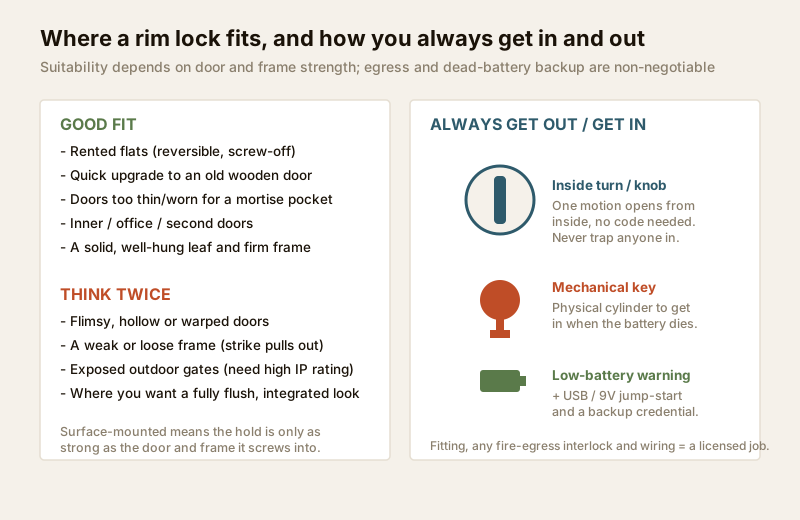
Many rim smart locks keep the night-latch character: the outside gets a keypad, reader or key, and the inside keeps a simple turn or knob that opens the door in one motion. That inside turn is not a nicety — it is your fire-egress path. Whatever the credential on the outside, a person on the inside must be able to leave immediately, without a code, a phone or a fingerprint. We come back to this under safety.
Suitability for Indian doors and gates
A rim lock is easy to fit, but "can I fit it" is not the same as "should I". Because it is surface-mounted, its security is only ever as good as the door and frame it screws into.
| Situation | Rim lock verdict |
|---|---|
| Rented flat | Excellent — reversible, screws off when you leave |
| Old / thin wooden door | Excellent — can hold a surface body when it cannot take a pocket |
| Solid main door, owned home | Fine, but a mortise gives a flusher, stronger, more integrated fit |
| Inner door, office, PG room | Very good — light-duty, quick, reversible |
| Flimsy / hollow / warped leaf | Weak — the door itself is the weak point, not the lock |
| Weak or loose frame | Weak — the strike can be forced out of a soft jamb; fix the frame first |
| Exposed outdoor gate | Needs care — see below |
For a gate, the surface-mounting is not the issue so much as the exposure. An outdoor gate lock lives in monsoon rain, summer heat, dust and humidity, so it must carry a genuine outdoor IP rating (weather sealing) or it will corrode and fail. Metal gates also have their own mounting quirks, so a purpose-built smart gate lock is usually a better match than pressing an indoor rim lock into outdoor duty. The same caution applies to any lock on a compound door in a villa or a common gate in an apartment complex.
The limits of a surface-mounted lock
Being honest about weaknesses is not a how-to for defeating a lock — it is a buying caution. Treat these as things to check and mitigate, not as flaws that rule the form out.
- It is only as strong as its anchor. A surface-mounted body concentrates force on the screws and the wood or metal they bite into. On a flimsy door or a soft frame, that is the weak link. Mitigate by fitting to a solid leaf, using a firm frame, and following the maker's fixing spec — the fitting itself is a job for a professional who can seat the screws properly.
- It is less flush and integrated. The body sits proud on the inside face. Some people find that fine; others want the clean, built-in look of a mortise. That is an aesthetic and space trade-off, not a security one.
- It depends on door and frame condition. A warped door that no longer closes squarely, or a jamb that has loosened over the years, undermines any rim lock. Sort the door and frame out first.
- Outdoor exposure needs a rated product. An indoor-grade rim lock on a weather-exposed door or gate will degrade. Match the IP rating to the exposure.
None of this makes a rim lock a bad choice — it makes it a situational one. On the right door, fitted well, it is a genuinely secure and hugely convenient upgrade. On the wrong door, no lock body can compensate for a weak leaf.
Dead batteries, power cuts and getting in
Every smart lock in India has to answer one question honestly: how do you get in when the power or the battery is gone? Load-shedding and flat batteries are facts of life, and a lock with no plan for them is a lock that eventually shuts you out of your own home. A good rim smart lock gives you layers of backup:
- A mechanical key override. A physical cylinder — often the same one the night-latch design already had — lets you unlock with a metal key when the electronics are dead. On a home door this is the single most important backup; keep a spare key somewhere sensible off-site.
- A low-battery warning, well ahead. The app and the lock itself should nag you for days or weeks before the batteries die, not spring it on you.
- An emergency power path. Many models take a jump-start from a 9V battery or a USB power bank held to contacts on the body, giving you enough charge to open the door and then swap the cells.
- A second credential. If your fingers are wet and the fingerprint reader baulks, a PIN code still works; if the phone is flat, a card or key does. Overlapping credentials mean a single failure never locks you out. For the full picture of backups, see the pillar guide.
Fire egress: the one rule you never bend
A lock is meant to keep the wrong people out — never to keep the people inside trapped. This matters most on any door someone would escape through in a fire.
On a rim smart lock, the inside turn or knob is the egress path: it must open the door in one motion, with no code, no app and no fingerprint, every single time, even with a dead battery. That is the whole point of the night-latch inside knob. If you are fitting a lock on a door that forms part of a fire-escape route — a stairwell door, a shared corridor door, certain flat entrances — the requirement for that door to unlock safely on power loss or a fire alarm (fail-safe behaviour) and any interlock with the building's alarm is a matter for the National Building Code and your fire consultant, and the selection, interlock and wiring are a coordinated, licensed job. Never fit anything that could block an escape route. Verify the current requirements via the BIS catalogue and route the work to professionals — this guide plans and decides; it does not wire.
Credentials and connectivity, in brief
The rim body is the form; the credential is how you unlock it, and rim locks come in every flavour. Rather than re-explain each here, pick the credential guide that fits how you want to open the door:
- PIN code and fingerprint — the two most common on-lock credentials in India.
- RFID/card, NFC and Bluetooth — tap and phone-proximity unlocking.
- Wi-Fi and remote access — unlocking or granting entry from anywhere, which brings the privacy duties below.
Whenever a lock logs who came and went, or stores a fingerprint, that data is sensitive personal data under the DPDP Act, 2023: collect the minimum, keep it on-device where you can, delete a departed user's access promptly, and be deliberate about anything that syncs to the cloud. The general smart-home and building security guides put this in context.
Buying and fitting: what to check
| Check | Why it matters |
|---|---|
| Mechanical key override | Your way in when the battery or power is dead |
| Emergency power path | A 9V/USB jump-start avoids a lockout |
| Fits your door thickness | Rim bodies suit a range, but confirm yours is covered |
| IP rating vs exposure | Indoor lock indoors; rated product for any exposed door/gate |
| Solid leaf & firm frame | The body is only as strong as what it screws into |
| Inside one-motion egress | The inside turn must always open the door instantly |
| Backup credential | Two ways to unlock so one failure never locks you out |
| On-device vs cloud logs | DPDP: minimise, keep local where practical, delete departed users |
Rough Indian pricing: a basic keypad-only rim smart lock starts around a few thousand rupees; models adding fingerprint, app and Wi-Fi typically run into the mid-teens of thousands and up, similar to comparable deadbolt models and generally below a full mortise handle-set. The cost calculator helps you budget across form and credentials.
When to bring in a professional. Choosing the lock, planning the credentials and reading the DPDP implications you can do yourself with this guide and the selector. Hand the fitting — seating the body and strike properly into a solid leaf and frame — to a competent installer or carpenter. Hand anything to do with fire egress, fail-safe behaviour, alarm interlock or mains wiring to a licensed professional and your fire consultant; verify code requirements via the BIS catalogue and see the electrical hub. Never fit a lock that could trap someone on an escape route.
Key takeaways
- Rim smart locks are surface-mounted — the body screws onto the inside face of the door and the bolt throws into a strike on the frame, so almost nothing is cut into the door.
- They are the easiest retrofit — minimal modification, reversible, quick, and often able to reuse or add a cylinder, which makes them ideal for renters, old or thin doors, and doors that cannot take a mortise.
- Know the form-factor map — a mortise suits most Indian main doors and gives a flusher, stronger fit; a deadbolt is the US pattern; the rim trades a little integration for the simplest install.
- Surface-mounting has limits — the lock is only as strong as the leaf and frame it screws into, sits proud rather than flush, and needs a properly rated product for any exposed door or gate.
- Always keep the fail-safes — a mechanical key override and a second credential for dead batteries, and an inside turn that opens in one motion for fire egress; route fitting, any egress interlock and wiring to licensed professionals.
References
- Digital Personal Data Protection Act, 2023 — smart-lock access logs and biometric credentials are personal (and often sensitive) data; minimise collection, prefer on-device storage, delete departed users' access, and be deliberate about cloud sync.
- Manufacturer specifications and datasheets — verify supported door thickness, the mechanical override, the emergency power method, and the IP rating on the maker's own datasheet before buying, especially for any exposed door or gate.
- National Building Code of India (SP 7), Bureau of Indian Standards, and local fire bye-laws for fire-egress doors, fail-safe behaviour and any alarm interlock; verify the current edition via the BIS catalogue: https://www.services.bis.gov.in/
This is an educational overview, not legal advice. Lock fitting, fire-egress interlocks and any electrical work are qualified professional tasks — engage licensed installers and your fire consultant, and verify any standard's current status via the BIS catalogue before relying on it.
Export this guide
Related Guides — Deep-dive reading
Smart Locks in India (2026): The Complete Guide to How They Work, How to Choose and How to Fit One Safely
The umbrella guide to smart locks for Indian homes: what a smart lock actually is, the credential that opens it, the lock body it lives in, and the safety, power and privacy calls every buyer must make.
SecurityAccess Control Maintenance in India (2026): Readers, Locks and Fail-Safe Egress
How to keep a card, keypad, fingerprint or face access-control system reading reliably and locking securely — and, above everything, how to test that its doors still release on a fire alarm and on power loss, so an access-controlled door never becomes a life-safety trap.
SecurityFire-Egress Compatibility for Smart Locks in India (2026): Never Trap Anyone
How to make sure a smart lock or access-controlled door on an escape route always lets people out in a fire or emergency: fail-safe hardware, free egress, fire-rated doors, and the fire-alarm interlock.
SecurityRelated Tools — Try Free
Access-Control Battery-Backup Calculator
Size the standby battery so an access system keeps running through a power cut, with an egress life-safety note.
Battery BackupDoor Lock Selector
Answer a few questions and get the right lock type — mortise, multipoint, deadbolt, privacy or smart — for any door.
Door ToolSmart Lock Door Compatibility Checker
Tell us your door build, existing lock or prep, thickness and location and find out which smart-lock form factor fits — mortise, deadbolt, rim, gate or a special case — plus the measurements to take.
Compatibility