

How Home Loans Work in India: The Full Journey from Apply to EMI (2026)
A plain-language map of the home-loan journey end to end - what a home loan is, the players, the key terms, how interest and EMI work, the application-to-disbursement steps, and the levers you actually control - with a loan-journey table and a key-terms glossary.
A home loan is the single biggest financial commitment most families in India ever make, and yet the mechanics stay hidden behind jargon: EBLR, LTV, amortisation, foreclosure. This guide is the anchor of the Home Finance hub. It explains the whole journey in plain language - what a home loan actually is, who lends it, the words on your sanction letter, how interest and your EMI really work, the steps from application to money-in-hand, and the few levers you genuinely control. It links to a dedicated deep-dive for every stage, and points you to calculators so you can run your own numbers instead of trusting a round figure.
Think of it as the map, not the territory. The binding numbers - your exact interest rate, how much you can borrow, your EMI, whether you are sanctioned - come from the lender after they assess you. What this guide owns is the understanding you bring to that conversation.
Scope and a plain disclaimer. This is an explainer to help you understand the process and ask the right questions. It is not financial, tax or investment advice. Every rate, limit, fee, tax section and subsidy slab below is indicative and CHANGES - the RBI repo rate moves, the annual budget revises deductions, and scheme windows open and close. Never treat a figure here as a current fixed fact. Get your actual rate, eligibility, EMI and sanction from the BANK or lender; confirm tax specifics with a CA or tax advisor; and take planning decisions with a financial planner. Confirm everything before you commit.
Key takeaways
- A home loan is a secured loan - the property is the collateral, so the lender registers a charge on it and holds the papers until you repay.
- You repay through an EMI - a fixed monthly instalment that blends interest and principal. Early on it is mostly interest; late on it is mostly principal.
- Almost all new floating-rate home loans are linked to an external benchmark (usually the RBI repo rate under the EBLR system), so your rate moves when the benchmark moves.
- Interest is charged on the reducing balance - only on the amount you still owe - so every prepayment cuts the interest you will ever pay.
- The levers you control are the down payment, the tenure, prepayment, and a balance transfer. The rate and eligibility are the lender's call.
What a home loan actually is
A home loan is money a bank or housing finance company lends you to buy, build or improve a home, repaid in monthly instalments over many years, with the property itself pledged as security. That last part is what makes it a "secured" loan and why the interest is far lower than on a personal loan or a credit card. The lender registers a legal charge (a mortgage) on the property and holds the original title documents until the loan is fully repaid. If you stop paying, the lender has the legal right to recover the outstanding amount from the property. In return for that security, you get a large sum at a relatively low rate over a long tenure.
You never borrow the full price. The lender funds a percentage of the property value - the loan-to-value or LTV ratio - and you fund the rest yourself as the down payment. The gap you must cover, and how to build it, is the subject of down-payment planning.
The players - banks and housing finance companies
Two kinds of lenders dominate home loans in India. Banks (public-sector and private) are regulated by the RBI and typically offer repo-linked floating rates. Housing finance companies (HFCs) specialise in home loans and are regulated under the RBI's oversight of the housing finance sector; they can be more flexible on eligibility and self-employed or informal-income profiles, sometimes at a slightly higher rate. There are also aggregators and connectors who help you compare, but the loan always sits with a bank or HFC. Which suits you depends on your income profile, the property, and the rate on offer - the home-loan types guide breaks down the product landscape, and the home-buying basics hub frames where a loan sits in the wider purchase.
The key terms, decoded
Your sanction letter is dense with terms. Here is the working vocabulary, and the guides that go deeper on each.
| Term | What it means in plain words |
|---|---|
| Principal | The amount you actually borrow (property price minus your down payment, within the LTV cap). |
| Interest rate | The yearly cost of the loan, as a percentage. Fixed or floating - compared in fixed vs floating. |
| EMI | Equated Monthly Instalment - the fixed amount you pay every month, blending interest and principal. |
| Tenure | The number of years over which you repay - commonly up to 20 to 30 years, subject to your age and profile. |
| LTV | Loan-to-value - the share of the property value the lender funds. You fund the rest as the down payment. |
| Processing fee | A one-time charge to process the application, often a small percentage of the loan or a flat fee, plus taxes. |
| EBLR | External Benchmark Lending Rate - the benchmark (usually the RBI repo) your floating rate is linked to, plus the lender's spread. |
| Sanction | The lender's formal approval of a loan amount, rate and tenure for you, subject to conditions. |
| Disbursement | The actual release of the money - in one go for a ready home, or in stages for construction. |
| Foreclosure | Closing the loan early by repaying the full outstanding balance. Covered in prepayment and foreclosure. |
How interest works - reducing balance and the benchmark
Home-loan interest in India is charged on the reducing balance: interest each month is calculated only on the principal you still owe, not on the original amount. As you repay, the balance shrinks, so the rupee interest shrinks too. This is why paying even a little extra early saves a disproportionate amount of total interest.
Most floating-rate loans today are externally benchmarked. Under the EBLR system, your rate is the benchmark (commonly the RBI repo rate) plus a spread the lender sets for your profile. When the RBI changes the repo rate, banks reset your rate - usually your EMI stays the same and the tenure lengthens or shortens, unless you ask to reset the EMI instead. A fixed-rate loan holds the rate steady for a period regardless of the benchmark. Which to choose, and how resets play out, is the whole subject of the fixed vs floating interest guide. Your actual rate is set by the lender after assessing your credit profile - understand what drives it in the CIBIL and credit-score guide.
How an EMI splits - the amortisation curve
An EMI is a single number, but inside it are two moving parts. Each month, the interest portion is that month's rate applied to the outstanding balance; the rest of the EMI is principal, which reduces the balance for next month. Because the balance is highest at the start, early EMIs are mostly interest and only a sliver of principal. As the years pass the split flips, and by the end almost the entire EMI is principal. This schedule is called the amortisation of the loan.
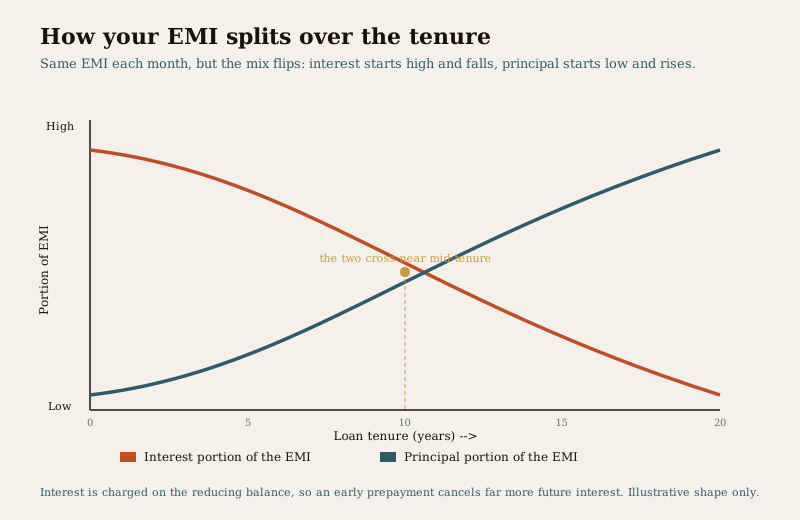
Two consequences follow. First, in the early years your outstanding balance barely moves even though you are paying diligently - most of your money is servicing interest. Second, a prepayment made early, when the balance is large, wipes out far more future interest than the same prepayment made late. See the numbers for yourself with the EMI calculator, and model an early lump-sum with the loan-prepayment calculator.
The journey - from application to disbursement
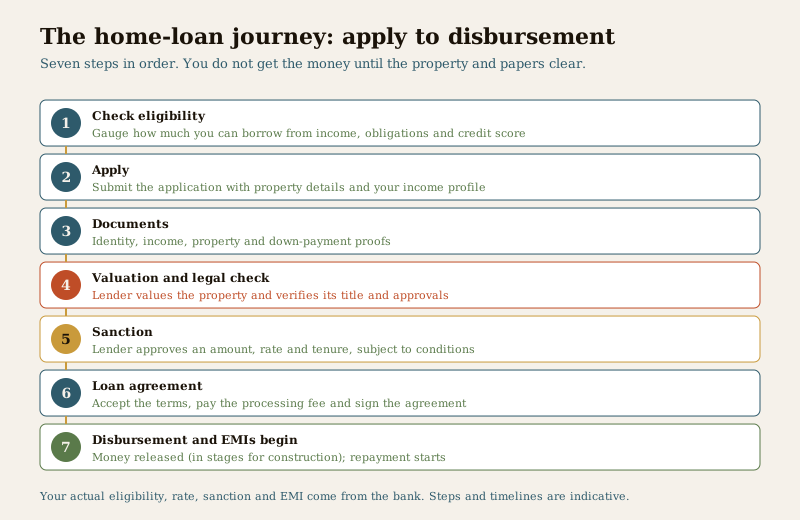
The loan moves through a fixed sequence. You do not get the money until the property and the paperwork clear, so the order matters.
| Step | What happens | Who leads it |
|---|---|---|
| Check eligibility | You gauge how much you can borrow from income, obligations and credit score | You (with the eligibility calculator) |
| Apply | Submit the application with the property details and your income profile | You and the lender |
| Documents | Provide identity, income, property and down-payment proofs | You (see the documents checklist) |
| Valuation and legal check | The lender values the property and verifies its title and approvals | The lender's valuer and lawyer |
| Sanction | The lender approves an amount, rate and tenure, subject to conditions | The lender |
| Loan agreement | You accept the terms, pay the processing fee and sign the agreement | You and the lender |
| Disbursement and EMIs | The money is released; your EMIs begin (in stages for construction) | The lender, then you |
A few things are worth knowing at each stage. Eligibility turns on your income, existing EMIs and credit score - the eligibility guide explains the sums, and a co-applicant can raise it, which is the subject of the joint home loan guide. The documents stage is smoother if you have the pack ready; the documents checklist is the master list. The valuation and legal check is the lender protecting its own security - it is not a substitute for your own due diligence when buying a plot or a home. Disbursement is a single release for a ready property, but staged against construction progress for a self-build, which is why a construction loan works differently and a bare plot uses a plot loan rather than a home loan.
The levers you control
You do not set the rate and you do not decide your own eligibility - the lender does. But four levers are genuinely yours, and together they decide how much the loan really costs you.
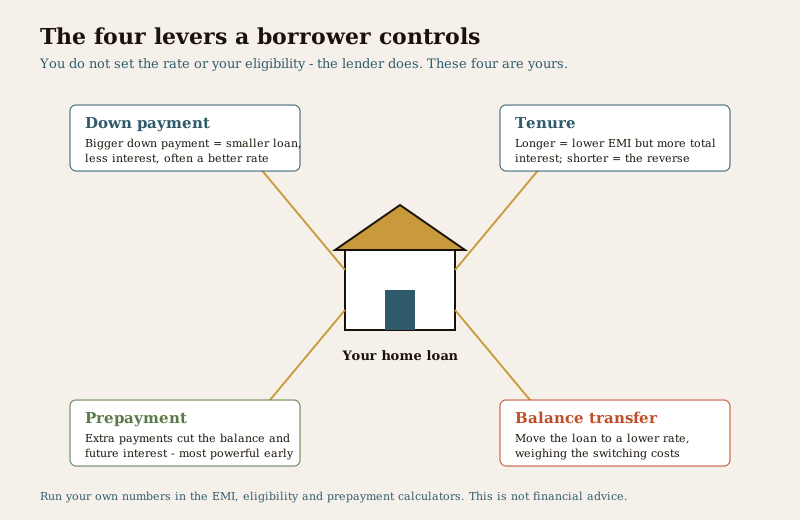
- Down payment. A larger down payment means a smaller loan, less interest overall and often a better rate. Plan it with the down-payment guide.
- Tenure. A longer tenure lowers the monthly EMI but raises the total interest paid; a shorter tenure does the reverse. Test both in the EMI calculator.
- Prepayment. Paying extra - a bonus, a windfall, a regular top-up - cuts the outstanding balance and the future interest, especially early. See prepayment and foreclosure and the loan-prepayment calculator.
- Balance transfer. If another lender offers a materially lower rate, you can move the outstanding loan across - weighing the switching costs. Read the balance-transfer guide.
Two more things shape the true cost. Tax relief on a home loan can reduce what it effectively costs you: interest and principal attract deductions under sections named generally as 80C, 24(b) and 80EEA - the limits and eligibility change with the budget, so confirm with a CA. The tax-benefits guide explains the shape of it, and the tax-benefit calculator estimates the effect. And first-time buyers in the eligible income bands may qualify for an interest subsidy under a scheme such as PMAY, whose slabs and windows change - see the PMAY subsidy guide and the PMAY subsidy calculator.
Where this fits in the money picture
The loan is one line in a larger budget. You also pay stamp duty and registration, and later property tax; if you sell, capital gains apply. Those live in the cost-and-budget hub, the stamp-duty guide and calculator, the property-tax guide, the capital-gains guide and calculator, and the TDS-on-property guide and calculator. Before you borrow, settle whether to rent or buy with the rent-vs-buy calculator, size the decision with the affordability guide and calculator, estimate a build with the house-construction cost calculator, and frame it all from the planning-your-project hub.
References
- Reserve Bank of India - the External Benchmark Lending Rate (EBLR) framework linking floating home-loan rates to an external benchmark such as the repo rate (named generally; confirm current provisions).
- Reserve Bank of India - regulation and supervision of banks and housing finance companies (HFCs), including fair-practices norms on charges and foreclosure.
- Income-tax deductions relevant to home loans, named generally - Section 80C (principal), Section 24(b) (interest) and Section 80EEA (additional interest for eligible first-time buyers). Limits and eligibility change with the annual budget; confirm with a CA.
- Pradhan Mantri Awas Yojana (PMAY) and Credit Linked Subsidy Scheme (CLSS) - income-band interest subsidy for eligible buyers; slabs and scheme windows change over time.
- Credit information bureaus (CIBIL and others) - the credit score that lenders use to assess and price your loan.
- All rates, limits, fees, tax sections and subsidy slabs above are indicative and change over time - get your actual rate, eligibility and EMI from the bank, tax specifics from a CA, and planning from a financial planner before acting.
Interactive · Explore your EMI
₹50.0 L loan @ 8.5% for 20 years
At 20-year tenure
₹43,391/month
Drag the tenure slider to highlight a different bar.
Export this guide
Related Guides — Deep-dive reading
Home Loan Eligibility Explained: How Much Loan Can You Get in India (2026)
A plain-language explainer of home loan eligibility in India - how income and the FOIR or EMI-to-income rule, your age and tenure, credit score, existing debts, employment type, a co-applicant, property value and LTV all decide how much a lender will sanction - with an indicative illustration table and ways to improve your number.
Home FinanceHome Loan Prepayment and Foreclosure in India: A Plain Guide (2026)
How paying extra into your home loan works - part-prepayment versus full foreclosure, whether to cut your EMI or your tenure, why prepaying early saves the most, and the honest trade-off against investing the money instead.
Home FinancePlot Loan vs Home Loan (India): LTV, Tenure, Tax and the Composite Loan Explained (2026)
If you are buying land, a plot loan is not the same product as a home loan - it usually funds only the land at a lower loan-to-value, runs a shorter tenure, is restricted to approved non-agricultural residential plots, and often carries a build-within-N-years condition. This guide compares plot loan, home loan and the composite (plot-plus-construction) loan, explains the tax-benefit difference, and helps you pick the right product for your situation.
Home FinanceRelated Tools — Try Free
Home Loan Affordability Calculator
Max eligible home loan and property price from your income, FOIR, LTV, tenure, and interest rate — with Section 24(b) + 80C tax savings.
Loan EligibilityStamp Duty Calculator — All Indian States
Stamp duty + registration charges for all 28 states and 8 UTs — gender concessions, urban/rural variants, metro cess built in.
Stamp DutyPMAY Subsidy Calculator
An illustrative net-present-value estimate of a credit-linked interest subsidy on a home loan. Verify the current scheme officially.
Finance Calculator