

Home Loan Prepayment and Foreclosure in India: A Plain Guide (2026)
How paying extra into your home loan works - part-prepayment versus full foreclosure, whether to cut your EMI or your tenure, why prepaying early saves the most, and the honest trade-off against investing the money instead.
A home loan is usually the longest, largest debt a family carries - often 15 to 20 years. The good news is you are not locked into that timeline. By paying extra into the loan, either in lump sums along the way or by closing it out entirely, you can finish years early and save a large amount of interest. This guide explains how that works in plain language, so you can decide what fits your situation and then run your own numbers.
This is an explainer, not financial advice. Your exact rate, outstanding balance, any charges, and whether a prepayment reduces your EMI or your tenure are decided by your bank or housing finance company - get them in writing. Interest rates, tax rules and lender charges are indicative and change (the RBI repo rate moves, budgets revise deductions, lenders update their terms). Confirm tax specifics with a CA or tax advisor, and treat the choice between prepaying and investing as a personal decision best weighed with a financial planner.
The two ways to pay a loan off faster
There are two distinct moves, and the difference matters.
Part-prepayment means paying an extra lump sum on top of your regular EMI, while the loan continues. That extra money goes straight against the outstanding principal - the amount you still owe. Because future interest is charged only on the balance, knocking the balance down means every future EMI carries less interest. You can do this once, or repeatedly, whenever you have spare cash (a bonus, a maturing deposit, a gift).
Full foreclosure (also called pre-closure) means paying off the entire remaining balance in one go and closing the loan before the scheduled end. The loan is over. You collect your original property documents from the lender, and you should obtain a "no dues" or loan closure certificate and ensure the charge on your property is released.
The mechanics are the same - extra money reduces principal - but foreclosure ends the relationship, while part-prepayment simply speeds it up.
After a part-prepayment: reduce the EMI or reduce the tenure?
When you make a part-prepayment, the principal drops. But your loan still has an EMI and a remaining term, and something has to give. You generally get to choose which one the lender keeps the same:
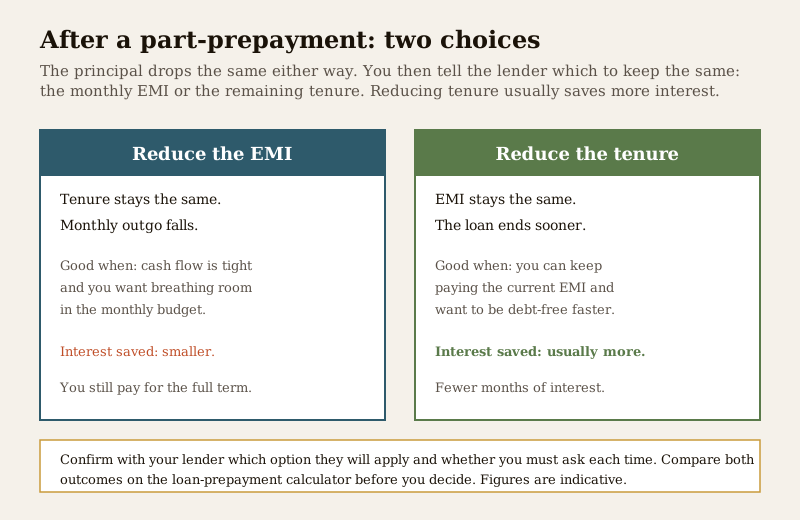
- Reduce the EMI, keep the tenure. Your monthly payment falls, but you keep paying for the full original term. This eases monthly cash flow - useful if the budget is tight or income is uncertain.
- Reduce the tenure, keep the EMI. You keep paying the same monthly amount, but the loan ends sooner. Because you are cutting months of interest off the back end, this usually saves more interest overall.
For most people who can comfortably keep paying the current EMI, reducing the tenure saves more. Reducing the EMI is the gentler choice when monthly breathing room matters more than the last rupee of interest saved.
| Question | Reduce the EMI | Reduce the tenure |
|---|---|---|
| What stays the same | The number of months left | Your monthly EMI amount |
| What changes | EMI falls each month | Loan ends earlier |
| Monthly cash flow | Eases immediately | Unchanged |
| Total interest saved | Smaller | Usually larger |
| Best when | Budget is tight, income uncertain | You can keep paying and want to be debt-free sooner |
| Watch for | You still pay across the full term | No monthly relief today |
One practical note: some lenders default to one option and require you to request the other, and a few ask you to re-confirm on each prepayment. Ask your lender exactly how they apply prepayments, and put your preference in writing.
Why prepaying early saves the most
Home loan EMIs are front-loaded with interest. In the first years, most of each EMI is interest and only a little chips away at the principal; by the final years it flips, and most of the EMI is principal. This is just how a reducing-balance loan works - interest is charged on a large outstanding balance early on.
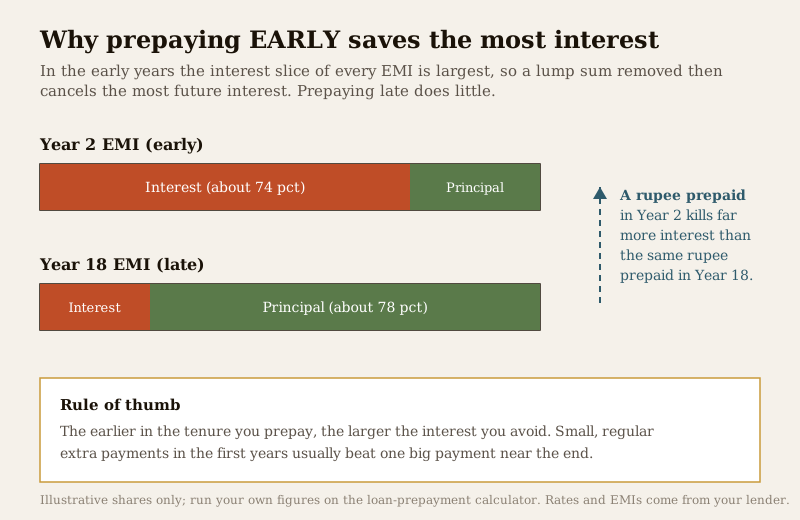
The consequence is powerful: a rupee prepaid early cancels far more future interest than the same rupee prepaid late. Prepaying in year two removes many years of interest that would have accrued on that amount. Prepaying in year eighteen, when little interest is left to charge, does much less.
Two takeaways follow. First, if you are going to prepay at all, sooner is better than later. Second, small, regular extra payments made in the early years often beat waiting to accumulate one big lump sum for later. Even modest annual top-ups in the first third of the tenure can shorten the loan meaningfully. Use the loan-prepayment calculator to see the effect for your own loan - the numbers are usually more dramatic than people expect.
The charges question: floating versus fixed
A common worry is whether the lender will penalise you for paying early. Here the type of interest rate matters.
For floating-rate home loans taken by individual (non-business) borrowers, the regulator's stated position has long been that lenders should not levy prepayment or foreclosure charges. In practice this means most retail floating-rate home loans in India can be prepaid or foreclosed without a penalty, including when you prepay from your own savings. This is a general position, not a promise about your specific loan.
For fixed-rate loans, or loans that are not purely individual/retail, a prepayment or foreclosure charge may apply, because the lender priced the loan expecting a fixed stream of interest. The charge is typically a percentage of the amount prepaid or the balance foreclosed.
Because rules and lender practices change, and because your loan may be fixed, floating, or a hybrid, do not assume. Read your sanction letter and loan agreement, and ask your lender directly:
- Is my loan floating-rate or fixed-rate right now?
- Are there any charges for part-prepayment or full foreclosure, and how are they calculated?
- Is there a limit or lock-in on how much or how often I can prepay in a year?
- Will a prepayment reduce my EMI or my tenure by default, and can I choose?
If you are on a fixed rate and want penalty-free prepayment, that can be one reason people look at switching lenders - see the balance transfer guide, which is a separate decision with its own costs.
Prepay, or invest the money instead?
Prepaying is not automatically the best use of a spare lump sum. The honest framing is a comparison: the interest you would save by prepaying versus the return you might earn by investing that money elsewhere - adjusted for risk, liquidity and tax.
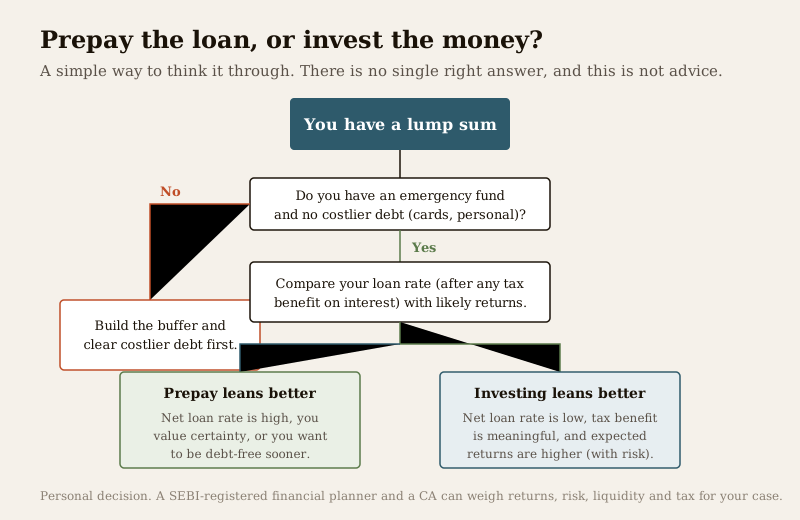
A few factors tilt the scales:
- Your effective loan cost. Home loan interest can qualify for income-tax deductions (commonly discussed under Section 24(b) for interest and Section 80C for principal, with limits that change and conditions to confirm with a CA). If you genuinely claim these, your effective borrowing cost is lower than the headline rate, which makes prepaying slightly less compelling. See the home-loan tax benefits guide.
- Expected returns versus certainty. Prepaying gives a guaranteed, risk-free "return" equal to your loan rate. An investment might earn more - but with risk and no guarantee. Paying off debt is certain; markets are not.
- Liquidity. Money put into the loan is hard to get back. Once prepaid, you cannot easily withdraw it if an emergency hits. Keep an emergency fund before you prepay.
- Peace of mind. For many families, being debt-free years early is worth more than squeezing out a slightly higher return. That is a valid, personal reason.
| Consideration | Leans toward prepaying | Leans toward investing |
|---|---|---|
| Effective loan rate (after tax benefit) | Higher | Lower |
| Value of certainty vs risk | You prefer a sure thing | You accept risk for higher expected return |
| Tax benefit you actually use | Small or none | Meaningful and fully utilised |
| Emergency fund | Already in place | Not yet built - build this first |
| Other high-cost debt | None outstanding | Clear cards/personal loans first |
| Emotional weight of debt | You want to be debt-free | You are comfortable carrying a low-cost loan |
Before any of this, two things come first: build an emergency fund, and clear costlier debt (credit cards, personal loans) whose interest is far higher than a home loan. Only then does the prepay-versus-invest question really apply. Because it depends on your income, tax position, risk appetite and goals, this is a personal decision - a SEBI-registered financial planner and a CA can weigh it for your specific case.
When prepaying makes sense, and when it may not
Prepaying tends to make sense when: you are early in the tenure, you have a stable emergency fund, you have no costlier debt, you do not rely heavily on the interest tax deduction, and you value being debt-free. Full foreclosure makes sense when you can clear the whole balance without draining your safety net - and, ideally, when there is no penalty to do so.
It may make less sense when: prepaying would wipe out your emergency savings, when a fixed-rate penalty eats much of the saving, when you are near the end of the tenure (little interest left to save), or when a meaningful tax benefit plus a realistic higher-return investment genuinely beats the interest saved. None of these are absolute rules - they are prompts to run the numbers.
How to actually do it
1. Check your loan type and any charges in your sanction letter, and ask the lender the four questions above.
2. Keep your emergency fund and clear costlier debt first.
3. Decide the goal - lower monthly outgo (reduce EMI) or finish sooner and save more interest (reduce tenure).
4. Model it on the loan-prepayment calculator, and use the EMI calculator to sanity-check any new EMI.
5. Make the payment through the lender's official channel, state whether it is a part-prepayment or full foreclosure, and specify EMI-reduction or tenure-reduction.
6. Collect written confirmation - a revised amortisation schedule for a part-prepayment, or a no-dues/closure certificate and your original property documents for a foreclosure.
Key takeaways
- Part-prepayment speeds the loan up; full foreclosure ends it early. Both work by cutting the outstanding principal.
- After a part-prepayment you usually choose: reduce the EMI (easier cash flow) or reduce the tenure (usually saves more interest).
- Prepaying early saves the most, because early EMIs are mostly interest - sooner beats later, and regular small top-ups can beat one late lump sum.
- Floating-rate home loans to individuals generally carry no prepayment or foreclosure penalty; fixed-rate loans may - confirm your loan type and charges in writing.
- Prepaying is not always best: weigh it against your emergency fund, costlier debt, the tax benefit you actually use, liquidity, and realistic investment returns.
- The binding numbers come from your lender; tax specifics from a CA; the prepay-versus-invest call is personal - a financial planner can help. Everything here is indicative.
Related guides and tools
- How home loans work in India - the pillar overview of the loan journey.
- Fixed vs floating interest rates - which type you have shapes prepayment charges.
- Home loan tax benefits: Section 80C and 24(b) - the deductions that lower your effective loan cost.
- Home loan balance transfer - switching lenders as an alternative to prepaying a costly loan.
- Run your own figures on the loan-prepayment calculator and the EMI calculator.
References
- Reserve Bank of India - guidance on foreclosure and prepayment charges on floating-rate term loans to individual borrowers (indicative; verify current position at rbi.org.in).
- Income-tax provisions on home loan interest and principal (Sections 24(b), 80C and related) - limits and conditions change; confirm with a CA or the Income Tax Department.
- Your loan sanction letter and loan agreement - the binding source for your rate, charges, and prepayment terms.
- Studio Matrx Home Finance hub - companion guides and calculators for the home-loan journey.
Interactive · Prepayment impact
₹5.0 L prepaid on a ₹40.0 L balance
Interest saved
₹14.0 L
EMI held constant; the prepayment clips months off the end.
Total interest paid — with vs without the prepayment.
Floating-rate home loans carry no prepayment penalty for individuals (RBI). Fixed-rate loans may. Assumes the EMI is unchanged and the tenure reduces. Illustrative.
Export this guide
Related Guides — Deep-dive reading
Home Loan Balance Transfer in India: When Refinancing to a Lower Rate Is Worth It (2026)
What a balance transfer really is, how to run the break-even before you switch lenders, the top-up option, the full process, and when it is smarter to just ask your own bank to re-price.
Home FinanceHow Home Loans Work in India: The Full Journey from Apply to EMI (2026)
A plain-language map of the home-loan journey end to end - what a home loan is, the players, the key terms, how interest and EMI work, the application-to-disbursement steps, and the levers you actually control - with a loan-journey table and a key-terms glossary.
Home FinanceHome Loan Eligibility Explained: How Much Loan Can You Get in India (2026)
A plain-language explainer of home loan eligibility in India - how income and the FOIR or EMI-to-income rule, your age and tenure, credit score, existing debts, employment type, a co-applicant, property value and LTV all decide how much a lender will sanction - with an indicative illustration table and ways to improve your number.
Home FinanceRelated Tools — Try Free
Home Loan EMI Calculator — 2026
Monthly EMI, total interest, tax savings, and year-by-year amortization across 10 bank rates.
EMI CalculatorBefore vs After — Cost Reality Check
Compare what you expected to pay vs what you actually paid, category by category.
Reality CheckInterior Budget Planner
Live room-wise and component-wise cost breakdown in ₹ with contingency, GST, and PDF summary.
Budget Calculator