

Home Loan Tax Benefits - Section 80C and 24(b) in India (2026)
How a home-loan borrower may claim income-tax deductions on principal, interest, stamp duty and first-time-buyer benefits - explained in plain language, with the limits and regime rules that keep changing left for your CA to confirm.
A home loan is one of the few large debts the Indian income-tax law actively rewards. Both the principal you repay and the interest you pay can reduce your taxable income - under different sections, with different rules, and up to caps that change from budget to budget. Used well, these deductions can quietly shave a meaningful amount off your annual tax. Used carelessly - or claimed under the wrong tax regime - they can vanish entirely.
This guide explains, in plain language, the main deductions a home-loan borrower may be able to claim: principal under Section 80C, interest under Section 24(b), the extra first-time-buyer interest benefit under 80EE / 80EEA, stamp duty and registration under 80C, how a joint loan can double the room, and the special "pre-construction interest" rule for a home still being built. It is a companion to our pillar, How home loans work in India, and to the guides on joint home loans and prepayment and foreclosure.
Scope and disclaimer: This is a plain-language explainer, not tax, legal or financial advice. Tax is a Chartered Accountant's domain. Every section limit, eligibility window and regime rule below is INDICATIVE and CHANGES - the annual Union Budget revises caps and thresholds, and special first-time-buyer schemes open and close on fixed dates. Crucially, whether these deductions apply AT ALL depends on which tax regime (old or new) you choose. Never treat any figure here as a fixed current limit. Confirm the current caps, your eligibility and the regime maths with a qualified CA or tax advisor before you file, and defer your actual EMI, sanction and interest split to your lender.
Two parts of every EMI - two different sections
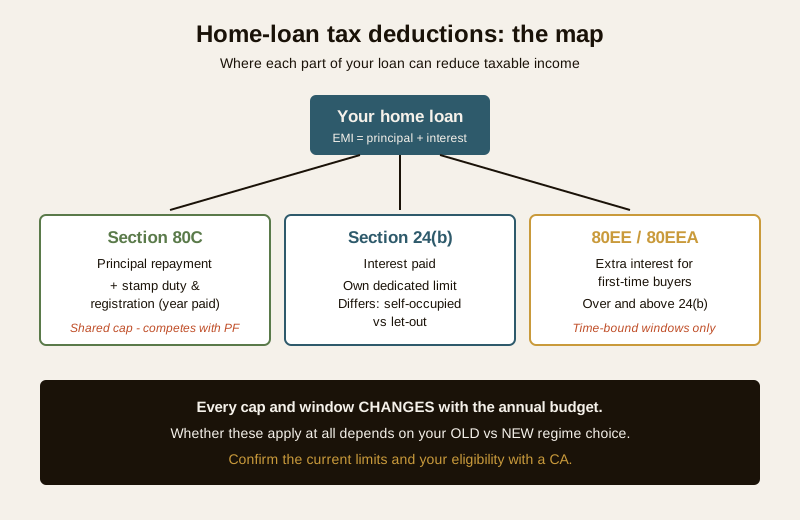
Every home-loan EMI is made of two parts: principal (repaying what you borrowed) and interest (the cost of borrowing). The tax law treats them completely separately.
- Principal repayment is a deduction under Section 80C - the same bucket that holds your PF, life insurance, ELSS and children's tuition. Because that bucket is shared and capped, your loan principal competes with everything else you already put there.
- Interest is a deduction under Section 24(b) - a separate, dedicated head under "income from house property", with its own limit that behaves differently for a home you live in versus one you rent out.
Your lender issues an annual "provisional" and "final" interest certificate that splits your EMIs into principal and interest for the year. That certificate is the document your CA works from - so keep it.
The sections at a glance
Here is the map of the main deductions a home-loan borrower may claim. The "cap" column is deliberately left as "a cap that changes" - because it does, almost every year.
| Section | What it covers | Who can claim | Cap |
|---|---|---|---|
| 80C | Principal repayment on a home loan | Owner who is also the borrower | Shared cap that changes - confirm with a CA |
| 80C | Stamp duty and registration charges | Owner, in the year actually paid | Within the same shared 80C cap |
| 24(b) | Interest on a home loan | Owner who is also the borrower | Cap differs for self-occupied vs let-out - confirm |
| 80EE | Extra interest for first-time buyers | First-timers, loans in a past window | Time-bound scheme - check if your loan qualifies |
| 80EEA | Extra interest for first-time buyers | First-timers, affordable-housing window | Time-bound scheme - check if your loan qualifies |
Notice two things. First, principal and stamp duty share ONE 80C cap - so if your 80C is already full from PF and insurance, extra home-loan principal may give you no further benefit. Second, 80EE and 80EEA are the interesting extras: they are meant to be OVER AND ABOVE the Section 24(b) interest limit, but they only apply to loans sanctioned inside specific past windows, for first-time buyers, subject to property-value and loan-amount conditions. Whether your loan falls inside any such open window is exactly the kind of thing to check with a CA, because those windows open and close by budget notification.
Self-occupied vs let-out - the interest rule that trips people up
Section 24(b) interest behaves very differently depending on how you use the property.
If the home is self-occupied (you live in it, or it is treated as such), the interest you can deduct is capped. If the home is let out (rented), the position is different: in principle the full interest is deductible against the rental income, but a separate rule limits how much overall "house property loss" you can set off against your other income in a year, with the balance carried forward. This is genuinely fiddly, and the exact figures move - so treat the table below as a shape, not a scoreboard.
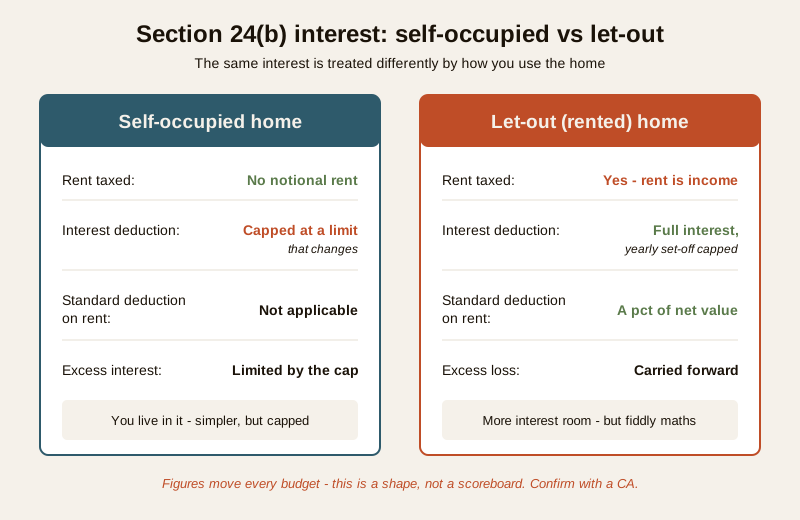
| Feature | Self-occupied home | Let-out (rented) home |
|---|---|---|
| Rental income taxed | No notional rent for a self-occupied home | Yes - rent received is taxable income |
| Interest deduction under 24(b) | Capped at a limit that changes | Full interest, but loss set-off is capped per year |
| Standard deduction on rent | Not applicable | A percentage of net annual value is allowed |
| Excess loss | Cannot exceed the self-occupied cap | Balance carried forward to future years |
| Principal under 80C | Same shared cap either way | Same shared cap either way |
The practical upshot: a rented second home can sometimes let you claim more interest than a self-occupied one - but the set-off and carry-forward maths is exactly where people get it wrong. A CA earns their fee here.
Stamp duty and registration - a one-time 80C claim
When you buy, you pay stamp duty and registration charges to the state. These are deductible under Section 80C - but only in the financial year you actually paid them, and only within the same shared 80C cap. So if you bought and paid these in the same year your 80C is already full of PF and insurance, the benefit may be limited. If you want to understand the charges themselves, see our guide on stamp duty in India.
Joint loans - two borrowers, potentially double the room
If a property is jointly owned AND the loan is jointly taken, each co-borrower who is also a co-owner can claim the deductions separately, in proportion to their share of ownership and repayment. In effect, a couple who both earn and both service the loan may each claim principal under 80C and interest under 24(b) up to their own limits - potentially doubling the household's total deduction.
The conditions matter, though: both people must be co-owners AND co-borrowers, and each can only claim to the extent they actually paid. Simply adding a spouse's name to the loan without ownership, or without them contributing to the EMI, does not create a valid claim. Our joint home loan guide walks through the ownership-and-repayment split in detail; the exact way to apportion it for tax is a CA's call.
Under-construction homes - the pre-construction interest rule
Here is the rule most first-time buyers miss. You often start paying interest on a home loan while the home is still being built - during the "pre-construction" or "pre-EMI" period. But you generally CANNOT claim that interest in the year you pay it. Instead, the interest paid before the year of completion is aggregated and then claimed in equal instalments over a number of years, starting from the financial year in which construction is completed and you take possession.
So if your flat is delayed for years, all that interest you paid meanwhile does not disappear - it waits, then flows into your returns in instalments once you get possession. It is subject to the same overall Section 24(b) limits, and it interacts with the self-occupied cap. This is a common source of missed or wrongly-timed claims, so flag any under-construction purchase to your CA early. If you are financing your own build, our construction loan guide explains how disbursement works.
Old regime vs new regime - the make-or-break question
None of the above may help you if you have chosen the wrong tax regime. India runs two parallel systems: an older regime with higher rates but a long menu of deductions, and a newer regime with lower rates but most of those deductions removed. Broadly, many of the home-loan deductions above are associated with the older, deduction-rich regime, while the newer regime is designed to be simpler and to NOT rely on them - with important exceptions and nuances that keep changing.
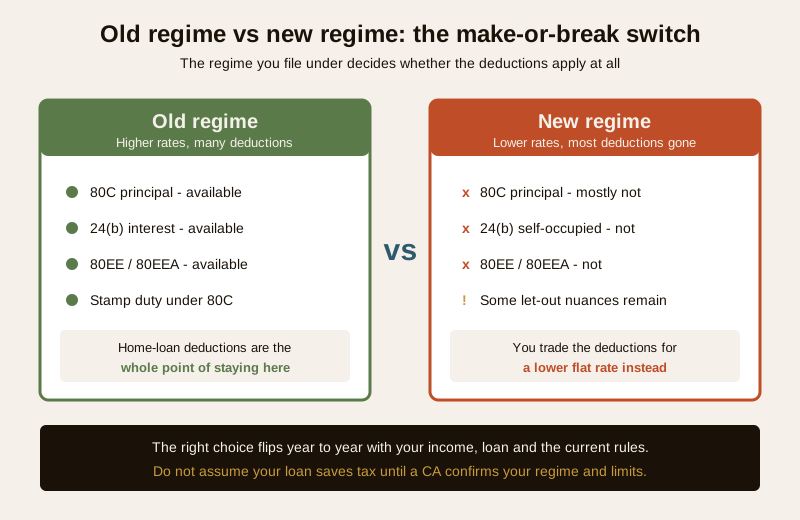
The point is not to tell you which regime wins - that depends entirely on your income, your other investments, your loan size and the current year's rules, which change annually. The point is to WARN you: do not assume your home loan is saving you tax until you have confirmed that the regime you are actually filing under lets you claim these sections. For many borrowers the answer flips year to year. This is precisely the calculation a CA runs for you - and precisely why you should not decide from a blog.
To see how the deductions might shape up for your own numbers before you talk to a CA, run them through our home-loan tax-benefit calculator. Treat its output as an estimate to discuss, not a filing.
Selling later - a quick pointer
The deductions above are about the years you HOLD and repay the loan. When you eventually SELL, a different set of rules - capital gains - applies, and the interest you have already claimed can interact with your cost of acquisition. That is a separate subject; see our capital gains in India guide, and again, confirm the treatment with a CA.
Key takeaways
- A home loan can give income-tax deductions on BOTH principal (Section 80C) and interest (Section 24(b)) - they are separate sections with separate rules.
- Principal AND stamp duty share one crowded 80C cap; interest has its own limit under 24(b) that differs for a self-occupied versus a let-out home.
- 80EE and 80EEA are extra first-time-buyer interest benefits, but only for loans inside specific past windows and subject to conditions - check if yours qualifies.
- A joint loan on a jointly-owned home can let each co-owner-borrower claim separately, potentially doubling the household benefit.
- Interest paid while a home is under construction is claimed later, in equal instalments from the year of completion - not in the year you pay it.
- Whether ANY of this applies depends on choosing the old versus new tax regime - a choice that can flip year to year.
- Every cap, window and rule here CHANGES. Confirm the current limits and your eligibility with a CA before you file.
References
- Income-tax Act sections on deductions for house property and repayment (Sections 24, 80C, 80EE, 80EEA) - as amended from time to time; confirm the current text and limits with a CA.
- Your lender's annual home-loan interest certificate (provisional and final) - the primary document for splitting principal and interest.
- Studio Matrx pillar: How home loans work in India.
- Studio Matrx: Joint home loan in India, Prepayment and foreclosure, Stamp duty in India, Capital gains in India.
- Studio Matrx tool: Home-loan tax-benefit calculator - run your own numbers, then confirm with a CA.
Interactive · Year-1 tax benefit
₹50.0 L @ 8.5% · 30% slab
Marginal tax slab (old regime)
Income tax saved (year 1)
₹89,853/yr
≈ ₹7,488/month back — effectively lowers your carrying cost.
Darker bar = deduction hit its statutory cap.
Old regime, self-occupied property. §80C is shared with other investments (EPF, ELSS, LIC). The new regime doesn't allow these deductions. Illustrative — confirm with your CA.
Export this guide
Related Guides — Deep-dive reading
Home Loan Prepayment and Foreclosure in India: A Plain Guide (2026)
How paying extra into your home loan works - part-prepayment versus full foreclosure, whether to cut your EMI or your tenure, why prepaying early saves the most, and the honest trade-off against investing the money instead.
Home FinancePMAY Home Loan Subsidy Explained: Credit-Linked Help for First-Home Buyers (2026)
A plain-language look at how the Pradhan Mantri Awas Yojana interest subsidy works on a home loan, who the income categories are meant for, and why you must confirm the current rules on the official portal or with your lender.
Home FinanceHow Home Loans Work in India: The Full Journey from Apply to EMI (2026)
A plain-language map of the home-loan journey end to end - what a home loan is, the players, the key terms, how interest and EMI work, the application-to-disbursement steps, and the levers you actually control - with a loan-journey table and a key-terms glossary.
Home FinanceRelated Tools — Try Free
Stamp Duty Calculator — All Indian States
Stamp duty + registration charges for all 28 states and 8 UTs — gender concessions, urban/rural variants, metro cess built in.
Stamp DutyHome Loan Affordability Calculator
Max eligible home loan and property price from your income, FOIR, LTV, tenure, and interest rate — with Section 24(b) + 80C tax savings.
Loan EligibilityCapital Gains Tax Calculator — Property
LTCG and STCG on property sale with Cost Inflation Index (CII) indexation, Section 54 and 54EC exemptions, and Budget 2024 dual-method comparison.
Capital Gains