

CIBIL Score for Home Loan: Credit Score Explained (India, 2026)
What a credit score is, why lenders care, what moves it, how to check yours for free, and how to improve it before you apply for a home loan.
When you apply for a home loan, one of the first things a lender pulls is your credit score. It is a three-digit number that sums up your track record with borrowed money, and it quietly shapes whether you are approved, how much you can borrow, and often the rate you are offered. The good news: a score is not fixed. You can understand it, check it for free, and improve it well before you apply.
This guide explains what the score is, why lenders lean on it, what goes into it, how to check yours, how to lift it, and the common myths worth ignoring. It is a plain-language companion to the numbers-heavy parts of your loan journey.
This is general education, not financial advice. Score bands, cut-offs and the link between a score and your interest rate are indicative and set by each lender and bureau - they change over time. Your actual approval, rate and eligibility come from the bank or lender; tax questions belong with a CA or tax advisor, and money planning with a financial planner. Always confirm the current position with your lender before you decide.
What a credit score actually is
A credit score is a number, usually on a scale that runs to the low 900s, that predicts how likely you are to repay what you borrow. It is calculated from your credit report - a record of your loans, credit cards, repayments, defaults and enquiries. The higher the number, the lower the risk you look to a lender.
In India the score is produced by licensed credit bureaus. The best known is often referred to simply as "CIBIL", but there are several bureaus, including Experian, Equifax and CRIF. Banks and housing finance companies may check one or more of them. Each bureau uses its own model, so your number can differ slightly from one to another. Treat any single score as an indication of the same underlying story rather than an exact, universal figure.
The score sits on top of your report. The report is the full history; the score is the summary. Lenders read both - the number for a quick sort, and the detail underneath to understand it.
Why lenders care so much
A home loan is a large, long commitment - often decades. Before handing over that much money, a lender wants evidence that you repay on time. Your score is the fastest read of that.
A stronger score generally means:
- Easier approval, with fewer questions and conditions.
- Access to a lender's standard rate card rather than a cautious, marked-up offer.
- More room to negotiate, because you are a lower-risk borrower.
A weaker score does not automatically mean rejection, but it can mean a smaller sanction, a request for a co-applicant or guarantor, a larger down payment, or a higher rate to offset the perceived risk. Because a home loan runs for so long, even a small rate difference driven by your score can add up over the full tenure. Run your own comparison with the site's EMI calculator at /utilities/emi-calculator to see how a rate change moves the monthly figure.
Remember that the score is only one input. Lenders also weigh your income, existing obligations, job stability, the property and more. The companion guide at /guides/home-loan-eligibility-explained-india walks through how those pieces fit together.
What goes into your score
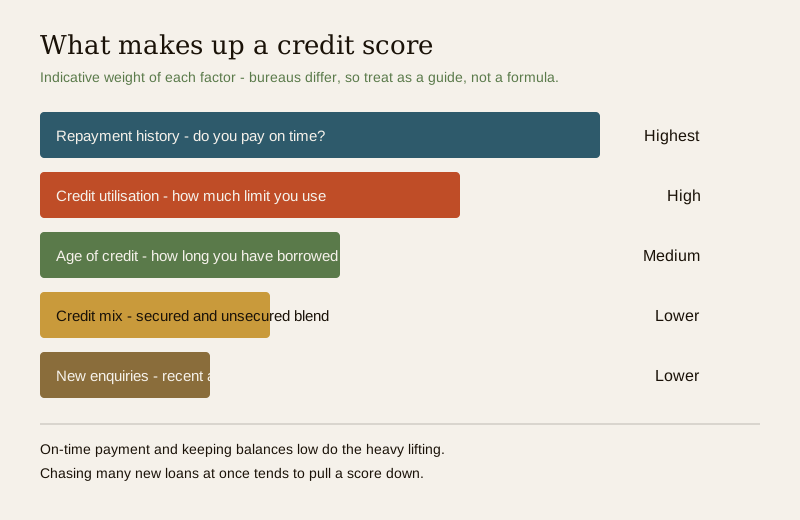
Bureaus keep the exact formula private and each weighs things a little differently, but the main ingredients are well understood. The table below shows what tends to matter most and how to keep each one healthy.
| Factor | Roughly how much it counts | Why it matters and what helps |
|---|---|---|
| Repayment history | Highest | Whether you pay EMIs and card bills on time. A single default or a run of late payments hurts most. Pay on or before every due date. |
| Credit utilisation | High | How much of your card limits you actually use. High balances signal stress. Keep usage well below your limit. |
| Age of credit | Medium | How long you have held credit. A longer, clean history reads as reliable. Keep older accounts open. |
| Credit mix | Lower | The blend of secured loans and unsecured cards. A sensible mix helps a little; do not borrow just to build one. |
| New enquiries | Lower | How many fresh applications you have made recently. Many at once can look like distress. Space them out. |
Two of these do most of the work: paying on time and keeping balances low. If you focus your energy anywhere, focus it there.
The score bands lenders read
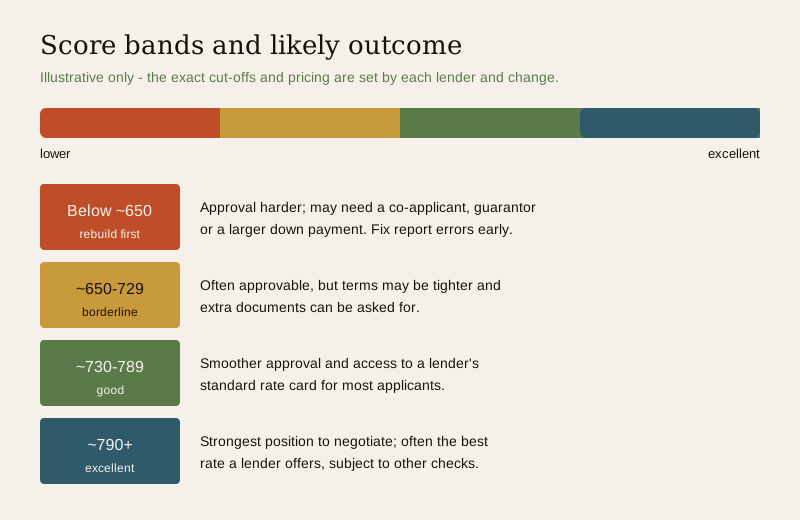
Lenders group scores into broad bands and treat each band differently. The cut-offs below are illustrative - every lender sets its own thresholds and pricing, and those move over time - but they show the general shape of how a score is read.
| Indicative band | How a lender tends to read it | Likely outcome |
|---|---|---|
| Below about 650 | Higher risk; thin or blemished history | Approval is harder. Expect requests for a co-applicant, guarantor or a larger down payment. Rebuild before applying. |
| About 650 to 729 | Borderline | Often approvable, but terms may be tighter and extra documents can be asked for. |
| About 730 to 789 | Good | Smoother approval and access to the standard rate card for most applicants. |
| About 790 and above | Excellent | The strongest position to negotiate, often the best rate a lender offers, subject to its other checks. |
Do not treat a band as a promise. A high score with weak income or heavy existing debt can still be declined, and a modest score backed by strong income and a co-applicant can still succeed. The score opens or narrows the conversation; it does not settle it.
How to check your score
You are entitled to see your own credit information, and checking it yourself does not hurt your score. There are two kinds of enquiry, and the difference matters:
- A "soft" enquiry is you checking your own report, or a lender pre-screening you. It has no effect on your score.
- A "hard" enquiry is a lender pulling your report because you applied for credit. Several hard enquiries in a short window can pull a score down a little.
So checking your own score often is completely safe. Each bureau is required to provide a free full credit report to you periodically - commonly described as one free report a year per bureau - and many banks, card issuers and money apps show a score for free too. Because there are several bureaus, you can stagger your free reports across the year to keep an eye on things at no cost.
When you look, do not just glance at the number. Read the report underneath for:
- Accounts you do not recognise, which can signal an error or misuse.
- Loans or cards shown as open that you have actually closed.
- Wrong "overdue" or "settled" markings against accounts you paid in full.
- Personal details - name, PAN, address - that are mixed up with someone else's file.
Errors are more common than people expect, and they quietly drag a score down. Finding them early gives you time to fix them before you apply.
How to improve your score
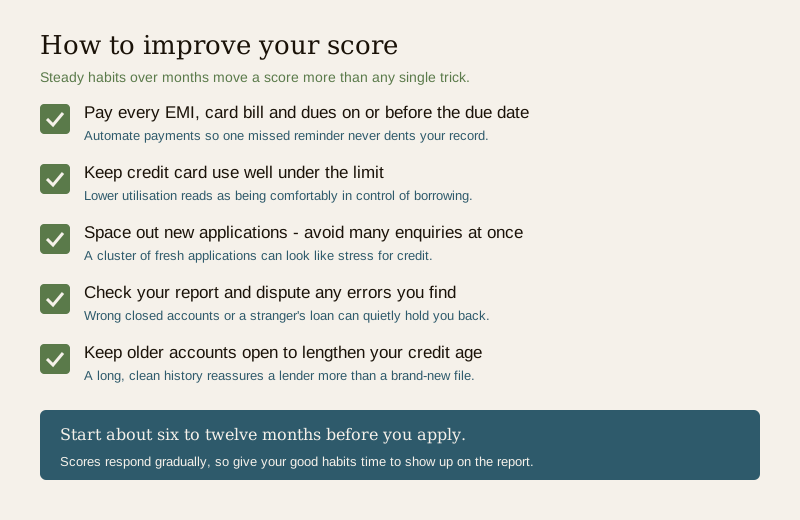
Improving a score is less about clever tricks and more about steady habits that show up over months. If a home loan is on the horizon, start early - ideally six to twelve months before you apply.
Pay on time, every time. This is the single biggest lever. Set up auto-pay or reminders for every EMI and card bill so one forgotten due date never marks your record.
Keep utilisation low. Try to use only a modest slice of your card limits, and pay balances down before the statement date if you can. Low utilisation reads as being comfortably in control.
Space out new applications. Avoid applying for several cards or loans in a short window, especially just before a home-loan application. Each hard enquiry leaves a mark, and a cluster can look like stress.
Fix report errors. If you spot a mistake, raise a dispute with the bureau. Corrections take time, so do this well ahead of applying.
Keep old accounts open. A long history helps. Closing your oldest card can shorten your credit age and nudge the number down, so keep a clean older account running.
Do not borrow just to build a mix. A varied credit mix helps a little, but taking on debt you do not need to game the score is a poor trade. Let the mix build naturally.
None of this moves the number overnight. Scores respond gradually, which is exactly why starting early beats scrambling in the last month before you apply.
Common myths worth ignoring
- "Checking my own score lowers it." It does not. Only hard enquiries from applications count, and viewing your own report is a soft enquiry.
- "I have never borrowed, so my score must be great." A thin file with no history can be as hard to lend against as a poor one, because there is nothing to judge. Some sensible, well-repaid credit builds a track record.
- "Closing all my cards helps." It often hurts, by shortening your history and raising utilisation on what remains.
- "Settling a loan is the same as paying it in full." A "settled" status - where a lender accepts less than owed - can read worse than a clean, fully-paid closure. Aim to close accounts as fully paid.
- "One score fits every lender." Each bureau and lender uses its own model and cut-offs, so numbers and outcomes vary. Your score is a strong indicator, not a guaranteed ticket.
Where the score fits in your loan journey
Your score is the first gate, not the whole path. Once it is in good shape, the rest of the journey follows: understanding how loans work, choosing the right product, gathering documents and confirming eligibility. These guides carry the story forward:
- Start with the overview at /guides/how-home-loans-work-india to see the full journey.
- Compare products at /guides/home-loan-types-india so you apply for the right one.
- Check what lenders assess alongside your score at /guides/home-loan-eligibility-explained-india.
- Prepare your paperwork with /guides/home-loan-documents-checklist-india so a clean score is not held up by missing documents.
When you are ready to test real numbers, use /utilities/loan-eligibility and /utilities/emi-calculator to see how your position translates into an amount and a monthly payment - then take those to a lender for a binding offer.
Key takeaways
- A credit score is a lender's quick read of how reliably you repay; the report underneath tells the fuller story.
- Several bureaus - commonly CIBIL, plus Experian, Equifax and CRIF - each produce a score using their own model, so numbers can differ.
- A stronger score usually means easier approval and often a better rate, but income, obligations and the property still matter.
- Repayment history and credit utilisation carry the most weight; age, mix and enquiries matter less.
- Checking your own score is free and harmless; do it periodically and read the report for errors.
- Improve a score with steady habits over months - pay on time, keep balances low, space out applications and fix errors - starting well before you apply.
- Bands, cut-offs and the score-to-rate link are indicative and lender-specific; confirm the current position with your lender.
References
- Reserve Bank of India (RBI) - guidance on credit information companies and consumer access to credit reports, rbi.org.in.
- Credit Information Companies (Regulation) Act framework - the basis on which bureaus operate and provide free reports to individuals.
- Individual credit bureau consumer resources - CIBIL, Experian, Equifax and CRIF High Mark - for checking your own report and raising disputes.
- Your lender's published eligibility and interest-rate policy, which sets the actual bands, cut-offs and pricing that apply to you.
Interactive · What your CIBIL score costs
Score 700–749 → 8.80% on ₹50.0 L
Your CIBIL band
Extra interest vs an 800+ score
₹3.0 L
Raising the score before you apply can claw this back.
Lifetime interest by score band — your band highlighted.
Rate premiums per band are illustrative — actual pricing varies by lender, income profile and product. Below ~650 many lenders decline outright. Not a rate quote.
Export this guide
Related Guides — Deep-dive reading
Home Loan Eligibility Explained: How Much Loan Can You Get in India (2026)
A plain-language explainer of home loan eligibility in India - how income and the FOIR or EMI-to-income rule, your age and tenure, credit score, existing debts, employment type, a co-applicant, property value and LTV all decide how much a lender will sanction - with an indicative illustration table and ways to improve your number.
Home FinanceHow Home Loans Work in India: The Full Journey from Apply to EMI (2026)
A plain-language map of the home-loan journey end to end - what a home loan is, the players, the key terms, how interest and EMI work, the application-to-disbursement steps, and the levers you actually control - with a loan-journey table and a key-terms glossary.
Home FinanceHome Loan Prepayment and Foreclosure in India: A Plain Guide (2026)
How paying extra into your home loan works - part-prepayment versus full foreclosure, whether to cut your EMI or your tenure, why prepaying early saves the most, and the honest trade-off against investing the money instead.
Home FinanceRelated Tools — Try Free
Home Loan EMI Calculator — 2026
Monthly EMI, total interest, tax savings, and year-by-year amortization across 10 bank rates.
EMI CalculatorHome Loan Eligibility Checker
Eligible home loan amount across 12 Indian banks with rates, tenure, FOIR, and processing fees.
Loan CalculatorCross-Ventilation Analyzer
Estimate airflow and air changes per hour (ACH) from room size, window areas, layout, and local wind — with NBC 2016 Part 8 compliance check.
Ventilation Calculator