

Fixed vs Floating Interest Rate on a Home Loan in India (2026)
How the two rate structures work under the RBI repo-linked (EBLR) regime, what happens to your EMI or tenure when rates move, and who each one really suits.
When you take a home loan in India, one early question decides how the loan behaves for the next fifteen or twenty years: should the interest rate be "floating" or "fixed"? It is not a small detail. It shapes whether your EMI is predictable, whether it can rise when the Reserve Bank of India (RBI) tightens policy, and whether you can prepay freely without a penalty. This guide explains both structures in plain language, plus the "hybrid" option that sits between them, so you can walk into the bank knowing what you are choosing and why.
This is a companion to our pillar, How home loans work in India, and to Home loan types explained. Read them together for the full picture.
Scope and disclaimer: This is a plain-language explainer, not financial, tax or investment advice. Your actual interest rate, spread, reset mechanism and any charges are set entirely by your lender and depend on your profile, the RBI policy rate and market conditions - all of which change. Every rate direction, example and rule of thumb here is indicative only. Confirm your exact rate and reset terms in the loan sanction letter and key facts statement from the bank, and discuss your overall plan with a qualified financial planner before you commit.
The two structures in one paragraph
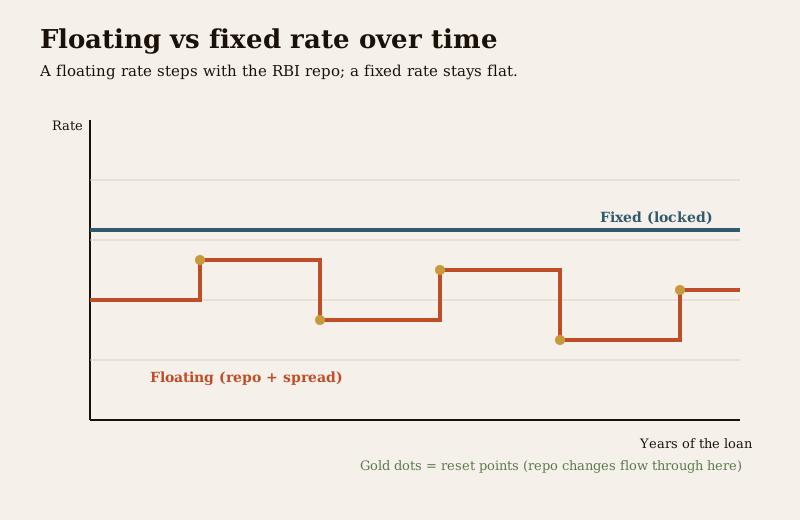
A "floating" (or "adjustable") rate is tied to an external benchmark. When the benchmark moves, your rate moves with it - up or down - at defined reset points. A "fixed" rate is locked at a set figure for a defined period (sometimes the full tenure), so it does not move even if market rates do. Floating rates are usually a little lower to start with and, for individual home-loan borrowers, generally carry no or low prepayment penalty. Fixed rates buy you certainty, but you usually pay for that certainty with a higher rate and, often, a prepayment or foreclosure charge. Most home loans in India are floating; fixed and hybrid options exist but are less common.
How a floating rate actually works: EBLR and the spread
Since October 2019, the RBI has required banks to link new floating-rate retail loans, including most home loans, to an "external benchmark". For the vast majority of home loans that benchmark is the RBI "repo rate" - the rate at which the RBI lends to banks. This is called the External Benchmark Lending Rate, or "EBLR" regime. (Older loans may still sit on earlier internal benchmarks such as the MCLR or the base rate; those move more slowly and less transparently.)
Your floating rate is built in two parts:
- The "benchmark" - the RBI repo rate, which the central bank reviews and can change at its policy meetings.
- The "spread" (also called the margin) - a fixed add-on the bank charges on top of the benchmark. The spread reflects the bank's cost, plus a risk premium that depends on your credit profile, loan size and property. Once set, the spread on a given loan usually stays put; the benchmark part is what moves.
So your rate is roughly "repo rate plus spread". When the RBI raises the repo rate, your floating rate rises by the same amount at the next reset. When the RBI cuts, it falls. Because the benchmark is public and the change is mechanical, a floating rate is transparent: you can see exactly why it moved.
Under the external-benchmark rules, floating rates are typically reset at least once every three months. The reset is not instant on the day the RBI acts - it flows through at your loan's next scheduled reset date. Your loan documents state the reset frequency; confirm it.
When rates rise: does your EMI change, or your tenure?
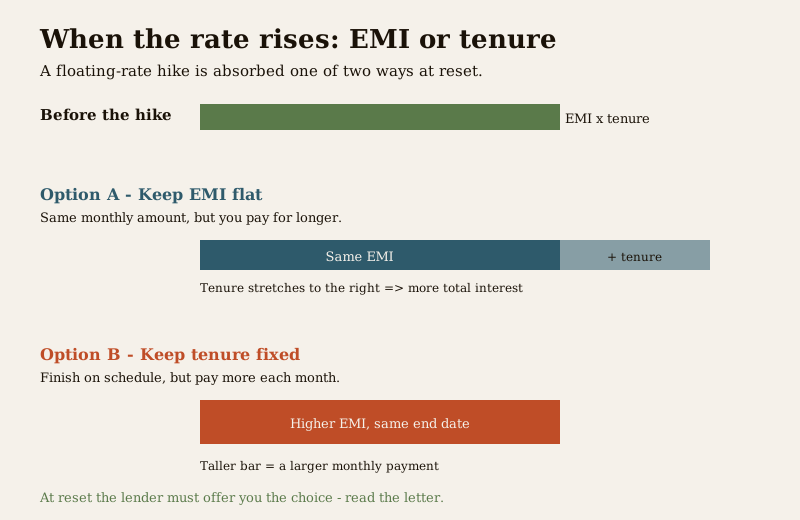
This is the part borrowers most often misunderstand. When your floating rate goes up, the bank can adjust the loan in two ways, and the default is not always what you expect:
- Keep the EMI the same and "extend the tenure" - you pay the same monthly amount for longer. This is the common default, because a steady EMI is easier on a household budget.
- Keep the tenure the same and "raise the EMI" - you finish on schedule but pay more each month.
Following an RBI framework introduced to protect borrowers, lenders must, at the time of a reset, give you clear options - such as increasing the EMI, extending the tenure, or a combination - and let you switch to a fixed rate where the product allows. There are limits: a tenure cannot stretch so far that the loan never clears within a reasonable working life, and negative amortisation (where the EMI does not even cover the interest, so the balance grows) must be avoided. Read every reset letter and choose deliberately - silently extending the tenure can add years and a large amount of total interest.
To see how a small rate change moves your EMI or your payoff date, run your own figures on the EMI calculator. Change only the rate and watch the EMI and total interest move - it makes the trade-off concrete.
How a fixed rate works, and its catches
A fixed rate locks your interest for a stated period. Two things are worth knowing:
- "Fixed" is often not fixed for the whole tenure. Many so-called fixed home loans are fixed only for an initial block - say two, three, five or ten years - and then convert to floating. Read the sanction letter for the exact lock period, or you may be surprised when it resets later.
- Fixed loans commonly carry a "prepayment or foreclosure charge", especially if you repay from your own funds early or refinance elsewhere. This is different from floating home loans to individuals, where the RBI does not permit foreclosure or prepayment penalties on floating-rate term loans. If flexibility to prepay matters to you, that difference is significant. See Prepayment and foreclosure for how those charges and savings work.
The upside of fixed is simple and real: certainty. Your EMI will not rise even if the RBI hikes aggressively. For a household on a tight, fixed monthly budget, that predictability can be worth paying a slightly higher rate for.
The hybrid or semi-fixed option
Between the two sits the "hybrid" (sometimes "semi-fixed" or "fixed-then-floating") loan. The rate is fixed for an initial period - giving you certainty through the early, interest-heavy years - and then automatically switches to a floating rate for the remainder. It is a middle path: you get a predictable start when the outstanding balance and interest burden are largest, then ride the benchmark later. The trade-off is that you inherit floating-rate risk exactly when you have less control over timing. Check the fixed-period length, the rate that applies after conversion, and whether any charges apply if you exit during the fixed block.
Fixed vs floating: side-by-side
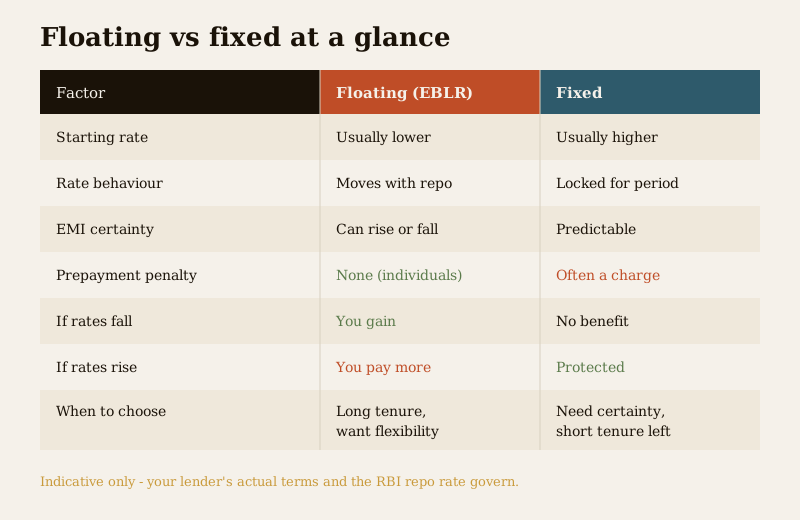
The table below summarises the practical differences. Treat every "typically" as indicative - your lender's actual terms govern.
| Factor | Floating (repo-linked / EBLR) | Fixed |
|---|---|---|
| Starting rate | Usually lower | Usually higher |
| Rate behaviour | Moves with the RBI repo rate at each reset | Locked for the fixed period |
| EMI certainty | Can rise or fall; less predictable | Predictable within the lock period |
| Transparency | High - benchmark is public | Set by the bank; no benchmark link |
| Prepayment / foreclosure | Generally no penalty for individuals | Often carries a charge |
| Benefit if rates fall | You gain - rate drops automatically | No benefit; you stay locked |
| Risk if rates rise | Your EMI or tenure increases | You are protected |
| Common use | The default for most home loans | Chosen for certainty / short remaining tenure |
What happens when the RBI raises rates
Here is the same event - a repo hike - seen from both structures, so you can picture your own position.
| At the next reset, after an RBI hike | If your loan is floating | If your loan is fixed |
|---|---|---|
| Your interest rate | Rises by the repo change | Unchanged (within the lock period) |
| Your EMI | Rises, unless you extend tenure instead | Unchanged |
| Your tenure | Lengthens, if you keep the EMI flat | Unchanged |
| Total interest over the loan | Increases | Unchanged during the lock |
| Your choice at reset | Bank must offer options - higher EMI, longer tenure, or switch to fixed | None needed until the fixed period ends |
The mirror image is also true. If the RBI "cuts" rates, a floating borrower benefits automatically at the next reset, while a fixed borrower keeps paying the older, higher rate until the lock ends.
Who each one suits
There is no universally correct answer - it depends on your risk appetite, your read of where rates are headed (which nobody can know for certain), and how much tenure you have left.
- "Floating" tends to suit borrowers who can absorb some EMI variation, who value the freedom to prepay without penalty, who have a long tenure ahead, and who believe rates are stable or likely to fall. It is the mainstream choice for a reason - lower entry rate and full prepayment flexibility.
- "Fixed" tends to suit borrowers who need budget certainty above all, who are risk-averse, who expect rates to rise, or who have only a few years left and want to lock in a known cost. The certainty premium is smaller in rupee terms when the outstanding balance is already low.
- "Hybrid / semi-fixed" tends to suit borrowers who want certainty through the early, interest-heavy years but are comfortable floating later.
If you already have a loan and your floating rate feels high relative to what new borrowers are being offered, do not assume you are stuck. You can often negotiate the spread with your existing lender, or move the loan elsewhere - see Home loan balance transfer for how that works and when it is worth the switching cost.
A note on comparing offers
When you compare two floating offers, look past the headline rate to the "spread" over the repo benchmark, because that spread is the part that stays with you. A low teaser rate with a fat spread can end up costlier than a slightly higher rate with a thin spread once the benchmark moves. For fixed and hybrid offers, note the exact lock period and the prepayment charge. Always read the "key facts statement" and sanction letter, and where you can, run the numbers yourself before you sign.
Key takeaways
- Floating rates are linked to the RBI repo rate under the EBLR regime: rate equals benchmark plus a fixed spread, and it resets at least quarterly.
- When rates rise, a floating loan raises your EMI or lengthens your tenure; the bank must offer you a choice at reset - read every reset letter.
- Fixed rates lock your EMI for a period (often not the whole tenure) but usually cost more and may carry a prepayment charge.
- Floating home loans to individuals generally have no prepayment or foreclosure penalty; fixed loans often do.
- Hybrid loans fix the rate early, then float - a middle path.
- There is no single right answer: it depends on your risk appetite, rate outlook and remaining tenure. Confirm your actual rate and terms with the lender; this is not financial advice.
References
- Reserve Bank of India - External Benchmark Based Lending framework (repo-linked floating rates), rbi.org.in.
- Reserve Bank of India - guidelines on reset of floating interest rates on EMI-based personal loans (borrower options at reset), rbi.org.in.
- Reserve Bank of India - regulations on foreclosure and prepayment charges on floating-rate term loans to individual borrowers, rbi.org.in.
- Studio Matrx guide: How home loans work in India.
- Studio Matrx guide: Home loan types explained.
- Studio Matrx guide: Prepayment and foreclosure.
- Studio Matrx guide: Home loan balance transfer.
- Studio Matrx tool: EMI calculator.
Last verified July 2026. Interest-rate structures, the RBI repo rate and reset rules change - reconfirm your exact terms with your lender.
Interactive · Fixed vs floating
₹50.0 L · 20 yrs · Stable
Floating rate scenario (avg over tenure)
Cheaper under this scenario
Floating · saves ₹3.8 L
Total interest over the full tenure — shorter bar wins.
Floating cost is modelled as a constant average rate over the tenure; real floating rates reset with the RBI repo rate, so actual cost varies. Illustrative — not financial advice.
Export this guide
Related Guides — Deep-dive reading
Home Loan Balance Transfer in India: When Refinancing to a Lower Rate Is Worth It (2026)
What a balance transfer really is, how to run the break-even before you switch lenders, the top-up option, the full process, and when it is smarter to just ask your own bank to re-price.
Home FinanceHome Loan Prepayment and Foreclosure in India: A Plain Guide (2026)
How paying extra into your home loan works - part-prepayment versus full foreclosure, whether to cut your EMI or your tenure, why prepaying early saves the most, and the honest trade-off against investing the money instead.
Home FinanceHow Home Loans Work in India: The Full Journey from Apply to EMI (2026)
A plain-language map of the home-loan journey end to end - what a home loan is, the players, the key terms, how interest and EMI work, the application-to-disbursement steps, and the levers you actually control - with a loan-journey table and a key-terms glossary.
Home FinanceRelated Tools — Try Free
Home Loan EMI Calculator — 2026
Monthly EMI, total interest, tax savings, and year-by-year amortization across 10 bank rates.
EMI CalculatorBefore vs After — Cost Reality Check
Compare what you expected to pay vs what you actually paid, category by category.
Reality CheckStamp Duty Calculator — All Indian States
Stamp duty + registration charges for all 28 states and 8 UTs — gender concessions, urban/rural variants, metro cess built in.
Stamp Duty