
Stamp Duty in India 2026 — State-wise Guide
Rates, Registration Charges, Concessions & How to Calculate Your Liability
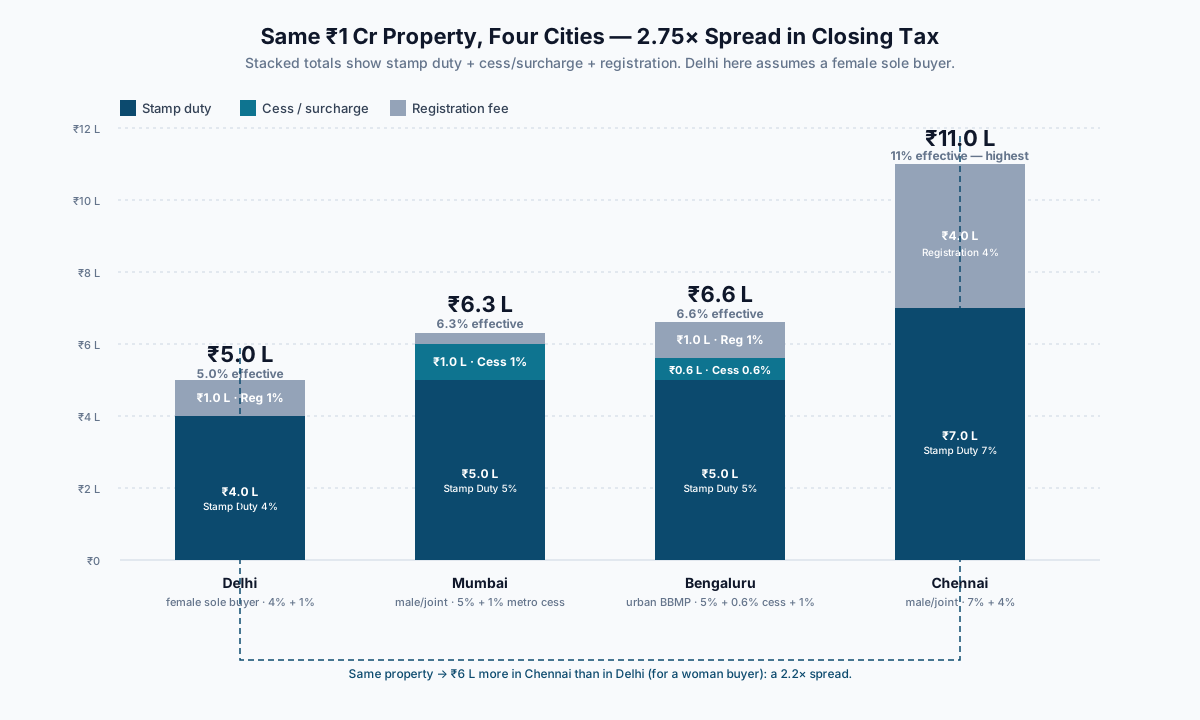
When you buy a flat in Mumbai, a villa in Bengaluru, or a plot in Pune, the sticker price is only part of the bill. A separate cost — often between 5% and 8% of the transaction — is owed to the state government the moment you register the sale deed. This is stamp duty, and in most Indian cities it is the single largest closing cost a homebuyer pays.
For a ₹1 crore apartment in Mumbai, stamp duty and registration together cost roughly ₹6 lakh. The same apartment in Chennai attracts closer to ₹11 lakh, because Tamil Nadu stacks an unusually high 4% registration fee on top of its 7% stamp duty. In Delhi, a woman buying in her own name pays 2% less than a man — a concession that can save over ₹2 lakh on a ₹1 crore flat.
These variations are not administrative trivia. They affect whether you can afford a property, whose name the sale deed should be in, and even which city is financially sensible for you to buy in. Yet most homebuyers discover stamp duty as a line item on the registration day — long after every other decision has been locked in.
This guide provides a complete 2026 reference — state by state, with rates, concessions, worked examples, and the legal framework behind the numbers.
>
Runs the math for any of the 28 states or 8 UTs, factoring in gender concessions, urban/rural variations, caps, and cess. Useful while reading this guide — switch between tabs to compare scenarios.
What Stamp Duty Actually Is
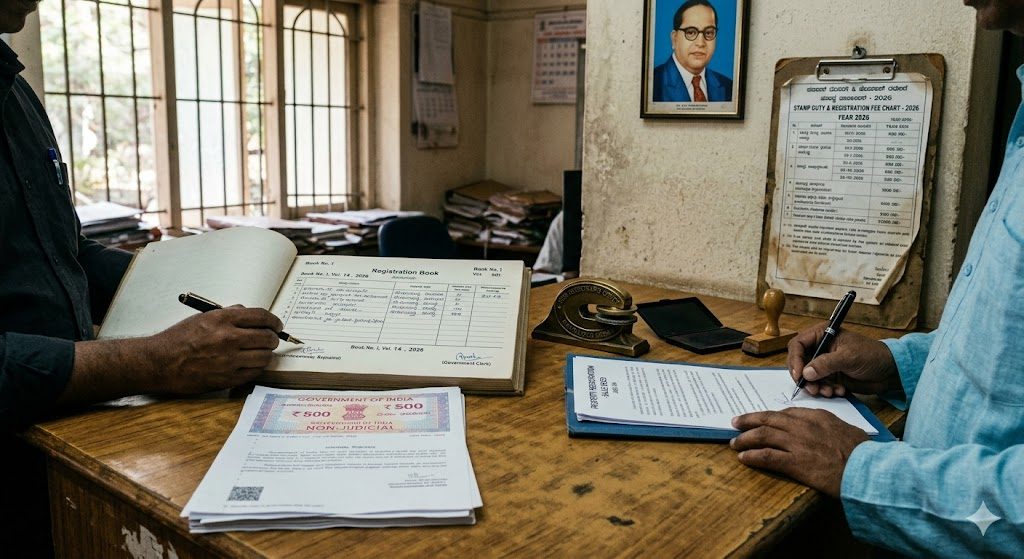
Stamp duty is a tax on a document, not on a transaction. The legal basis is the Indian Stamp Act, 1899 — one of the few colonial-era statutes still in near-original form — which requires certain documents to be "duly stamped" before they can be presented as evidence or registered with a government authority (Government of India, 1899).
Section 17 of the Registration Act, 1908 makes registration of sale deeds compulsory for property worth ₹100 or more. Section 17(1)(b) ensures no conveyance of immovable property can be legally recognised without registration, and no registration can happen without the correct stamp duty paid (Government of India, 1908). This coupling — "no stamp, no registration, no title" — is the mechanism by which the state collects its share of every real estate transaction.
In 2016, the 46th Amendment to the Constitution brought stamp duty under the concurrent list, meaning both the Centre and States can legislate on it. In practice, states control their own rates for immovable property, while the Centre sets rates for bills of exchange, promissory notes, and insurance policies.
"Stamp duty is the oldest form of tax and has been the backbone of our registration system for over a century. Unlike GST, it is one of the few taxes entirely within state hands — which is why you will never find a uniform rate across India." — Justice K. K. Mathew, as quoted in Nariman (2006, p. 212).
How Stamp Duty is Calculated
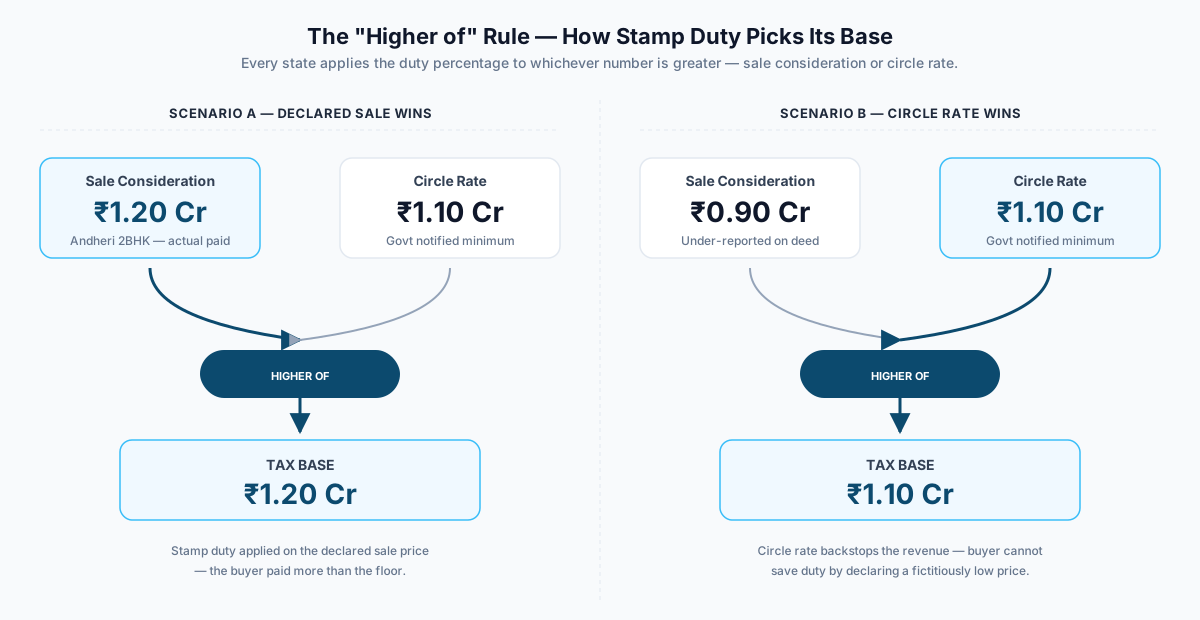
Every state applies the stamp duty percentage to the higher of:
1. The sale consideration — the actual amount the buyer paid.
2. The circle rate (also called ready reckoner rate, guidance value, or fair market value) — the government-notified minimum value for the locality.
The purpose of this "higher-of" rule is to prevent under-reporting of transaction values. If a seller and buyer collude to declare a lower sale price (to save on duty and capital gains tax), the circle rate backstops the revenue.
Worked Example — Mumbai
Assume you buy a 2BHK in Andheri for ₹1.2 crore. The government circle rate for your building is ₹1.1 crore. Stamp duty is calculated on ₹1.2 crore because that is higher.
| Line item | Rate | Amount |
|---|---|---|
| Stamp duty (base) | 5% of ₹1.2 Cr | ₹6,00,000 |
| Metro cess (Mumbai is a metro) | 1% of ₹1.2 Cr | ₹1,20,000 |
| Registration fee | 1%, capped at ₹30,000 | ₹30,000 |
| Total closing tax | — | ₹7,50,000 |
If the buyer is a woman registering in her sole name, the base rate drops to 4% — saving ₹1.2 lakh.
Worked Example — Bengaluru
Buying a ₹75 lakh apartment in an urban BBMP area:
| Line item | Rate | Amount |
|---|---|---|
| Stamp duty | 5% of ₹75 L | ₹3,75,000 |
| Infrastructure cess | 0.5% | ₹37,500 |
| Urban surcharge | 0.1% | ₹7,500 |
| Registration fee | 1% | ₹75,000 |
| Total | 6.6% | ₹4,95,000 |
Below ₹45 lakh, Karnataka drops the base rate to 3%. Below ₹21 lakh, it drops further to 2% — a deliberate concession for affordable housing.
State-wise Summary — Base Rates (2026)
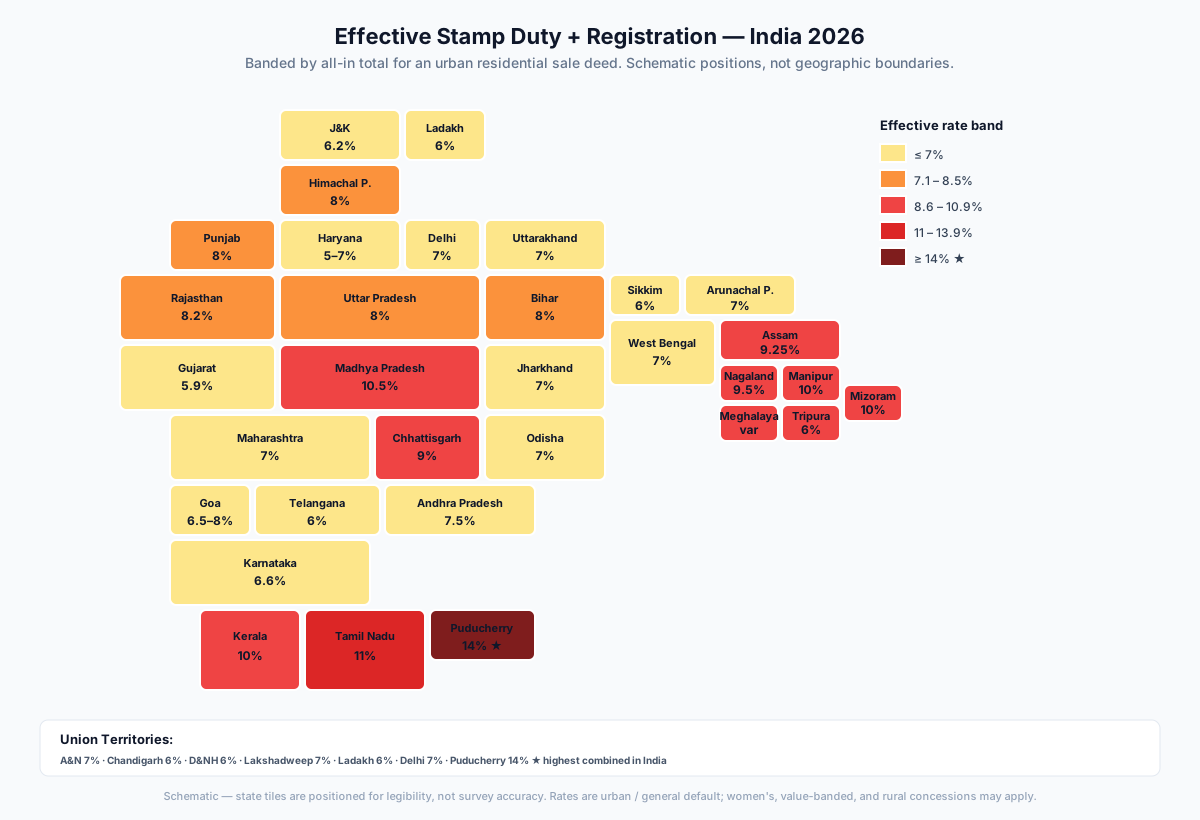
The table below shows the default male/joint rate for urban residential sale deeds. Women's concessions, rural variants, and property-value bands are detailed in the sections that follow.
| State / UT | Stamp Duty | Registration | Effective Total | Notes |
|---|---|---|---|---|
| Andhra Pradesh | 5% | 1% + 1.5% transfer | 7.5% | No gender concession |
| Arunachal Pradesh | 6% | 1% | 7% | — |
| Assam | 8.25% | 1% | 9.25% | Women: 6% |
| Bihar | 6% | 2% | 8% | Women: 5.7% |
| Chhattisgarh | 5% | 4% | 9% | Women: 4% SD |
| Goa | 3.5%–5% | 3% | 6.5%–8% | Tiered by value |
| Gujarat | 4.9% | 1% | 5.9% | Women: 0% registration |
| Haryana | 5%/7% (rural/urban) | ₹50k cap | 5%–7% | Women −2% |
| Himachal Pradesh | 6% | 2% | 8% | Women: 4% |
| Jammu & Kashmir | 5% | 1.2% | 6.2% | Women: 3% |
| Jharkhand | 4% | 3% | 7% | Women ≤ ₹50L: ₹1 registration |
| Karnataka | 5% + 0.6% cess | 1% | 6.6% | Tiered: 3% / 2% below thresholds |
| Kerala | 8% | 2% | 10% | Highest in south |
| Madhya Pradesh | 7.5% (urban) | 3% | 10.5% | Urban municipal duty |
| Maharashtra | 5% + 1% metro cess | 1% (cap ₹30k) | 7% | Women: −1% |
| Manipur | 7% | 3% | 10% | — |
| Meghalaya | 4.6%–9.9% | — | — | Tiered by value |
| Mizoram | 9% | 1% | 10% | Land-restricted state |
| Nagaland | 8.25% | 1.25% | 9.5% | — |
| Odisha | 5% | 2% | 7% | Women: 4% |
| Punjab | 7% | 1% | 8% | Women: 5% |
| Rajasthan | 6% + 20% surcharge | 1% | 8.2% | Women: 5% base |
| Sikkim | 5% | 1% | 6% | — |
| Tamil Nadu | 7% | 4% | 11% | Highest registration |
| Telangana | 4% | 1.5% + 0.5% transfer | 6% | — |
| Tripura | 5% | 1% | 6% | — |
| Uttar Pradesh | 7% | 1% | 8% | Women ≤ ₹10L: 6% |
| Uttarakhand | 5% | 2% | 7% | Women ≤ ₹25L: 3.75% |
| West Bengal | 6% (urban ≤ ₹1Cr) | 1% | 7% | 7% above ₹1Cr |
| Andaman & Nicobar (UT) | 5% | 2% | 7% | — |
| Chandigarh (UT) | 5% | 1% | 6% | Women: 3% |
| Dadra & Nagar Haveli (UT) | 5% | 1% | 6% | — |
| Delhi (UT) | 6% | 1% | 7% | Women: 4%, Joint M+F: 5% |
| Ladakh (UT) | 5% | 1% | 6% | Administered under J&K framework |
| Lakshadweep (UT) | 5% | 2% | 7% | Rare private transactions |
| Puducherry (UT) | 10% | 4% | 14% | Highest combined |
Rates verified against state revenue departments as of April 2026. Budget revisions can shift percentages by 0.5–1% each year — the calculator above auto-reflects the latest administrative updates.
Women's Concessions — Why the Discount Exists
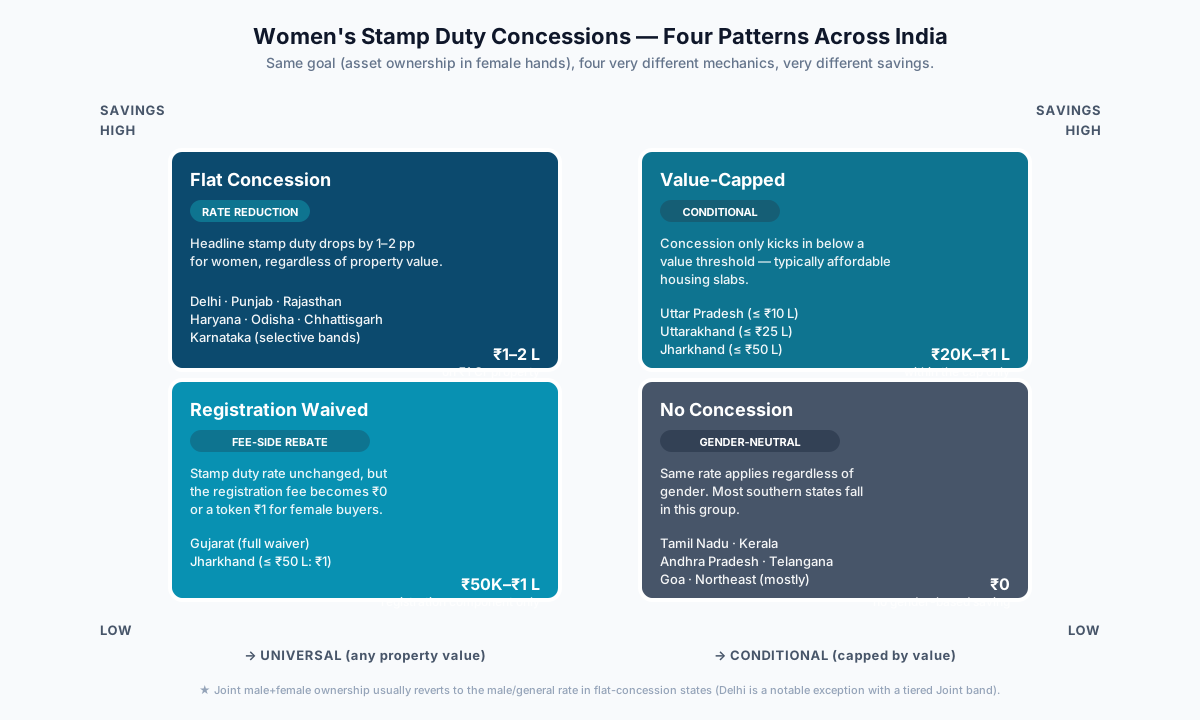
In 2014, the Ministry of Women and Child Development recommended that states offer a 1–2% stamp duty concession to women purchasers to "encourage property ownership and economic security among women" (MoWCD, 2014). The logic was twofold:
1. Asset-backed social security. A woman who owns the family home has negotiating power in marital disputes and protection against in-law eviction — a leading cause of destitution among widowed or separated women in India.
2. Encouraging disclosure. Lower rates reduce the temptation to under-report the sale price, which in turn grows the state's long-term tax base.
The concession has since been adopted in 14 states and 2 UTs, though the shape varies:
| Type | Example states | How it works |
|---|---|---|
| Flat concession | Delhi, Punjab, Rajasthan, Haryana, Odisha | Fixed 1–2% less for women, regardless of property value |
| Value-capped | UP, Uttarakhand, Jharkhand | Concession only below a threshold (₹10L, ₹25L, ₹50L) |
| Registration waived | Gujarat, Jharkhand (≤₹50L) | Stamp duty unchanged, registration fee becomes ₹0 or ₹1 |
| No concession | Tamil Nadu, Kerala, AP, Telangana | Equal rates regardless of gender |
"The stamp duty concession for women is a subtle but powerful tool. It costs the state a small amount of foregone revenue but dramatically improves household wealth concentration in female hands — a key predictor of child nutrition, school attendance, and long-term family stability." — Reema Nanavaty, SEWA, in Nanavaty (2021, p. 87).
Joint Ownership — A Common Misconception
Many buyers assume that adding a spouse's name automatically qualifies for the women's rate. In most states, this is wrong:
- Delhi has a distinct joint (male + female) rate at 5% — higher than the female-only 4%, but lower than the male-only 6%.
- Haryana has explicit joint rates (urban 6%, rural 4%) between male and female tiers.
- Most other states apply the male/general rate whenever at least one owner is male — no partial concession.
The practical implication: if only the wife's name is on the sale deed, she gets the full concession. If the husband is added as co-owner, most states revert to the higher male rate. For larger properties, single-name ownership can save ₹2–3 lakh, but comes at the cost of reduced inheritance flexibility and succession risk.
Urban vs Rural — The Municipal Gap
Four states apply meaningfully different rates to urban and rural properties:
| State | Urban | Rural | Rationale |
|---|---|---|---|
| Haryana | Up to 7% | 5% | Urban corporation surcharge |
| Maharashtra | 5% + 1% metro cess | 4%, no cess | Metro cess funds municipal infra |
| Madhya Pradesh | 7.5% (includes 2.5% municipal duty) | 5% | Municipal vs panchayat authority |
| West Bengal | 6%–7% (urban) | 5%–6% (rural) | Urban land premium |
For buyers in peri-urban areas — the grey zone where a city extends into adjacent villages — it is worth confirming with the sub-registrar which category applies. A property 500 metres either side of the municipal boundary can attract materially different duty.
Beyond the Sticker — Hidden Costs Most Buyers Miss
1. Additional cess and surcharge. Mumbai charges a 1% metro cess; Rajasthan adds a 20% surcharge on stamp duty (not property value); Andhra Pradesh adds 1.5% transfer duty. These are often omitted from quick online calculators and surprise buyers at the counter.
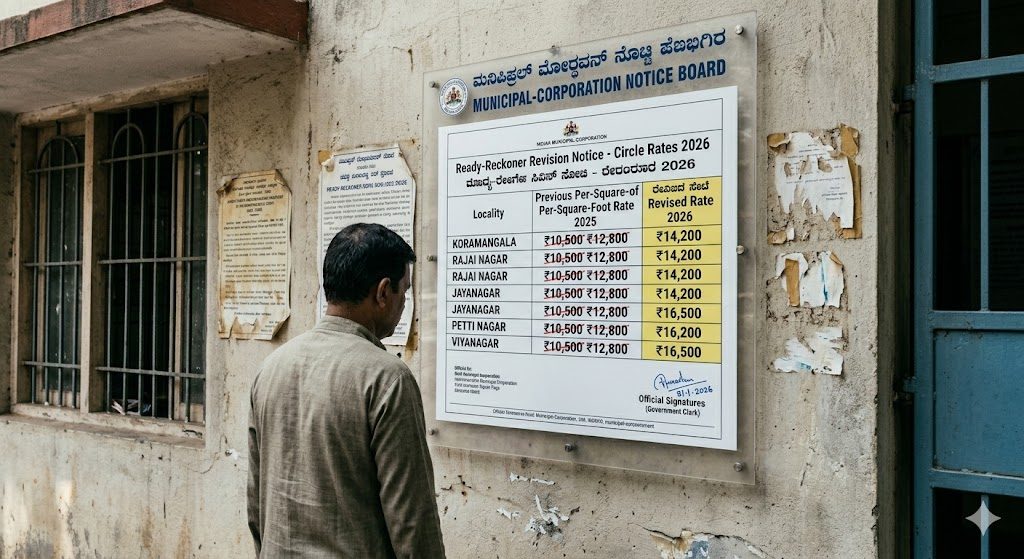
2. Market value revisions. Circle rates are typically revised every 1–3 years. If you sign an agreement at the current rate but register after a revision, the new (higher) rate applies. For under-construction purchases, factor in a 5–10% buffer for possible circle rate increases before handover.
3. Builder-paid stamp duty offers. Many new-launch projects advertise "free stamp duty" — but this is almost always rolled into the sale price. Insist on seeing the sale deed value separate from the marketing price.
4. Women-buyer gift deed variant. In several states, gifting property to a woman attracts concessional stamp duty. Gift within family can be ₹100 to ₹5,000 fixed instead of percentage-based. This is a legitimate tax-planning technique, not evasion — but consult a lawyer first.
5. Section 80C relief. Stamp duty and registration charges paid in the year of purchase are deductible under Section 80C of the Income Tax Act, up to the ₹1.5 lakh combined 80C limit (Income Tax Department, 2024). Most salaried buyers lose this benefit because they only discover it during tax filing the next year. Plan your 80C contributions around the purchase.
The Registration Process — What Happens on Registration Day
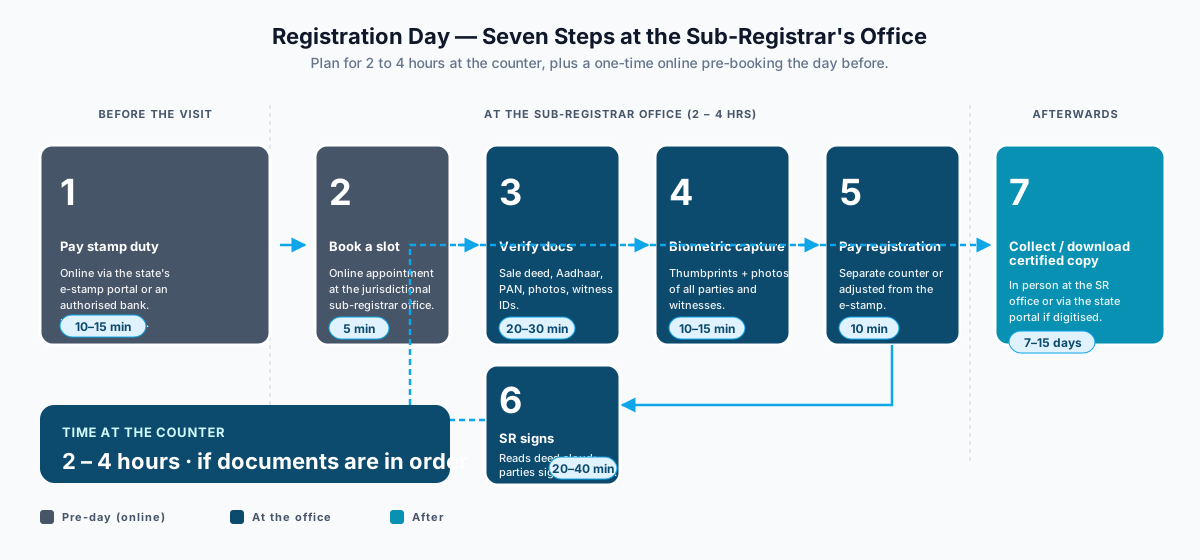
The typical sequence at a sub-registrar office takes 2–4 hours if documents are in order:
1. Stamp duty payment — online via the state's e-stamping portal (stamps.gov.in for most states) or in person at an authorised bank. Print the challan.
2. Appointment booking — online slot at your jurisdictional sub-registrar office.
3. Document verification — sale deed, Aadhaar, PAN, passport-size photos of buyer, seller, and two witnesses.
4. Biometric capture — thumbprints and photos of all parties.
5. Registration fee payment — separate counter or adjusted from the e-stamp.
6. Sub-registrar signing — reads the document aloud; parties sign in presence.
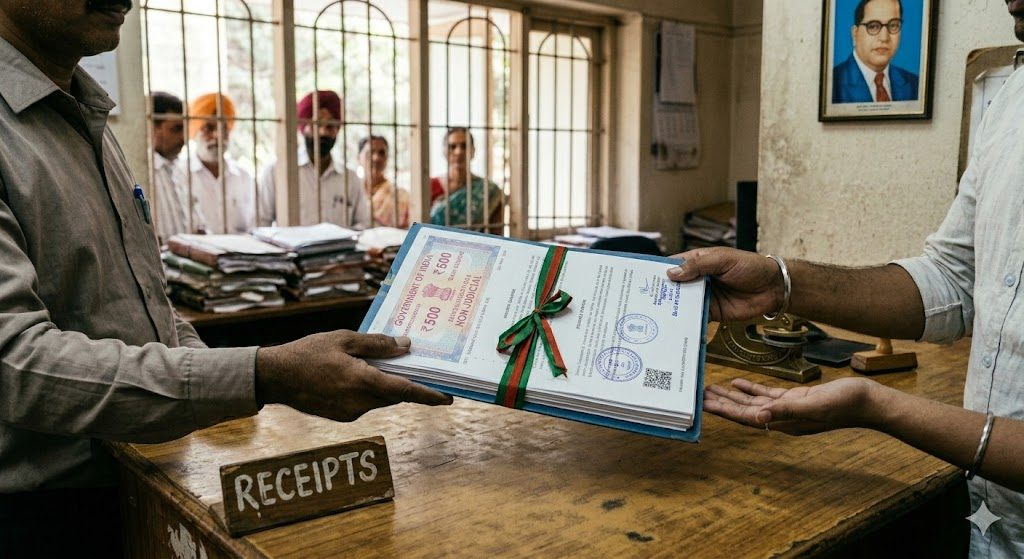
7. Receipt and certified copy — collect within 7–15 days, or download from the state portal if digitised.
"The sub-registrar's office is where title is born. Everything before — the token, the agreement, the loan approval — is contingent. Everything after — your legal defence, your resale, your inheritance — depends on what happens there. Treat the registration appointment with the same seriousness as a court hearing." — Anil Harish, Senior Counsel, Bombay High Court, quoted in Mehta (2019, p. 334).
Documents You Must Carry
| Document | Buyer | Seller |
|---|---|---|
| Identity proof (Aadhaar + PAN) | ✓ | ✓ |
| Passport-size photos (2 each) | ✓ | ✓ |
| Sale deed (2 original copies) | — | ✓ |
| Previous chain of title | — | ✓ |
| Approved building plan / OC | — | ✓ |
| Encumbrance Certificate (EC) | — | ✓ |
| NOC from society / builder | — | ✓ |
| Loan sanction letter (if financed) | ✓ | — |
| TDS challan (if sale > ₹50L) | ✓ | — |
Common Mistakes That Cost Money
Mistake 1 — Paying on Agreement Value, Not Circle Rate
If you inherit an agreement signed at ₹80 lakh but the circle rate has since risen to ₹1 crore, stamp duty is paid on ₹1 crore. Many buyers pay on the lower agreement value in error — the sub-registrar flags the shortfall later, and penalty interest at 2% per month accrues.
Mistake 2 — Registering Before Loan Disbursal Confirmation
Some banks require registered sale deeds before disbursing the loan. Others disburse to the seller only after registration. Clarify sequencing with both the bank and the seller — a mismatch can leave you having paid stamp duty but unable to complete the purchase.
Mistake 3 — Forgetting the 80C Deduction
Rs 1.5 lakh of stamp duty and registration qualifies under Section 80C in the year of purchase. If you also have PF, ELSS, or LIC premiums exhausting 80C, you can reallocate — but you cannot carry the stamp duty deduction forward to the next year.
Mistake 4 — Trusting Builder-Supplied Calculators
Builder sales teams often present stamp duty numbers that omit cess, surcharge, or outdated circle rates. Use the state revenue department's official calculator or the Studio Matrx calculator — which pulls from official rate tables updated monthly.
Mistake 5 — Overlooking the Resale Impact of Sole Ownership
Registering in one spouse's name alone saves ₹2–3 lakh in stamp duty but creates succession complications. If the sole owner passes away, the property goes through succession certificate/probate — a 12–24 month process. Joint ownership costs more at purchase but saves the family enormous friction later.
Stamp Duty vs Property Tax — A Recurring Confusion
These are different taxes paid to different authorities for different reasons:
| Stamp Duty | Property Tax | |
|---|---|---|
| Authority | State government (sub-registrar) | Municipal corporation |
| When paid | Once, at purchase/transfer | Annually, for ownership |
| Basis | Transaction value | Annual rental value or capital value |
| Rate | 3%–10% one-time | 0.5%–2% per year |
| Purpose | Registering the deed | Funding city services |
| Deduction | 80C (year of purchase) | Section 24, for let-out property only |
Looking Ahead — What Could Change
Three likely shifts over the next 24 months:
1. Women's concession expansion. The NITI Aayog 2025 Gender Budget recommended a minimum 1% national stamp duty concession for women, regardless of state. Expect Kerala, Tamil Nadu, and Telangana to come under pressure to introduce one.
2. Digitisation of registration. Karnataka's Kaveri 2.0 and Maharashtra's IGR portal have demonstrated fully online registration for small-value transactions (gift deeds, lease agreements). Nationwide rollout for sale deeds is expected by 2027.
3. GST integration. The 15th Finance Commission proposed subsuming stamp duty into GST over a 5-year transition. Strong state resistance — stamp duty is their largest independent revenue source — makes this unlikely before 2030, but it remains a live policy debate.
Open the Calculator
>
Select your state, choose gender/area variant, enter property value, and see stamp duty + registration + any cess as a clean breakdown. Updated monthly against official state revenue department notifications.
References
- Government of India (1899) The Indian Stamp Act, 1899 (Act No. 2 of 1899). New Delhi: Ministry of Law and Justice.
- Government of India (1908) The Registration Act, 1908 (Act No. 16 of 1908). New Delhi: Ministry of Law and Justice.
- Income Tax Department (2024) Income Tax Act 1961 — Section 80C Deductions. New Delhi: Central Board of Direct Taxes.
- Inspector General of Registration, Maharashtra (2026) Stamp Duty Rates — Sale Deed and Conveyance. Mumbai: IGR Maharashtra. Available at: https://igrmaharashtra.gov.in/ (Accessed: April 2026).
- Karnataka Department of Stamps and Registration (2026) Kaveri Online Services — Rate Tables. Bengaluru: Government of Karnataka. Available at: https://igr.karnataka.gov.in/ (Accessed: April 2026).
- Mehta, H. (2019) Real Estate Law and Practice in India. 4th edn. New Delhi: LexisNexis.
- Ministry of Women and Child Development (2014) National Policy for Women — Draft Framework. New Delhi: Government of India.
- Nanavaty, R. (2021) A Bank of Her Own: SEWA and the Economics of Empowerment. Ahmedabad: Navjivan Trust.
- Nariman, F. S. (2006) Before Memory Fades: An Autobiography. New Delhi: Hay House India.
- NITI Aayog (2025) Gender Budget 2025 — Recommendations for State and Central Finance Ministries. New Delhi: Government of India.
- Registration Department, Tamil Nadu (2026) Stamp and Registration Fees — Schedule. Chennai: Government of Tamil Nadu. Available at: https://tnreginet.gov.in/ (Accessed: April 2026).
Author's Note: This guide compiles rate information from state revenue department publications as of April 2026. State budgets typically revise rates once a year — always verify current rates via the Studio Matrx calculator (which is updated monthly) or the state's official portal before registration.
Disclaimer: This article is for informational and educational purposes only. It does not constitute legal, tax, or financial advice. Consult a qualified lawyer and chartered accountant before making property purchase decisions. Stamp duty interpretations and exemptions vary by case, document type, and specific circumstances — the rates listed here are indicative for standard residential sale deeds.
Interactive · State-wise stamp duty + registration
₹1.00 Cr property in Maharashtra → ₹7.0 L total
Total payable
₹7.0 L
7.00% of property value
Same ₹1.00 Cr property across states
Export this guide
Related Guides — Deep-dive reading
Property Registration Process in India: How a Plot Is Registered in Your Name (2026)
Registration is the step that makes you the legal owner. This guide walks through the sequence - agreement to sell, drafting the sale deed, calculating and paying stamp duty and registration fee, the sub-registrar appointment, the registration day, and the mutation and khata transfer that follow.
Buying LandHow to Buy a Plot in India: Step-by-Step Due Diligence, Documents and Registration (2026)
The complete, plain-language map of buying a residential plot in India end to end - define your requirement and budget, evaluate the site, run the due-diligence stage (title, documents, encumbrance, khata, land-use, approvals), discover the fair price, sign the agreement, register the sale deed, and get mutation and possession - with a step-by-step process table and a red-flags table.
Buying LandPlot Due Diligence in India: The Complete Pre-Purchase Check (2026)
Before you pay a rupee for a plot, run the full pre-purchase check with your lawyer and a licensed surveyor - legal title, revenue records, planning approvals, physical survey and financial dues. This guide walks through each pillar, gives you a checklist and tells you when to walk away.
Buying LandRelated Tools — Try Free
Stamp Duty Calculator — All Indian States
Stamp duty + registration charges for all 28 states and 8 UTs — gender concessions, urban/rural variants, metro cess built in.
Stamp DutyProperty Tax Calculator — 10 Indian Cities
Estimate annual municipal property tax across BBMP / MCD / MCGM / GHMC / GCC / KMC / PMC / AMC / TMC / PCMC — with self-occupied, tenanted, and age-rebate adjustments.
Property TaxApartment Video Door System Planner
Enter flats, entrances, floors and guard desk for a first-pass building intercom plan — door stations, indoor monitors, guard station, the right architecture and an indicative cost band.
Building Planner