

Home Loan Eligibility Explained: How Much Loan Can You Get in India (2026)
A plain-language explainer of home loan eligibility in India - how income and the FOIR or EMI-to-income rule, your age and tenure, credit score, existing debts, employment type, a co-applicant, property value and LTV all decide how much a lender will sanction - with an indicative illustration table and ways to improve your number.
"How much loan will I get?" is usually the first question a home buyer asks, and it is the one nobody can answer for you in a single number. Eligibility is not a fixed figure attached to your salary. It is the output of a short assessment the lender runs on your income, your existing commitments, your age, your credit history and the property itself. Change any one of those and the number moves. This guide explains what goes into that assessment in plain language, so you walk into the bank understanding why the answer is what it is, and knowing which levers you can actually pull to raise it.
This is the eligibility chapter of the home-loan journey. It sits alongside the pillar explainer on how home loans work, and it points you to the site calculators so you can put your own figures in rather than trust anyone else's rule of thumb.
A plain disclaimer. This is an explainer to help you understand how eligibility is assessed, not financial advice and not a promise of any amount. Only the lender's own assessment is binding - the real sanction, rate, EMI and eligible amount come from the bank or housing finance company after they see your documents. Every ratio, percentage and figure below is INDICATIVE and CHANGES with the RBI repo rate, each lender's policy and your own profile. Confirm your numbers with the bank, a CA or tax advisor for tax questions, and a financial planner before you commit.
Key takeaways
- Eligibility is a calculation, not a fixed number. Income, existing EMIs, age or tenure, credit score, employment type and the property together decide it.
- Income drives the ceiling, but through a cap: lenders limit your total EMIs to a share of your net monthly income - the FOIR or EMI-to-income ratio - so existing loans directly shrink what is left for a home loan.
- A longer tenure raises the eligible amount but costs far more interest overall; your age limits how long the tenure can be.
- A strong credit score and a clean repayment record widen eligibility and can improve the rate; a weak one narrows both.
- Adding an earning co-applicant, clearing small debts and improving your score are the most reliable ways to raise the number. The lender's sanction letter is the only figure that counts.
What "eligibility" actually means
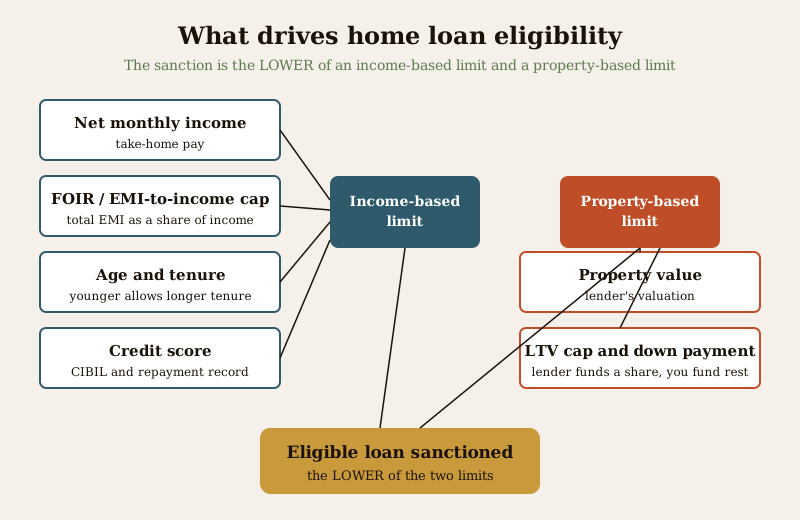
When a lender assesses eligibility it is really answering two separate questions. First, how much monthly EMI can this borrower comfortably afford without over-stretching? That is driven by income and existing obligations. Second, is the property worth enough to secure that loan, and how much of its value will we fund? That is driven by the valuation and the loan-to-value limit. Your final eligible amount is the LOWER of these two answers. You might earn enough to service a large EMI, but if the property valuation is modest the LTV cap holds you back, and vice versa.
Income and the FOIR or EMI-to-income rule
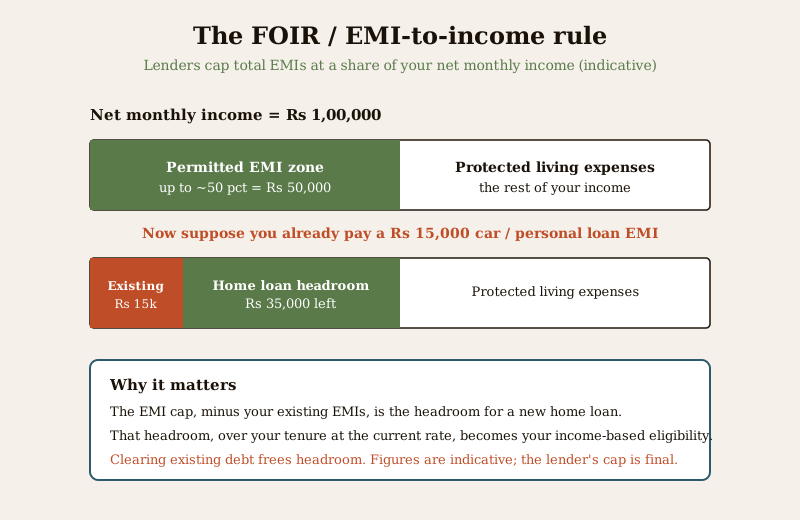
Income sets the ceiling, but not directly. Lenders do not simply multiply your salary. They start from your NET monthly income - take-home pay after statutory deductions - and apply a cap on how much of it can go toward all your loan EMIs put together. This cap is usually called the FOIR (fixed-obligation-to-income ratio) or the EMI-to-income ratio. Indicatively it sits somewhere in the region of 40 to 55 per cent, higher for larger incomes and lower for smaller ones, and it varies by lender. The idea is simple: after paying every EMI you still need enough left for living costs.
Here is the mechanism. Suppose the lender allows total EMIs of up to 50 per cent of your net income. If you take home Rs 1,00,000 a month, the ceiling for all EMIs combined is Rs 50,000. If you already pay Rs 15,000 on a car loan and a personal loan, only Rs 35,000 of headroom is left for a new home-loan EMI. That remaining EMI capacity, converted into a loan amount over your chosen tenure at the prevailing rate, is your income-based eligibility. This is exactly why two people on the same salary can be sanctioned very different amounts: the one carrying existing EMIs has less headroom.
Two people on the same pay can also differ because of income QUALITY. Stable, documented, growing income reassures a lender; variable or hard-to-verify income invites caution. That brings us to employment type.
Age, tenure and why they are linked
Tenure - the number of years you take to repay - is a powerful eligibility lever, because a longer tenure means a smaller EMI for the same loan, which means the same EMI headroom supports a larger loan. But you cannot stretch tenure freely. Lenders cap the loan so it ends by a target age, often around retirement for a salaried borrower and a little later for the self-employed. So a 30-year-old can usually take a much longer tenure - and therefore a larger eligible loan - than a 50-year-old on the same income. Age does not reduce eligibility by itself; it reduces the maximum tenure, and the shorter tenure is what pulls the number down. A longer tenure raises eligibility but costs far more total interest, so treat it as a trade-off, not a free win.
Credit score and existing obligations
Your credit score - from CIBIL or another bureau - is the lender's shorthand for how reliably you repay. A strong score signals low risk: it can widen eligibility, smooth approval and sometimes earn a better rate. A weak score, missed payments or a very high credit-card utilisation can shrink the eligible amount, attract a higher rate, or lead to rejection. Existing obligations hurt in two ways at once: they eat directly into your FOIR headroom (as shown above), and a stretched, debt-heavy profile can also dent the score. The dedicated credit score and CIBIL guide explains how the score is built and how to strengthen it before you apply.
Employment type: salaried versus self-employed
Lenders assess a salaried applicant and a self-employed applicant differently, mostly because income is verified differently. A salaried borrower shows salary slips, bank-credited salary and Form 16 or equivalent, and income is usually read as fairly stable. A self-employed borrower - a professional or a business owner - shows income-tax returns over a few years, audited financials or profit figures, and bank statements, and the lender typically looks at an averaged, sustained profit rather than the best single year. Neither is "better", but the self-employed generally need a longer and cleaner documentation trail to establish the same income, and lenders may apply more caution to fluctuating profits. Knowing this early helps you prepare the right paperwork.
Co-applicant income and joint loans
One of the most effective ways to raise eligibility is to add an earning co-applicant - commonly a spouse, parent or child. The lender can combine the incomes, which lifts the FOIR headroom and therefore the eligible amount, subject to each applicant's own age, obligations and credit profile. A co-applicant is not the same as a guarantor, and co-ownership of the property usually goes with it, so this is a decision with legal and tax dimensions, not just a number. Read the joint home loan guide before you decide, and note that a co-applicant with a weak credit history can pull the joint assessment down rather than up.
Property value, LTV and your down payment
Even with ample income, the loan is capped against the property. The lender gets the property valued and lends only a share of that value - the loan-to-value or LTV ratio. Indicatively, lenders fund a large majority of the value but not all of it, with the permitted share tending to be higher for smaller loans and lower for larger ones, and always subject to the lender's valuation rather than the price you agreed. The rest is your DOWN PAYMENT, which you fund yourself, along with stamp duty, registration and other costs that the loan usually does not cover. A bigger down payment means you need a smaller loan, which is easier to be eligible for; a thin down payment pushes against the LTV cap. Plan this deliberately using the down-payment planning guide. Remember the lender values the property its own way - if its valuation is below your purchase price, the LTV amount falls and your down payment has to rise to fill the gap.
An indicative illustration
The table below shows how a net monthly income might translate into an indicative eligible loan. It assumes no existing EMIs, an indicative EMI-to-income cap and a long tenure, at an indicative rate. It is a teaching illustration ONLY - your real number depends on your rate, tenure, obligations, score and the property, and only the lender's assessment is binding.
| Net monthly income | Indicative EMI headroom | Indicative eligible home loan (long tenure) | Note |
|---|---|---|---|
| Rs 40,000 | Around Rs 18,000 to 20,000 | Roughly Rs 20 to 25 lakh | Smaller incomes often get a lower cap |
| Rs 75,000 | Around Rs 35,000 to 40,000 | Roughly Rs 40 to 50 lakh | Assumes a clean profile, no other EMIs |
| Rs 1,25,000 | Around Rs 60,000 to 68,000 | Roughly Rs 70 to 85 lakh | Higher income can carry a higher cap |
| Rs 2,00,000 | Around Rs 1,00,000 to 1,10,000 | Roughly Rs 1.1 to 1.4 crore | Still subject to property LTV limit |
Every figure above is indicative and will shift with the interest rate, the tenure the lender allows for your age, any EMIs you already pay, your credit score and the property valuation. Do not plan a purchase on these ranges - run your own with the calculators below and confirm with the lender.
Factors and their effect on eligibility
| Factor | Effect on eligibility |
|---|---|
| Higher net monthly income | Raises the EMI headroom and the eligible amount |
| Existing EMIs and debts | Reduce headroom directly under the FOIR cap - clearing them helps |
| Longer tenure | Raises the eligible amount, but increases total interest paid |
| Younger age | Allows a longer tenure, indirectly raising eligibility |
| Older age | Caps tenure lower, which trims the eligible amount |
| Strong credit score | Can widen eligibility and improve the rate |
| Weak or thin credit history | Can shrink eligibility, raise the rate, or cause rejection |
| Salaried, stable income | Usually straightforward income verification |
| Self-employed income | Needs a longer documentation trail; averaged profits assessed |
| Adding an earning co-applicant | Combines incomes and can lift eligibility |
| Larger down payment | Reduces the loan needed - easier to be eligible |
| Lower property valuation | Caps the loan via LTV, raising the down payment required |
How to improve your eligibility
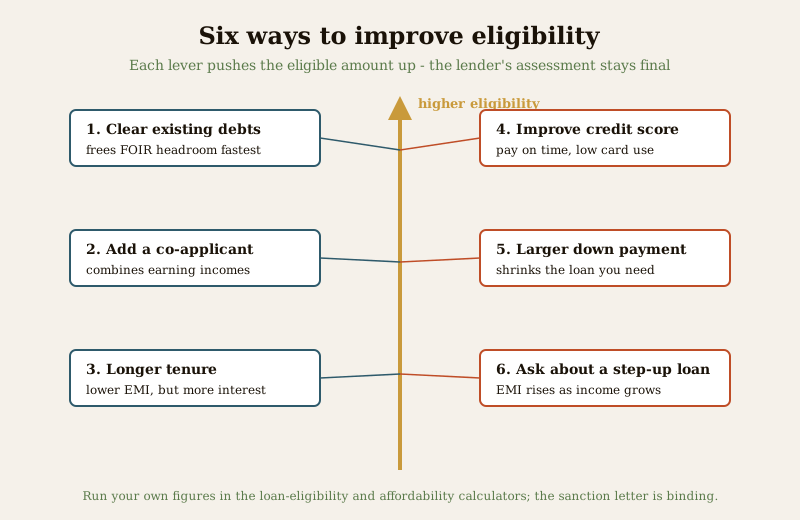
Eligibility is not fixed, and several of its inputs are within your control. The most reliable moves are these.
- Clear or reduce existing debts. Paying off a small loan or a credit-card balance frees up FOIR headroom immediately, and can lift your credit score too. This is often the single fastest lever.
- Add an earning co-applicant. Combining a spouse's or parent's income can materially raise the eligible amount - provided their credit profile is sound.
- Choose a longer tenure - with eyes open. A longer tenure lowers the EMI and raises eligibility, but you pay much more interest overall. Use it to qualify, then consider prepaying later.
- Improve your credit score before applying. Pay every EMI and card bill on time, keep card utilisation low, and fix any errors on your bureau report. A few months of discipline can move the score.
- Bring a larger down payment. Saving more upfront shrinks the loan you need, which is easier to clear and reduces your interest cost.
- Ask about a step-up loan. Some lenders offer step-up repayment, where the EMI starts lower and rises as your income is expected to grow - this can raise the eligible amount for younger borrowers early in their careers. Confirm availability and terms with the lender.
Run your own numbers
The honest answer to "how much can I get" is: put your figures into a calculator, then let the lender confirm. Start with the loan-eligibility calculator to see an indicative eligible amount from your income, obligations and tenure. Cross-check it against the home-loan affordability calculator and the affordability guide to make sure the EMI is one you can live with, not just one you qualify for. Then use the EMI calculator to see the monthly payment and total interest for the amount and tenure you have in mind. These tools give you a realistic bracket to plan around - but the sanction letter from the bank is the only number that binds.
References
- Reserve Bank of India (RBI) - guidelines that shape loan-to-value norms and the repo or external-benchmark rate that lending rates track (named generally; policy changes over time - confirm current norms).
- Credit information bureaus - CIBIL and other RBI-licensed bureaus - for the credit score and report used in eligibility assessment.
- Individual bank and housing finance company credit policies - the FOIR or EMI-to-income cap, tenure and age limits, LTV bands and documentation requirements are set by each lender and revised periodically.
- All ratios, percentages and figures here are indicative and change with the repo rate, lender policy and your profile. Only the lender's own assessment and sanction letter are binding - confirm with the bank, a CA or tax advisor for tax questions, and a financial planner before acting.
Interactive · Check your eligibility
₹1.2 L/mo income · Typical FOIR
Lender FOIR band
Maximum eligible loan
₹51.9 L
Assumes ~80% loan-to-value (20% down payment).
Eligible loan by tenure — longer tenure lifts eligibility but raises total interest.
Illustrative only. Actual eligibility depends on the lender's FOIR policy, your CIBIL score, income stability, and the property valuation. Confirm with your bank or a CA.
Export this guide
Related Guides — Deep-dive reading
How Home Loans Work in India: The Full Journey from Apply to EMI (2026)
A plain-language map of the home-loan journey end to end - what a home loan is, the players, the key terms, how interest and EMI work, the application-to-disbursement steps, and the levers you actually control - with a loan-journey table and a key-terms glossary.
Home FinanceHome Loan Documents Checklist (India): The Complete List (2026)
Every home loan documents category explained in plain language - KYC, income proof (very different for salaried and self-employed), property papers and the loan forms - so you can assemble a clean file before you apply and avoid the back-and-forth that delays sanction.
Home FinanceHome Loan Tax Benefits - Section 80C and 24(b) in India (2026)
How a home-loan borrower may claim income-tax deductions on principal, interest, stamp duty and first-time-buyer benefits - explained in plain language, with the limits and regime rules that keep changing left for your CA to confirm.
Home FinanceRelated Tools — Try Free
Home Loan Affordability Calculator
Max eligible home loan and property price from your income, FOIR, LTV, tenure, and interest rate — with Section 24(b) + 80C tax savings.
Loan EligibilityStamp Duty Calculator — All Indian States
Stamp duty + registration charges for all 28 states and 8 UTs — gender concessions, urban/rural variants, metro cess built in.
Stamp DutyHome Loan Eligibility Checker
Eligible home loan amount across 12 Indian banks with rates, tenure, FOIR, and processing fees.
Loan Calculator