

Home Loan Down Payment Planning in India (2026)
Why lenders fund only part of a home, what the loan quietly leaves you to pay, how much to save and how, and why borrowing for the down payment is a red flag.
No home loan in India pays for the whole house. The lender funds a large slice; you have to bring the rest in cash, up front, before the loan disburses. That upfront cash is the down payment - and getting it wrong is one of the most common reasons a sanctioned buyer stalls at the last step. This guide explains why the gap exists, what the loan quietly refuses to cover, how much you should realistically save, and the one shortcut - borrowing for your own contribution - that experienced lenders treat as a warning sign.
It is a companion to our pillar, How home loans work in India, and to Home loan eligibility explained and Home loan types in India. For the numbers that decide your specific case, read home loan affordability in India and, if you are self-building, use the house construction cost calculator.
Scope and disclaimer: This is a plain-language explainer, not financial, tax or legal advice. Loan-to-value caps, interest rates, tax sections and scheme windows are set by the RBI, individual lenders and the annual budget, and they change often. Every figure here is indicative only. Confirm your actual loan-to-value, sanctioned amount and rate with the bank or housing finance company, tax specifics with a qualified CA, and your savings plan with a financial planner before you commit.
Why the loan never covers the whole house
Lenders think in terms of "loan-to-value", or LTV - the share of a property's value they are willing to lend against. If a lender offers eighty per cent LTV on a home valued at one crore, it will lend up to eighty lakh and expect you to fund the remaining twenty lakh yourself. That buyer-funded slice is the down payment, sometimes called "margin money" or "own contribution".
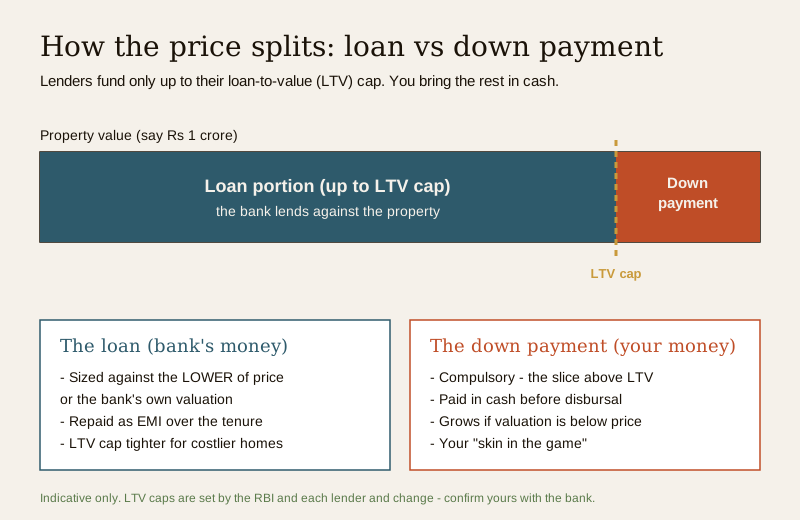
Why not lend the full value? Because the property is the lender's security. If a borrower defaults and the lender has to sell, prices can fall, sale costs eat into the recovery, and a loan for the full value could leave the lender short. Requiring you to put your own money in first does two things: it gives the lender a cushion, and it gives you "skin in the game" - a real stake that makes default less likely. Regulators reinforce this by capping how much of a property's value may be financed, and the cap is generally tighter for higher-value homes.
A crucial subtlety: lenders apply LTV to their own assessed value of the property, not necessarily the price you negotiated. If the price you agreed is higher than the lender's valuation, the loan is calculated on the lower figure - and your down payment silently grows to fill the gap. Always ask what value the loan is being sized against.
The costs the loan quietly leaves to you
Here is the trap that catches first-time buyers: the down payment is not the only cash you need. The loan is sized against the property value, but several large, unavoidable charges sit outside that value - and the lender usually will not fund them. You pay them from your own pocket, on top of the down payment.
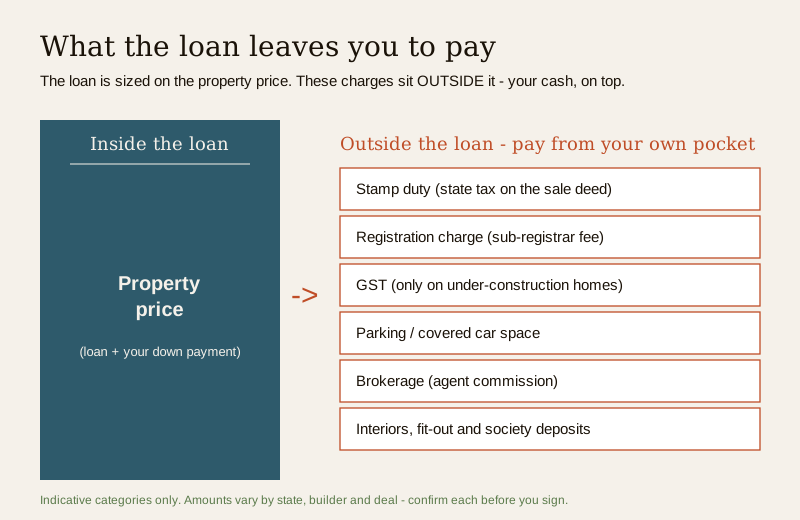
| Cost the loan usually does NOT cover | What it is | Rough scale (indicative) |
|---|---|---|
| Stamp duty | State tax on registering the sale deed in your name | A few per cent of value, varies by state - see the stamp duty guide |
| Registration charge | Government fee to register the deed at the sub-registrar | Often around one per cent, capped in some states |
| GST (under-construction) | Goods and services tax on under-construction homes; ready or resale homes usually attract none | Applies only to under-construction property; confirm the current rate with a CA |
| Parking / covered car space | Builders often price parking separately from the flat cost | A lump sum, quoted per space by the builder |
| Brokerage | Agent commission on a resale or facilitated purchase | Typically a per cent or two of the deal, negotiable |
| Interiors and fit-out | Modular kitchen, wardrobes, false ceiling, painting, furniture | Highly variable; often a large second budget of its own |
| Society / maintenance deposits | Corpus and advance maintenance a builder or society collects at handover | A lump sum set by the builder or association |
Two of these - stamp duty and registration - are effectively compulsory and can add up to a meaningful sum by themselves. Model your stamp duty for your state and value with the stamp duty calculator rather than guessing. Treat every row above as cash you must have arranged before you sign, because the loan will not appear to plug it.
So how much should you actually save?
Your true upfront requirement is the sum of two things: the compulsory down payment (the slice above the lender's LTV), plus the out-of-pocket charges the loan does not cover. A buyer who saves only for the first number and forgets the second is the buyer who scrambles for a last-minute personal loan.
A sensible way to plan: start from the property value, apply a conservative LTV assumption to estimate the loan, and take the rest as your down payment. Then add a realistic allowance for stamp duty, registration, any GST, parking, brokerage and a first-cut interiors budget. Weigh your income and existing obligations against the guidance in home loan affordability in India so the EMI on the loan portion is one you can actually carry, and confirm the eligibility and rate with the lender - those are the binding numbers, not anything on this page.
How to build the down payment - without wrecking your safety net
Once you know the target, the question is where the money comes from. A few principles that financial planners tend to agree on:
- Give yourself a runway. A down payment is a large goal; the earlier you start, the less each month has to be and the less you are tempted to cut corners later.
- Use a dedicated, time-matched pot. Money you will need in one to three years generally does not belong in volatile assets that could be down exactly when you need to withdraw. A recurring deposit (RD) or a conservative systematic investment plan (SIP) into lower-volatility instruments is the usual home for a near-term goal - but the right instrument depends on your timeline and risk tolerance, which is a conversation for a financial planner.
- Do not raid your emergency fund. The three-to-six months of expenses that protect you against job loss or a medical shock should survive the home purchase intact. Buying a house and then having no buffer is how a manageable setback turns into a missed EMI.
- Leave retirement savings alone. Withdrawing or pausing long-term retirement contributions to fund a down payment trades decades of compounding for one purchase. Treat it as a last resort, not a plan.
- Keep some liquidity after closing. Moving in triggers its own wave of spending - deposits, immediate repairs, essential furniture. Draining every rupee into the down payment leaves you exposed in the first months of ownership.
Bigger down payment or smaller? The real trade-off
Beyond the compulsory minimum, you often have a choice: put down more and borrow less, or put down the minimum and keep more cash. Both are defensible; the right answer depends on your situation, not on a rule of thumb.
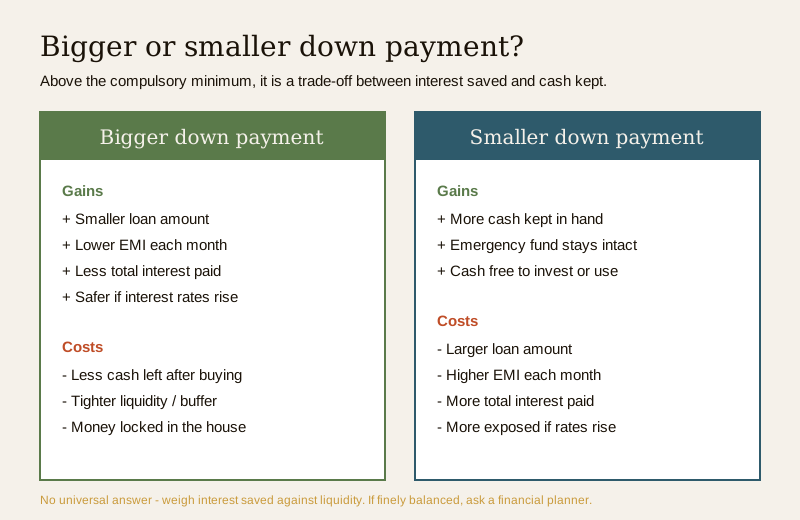
| Factor | Bigger down payment | Smaller down payment |
|---|---|---|
| Loan amount | Smaller | Larger |
| EMI | Lower | Higher |
| Total interest over the tenure | Less | More |
| Cash left in hand after buying | Less - tighter liquidity | More - a bigger buffer |
| Sensitivity to a rate rise | Lower (smaller balance) | Higher (larger balance) |
| Opportunity cost | Cash is locked in the house | Cash stays available to invest or cover emergencies |
The case for a bigger down payment is simple: a smaller loan means a lower EMI, less total interest, and less exposure if rates climb. The case against is liquidity - money sunk into the house is hard to get back out without selling or taking a fresh loan. If putting down more would leave you with no emergency fund, a smaller down payment that preserves your buffer is often the wiser choice, even though it costs more in interest over time. There is no universal answer; weigh the interest saved against the flexibility given up, and if the decision is finely balanced, talk it through with a financial planner.
The shortcut to avoid: borrowing your own contribution
The point of a down payment is that it is your money. So funding it with a personal loan, a credit-card drawdown, gold loan or informal borrowing defeats the purpose - and lenders know it. Many will not sanction a home loan if they can see the down payment itself came from fresh debt, because it signals you cannot actually afford the purchase and are over-leveraged before you even start.
Even where it slips through, the arithmetic is punishing. Personal loans carry far higher interest rates and much shorter tenures than home loans, so you end up servicing an expensive short loan and a large home loan at the same time - two EMIs stacked on the income the lender already stress-tested against one. Treat "borrow the down payment" as a red flag telling you the home is out of reach today. The healthier responses are to save longer, choose a less expensive property, or look at whether a joint home loan with a co-applicant genuinely raises what you can afford - not to paper over the gap with costly debt.
Key takeaways
- The down payment exists because lenders cap how much of a property's value they will fund (loan-to-value); the slice above that cap is your compulsory own contribution.
- LTV is applied to the lender's assessed value, which can be lower than your negotiated price - quietly enlarging your down payment.
- Budget separately for costs the loan does not cover: stamp duty, registration, GST on under-construction homes, parking, brokerage, interiors and society deposits.
- Save through a time-matched vehicle like an RD or conservative SIP; do not drain your emergency fund or retirement savings, and keep liquidity for the move-in.
- A bigger down payment cuts EMI and interest but ties up cash; a smaller one preserves your buffer at the cost of more interest - weigh liquidity against savings.
- Borrowing for the down payment is a red flag - to lenders and to your own finances. Save more, buy less, or reconsider, rather than stacking expensive debt.
- Run your own numbers with the affordability and construction-cost calculators, and confirm the binding figures with your lender.
References
- Reserve Bank of India - guidelines on loan-to-value and housing loan norms (rbi.org.in). Indicative; LTV bands are revised periodically.
- Studio Matrx - How home loans work in India, the pillar guide for this cluster.
- Studio Matrx - Home loan eligibility explained and Home loan types in India.
- Studio Matrx - Stamp duty in India and the home loan affordability guide.
- Studio Matrx tools - house construction cost calculator and stamp duty calculator.
Last verified July 2026. Figures, LTV caps, tax sections and scheme details are indicative and change - always confirm the current position with your lender, a CA and a financial planner.
Interactive · Check your eligibility
₹1.2 L/mo income · Typical FOIR
Lender FOIR band
Maximum eligible loan
₹51.9 L
Assumes ~80% loan-to-value (20% down payment).
Eligible loan by tenure — longer tenure lifts eligibility but raises total interest.
Illustrative only. Actual eligibility depends on the lender's FOIR policy, your CIBIL score, income stability, and the property valuation. Confirm with your bank or a CA.
Export this guide
Related Guides — Deep-dive reading
Home Loan Eligibility Explained: How Much Loan Can You Get in India (2026)
A plain-language explainer of home loan eligibility in India - how income and the FOIR or EMI-to-income rule, your age and tenure, credit score, existing debts, employment type, a co-applicant, property value and LTV all decide how much a lender will sanction - with an indicative illustration table and ways to improve your number.
Home FinanceHome Loan Tax Benefits - Section 80C and 24(b) in India (2026)
How a home-loan borrower may claim income-tax deductions on principal, interest, stamp duty and first-time-buyer benefits - explained in plain language, with the limits and regime rules that keep changing left for your CA to confirm.
Home FinanceRERA Buyer Rights: A Homeowner's Guide (2026)
What RERA actually gives you as a home buyer -- registered projects, sale on carpet area, an escrow rule that curbs fund diversion, defined possession dates with delay compensation, a defects-liability period, and a real complaint route -- plus how to check a project on your state RERA portal before you pay a rupee.
Building RegulationsRelated Tools — Try Free
Stamp Duty Calculator — All Indian States
Stamp duty + registration charges for all 28 states and 8 UTs — gender concessions, urban/rural variants, metro cess built in.
Stamp DutyHome Loan Affordability Calculator
Max eligible home loan and property price from your income, FOIR, LTV, tenure, and interest rate — with Section 24(b) + 80C tax savings.
Loan EligibilityModular Kitchen Budget Calculator
Live breakdown by running feet, countertop area, material tier and city — with wastage, design fee, GST.
Kitchen Calculator