

Home Loan Documents Checklist (India): The Complete List (2026)
Every home loan documents category explained in plain language - KYC, income proof (very different for salaried and self-employed), property papers and the loan forms - so you can assemble a clean file before you apply and avoid the back-and-forth that delays sanction.
A home loan is one of the most document-heavy purchases you will ever make. The lender is handing you a very large sum against a property it has not yet seen, repaid over fifteen or twenty years, so it wants proof of three things before it commits: that you are who you say you are, that you earn enough to repay, and that the property is real, legal and worth the money. Almost every document on the checklist maps to one of those three questions.
The good news is that the list, though long, is predictable. If you understand what the bank is really checking, you can assemble a clean, complete file before you apply - and a complete file is the single biggest thing that speeds up a sanction. Missing or mismatched papers are the most common reason a loan stalls for weeks. If you are still getting your bearings on the whole process, start with our overview of how home loans work in India.
Scope and disclaimer: This is an educational overview, not financial or legal advice. The exact home loan documents list is set by each LENDER and VARIES by bank, product, loan amount and your profile - the checklist you receive at application is final, this one is indicative. Rules, formats and validity periods change. Confirm the current requirement with your bank or housing finance company, have property papers vetted by a property lawyer, and take tax questions to a CA. Do not treat any item here as guaranteed to be accepted or waived.
The four categories of home loan documents
Nearly every home loan documents checklist sorts into four buckets. Keeping them in these buckets - rather than one loose pile - is how professionals think about the file, and it makes gaps obvious.
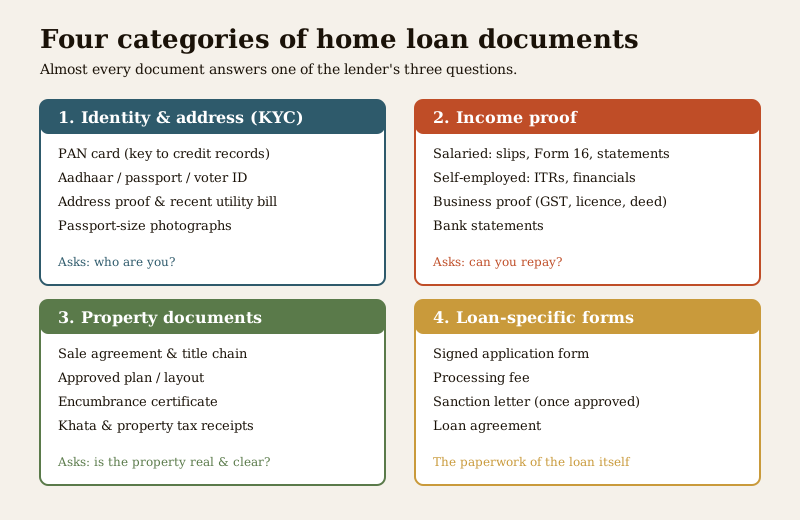
1. Identity and address (KYC) - proves who you are and where you live.
2. Income proof - proves you can repay; this is where salaried and self-employed applicants differ sharply.
3. Property documents - proves the property is legal, clear and worth the loan.
4. Loan-specific forms - the application, photographs, fees and, once approved, the sanction and agreement paperwork.
Work through them in that order. Your own KYC and income papers you can gather today; the property papers come from the seller or builder, so start chasing those early because they are the ones most likely to hold you up.
Category 1: Identity and address (KYC)
KYC - "know your customer" - is a regulatory requirement, not just a bank preference. Every applicant and co-applicant provides it. The bank needs one document that proves identity and one that proves current address; a single document sometimes covers both.
- Identity proof: PAN card (effectively mandatory for a loan, because it links to your credit and tax records), plus one of Aadhaar, passport, voter ID or driving licence.
- Address proof: Aadhaar, passport, utility bill (electricity, water, piped gas), or a registered rent agreement. Banks usually want a recent bill, often within the last two or three months.
- Passport-size photographs of each applicant.
Your PAN is the thread that ties the whole file together - it is how the lender pulls your credit history from the bureaus. If the name or date of birth on your PAN does not match your other documents, fix that mismatch before you apply, because it can quietly block the credit check. To understand what the bureau report itself contains, see our guide to credit score and CIBIL for a home loan.
Category 2: Income proof - the big salaried vs self-employed split
This is the category where the two types of applicant part ways completely. The lender is trying to answer the same question for both - how much steady, provable income do you have? - but a salaried person and a self-employed person prove it in entirely different ways.
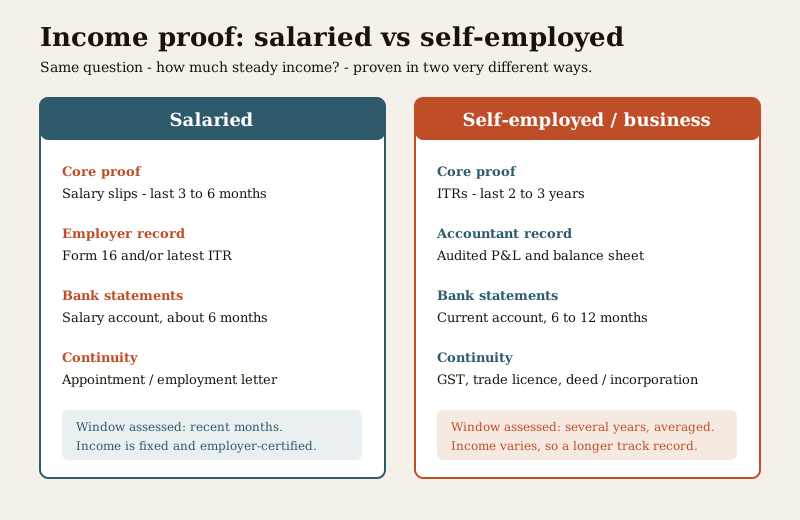
If you are salaried
Your income is documented for you by your employer, so the proof is relatively simple:
- Salary slips for the last three months (some lenders ask for six).
- Form 16 and/or the latest income tax return, usually for the last one to two years.
- Bank statements of your salary account, typically for the last six months, so the lender can see the salary actually credited and your existing obligations.
- Employment proof - an offer or appointment letter, or an employee ID, and sometimes a letter confirming your current designation.
The lender cross-checks the salary on your slips against the credits in your bank statement. They should agree. It also scans the statement for existing EMIs and for bounced payments, both of which affect how much it will lend.
If you are self-employed or run a business
Here you must prove income yourself, over a longer window, because business income is more variable. Expect to provide:
- Income tax returns for the last two to three years, with the computation of income.
- Financial statements - profit and loss account and balance sheet - for the same years, audited by a chartered accountant where applicable.
- Business bank statements (current account), usually for the last six to twelve months.
- Proof that the business exists and is yours: GST registration, shop and establishment or trade licence, partnership deed or certificate of incorporation, and proof of business continuity or address.
- For professionals such as doctors or architects, the relevant qualification or practice certificate.
Because the lender averages your income over several years and looks for consistency, a single strong year does not carry the same weight as it does on a salary slip. This is also why self-employed applicants should keep their ITRs filed on time and their declared income consistent - it is the number the loan is built on. The table below sets the two side by side.
| Income document | Salaried applicant | Self-employed / business applicant |
|---|---|---|
| Core proof | Salary slips (3-6 months) | Income tax returns (2-3 years) |
| Employer / accountant record | Form 16 | Audited P and L and balance sheet |
| Bank statements | Salary account, ~6 months | Business current account, 6-12 months |
| Continuity proof | Appointment / employment letter | GST, trade licence, incorporation / partnership deed |
| Window the lender assesses | Recent months | Multiple years, averaged |
| Why it differs | Income is fixed and employer-certified | Income varies, so a longer track record is needed |
How much this income lets you borrow is a separate question - work through it in our guide to home loan eligibility, and remember that the type of loan you choose also shapes the paperwork, covered in home loan types.
Category 3: Property documents - and the checks the bank runs
The property is the bank's security, so this category matters as much to the lender as your income does. The papers you provide let the bank confirm the property is legally clean and correctly valued. The exact set depends on whether you are buying from a builder, buying resale, or building on your own plot, but the spine is the same.
- Agreement to sell / sale agreement (and, once done, the registered sale deed).
- Chain of title - the earlier sale deeds and ownership records showing an unbroken line of owners up to the current seller.
- Approved building plan or sanctioned layout from the local authority.
- Occupancy or completion certificate for a ready property.
- Encumbrance certificate (EC), which shows whether the property carries any existing loan, mortgage or charge.
- Khata / property tax records and the latest paid tax receipts.
- For a builder purchase: the allotment letter, builder-buyer agreement, and the project's approvals and, where applicable, RERA registration.
- For construction on your own plot: the plot title papers, approved plan and a cost estimate.
Once you hand these over, the bank does not simply file them. It runs two independent checks. A legal verification, done by the bank's empanelled lawyer, examines the title chain and the EC to confirm the seller can legally transfer the property and that it is free of undisclosed charges. A technical valuation, done by the bank's valuer, confirms the property physically exists, is built to the approved plan, and is worth what you are paying - the bank lends against this valuation, not the sale price, so a low valuation can reduce your loan. If either check throws up a problem, the loan can be reduced or refused even after your income is approved.
The same legal and revenue papers - title chain, EC, khata, approved plan - are exactly what you should verify before you commit to a plot in the first place; our guide on how to buy a residential plot in India walks through that due diligence. The final step, registering the property, is covered in the property registration process.
Category 4: The loan-specific forms
The last bucket is the paperwork of the loan itself:
- The completed and signed loan application form.
- Passport-size photographs of all applicants.
- The processing fee cheque or payment.
- A cheque or mandate for the loan account, and, once approved, the sanction letter you accept and the loan agreement you sign.
Where there is a co-applicant - a spouse or parent on a joint loan - each of them submits their own KYC and income set too. The rest of the file is shared.
The master checklist
Use this as your pre-application sweep. Tick the ones that apply to you; the property column applies to every applicant.
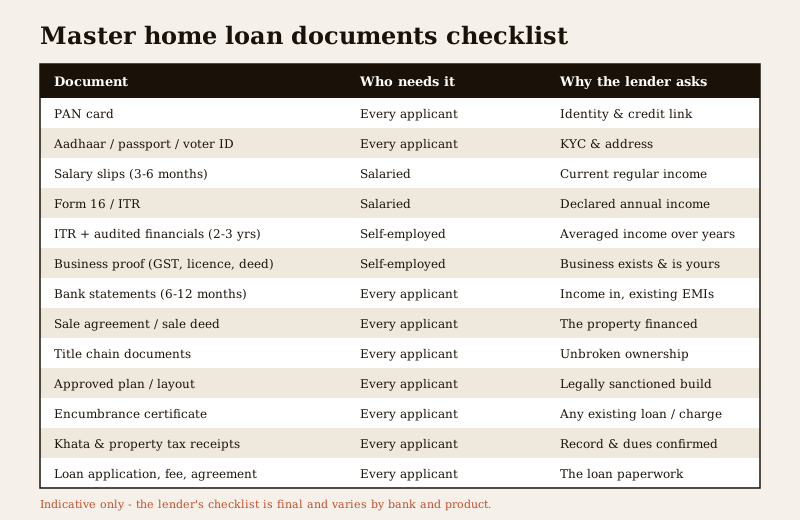
| Document | Who needs it | Why the lender asks |
|---|---|---|
| PAN card | Every applicant | Identity and the key to your credit and tax records |
| Aadhaar / passport / voter ID | Every applicant | Identity and address (KYC) |
| Passport-size photographs | Every applicant | Application record |
| Salary slips (3-6 months) | Salaried | Proof of current, regular income |
| Form 16 / ITR | Salaried | Confirms declared annual income |
| ITR + audited financials (2-3 yrs) | Self-employed | Proof of income over a longer, averaged window |
| Business proof (GST, licence, deed) | Self-employed | Confirms the business exists and is yours |
| Bank statements (6-12 months) | Every applicant | Shows income credited and existing EMIs |
| Sale agreement / sale deed | Every applicant | The property being financed |
| Title chain documents | Every applicant | Proves an unbroken line of ownership |
| Approved plan / layout | Every applicant | Confirms the build is legally sanctioned |
| Encumbrance certificate | Every applicant | Reveals any existing loan or charge |
| Khata and property tax receipts | Every applicant | Confirms the property record and dues |
| Loan application, fee, agreement | Every applicant | The loan paperwork itself |
How to assemble a clean file
A few habits make the difference between a smooth sanction and weeks of back-and-forth. Keep self-attested photocopies ready but carry the originals for verification. Make sure the name and date of birth are spelt identically across every document. Gather property papers early, since they depend on the seller. And ask your loan officer for their specific checklist up front - because, as the disclaimer says, that list is the one that counts.
Key takeaways
- Home loan documents fall into four buckets: KYC, income proof, property papers and the loan forms - assemble them in that order.
- Income proof is where salaried and self-employed applicants differ most: salary slips and Form 16 versus multi-year ITRs and audited financials.
- Property documents are the bank's security; it runs an independent legal verification and technical valuation, and lends against the valuation.
- Your PAN ties the file to your credit record - fix any name or date-of-birth mismatch before you apply.
- The lender's checklist is final and varies by bank and product; treat this list as indicative and confirm the current requirement with your bank, a property lawyer and a CA.
References
- Reserve Bank of India (RBI) - Know Your Customer (KYC) Master Direction, on the identity and address requirements banks must collect.
- Reserve Bank of India (RBI) - guidelines on housing finance and loan-to-value norms, which underpin the property valuation the bank relies on.
- National Housing Bank (NHB) - guidance for housing finance companies on documentation and property verification.
- Income Tax Department, Government of India - Form 16 and income tax return formats used as income proof (confirm current forms and any tax questions with a CA).
- Real Estate (Regulation and Development) Act (RERA) and state RERA portals - project registration status for builder purchases.
- Your lender's official home loan documentation checklist - the final, binding list for your specific application.
Export this guide
Related Guides — Deep-dive reading
Plot Due Diligence in India: The Complete Pre-Purchase Check (2026)
Before you pay a rupee for a plot, run the full pre-purchase check with your lawyer and a licensed surveyor - legal title, revenue records, planning approvals, physical survey and financial dues. This guide walks through each pillar, gives you a checklist and tells you when to walk away.
Buying LandLand Documents Checklist Before Buying a Plot in India (2026)
Every document to collect and verify before you buy a residential plot in India - the title chain, encumbrance certificate, khata or patta, mutation, survey and layout, land-use conversion and tax dues - what each one proves, the red flag if it is missing, and how the same record is named differently in each state.
Buying LandHome Loan Eligibility Explained: How Much Loan Can You Get in India (2026)
A plain-language explainer of home loan eligibility in India - how income and the FOIR or EMI-to-income rule, your age and tenure, credit score, existing debts, employment type, a co-applicant, property value and LTV all decide how much a lender will sanction - with an indicative illustration table and ways to improve your number.
Home FinanceRelated Tools — Try Free
Construction Approval Checklist — 24-Stage Tracker
Track every approval, permit, and NOC from land title to occupancy certificate across 24 stages.
ApprovalsHome Loan Eligibility Checker
Eligible home loan amount across 12 Indian banks with rates, tenure, FOIR, and processing fees.
Loan CalculatorStamp Duty Calculator — All Indian States
Stamp duty + registration charges for all 28 states and 8 UTs — gender concessions, urban/rural variants, metro cess built in.
Stamp Duty