

Joint Home Loan in India: Co-Applicant, Co-Owner and Tax (2026)
How adding a spouse, parent or child as a co-applicant can boost your eligibility, unlock separate tax deductions, and what the shared liability really means.
A joint home loan is a single loan that two or more people take together. Most Indian families use one without thinking much about the mechanics: a couple buys a flat, both names go on the paperwork, the bank sanctions a larger amount. But a joint loan quietly changes three things at once. It changes how much you can borrow, who can claim the tax deductions, and who is on the hook if an EMI is missed. Getting the structure right can mean a bigger sanction and two sets of tax savings. Getting it wrong can mean one person carries all the liability with none of the benefit.
This guide explains how joint home loans work in plain language so you can have an informed conversation with your bank and your CA. It is not financial or legal advice. If you are new to borrowing for a home, start with our overview of how home loans work in India, then come back here for the joint-loan specifics.
This is general educational information, not financial, tax or legal advice. Your actual eligibility, interest rate, EMI and sanction are decided by the lender. Tax sections, deduction limits and state concessions are named generally, change with the annual budget and RBI decisions, and must be confirmed with a CA or tax advisor. Ownership shares, deed wording and succession must be settled with a lawyer. Every figure here is indicative.
Why families take a joint home loan
The single biggest reason is eligibility. A lender sizes your loan to what your household can comfortably repay each month. It looks at combined take-home income, existing EMIs and obligations, and applies its own ratio (often called FOIR or the fixed-obligation-to-income ratio) to decide how much EMI you can carry. When you add a co-applicant whose income is clubbed with yours, the household repayment capacity rises, and so does the loan you qualify for, usually without stretching the tenure.
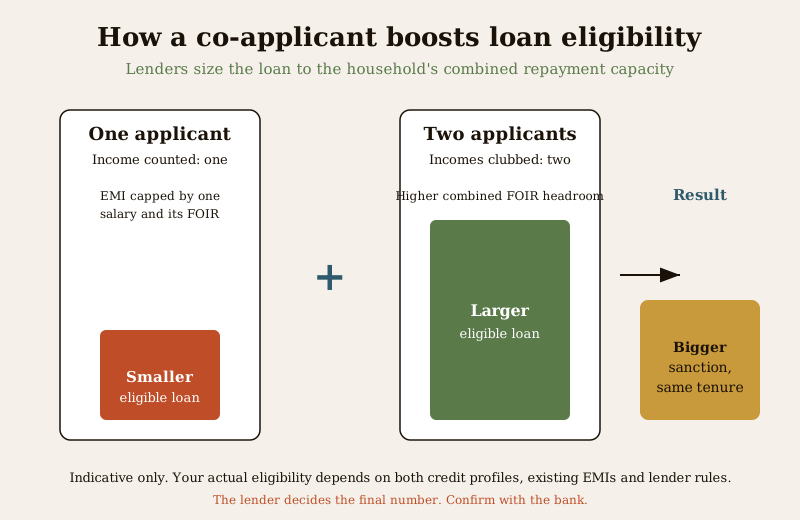
There are three other common motives:
- Two sets of tax deductions. If the co-applicant is also a co-owner and pays part of the EMI, each person can claim the interest and principal deductions separately, in their ownership ratio. Named generally, these fall under Section 24(b) for interest and Section 80C for principal, with Section 80EEA available in some windows for eligible first-time buyers. Limits and eligibility change, so confirm the current position with a CA.
- State concessions for women owners. Several states offer a lower stamp-duty rate, and some lenders a marginally lower interest rate, when a woman is a co-owner or the primary owner. The concession varies by state and year, so check the local rate before you register.
- Shared monthly burden. Two earners splitting one EMI feel it less than one earner carrying the whole thing.
For the eligibility mechanics in detail, see our guide on home loan eligibility, and run the numbers yourself on the loan eligibility calculator and the EMI calculator.
The distinction that decides everything: co-applicant vs co-owner
This is the single most misunderstood part of a joint loan, and it is where families lose tax benefits or create disputes. The two roles are separate.
- A co-applicant (also called a co-borrower) signs the loan and is jointly responsible for repaying it. Their income can be clubbed for eligibility. But signing the loan does not, by itself, make them an owner of the property.
- A co-owner has their name on the sale deed and holds a legal share of the property. But being on the deed does not, by itself, make them liable for the loan.
The tax benefit sits only in the overlap. To claim a deduction, a person must be all three at once: a co-owner (name on the deed), a co-borrower (name on the loan), and someone who actually pays the EMI from their own funds. Miss any of the three and the deduction is not available, even if the loan is large and the interest paid is real.
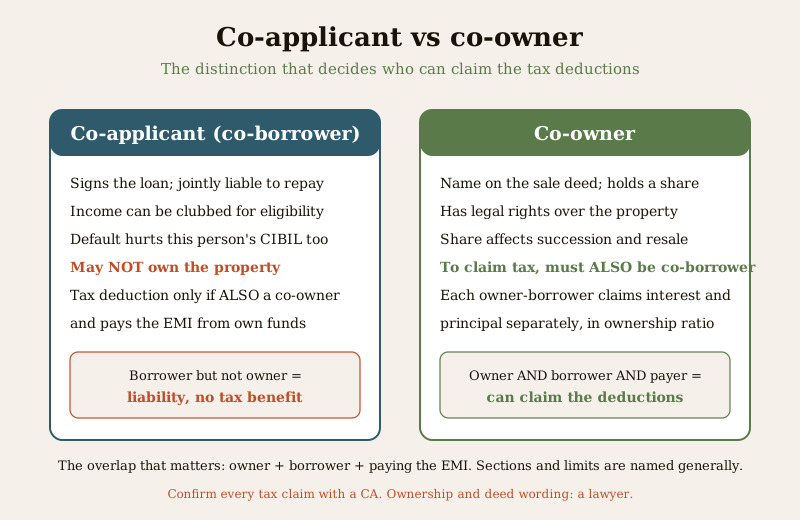
| Aspect | Co-applicant (co-borrower) | Co-owner |
|---|---|---|
| Name appears on | The loan agreement | The sale deed / registered document |
| Income clubbed for eligibility | Yes | Only if also a co-borrower |
| Legally liable to repay | Yes, fully | No, unless also a co-borrower |
| Holds a share of the property | No, unless also on the deed | Yes |
| Can claim interest / principal deduction | Only if also a co-owner and pays EMI | Only if also a co-borrower and pays EMI |
| Credit score affected by default | Yes | Only if also a co-borrower |
The practical rule: if the point of adding someone is tax savings, they must be a co-owner AND a co-borrower AND contribute to the EMI, ideally from their own bank account so the payment trail is clean. Who can be a co-applicant is also limited by lender policy. Spouses are almost always accepted. Parents and financially independent children are usually accepted. Some lenders allow siblings under conditions. Unmarried partners and friends are often not accepted as co-applicants for a property loan. Confirm the exact combination your lender permits before you plan the ownership.
The part people underweight: shared and full liability
A joint loan is not a loan split in half. Each co-borrower is jointly and severally liable, which means every borrower is responsible for the entire outstanding amount, not merely their notional share. If one co-borrower stops paying, the lender can pursue the other for the full EMI. There is no "I only agreed to half" defence.
This has direct consequences:
- A missed EMI dents every co-borrower's credit score. A default reported to the bureaus lands on both CIBIL records, even the co-borrower who was paying on time. See our guide on the credit score and CIBIL for a home loan for how that reporting works and why it matters for your next loan.
- Both profiles must qualify. A weak credit history on either co-applicant can raise the rate or shrink the sanction for both.
- Exit is hard. Removing a name from a running joint loan is not a form-filling exercise. It usually means the remaining borrower must re-qualify alone for the full outstanding, and the lender must agree. Plan the structure as if it is permanent.
What to weigh before you sign
A joint loan is a long commitment tying two people's finances together for a decade or two. Weigh the upside against the shared risk with clear eyes.
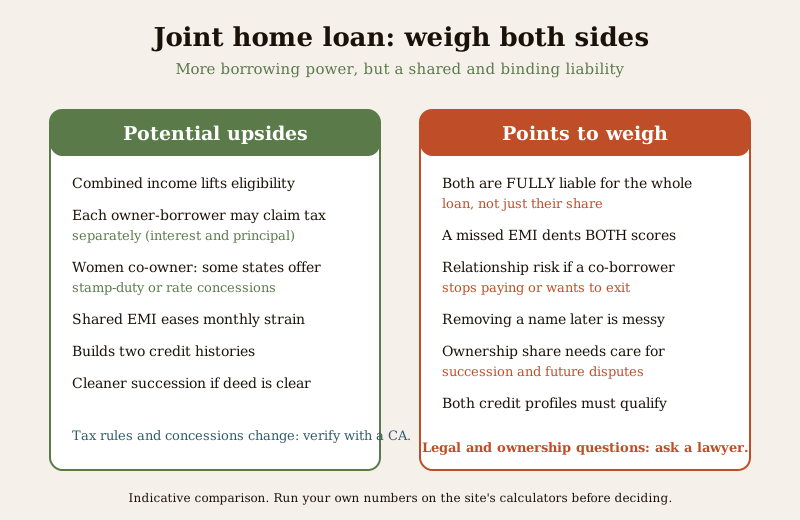
| Potential upside | Point to weigh against it |
|---|---|
| Combined income lifts eligibility and sanction | Both credit profiles must qualify; a weak one drags both |
| Each owner-borrower may claim deductions separately | Only if all three roles overlap; a paper co-borrower gets no benefit |
| Some states give women co-owners stamp-duty or rate concessions | Concession varies by state and year; verify locally |
| Shared EMI eases the monthly strain | Both are fully liable for the whole loan, not a half each |
| Builds credit history for both borrowers | A single missed EMI dents both scores |
| Cleaner succession when the deed is clear | Removing a name later is difficult and needs re-qualification |
Three questions worth settling in writing before you register:
1. Ownership share. Decide the ratio (for example 50:50, or matched to who pays how much of the EMI) and record it in the deed. Tax deductions are claimed in the ownership ratio, so the split has consequences beyond sentiment. This is a lawyer's question.
2. Succession. Think through what happens to each share on death or separation, and whether a will or nomination is in place. Joint ownership does not automatically transfer the full property to the survivor. A lawyer can explain the succession rules that apply to you.
3. Relationship risk. A joint loan couples two people financially for years. Agree in advance how the EMI is split, what happens if one person's income drops, and how an exit would work. These conversations are far easier before signing than after a dispute.
How the tax benefit actually splits
When each co-owner is also a co-borrower and pays their share of the EMI, the interest and principal are apportioned in the ownership ratio, and each person claims their portion in their own return, up to the limits that apply to them individually. Because the limits apply per person, two qualifying owners can, in effect, claim more household deduction than one owner alone, subject to how much interest and principal is actually paid and the caps in force that year.
The key phrase is "in force that year". The sections, the ceilings and the availability of extra deductions such as 80EEA move with the annual budget and scheme windows. Treat any specific number you read as indicative and confirm the current position with a CA before you file. Our guide on home loan tax benefits under Section 80C and 24(b) walks through the deductions in more depth, and the home loan tax benefit calculator lets you estimate your own split. If a subsidy is in play, see the PMAY subsidy explainer.
Key takeaways
- A joint home loan clubs incomes so the household qualifies for a larger loan, usually the main reason families take one.
- Co-applicant and co-owner are different roles. Liability comes from the loan; ownership comes from the deed; tax benefit needs both plus paying the EMI.
- To claim a deduction a person must be co-owner AND co-borrower AND contribute to the EMI, ideally from their own account for a clean trail.
- Liability is joint and several. Each borrower is responsible for the whole loan, and a missed EMI dents every co-borrower's credit score.
- Some states offer stamp-duty or rate concessions when a woman is a co-owner; the concession varies by state and year.
- Settle ownership share, succession and the exit plan in writing before you register. Ownership is a lawyer's call; tax is a CA's call.
- Rates, limits and tax sections are indicative and change. Run your own numbers on the calculators and confirm specifics with the professionals.
References
- Reserve Bank of India (RBI) - repo rate and external benchmark (EBLR) framework that lenders price home loans against. rbi.org.in
- Income-tax provisions on housing loans - deductions for interest (Section 24(b)), principal (Section 80C) and additional first-time-buyer relief (Section 80EEA), named generally as sections and limits change each budget. incometax.gov.in
- Ministry of Housing and Urban Affairs - Pradhan Mantri Awas Yojana (PMAY) scheme details and eligibility windows. pmaymis.gov.in
- CIBIL / credit bureaus - how joint-loan repayment and default are reported on each borrower's record. cibil.com
- State stamp-duty and registration departments - women-owner concessions and current rates vary by state; check your state's registration department.
- Studio Matrx guides: home loan eligibility, credit score and CIBIL, and home loan tax benefits under 80C and 24(b).
Explore the full Money Library for more on financing your home.
Interactive · Check your eligibility
₹1.2 L/mo income · Typical FOIR
Lender FOIR band
Maximum eligible loan
₹51.9 L
Assumes ~80% loan-to-value (20% down payment).
Eligible loan by tenure — longer tenure lifts eligibility but raises total interest.
Illustrative only. Actual eligibility depends on the lender's FOIR policy, your CIBIL score, income stability, and the property valuation. Confirm with your bank or a CA.
Export this guide
Related Guides — Deep-dive reading
Home Loan Tax Benefits - Section 80C and 24(b) in India (2026)
How a home-loan borrower may claim income-tax deductions on principal, interest, stamp duty and first-time-buyer benefits - explained in plain language, with the limits and regime rules that keep changing left for your CA to confirm.
Home FinancePMAY Home Loan Subsidy Explained: Credit-Linked Help for First-Home Buyers (2026)
A plain-language look at how the Pradhan Mantri Awas Yojana interest subsidy works on a home loan, who the income categories are meant for, and why you must confirm the current rules on the official portal or with your lender.
Home FinanceHome Loan Eligibility Explained: How Much Loan Can You Get in India (2026)
A plain-language explainer of home loan eligibility in India - how income and the FOIR or EMI-to-income rule, your age and tenure, credit score, existing debts, employment type, a co-applicant, property value and LTV all decide how much a lender will sanction - with an indicative illustration table and ways to improve your number.
Home FinanceRelated Tools — Try Free
Stamp Duty Calculator — All Indian States
Stamp duty + registration charges for all 28 states and 8 UTs — gender concessions, urban/rural variants, metro cess built in.
Stamp DutyHome Loan Affordability Calculator
Max eligible home loan and property price from your income, FOIR, LTV, tenure, and interest rate — with Section 24(b) + 80C tax savings.
Loan EligibilityHome Loan Eligibility Checker
Eligible home loan amount across 12 Indian banks with rates, tenure, FOIR, and processing fees.
Loan Calculator