
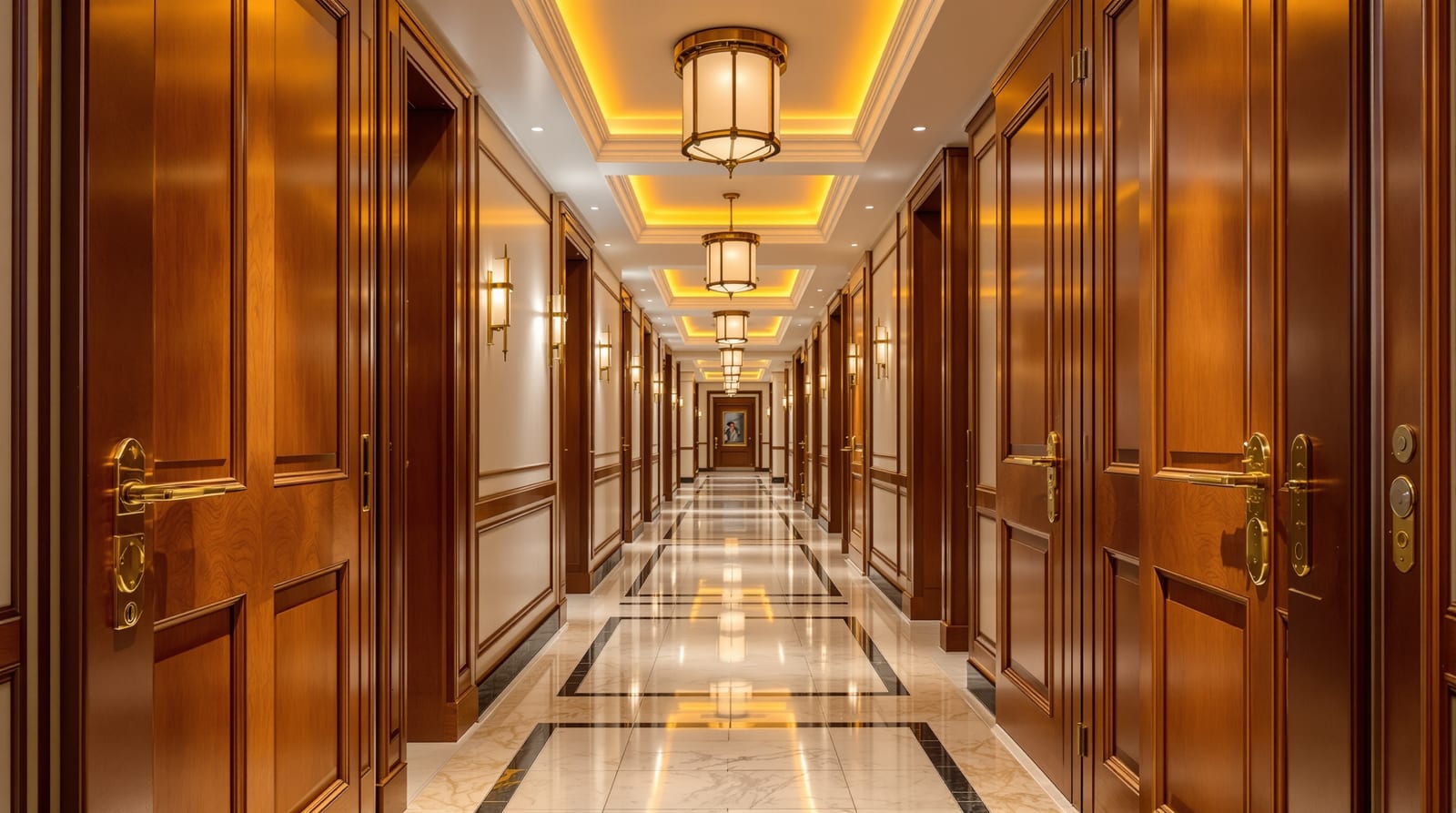
Hotel Doors in India: The Right Door for Every Zone, from Grand Entrance to Guest Room (2026)
A zone-by-zone guide to specifying doors for a hotel in India - the revolving or automatic-sliding grand entrance, the acoustic smart-lock guest-room door, bathrooms, banquet operable walls, restaurant, spa, back-of-house and rated fire exits - with the drivers and indicative per-door costs behind each choice.
A hotel is not one building but a dozen building types stitched together behind a single brand, and its doors tell you exactly where you are standing. The grand entrance has to perform a piece of theatre while sealing in the air conditioning. The guest-room door, the one a tired traveller pushes open at midnight, is quietly the most demanding door in the whole property: it has to feel reassuringly solid, lock with a tap of a phone or card, keep a corridor party from waking the occupant, and hold a fire for sixty minutes if the worst happens. Banquet halls need walls that turn into doors and back again. Kitchens, spas, service corridors and fire stairs each demand a different machine. Get the door schedule wrong and the cost is not just money - it is one-star reviews about noise, a security incident, or a fire-safety notice that closes the floor. This guide walks a hotel zone by zone, names the right door for each, explains the driver that decides it, cites the Indian codes that govern it, and gives indicative 2026 per-door costs. For the wider logic of matching a door to its space, start with the master overview on choosing a door by space; this is its hospitality application.
The six forces that shape every hotel door
Before the zones, the drivers. Every hotel door is a weighting of these six demands, and the balance shifts completely as you move from the porte-cochere to a back-of-house cleaner's cupboard.
- Guest acoustics and privacy. The single biggest source of bad hotel reviews is noise. A guest-room door must block corridor sound, lift dings, trolleys and neighbours - a real acoustic seal, not just a heavy slab. Spa and conference doors carry the same burden.
- Smart-lock security and the audit trail. Modern hotels run on RFID or mobile keys: who entered which room, when, on whose credential. Guest rooms, back-office, stores and plant rooms all need electronic access tied to the property-management system, not brass keys.
- Fire and life safety. A hotel is a high-occupancy sleeping building - the most safety-critical occupancy class there is. Guest-room doors, corridors, stairwells and exits must follow NBC 2016 egress rules and carry IS 3614 fire-rated assemblies, with self-closers, and never trap a sleeping guest.
- Brand image and luxe finish. The entrance and public doors sell the room rate before the guest reaches reception. Veneer, polished metal, frameless glass and proportion do the talking.
- Durability under 24x7 use. A hotel door cycles thousands of times a year for decades. Hardware, hinges, closers and finishes must survive housekeeping trolleys, suitcases and relentless use without sagging or rattling.
- Accessibility. Hotels must provide accessible rooms and step-free public routes under RPwD 2021 - clear width at least 900 mm, lever handles, thresholds capped at 12 mm.
No single door scores high on all six. The craft is reading each zone and specifying for its dominant pair of forces.
Hotel zones and the door each one needs
Read the property as four concentric experiences. The arrival ring (porte-cochere, lobby entrance) is pure theatre and climate control. The guest ring (corridors, guest-room doors, room bathrooms) is privacy, acoustics and security. The event and leisure ring (banquet, restaurant, spa, gym) flexes between grandeur and function. The service core (kitchens, stores, plant, fire stairs) is hygiene, durability and code.
| Zone | Recommended door | Primary driver | Indicative ₹ (per door, 2026) |
|---|---|---|---|
| Grand entrance | Revolving door or automatic sliding toughened-glass door | Brand theatre + AC sealing + accessibility | Revolving 6,00,000-20,00,000+; auto-slide 1,80,000-4,50,000+ |
| Lobby / vestibule | Frameless toughened-glass swing or sliding with floor spring | Welcoming, transparent, durable | 25,000-70,000 |
| Guest-room (the key door) | Solid-core acoustic door + RFID/mobile smart lock + closer + viewer + DND + fire rating | Acoustics + security + fire + 24x7 durability | 22,000-65,000+ (door + smart lock) |
| Guest bathroom | WPC, engineered-wood or veneered flush door, privacy bolt | Moisture resistance, privacy, finish | 6,000-18,000 |
| Banquet / conference | Operable folding partition wall + acoustic timber double doors | Flexible room sizing + acoustics | Partition 1,800-4,500 per sq ft of wall; doors 30,000-90,000 |
| Restaurant front | Frameless glass or panelled timber double doors | Ambience, footfall, brand | 30,000-1,10,000 |
| Restaurant / kitchen pass | Double-swing impact door, self-closing, vision panel, hygienic | Hands-free traffic, hygiene, sight line | 18,000-55,000 |
| Spa / treatment room | Solid acoustic door, soft-close, calm finish | Quiet, privacy, serenity | 18,000-45,000 |
| Back-of-house / service | Steel or laminate flush door, kick plate, closer, access control | Durability, hygiene, controlled access | 8,000-30,000 |
| Fire exit / stairwell | IS 3614 fire-rated door + panic/push bar, outward swing, self-closing | NBC egress; life safety | 14,000-45,000+ |
The sections below take the zones that decide whether the project succeeds.
The grand entrance: theatre that seals the air
The entrance does two jobs at once and they pull in opposite directions. It must look like the promise of the room rate, and it must stop the conditioned lobby air from pouring out into a Chennai or Delhi afternoon every time a guest walks through. That is why the two default answers are a revolving door or an automatic sliding glass door - both keep a near-continuous air seal while letting people flow. A revolving door is the most efficient air-lock and reads as the most premium, which is why five-star city hotels favour it; it must be paired with an adjacent automatic swing or sliding leaf for luggage trolleys, wheelchairs and accessibility under RPwD 2021, because a revolving door alone is not accessible. Resort and boutique properties more often choose large automatic sliding or grand timber pivot doors that suit a low-rise, landscaped arrival.
For the mechanism, sizing and Indian supplier landscape of these, see automatic sliding doors and the dedicated automatic glass doors guide; for the frameless-glass detailing that defines the lobby, read frameless glass doors. Whatever the choice, the entrance is also a fire-egress consideration: in an emergency, automatic and revolving doors must fail to a safe open or break-out position so they never trap guests.
The guest-room door: the most important door in the hotel
If you specify only one door correctly, make it this one. A guest-room door is asked to do four serious jobs simultaneously, and a weakness in any one shows up in reviews or incident reports.
The build, layer by layer:
- A solid-core acoustic slab. Hollow flush doors are out. You want a dense solid-core leaf with perimeter seals and an automatic drop seal at the threshold, targeting a real corridor-to-room sound block. The principle and the seal detailing are covered in soundproof doors; the core-construction trade-off is in solid vs hollow core doors.
- An RFID or mobile smart lock. The card or phone is the room key, integrated to the property-management system, with a full entry audit log and staff-override hierarchy. The technology, brands and integration are in smart door locks. Reception, housekeeping and maintenance credentials sit above the guest credential.
- A concealed door closer. Mandatory so the door latches behind a departing guest and behind a fire - it is both a security and a fire-safety device. See door closers.
- A wide-angle viewer, privacy/DND indicator and night latch. The small fittings that make a guest feel safe and undisturbed.
- A fire rating. Guest-room doors on a corridor are part of the fire-compartment line and typically need a 30 to 60 minute rating to IS 3614, with intumescent seals and the self-closer above. This is non-negotiable in a sleeping occupancy - read fire-rated doors.
Because all of this lands on one leaf, the guest-room door is a specialised product. The full anatomy, brands and a model spec sheet are in the dedicated hotel room door guide; this overview tells you why it sits at the centre of the schedule.
Banquet, conference and restaurant: walls that become doors
Banquet and conference revenue depends on flexibility - one ballroom that splits into three meeting rooms by lunchtime. The tool for that is an operable folding partition wall: top-hung acoustic panels that stack away to open the room and seal across to divide it, each panel rated for a meaningful sound block so a wedding and a board meeting can run side by side. Specify the acoustic rating honestly; cheap partitions leak sound and the complaints follow. The mechanism and Indian options are in folding doors and the broader partition doors guide. Pair the hall with acoustic timber double doors at the entrances, and a discreet service door to the kitchen pass.
The all-day restaurant and specialty diners want frameless glass or panelled timber double doors at the front for ambience and footfall - see double doors - and behind them a double-swing impact door between the dining floor and the kitchen pass: self-closing, with a vision panel so staff carrying trays do not collide, and a hygienic, wipeable face. The mechanism is covered in swing doors.
Bathrooms, spa, back-of-house and fire exits
Guest bathrooms sit in a wet zone and want a moisture-tolerant leaf - WPC, engineered-wood or a well-sealed veneered flush door - with a privacy bolt and a finish that coordinates with the room. Compare the materials in WPC doors and engineered wood doors.
Spa and treatment rooms are an acoustic and serenity problem disguised as a door: a solid soft-close leaf that holds quiet and privacy, finished to feel calm. The acoustic logic again points to soundproof doors.
Back-of-house - housekeeping stores, linen, plant and offices - wants durable steel or laminate flush doors with kick plates, closers and access control on the secure ones (stores, plant, server). Hardware selection sits in the door hardware guide.
Fire exits and stairwells are where life safety is won or lost in a sleeping building. They need IS 3614 fire-rated assemblies, panic/push bars so a fleeing crowd opens them without thinking, outward swing in the direction of escape, and self-closers - and they must never be chained or locked against egress, the recurring cause of fatal hotel fires. The standard is in fire-exit doors and the wider rules in emergency exit door standards.
For a refresher on which materials suit which job across the property, the best door material comparison is a useful companion.
Costs and how to budget the door schedule
Hotel doors range from a few thousand rupees for a back-of-house cupboard to twenty lakh or more for a signature revolving entrance, so budget by zone, not by an average. The highest-volume line item is almost always the guest-room door package - leaf plus acoustic seals plus smart lock plus closer and fittings - because you are buying it once per key. For a 100-key hotel at, say, 30,000 to 50,000 rupees per fully specified guest-room door, that single line is 30 to 50 lakh before public and service areas. The entrance, banquet partitions and kitchen impact doors are lower in count but high in unit cost. To pressure-test a commercial door schedule across zones and quantities, use Studio Matrx's commercial door cost calculator. All figures are indicative for 2026, exclude 18% GST, and vary by size, finish, rating and city.
Do and don't
- Do treat the guest-room door as the project's hero door - acoustic core, smart lock, closer, viewer, DND and fire rating together. Skimping here costs you reviews and revenue.
- Do pair a revolving grand entrance with an accessible automatic swing leaf for trolleys, wheelchairs and RPwD 2021 compliance.
- Do specify the acoustic rating of banquet operable walls explicitly and test it on site.
- Don't ever lock or chain a fire-exit door against escape - the deadliest mistake in hotel safety.
- Don't use hollow-core or unsealed doors on guest rooms, spa or conference - the noise transfer is the number-one complaint.
- Don't forget the closer and self-latch on guest rooms; an unlatched fire/security door is a defeated one.
Frequently asked questions
What is the most important door in a hotel?
The guest-room door. It is the one door that must simultaneously block corridor noise, lock securely by RFID or mobile key with a full audit trail, self-close, give the guest a viewer and DND privacy, and carry a fire rating in a sleeping occupancy. No other door in the property carries that many critical jobs at once, and it is repeated once per key, so it dominates both the schedule and the budget. See the dedicated hotel room door guide.
Revolving door or automatic sliding door for a hotel entrance?
Both seal the conditioned air; the choice is image and footfall. A revolving door is the most efficient air-lock and reads as the most premium, favoured by city five-stars, but it must be paired with an adjacent automatic swing or sliding leaf for accessibility and luggage. Automatic sliding glass suits resorts, boutiques and high-trolley arrivals and is a lower capital cost. Compare them in automatic sliding doors.
What fire rating do hotel doors need in India?
Guest-room doors on a corridor are part of the fire-compartment line and typically need a 30 to 60 minute rating to IS 3614 with intumescent seals and a self-closer. Stairwell and fire-exit doors must be rated to NBC 2016 egress requirements, fitted with panic hardware, swing outward in the direction of escape, and never be locked against egress. Details are in fire-rated doors.
How do you make hotel guest rooms quiet through the door?
Use a solid-core acoustic leaf, a continuous perimeter seal and an automatic drop seal at the threshold, and make sure the door self-closes and latches fully every time. The seal detailing matters more than slab weight alone; the full method is in soundproof doors.
How should I budget doors for a new hotel?
Budget by zone and quantity, not by an average. The guest-room door package, bought once per key, is usually the largest single line; the entrance, banquet partitions and kitchen impact doors are fewer but costly per unit. Build the schedule zone by zone and stress-test the totals with the commercial door cost calculator, then add 18% GST and a finish/city allowance. The wider zone logic lives in doors by space.
Export this guide
Related Guides — Deep-dive reading
Library Door in India: Quiet, Access-Controlled and Anti-Theft Reading-Room Entrances (2026)
Doors for public, college and corporate libraries in India - acoustic silence, RFID security gates, controlled single entry and a calm scholarly look, with zone-by-zone choices and costs.
Home Doors & EntrancesAuditorium Door in India: Acoustic Sound-Locks, Panic Exits and NBC Egress (2026)
Specifying doors for auditoriums, theatres and banquet halls - heavy STC 45-55 acoustic doors and sound-lock vestibules, outward-swing panic exits sized for huge crowds under NBC public-assembly rules, light-tight seals and divisible-hall operable partitions.
Home Doors & EntrancesGym and Fitness-Centre Door in India: Access Control, Acoustics, Durability and Costs (2026)
How to spec gym and fitness-studio doors zone by zone - a 24x7 access-controlled entrance, street-selling glass frontage, acoustic studio doors that keep loud classes off the neighbours, sweat-and-moisture-proof locker and steam doors, equipment-wide openings, and code-compliant fire exits with panic bars.
Home Doors & EntrancesRelated Tools — Try Free
Acoustic Privacy (STC) Visualizer
Indian healthcare acoustic visualizer — compare wall assemblies and noise sources, see received SPL after STC attenuation, and check FGI 2018 / IS 1950 / NABH speech-privacy compliance with live dual-canvas waveform.
Acoustic ToolDoor Cost Calculator
Estimate the all-in cost of a door — leaf, frame, hardware, fitting and GST — by type, material and size.
Door CalculatorDoor Material Comparison Tool
Compare 2–4 door materials on cost, durability, maintenance, security and moisture resistance.
Comparison Tool