
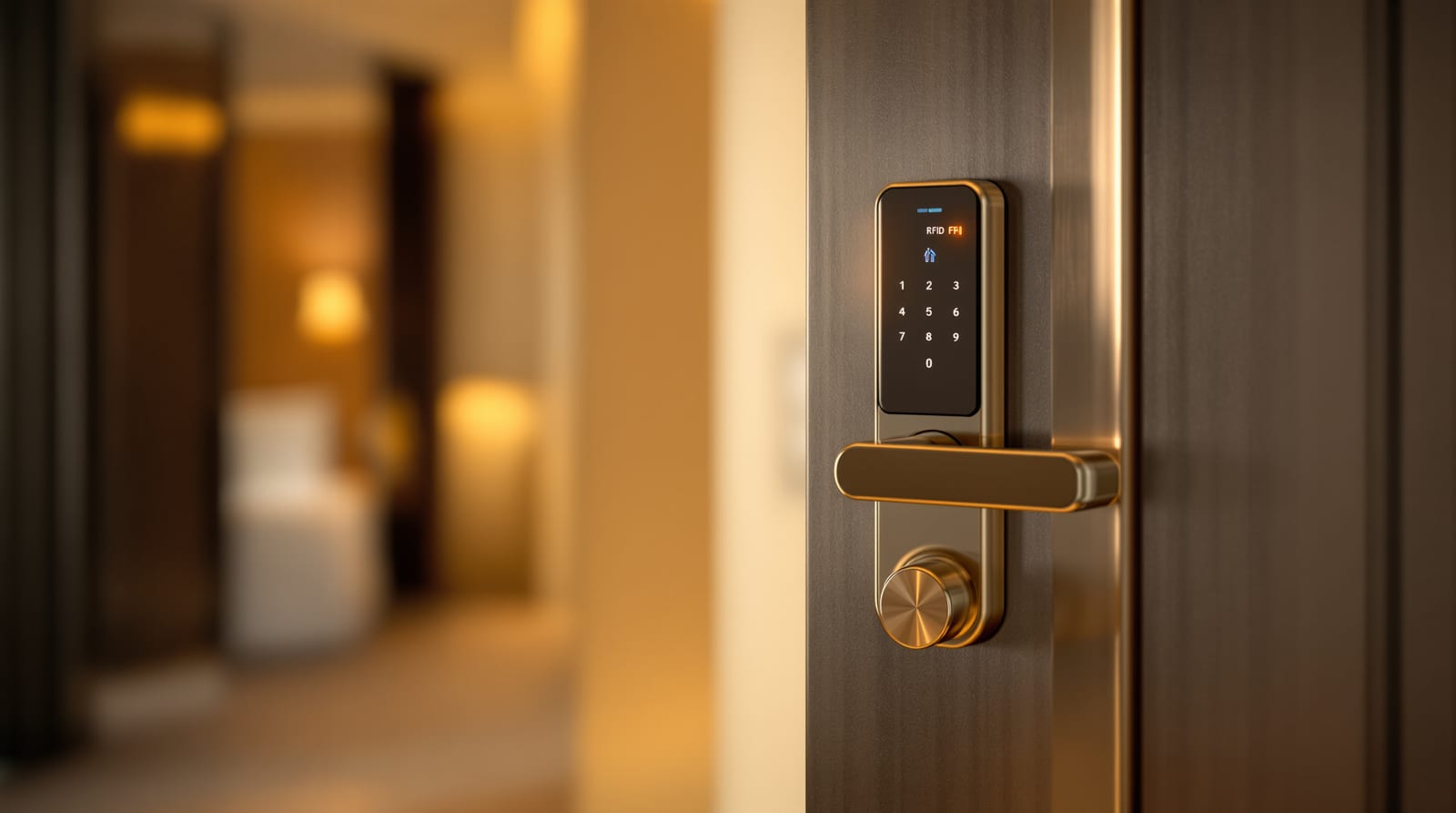
Hotel Room Door in India: The Complete Guest-Room Door Hardware Stack (2026)
A spec-led guide to the single most spec'd hotel door in India - the guest-room entry leaf - covering the fire-rated solid core, RFID/mobile smart lock, self-closing closer, viewer, DND/privacy hardware, acoustic STC and accessible-room rules, with indicative per-door-set costs.
The hotel guest-room door is the single most carefully specified door in the building - and the one ordered in the largest numbers. A 120-key hotel buys one revolving entrance and one or two banquet operable walls, but it buys 120 identical guest-room door sets, each carrying the same demanding brief: it must rate for fire and close itself, lock a stranger out with a card or phone, give the guest a viewer and a privacy mode, keep the corridor noise out so they sleep, and survive a decade of being slammed, kicked and card-tapped thousands of times - all while looking like the brand. Get the specification right once and it repeats flawlessly across every floor; get one component wrong and you repeat the mistake 120 times. This guide breaks down the complete guest-room door set component by component - leaf, frame, lock, closer, viewer, privacy hardware, acoustics, seals - tells you the spec and the reason behind each, and gives indicative rupee figures for the whole set.
For the property-wide view of every hotel door - entrance, banquet, kitchen, back-of-house and fire exits - start with hotel doors in India and the master doors by space guide for India.
Why the guest-room door carries so many demands at once
Most doors answer to one or two drivers. The guest-room door answers to five at the same time, and the leaf has to satisfy all of them simultaneously - you cannot trade one off against another.
- Fire and life-safety. A guest-room door usually opens onto an internal corridor that is part of the means of escape. Under the fire provisions of the National Building Code (NBC 2016), the door into a sleeping room on an enclosed corridor is typically required to be fire-rated and self-closing, so a fire in one room does not spread to the corridor and trap other guests. This single requirement forces a solid, rated leaf and a closer onto every door.
- Security and access. A guest must be the only person who can enter, and the front desk and housekeeping need controlled, auditable access. This is the job of the electronic lock - RFID card or mobile key - that defines the modern hotel door.
- Acoustic privacy. Guests sleep next to corridors, lifts and neighbours on a different clock from their own. The door is the weakest acoustic link in the room envelope, so its sound rating and its seals decide whether a guest sleeps.
- Durability and serviceability. A guest-room door is operated tens of thousands of times a year and treated roughly. Every component must survive heavy cycling and be replaceable by a maintenance technician without specialist tools.
- Brand finish. The corridor of identical doors is one of the strongest brand impressions in the hotel. The leaf face, the architrave, the lock escutcheon and the numbering must read as one designed system.
Because all five apply at once, the guest-room door is best thought of not as a leaf but as a complete, pre-specified door set - leaf, frame and a fixed stack of hardware that ships and installs together.
The hardware stack, component by component
The drawing below shows the standard hotel guest-room door from the corridor side with every component of the stack in its place. The table after it gives the spec and the reason for each.
| Component | Spec for a guest-room door | Why it is there |
|---|---|---|
| Leaf - solid core, fire-rated | Fire door rated 30-60 min to IS 3614; solid mineral/timber core, ~44-54 mm thick, flush face | NBC self-closing fire compartmentation; the mass also drives acoustics and the rough-use durability |
| Frame | Pressed-steel or hardwood fire-rated frame to IS 4351 with intumescent strips in the rebate | The rating is leaf-plus-frame, never the leaf alone; intumescent seals close the gap in a fire |
| Smart lock | RFID card and/or mobile (BLE/NFC) electronic lock with mechanical override, audit trail, deadbolt | Keyless, re-codable per guest, gives the desk control and a record of every entry |
| Door closer | Overhead or concealed closer, adjustable, with hold-open OFF | Mandatory self-closing for the fire rating; ensures the door never gets left ajar |
| Viewer | 180-200 degree wide-angle viewer at a height the guest can use | Lets the guest identify a caller before opening - basic personal security |
| Privacy / DND | Electronic DND and make-up-room indicator, or a mechanical privacy thumbturn / deadbolt | Guest controls interruptions; housekeeping reads status without knocking |
| Door guard / night latch | Swing-bar or U-guard secondary latch on the inside | Lets the guest open the door a few inches against a stranger; extra night security |
| Acoustic + seals | Perimeter gaskets plus an automatic drop seal at the threshold; target STC 35+ | The door is the weak acoustic link; seals close the gaps that leak most noise |
The rest of this guide explains the load-bearing components in turn.
The leaf: a fire-rated solid core, not a flush bedroom door
The biggest mistake in budget hotels is fitting an ordinary hollow-core residential flush leaf and bolting hotel hardware onto it. The guest-room leaf must do three jobs the residential flush door cannot: hold a fire rating, block sound, and survive abuse. All three point to the same answer - a fire-rated solid-core leaf.
A guest-room door on an enclosed escape corridor is typically a 30 to 60-minute fire door under NBC 2016, certified as a set to IS 3614 with a frame to IS 4351. That rating requires a dense mineral or treated-timber core, intumescent seals in the frame rebate, fire-rated hinges and a self-closing device. The same dense core that earns the fire rating is also what gives the door its acoustic mass and its resistance to kicks and slams - so the fire requirement and the comfort requirement are satisfied by one decision. This is why a hotel door is fundamentally a solid-core, not hollow-core, door; the hollow honeycomb leaf used in cheap flush doors fails on all three counts at once. For the wider menu of fire ratings and where each is mandated, see fire-rated doors in India.
The face finish is a separate decision layered on the rated core: a wipe-clean laminate or a factory veneer that matches the corridor's brand palette, with the architrave and number plate forming one system down the floor.
The smart lock: the component that defines the modern hotel door
If one component says "hotel," it is the electronic lock. The mechanical key is effectively gone from branded hotels. The standard today is an RFID card lock, increasingly paired with a mobile key the guest receives in the brand's app and presents over Bluetooth or NFC - so the guest can check in on the phone and walk straight to the room. Every lock keeps an audit trail of who opened the door and when, re-codes itself for each new guest at checkout, and accepts a tiered hierarchy of cards: guest, housekeeping, floor supervisor, emergency master. Critically, every electronic lock retains a mechanical key override for power or battery failure, and most run on battery so a mains outage never locks a guest out.
This is a specialist sub-system, not a residential lock-and-handle. The lever handle, the card reader, the deadbolt and the door-position sensor are integrated into one escutcheon set sized for the door. For the full landscape of card, mobile and networked hotel access - and how it ties into a property management system - read smart door locks in India alongside door access control in India, and use the smart-lock cost calculator to budget the lock line across the whole key count.
The closer: self-closing is a fire requirement, not a nicety
Because the door is a fire door, it must close itself fully every time - a guest-room door left ajar breaks the compartmentation that the rating exists to provide. So the door closer is mandatory, and it must be specified with hold-open disabled: the leaf returns to fully latched on its own after every use. A guest-room closer is tuned to a comfortable closing force - strong enough to latch reliably against the seals, gentle enough that a guest with luggage, or in an accessible room, is not fighting it. It is one of the highest-cycle components in the building, so it must be a quality unit and an easily replaced one. The broader selection and force-class logic is covered in door closers in India, part of the wider door hardware guide for India.
Viewer, DND and door guard: the guest's own controls
Three smaller items give the guest personal security and control:
- Wide-angle viewer (peephole). A 180-200 degree viewer lets the guest see a caller before opening. In accessible rooms, fit a second viewer at a lower height for a seated guest.
- DND / privacy and make-up-room indicator. Modern hotels use an electronic indicator beside the door - the guest sets do-not-disturb or make-up-room from inside, and housekeeping reads it in the corridor without knocking. Where there is no electronic indicator, a mechanical privacy thumbturn or interior deadbolt does the privacy job.
- Door guard / night latch. A swing-bar or U-shaped guard lets the guest crack the door a few inches against a chain-stop to speak to a stranger or take a delivery without granting full entry - a standard layer of night security on top of the deadbolt.
Acoustic privacy: the door is the weak link
A guest-room wall may be a good acoustic partition, but the door beside it is usually the weakest point in the envelope, and the gaps around the leaf leak more sound than the leaf itself. The target for a comfortable guest-room door is an acoustic performance around STC 35 and upwards - higher for premium and resort properties or rooms beside lifts and ice machines. The solid fire-rated core already provides much of the mass; the rest of the performance comes from sealing the perimeter and, above all, the bottom edge with perimeter gaskets and an automatic drop seal that drops to close the threshold gap when the door shuts. Where a property wants genuinely quiet rooms - city hotels on noisy streets, or rooms next to function space - step up to a purpose-built soundproof door with a tested STC rating; the gaps and sealing strategy are explained in door viewers and peepholes and the soundproofing guide.
Accessible rooms and interconnecting doors: two variants to plan for
Two variants of the guest-room door must be planned into the schedule from the start.
Accessible rooms. A share of guest rooms must be wheelchair-accessible. Under the harmonised guidelines that flow from the Rights of Persons with Disabilities Act 2016 / RPwD framework, the accessible room door needs a clear opening width of at least 900 mm, a lever handle (never a knob), a closer tuned to a low operating force, a threshold no higher than around 12 mm, and a second lower viewer. The leaf is still fire-rated and self-closing - it just has to be operable by a seated guest with limited force. The full rule set is in accessible doors in India - see the accessibility guidance referenced from the hotel doors guide.
Interconnecting (communicating) doors. Family and suite rooms use a pair of connecting doors between adjoining rooms - two leaves opening into a shared rebate, each lockable from its own side so the two rooms can be sold as a suite or as separate keys. This pair must still meet the fire rating between rooms and the acoustic rating, because guests in separately sold rooms expect full sound and security separation; specify a rated, double-sealed connecting door set, not a plain interior door.
Recommended door-set tiers and indicative costs
The table tiers the complete guest-room door set - leaf, fire-rated frame, smart lock, closer, viewer, privacy and seals - for the Indian market. Costs are per complete door set, indicative, excluding GST at 18%, and vary widely with key count, brand standard, finish and city. The lock is usually the largest single line and is often bought on a property-wide contract.
| Property tier | Leaf and core | Lock | Indicative ₹ per door set | Notes |
|---|---|---|---|---|
| Budget / 3-star | 30-min fire-rated solid-core flush, laminate | RFID card lock | 18,000-35,000 | Card lock, basic closer, mechanical privacy, perimeter seals |
| Upscale / 4-star | 30-60 min fire-rated, veneer or premium laminate | RFID + mobile key | 35,000-70,000 | Mobile key, electronic DND, drop seal, audit trail |
| Luxury / 5-star + resort | 60-min fire-rated, premium veneer / designer face | Mobile + networked lock | 70,000-1,40,000+ | Higher STC, designer escutcheon, lower-force closer, full integration |
| Accessible room (any tier) | As tier above, 900 mm clear | Lever-handle smart lock | Tier cost + 10-20% | Wider leaf, low-force closer, low threshold, second viewer |
| Interconnecting pair | Two rated leaves | One lock each | 1.6-1.9x a single set | Rated and double-sealed between rooms; lockable both sides |
For the per-component logic behind these numbers - the difference between a hollow and solid leaf, fire-rating premiums and lock tiers - cross-check the solid vs hollow core doors guide, fire-rated doors and smart door locks, and use the smart-lock cost calculator to scale the lock line by key count.
Do and don't
- Do specify the guest-room door as a complete, certified door set - rated leaf plus frame plus the full hardware stack - so the fire rating and the brand finish repeat identically across every key.
- Do confirm the door is fire-rated and self-closing with hold-open disabled; the closer is a life-safety device, not a convenience.
- Do choose a battery-powered smart lock with a mechanical override and an audit trail, and budget the lock as a property-wide line.
- Do seal the perimeter and the threshold with an automatic drop seal - the gaps, not the leaf, leak the most noise.
- Do plan accessible-room and interconnecting variants into the door schedule from day one, not as an afterthought.
- Don't fit a hollow-core residential flush leaf and hang hotel hardware on it - it fails fire, acoustics and durability together.
- Don't rely on a mechanical key as the primary lock; the re-codable electronic lock is the standard and the security backbone.
- Don't forget the frame and intumescent seals - the fire rating is the set, never the leaf alone.
Frequently asked questions
What is the standard specification for a hotel room door in India?
A complete door set: a fire-rated solid-core leaf (typically 30-60 minutes to IS 3614) in a rated frame, an RFID or mobile smart lock with mechanical override and audit trail, a self-closing door closer with hold-open disabled, a wide-angle viewer, a DND/privacy indicator, a door guard, and perimeter plus threshold acoustic seals targeting around STC 35.
Why does a hotel guest-room door have to be fire-rated and self-closing?
Because it usually opens onto an enclosed corridor that forms part of the means of escape. Under NBC 2016 fire provisions, the door must resist fire for a set period and close itself automatically so a fire in one room cannot spread to the corridor and trap other guests. That is why the closer is mandatory and the leaf must be a solid fire-rated core, not a hollow flush door.
How much does a hotel room door cost in India?
A complete budget door set runs roughly 18,000-35,000 rupees; an upscale set with a mobile key and electronic DND about 35,000-70,000; and a luxury or resort set 70,000-1,40,000 plus, all per door and excluding 18% GST. The smart lock is usually the largest single line - estimate it across your key count with the smart-lock cost calculator.
What lock is used on hotel room doors?
An electronic lock - RFID card and increasingly mobile key over Bluetooth or NFC - with a mechanical key override, a battery so a power cut never locks a guest out, an audit trail of every entry, and a card hierarchy from guest to emergency master. It re-codes for each new guest at checkout. See smart door locks and door access control.
What is an interconnecting hotel room door and how is it different?
It is a pair of doors between two adjoining rooms, each lockable from its own side, so the rooms can be sold as a connected suite or as separate keys. Unlike a plain interior door, an interconnecting set must still meet the fire rating and a high acoustic rating between rooms - guests in separately sold rooms expect full sound and security separation, so it is a rated, double-sealed door set.
For the whole-property door strategy, return to hotel doors in India and the master doors by space guide for India.
Export this guide
Related Guides — Deep-dive reading
Guest Room Door in India: Privacy, Quiet and Smart Picks Without Overspending (2026)
How to choose a guest bedroom door for an Indian home - privacy and acoustics so visitors feel comfortable, but budget-sensible for a room used only now and then: solid-core flush for quiet, panel or laminate for looks, the right privacy lock, simple soundproofing, and a finish that matches the rest of your doors - with picks ranked and indicative rupee costs.
Home Doors & EntrancesHotel Doors in India: The Right Door for Every Zone, from Grand Entrance to Guest Room (2026)
A zone-by-zone guide to specifying doors for a hotel in India - the revolving or automatic-sliding grand entrance, the acoustic smart-lock guest-room door, bathrooms, banquet operable walls, restaurant, spa, back-of-house and rated fire exits - with the drivers and indicative per-door costs behind each choice.
Home Doors & EntrancesSoundproof Doors in India: How Doors Leak Sound, STC Ratings, Seals & Real Costs
A door is the weakest acoustic link in any wall - and it usually leaks through the gaps, not the panel - so here is how to actually quieten a bedroom, home theatre or street-facing room, from a 1,500-rupee seal kit to a proper acoustic door.
Home Doors & EntrancesRelated Tools — Try Free
Acoustic Privacy (STC) Visualizer
Indian healthcare acoustic visualizer — compare wall assemblies and noise sources, see received SPL after STC attenuation, and check FGI 2018 / IS 1950 / NABH speech-privacy compliance with live dual-canvas waveform.
Acoustic ToolSmart Lock Cost Calculator
Estimate smart door lock cost by access type, tier and number of doors — and compare it to a mechanical lock.
Door CalculatorWindow Hardware Cost Calculator
Estimate window hardware cost — hinges, handles, locks, rollers and multipoint gears.
Window Calculator