
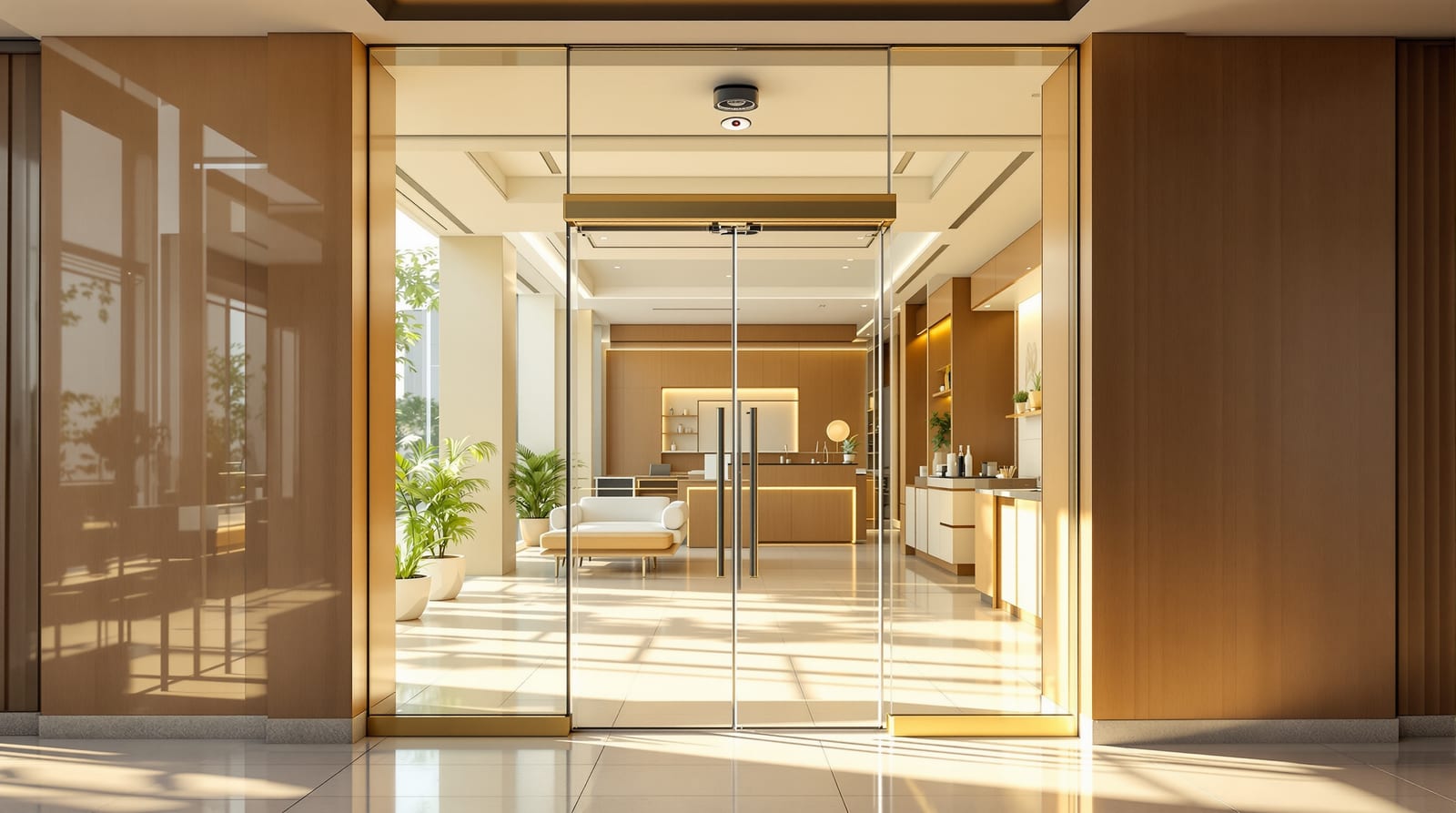
Automatic Glass Doors in India: Sensors, Operators, Breakout & Cost (2026)
Sensor-driven frameless and framed glass auto-doors for Indian clinics, shops, offices and villa entrances — the operator, touchless sensor, safety beam, battery backup and breakout, with indicative costs.
A patient on crutches approaches your dental clinic, a courier wheels a trolley into your office lobby, a family steps onto a villa porch at night with arms full — and a clean sheet of glass simply parts for them, untouched. That is the appeal of an automatic glass door: the visual lightness of frameless toughened glass married to a powered operator that opens on sensing, not on shoving. For Indian premises — clinics, shops-cum-homes, showrooms, offices and high-end villa entrances — it is the single most "arrived" detail you can specify, and also the one most often specified badly. This guide is the glass-specific companion to automatic sliding doors in India: we go deep on the glass itself, the breakout that saves lives in a power cut, manifestation, and what the whole system honestly costs.
If you want the general automation mechanics across all leaf materials, read the automatic sliding doors guide first; this page assumes the leaf is glass and focuses on what changes because of that.
What an automatic glass door is — the system, not the leaf
The glass is the part everyone notices, but it is the cheapest part of the decision. What you are really buying is a coordinated system of five components, and a thin quote almost always survives by quietly dropping one of them.
- The operator (header): a slim aluminium beam, typically 120-180 mm deep, mounted above the opening. It houses a DC motor, a toothed drive belt, the carriage that the glass hangs from, and a control board. On a frameless glass door the glass leaf is clamped into the carriage with patch fittings, so the operator must be rated for the glass weight (12 mm toughened glass is heavy — roughly 30 kg per square metre). A Dorma, Geze or record-grade operator is what buys you ten quiet years instead of eighteen grinding months.
- The activation / touchless sensor: an overhead microwave-radar or PIR sensor that opens on approach, or a no-touch wave sensor / hand-wave switch mounted on the side jamb for hygiene-critical doors (clinics, labs, kitchens). Post-pandemic, touchless wave activation is now the default ask for medical premises.
- The safety sensor (safety beam / presence curtain): an infrared beam or curtain across the opening that refuses to let the glass close on a person, pram or wheelchair. On glass doors this matters doubly, because a closing edge is a clear, near-invisible pane. Non-negotiable.
- The glass leaves: single sliding (one leaf parks aside), bi-parting (two leaves part from centre), telescopic (two stacked leaves per side for a wide opening in a short header), or a swing-type auto operator on a hinged/patch-fitted glass leaf. Default glass is 10-12 mm toughened to IS 2553.
- The power-resilience layer: push-and-go manual mode, a battery/UPS backup module, and — critically for glass on an exit — a breakout mechanism.
How it runs, and why glass changes the brief
The cycle is the same as any auto-door: a person enters the detection zone, the sensor signals the operator, the motor glides the glass open in about 1-2 seconds, it dwells (2-5 seconds, adjustable), then closes only once the safety beam confirms a clear opening. Speed, dwell, opening width and a partial-opening "energy mode" (to save air-conditioning) are set on the control board.
What glass adds to that brief is three things. First, weight and balance: the operator and patch fittings must be sized for 10-12 mm toughened glass, or the door sags and the belt slips. Second, visibility safety: a clear, frameless pane is easy to walk into, so a manifestation strip is mandatory, not optional. Third, breakout: because glass auto-doors so often sit on entrances and exits, codes and good practice demand a way to push through manually when power and the motor are dead.
Breakout — the feature that makes a glass auto-door legal on an exit
A breakout (or "anti-panic" / "swing-out") glass door has leaves that, when pushed firmly in the direction of escape, swing open on a concealed pivot like a normal hinged door — overriding the slide entirely. This is what lets a glass auto-door serve as an emergency egress.
It matters because NBC 2016 Part 4 (Fire & Life Safety) requires that occupants can always leave: exit doors must open in the direction of egress and must not need special knowledge or a power supply to operate. A rigid powered slider that locks dead in a power cut traps people — unacceptable on any exit route. For clinics, offices, showrooms and assembly spaces, specify breakout leaves with the operator and confirm the breakout force is low enough for a child or a panicking adult. Treat breakout as a code requirement on egress doors, not an upgrade.
Single, bi-parting, telescopic — and the swing-auto option
| Configuration | How it moves | Best for | Notes |
|---|---|---|---|
| Single sliding glass | one leaf parks to one side | narrow clinic/shop entries | cheapest; needs side wall = clear opening |
| Bi-parting glass | two leaves part from centre | main entrances, lobbies | symmetrical, wider opening, premium look |
| Telescopic (2 leaves/side) | stacked leaves per side | wide opening, short header | priciest; squeezes wide clear opening into limited wall |
| Swing-auto (auto operator on hinged glass) | leaf swings open powered | tight openings with no side wall to park | uses a swing operator; ideal where sliding has nowhere to go |
Bi-parting reads as a wide, welcoming, balanced entrance — which sits comfortably with Vastu ideas of a generous threshold (see the Vastu note below). The swing-auto option is the answer when there is simply no side wall for a leaf to park; it pairs an automatic swing operator with a frameless glass door leaf.
The glass itself — toughened, thickness and manifestation
The leaf must be toughened (tempered) glass to IS 2553, normally 10 mm for modest single leaves and 12 mm for entrances and larger panes. Toughened glass is the right call because it is roughly four to five times stronger than annealed glass and, if it ever breaks, crumbles into blunt granules rather than dagger shards. For toughened glass doors generally and the full pane menu, see that guide; here the key glass decisions are:
- Thickness: 12 mm for any leaf carrying patch fittings on an automatic operator; thinner glass flexes and stresses the fittings.
- Manifestation: a frosted band, ceramic frit, vinyl strip or etched motif at roughly 900-1500 mm above floor so people see the glass and do not walk into it. On a frameless auto-door this is a genuine safety item, not decoration — children and elderly visitors are the usual casualties of an invisible pane.
- Privacy options: frosted, ceramic-fritted or switchable (PDLC) glass for clinics and consulting rooms; see frosted glass doors.
- Edges and holes: all cutting, drilling for patch fittings and edge-polishing must be done before tempering — toughened glass cannot be worked afterwards without shattering.
Costs in India (2026, indicative)
Prices below are for the system and are indicative and vary widely by city, brand, leaf size and glass spec; add 18% GST and fitting and civil work. The operator, sensors, glass leaves and patch fittings are usually separate line items — make sure they all appear.
| Automatic glass door system | Typical use / opening | Indicative ₹ (operator + basic fit) |
|---|---|---|
| Budget single-slide glass operator (entry import / local) | shop / clinic, up to 1000 mm clear | ₹40,000 - 70,000 |
| Branded single-slide operator (Ozone, record-grade) | clinic / boutique, 900-1200 mm | ₹60,000 - 1,00,000 |
| Branded bi-parting operator (Geze, Dorma) | office lobby / villa entrance, 1200-1800 mm | ₹95,000 - 1,90,000 |
| Telescopic / heavy-duty branded | wide showroom entrance, 1800 mm+ | ₹1,60,000 - 3,20,000+ |
| Swing-auto operator on glass leaf | tight entry, no side wall | ₹45,000 - 1,20,000 (operator only) |
| 12 mm toughened glass leaves + patch fittings | per leaf | ₹450 - 1,200 / sq ft + ₹3,000 - 12,000 fittings |
| Touchless wave / hand sensor add-on | hygiene-critical doors | ₹2,000 - 9,000 |
| Battery / UPS backup module | power resilience | ₹8,000 - 30,000 |
| Annual maintenance contract (AMC) | servicing | ₹4,000 - 15,000 / yr |
A realistic all-in figure for a branded bi-parting glass entrance — operator, 12 mm toughened leaves with manifestation, safety sensor, breakout and backup — commonly lands in the ₹1.6 - 3.6 lakh range. A budget single-leaf clinic door can come in near ₹75,000 - 1,30,000 all-in. Estimate roughly with the door cost calculator and size the opening with the door size calculator.
Power backup and safety — non-negotiables for glass
India's outages make power resilience part of the safety case, not a luxury. Specify, in this order:
1. Push-and-go / manual override — built into good operators; the leaf can be hand-slid when the motor is off. Minimum acceptable.
2. Breakout leaves — manual swing-out in the egress direction; mandatory on any exit-route door (NBC 2016 Part 4).
3. Battery / UPS backup module — keeps the door cycling for a set number of operations after an outage, then parks it to a chosen state; strongly advised for clinics and exits. Wiring the operator onto the home inverter circuit achieves the same.
On the safety side, demand all of these in writing: a safety presence sensor / IR beam (anti-trap), reduced closing force and soft stop, finger-trap protection at leading and meeting edges, and toughened glass with a visible manifestation strip. A missing safety sensor is the single most common corner cut, and on glass it is the most dangerous one. For intruder security — a different problem from anti-trap — pair the glass auto-door with a shutter, grille or alarm; an auto-slider is about convenience and life-safety, not burglar resistance. See glass doors in India for the broader glazing-and-security picture.
Brands and buying in India
The established premium operators are Dorma (dormakaba), Geze and record — the systems malls, hospitals and good clinics specify, with proper safety sensors, breakout options and city service networks. Ozone is a widely stocked, more affordable Indian-market brand that suits homes and small premises. Entry-level imported operators exist, but verify who will service them in your city before buying — a cheap operator with no local service is a trap when the belt or board fails.
Buy through an authorised dealer who quotes the operator, activation sensor, safety sensor, glass leaves, patch fittings, breakout and AMC as separate line items, and who handles the toughened-glass tempering. Insist both the activation and the safety sensors are itemised, and confirm in writing that exit doors include breakout. GST is 18%; civil work and fitting labour are extra.
Vastu and the glass main door
If the automatic glass door is your main entrance, the usual main-door preferences apply in spirit — a generous, well-lit, north / east / north-east opening kept clean and unobstructed; a bi-parting glass door reads as a wide, symmetrical, welcoming threshold, which sits comfortably with Vastu ideas about an inviting entrance. Note that a sliding glass leaf does not "open inward and clockwise" the way a hinged door does, so some families prefer a hinged or breakout-swing main door and place the auto-slider at a porch or inner lobby. Treat this as tradition and personal comfort, not a rule — the reasoning is in main door Vastu in India and entrance Vastu.
Related reading
- Automatic sliding doors in India — the general operator, track and sensor mechanics across all leaf materials.
- Frameless glass doors in India — the patch-fitted toughened-glass leaf, manual and as a swing-auto leaf.
- Toughened glass doors in India — glass grades, thickness and IS 2553 safety.
- Glass doors in India — the full glass-door menu, privacy and security.
- Estimate with the door cost calculator and the door size calculator.
Frequently asked questions
Will an automatic glass door open during a power cut?
Yes, if specified correctly. A good operator has push-and-go so you can hand-slide the glass when the motor is off, and you should add a battery backup module or wire it to your home inverter to keep it cycling. Crucially, for any exit-route door specify breakout leaves that swing open manually in the escape direction — NBC 2016 Part 4 requires that people can always get out. Never accept an operator that locks rigid without power.
How much does an automatic glass door cost in India?
Indicatively, a branded single-leaf glass operator runs ₹60,000-1,00,000 and a bi-parting operator ₹95,000-1,90,000, before glass leaves, patch fittings, GST and install. An all-in branded glass entrance with 12 mm toughened leaves, manifestation, safety sensor, breakout and backup is commonly ₹1.6-3.6 lakh. Always get an itemised quote, as costs vary by city, brand and leaf size.
What thickness of glass is used in automatic glass doors?
Use toughened (tempered) glass to IS 2553 — typically 12 mm for entrances and larger leaves on an operator, and 10 mm only for modest single leaves. Twelve millimetre glass resists the flexing that stresses patch fittings, and toughened glass crumbles into blunt granules instead of shards if it ever breaks. Always add a manifestation strip so people do not walk into the clear pane.
Are automatic glass doors safe for clinics, children and the elderly?
They can be the safest, most accessible entrance you own when fitted with a touchless or wave sensor, a safety presence sensor (the anti-trap IR beam), soft-stop closing, finger-trap protection, toughened glass and a visible manifestation strip, plus breakout for emergencies. The wide, low-threshold, hands-free opening suits wheelchairs, walkers and prams. Insist the safety sensor is itemised — it is the commonest and most dangerous corner cut on glass doors.
What is breakout and do I need it?
Breakout means the glass leaves swing open manually in the escape direction when pushed firmly, overriding the slide, so people can exit even if power and the motor have failed. You need it on any door that serves as an exit from a clinic, office, shop or assembly space — NBC 2016 Part 4 requires occupants to be able to leave without power or special knowledge. For a porch or inner-lobby door that is not an exit route, push-and-go plus backup may suffice.
Export this guide
Related Guides — Deep-dive reading
Automatic Sliding Doors in India: Sensors, Operators, Cost & Safety (2026)
How sensor-driven auto-slide doors work, where they belong in Indian homes and clinics, and what the operator, track and install really cost.
Home Doors & EntrancesUniversal Design Doors for Indian Homes: Inclusive Doors That Work for Everyone (2026)
How to design and specify doors that serve children, the elderly, pregnant women, the injured and wheelchair users by default - generous width, lever handles, near-flush thresholds, low-force closing, contrast and good lighting - without your home ever looking medical.
Home Doors & EntrancesAutomatic Swing Door Operators: Retrofit Guide India 2026
How to retrofit a normal hinged door to open by itself — full-energy vs low-energy operators, activation, safety and cost for Indian buildings.
Home Doors & EntrancesRelated Tools — Try Free
Security Backup Power Calculator
Size a UPS/inverter and battery to keep CCTV, NVR, router and alarm running through a power cut — load, Ah, VA and cost.
Backup PowerAccess-Control Battery-Backup Calculator
Size the standby battery so an access system keeps running through a power cut, with an egress life-safety note.
Battery BackupAcoustic Privacy (STC) Visualizer
Indian healthcare acoustic visualizer — compare wall assemblies and noise sources, see received SPL after STC attenuation, and check FGI 2018 / IS 1950 / NABH speech-privacy compliance with live dual-canvas waveform.
Acoustic Tool