
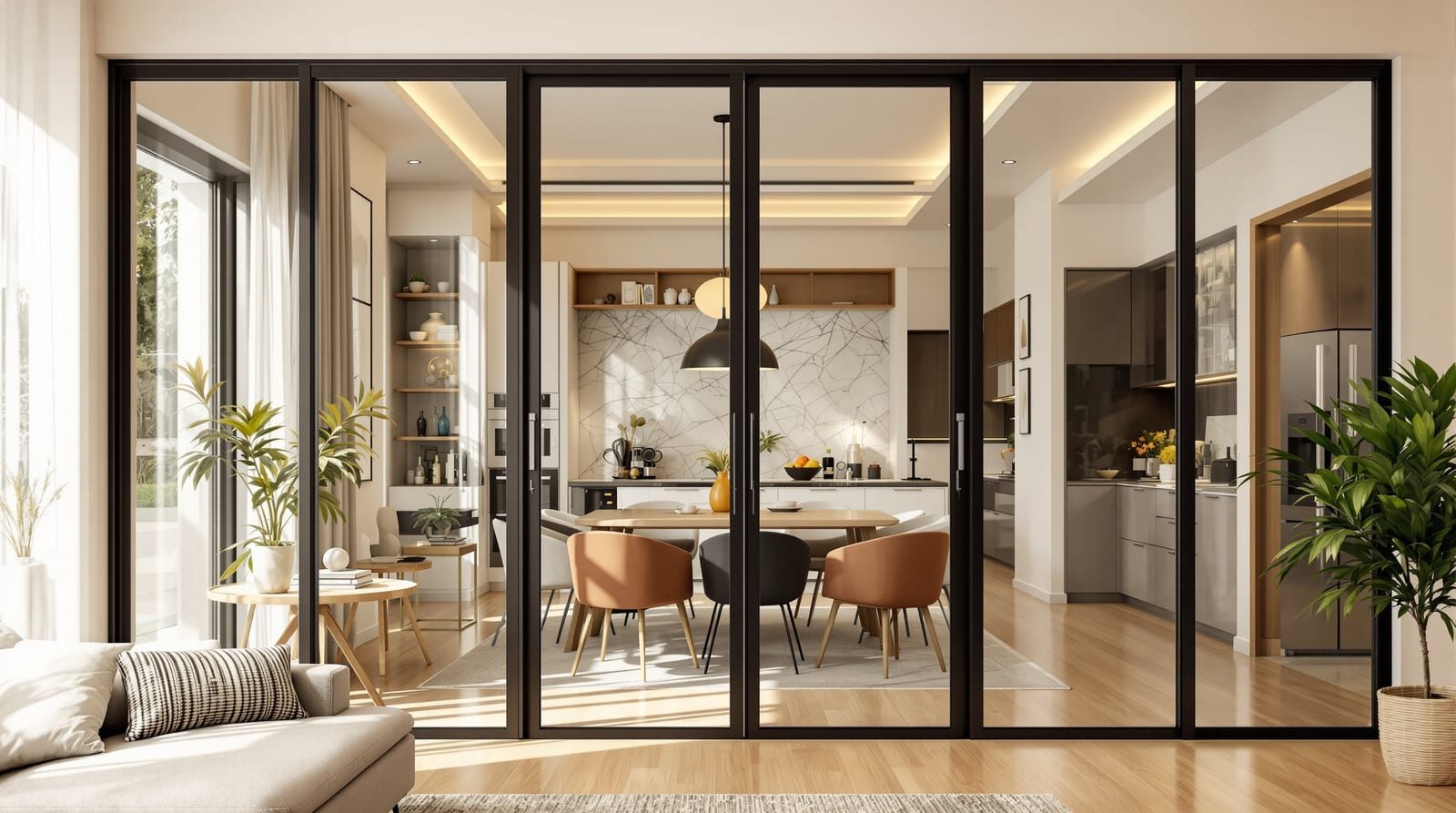
Partition Doors in India: Sliding, Folding & Glass Room Dividers That Open Up or Close Off Space
How to use partition doors — sliding, folding/accordion, bi-fold, fixed glass with a door, Crittall-style framed glass and barn-door partitions — to split or join living-dining, a WFH nook, kitchen or one room into two, with privacy, acoustic limits and real ₹/sq ft.
A wall is a decision you make once and live with for years. A partition door is the same decision made every day: slide it shut and the living-dining becomes two rooms; fold it back and they are one again. In Indian flats where a single 2 or 3 BHK has to be a joint-family living room by morning, a WFH office by afternoon, a guest room by night and a puja gathering on festival days, that flexibility is worth more than a fixed wall. This guide covers the partition-door families that actually work in Indian homes — sliding, folding/accordion, bi-fold, fixed glass with a door, Crittall-style framed glass and barn-door partitions — where each one earns its keep, what it does and does not do for privacy and sound, and indicative ₹ per square foot.
Partition door vs a wall vs a curtain
A partition door sits between three other ways of dividing space, and choosing it means knowing what it is not. A masonry or drywall partition is permanent, fully opaque, soundproof-able and load-stable, but it is fixed — you cannot open the room back up without a hammer. A curtain or screen is cheap and movable but offers no real privacy, no sound control and no security. A partition door is the middle path: a structured, openable divider that gives you visual separation and a real, latchable boundary when shut, yet packs away to reopen the space.
The catch you must accept up front: a partition door is rarely a true acoustic or thermal seal. Unlike a built wall, it has meeting gaps, a floor clearance and lightweight leaves, so it dampens sound rather than blocking it. If you need a quiet study or a soundproof bedroom, you want a properly sealed solid door in a real frame — see our soundproof doors guide — not a partition. Treat partitions as space-shaping tools first and privacy tools second.
The partition-door families
There are six common ways to make a divider that opens. Each has a different track or hinge mechanism, a different stacking footprint and a different feel.
- Sliding partition — one or more panels glide on a top track (and a floor guide), parking flat against a wall or into a pocket. Smooth, no swing space needed, the most common choice for living-dining and kitchen openings. Our sliding doors guide covers the track hardware in depth; a partition is simply a wide, often multi-panel version.
- Folding / accordion partition — many narrow leaves hinged together that concertina to one side, hung from a top track. Spans very wide openings and stacks into a small bundle, but has many vertical seams and is the least private/quiet of the lot.
- Bi-fold partition — pairs of leaves that fold flat against each other, two or four panels swinging open like a book. A heavier-built, better-sealing cousin of the accordion; the same family as our bi-fold doors and the wide-opening folding doors.
- Fixed glass with a door — a fixed glazed screen (or low-wall-plus-glass) with one openable leaf set into it. Lets light through the whole partition while giving a normal door to pass. Common for home offices and kitchen fronts.
- Crittall-style framed-glass partition — fixed glass panels in slim black steel or aluminium grids, with one hinged or sliding door in the run. The industrial-chic look that has become the signature WFH-nook and living-kitchen divider of the last few years.
- Barn-door partition — a single (or pair of) panels on an exposed top-mounted barn-door track that slides across an opening and parks against the wall. Decorative, easy to retrofit, no floor track. See barn doors for the rail hardware.
Where each partition earns its keep
Match the mechanism to the room, not the other way round.
- Living–dining — the classic Indian use. A sliding or Crittall-style framed-glass partition lets you keep the dining open to the living room for everyday meals, then slide it shut for a formal dinner, a card evening or to hide a messy table from guests. Glass keeps both halves bright.
- Study / WFH nook — carve a corner of the living or bedroom into an office. A glass partition with a door or a slim Crittall screen gives you a visual "I'm in a meeting" boundary and keeps daylight, while a barn door is the cheapest retrofit if you can't run a floor track. Pair with our home office door guide for the door-leaf and acoustic choices.
- Kitchen — Indian cooking means oil, steam, masala smell and noise. A sliding or bi-fold glass partition across the kitchen mouth gives a semi-open kitchen you can shut during heavy frying, then fold away for everyday open-plan living. Glass keeps the cook connected to the family.
- One room split into two — a long bedroom into a child's study plus sleep zone, or a hall into a guest area, with a folding/accordion or bi-fold partition spanning the full width. Folds away when you want the big room back; closes for privacy or a sleepover.
- Puja / prayer corner — a folding or sliding partition (often with jali or carved infill — see jali doors) screens the puja space for daily worship and opens fully for festival gatherings, keeping the corner respected without walling it off.
Comparison: type, use, privacy and acoustics, cost
Indicative 2026 figures; ₹ per square foot of finished partition (panel plus track/hardware, fitting extra), varying by city, material grade and vendor; add 18% GST on branded systems. Acoustic figures are realistic expectations, not lab ratings — no partition matches a sealed solid wall.
| Partition type | Best use | Privacy when shut | Acoustic limit | ₹ / sq ft (indicative) |
|---|---|---|---|---|
| Sliding (solid / laminate panel) | Living-dining, bedroom split | Full visual | Moderate — dampens speech, not a seal | ₹450-1,000 |
| Sliding (glass) | Living-dining, kitchen | Light only (use frosted/film for privacy) | Low-moderate | ₹550-1,200 |
| Folding / accordion (PVC/WPC/fabric) | Wide span, room split, puja | Visual, but many seams | Low — leaks at every seam | ₹350-800 |
| Bi-fold (aluminium-glass / wood) | Kitchen, living-dining, balcony | Full visual | Moderate (better sealed than accordion) | ₹600-1,400 |
| Fixed glass + hinged door | WFH nook, kitchen front | Light only / frosted for privacy | Low-moderate | ₹500-1,100 |
| Crittall-style framed glass | WFH nook, living-kitchen, statement | Light only / frosted door panel | Low-moderate | ₹700-1,600 |
| Barn-door partition | Retrofit study, alcove, utility | Full visual (solid leaf) | Low — big floor/edge gaps | ₹450-1,100 (panel) |
For the partition leaf itself you are choosing the same materials as any door — read door materials comparison — but weight matters more here because the panels hang from a track and you move them often.
Materials: glass, wood and aluminium-glass
Glass is the defining material of modern partitions because it divides without darkening. Use toughened (tempered) glass to IS 2553 — never annealed — typically 10-12 mm for frameless or large panels; see toughened glass doors. For privacy, specify frosted/acid-etched or apply a manifestation film (frosted glass doors), and always add a manifestation band or pattern at eye level so people don't walk into a clear pane. Toughened 12 mm runs about ₹450-1,200 per sq ft before fittings.
Wood, WPC and laminate panels give full visual privacy and a warmer, more traditional feel — right for a puja screen, a carved divider or where you simply don't want to see through. WPC and laminate resist Indian humidity and termites better than solid timber for a moving, frequently-handled panel; flush or laminate leaves keep the weight down so the track runs smoothly.
Aluminium-glass (and Crittall-style steel) framed systems are the workhorse of partitions: slim metal frames hold glass in a grid, are light, dimensionally stable through the monsoon-to-summer swing, and don't swell or rot. Powder-coated aluminium in matte black mimics the Crittall steel look at lower cost and weight, and is the practical pick for most Indian flats. For coastal homes, insist on marine-grade or properly powder-coated aluminium to resist salt corrosion. Our aluminium doors guide covers the section and finish choices.
A partition plan: open and closed
The diagram below shows the single most useful idea — the same opening behaving as two rooms or one, depending on whether the partition is parked or drawn across.
Two planning rules the diagram makes obvious. First, a sliding or folding partition needs somewhere to park — a clear stretch of wall or a pocket cavity — so a 12-foot opening might lose 18-24 inches of wall to the stacked panels; measure that before you commit. Second, build in a single pass door (a hinged leaf within the run, or one sliding panel you use as the everyday door) so you can walk through without operating the whole partition each time.
Acoustic and privacy reality
Be honest with yourself about what "closed" buys you. A partition door dampens sound — it will muffle a TV or conversation enough that a phone call in the next zone is comfortable — but it does not block it the way a sealed wall does, because every meeting joint, the floor clearance and the lightweight leaf leak sound. To get the most out of a partition acoustically: choose solid or laminated panels over thin or single-glazed ones; minimise the number of seams (a two-panel slider beats a ten-leaf accordion); add brush or rubber seals at the meeting stiles and a bottom brush sweep (without dragging the track) — see door seals and weatherstripping; and use frosted glass or film where you want visual privacy without losing light. If a genuinely quiet, private room is the requirement, build a wall with a proper sealed door rather than asking a partition to do a job it can't.
Cost, install and Vastu notes
Beyond the per-sq-ft panel figures above, budget for track and hardware (good sliding/folding gear from Hettich, Hafele, Ozone or Dorset is where partitions live or die — cheap rollers jam and sag within a year), frosting or manifestation film, floor guides and fitting labour. A typical 8-10 ft living-dining glass-and-aluminium partition with one pass door commonly lands around ₹35,000-90,000+ all-in, depending on glass thickness, frame system and brand; a simple PVC accordion across a bedroom split can be ₹8,000-20,000. Always invest in the track quality over the panel finish — the leaf you can upgrade later, a failed track you have to rip out. Estimate panel area and door sizing with our door size calculator and compare total spend with the door cost calculator.
On Vastu, partitions are generally additive rather than problematic, but two traditional points are worth noting as belief and practical reasoning. A partition that creates a new doorway should ideally not place that opening directly facing another door across a passage (the dwar vedha idea of two doors in direct line) — practically, offset openings also make for calmer circulation and more privacy. And a partition screening a puja corner is well regarded, keeping the prayer space defined and respected; align it so the worshipper faces a favourable direction. Frame these as tradition plus common-sense planning, and for the deeper treatment see entrance Vastu and vastu main door.
Frequently asked questions
Will a partition door give me a quiet, private room?
Visual privacy yes; acoustic privacy only partly. A closed partition muffles sound but does not seal like a wall, because it has meeting gaps and a floor clearance. Solid laminated panels with edge brush seals and few seams perform best; glass and many-leaf accordions perform worst. If you truly need a quiet room, build a wall with a sealed solid door instead.
Which partition type is best for a living-dining divider?
For most Indian flats, a sliding or Crittall-style framed-glass partition with one pass door is the sweet spot — it keeps both halves bright, slides away for everyday open-plan living and closes for formal occasions. Use frosted glass or a manifestation band if you want privacy as well as light.
Can I retrofit a partition door without breaking the floor for a track?
Yes — a barn-door partition or a top-hung sliding/folding system runs entirely from a header track fixed to the ceiling or a beam, with only a small floor guide pin, so there is little or no floor disruption. This makes barn and top-hung partitions the easiest retrofit in an already-finished flat.
How much does a partition door cost in India?
Indicative and varying by city and brand: a simple PVC accordion across a bedroom split runs about ₹8,000-20,000, while an 8-10 ft glass-and-aluminium living-dining partition with a pass door commonly lands ₹35,000-90,000+ all-in. Per square foot, finished partitions run roughly ₹350-1,600 depending on type; spend on the track hardware first.
Sliding, folding or bi-fold — how do I choose?
Sliding suits openings where you have wall to park the panels and want smooth everyday use. Folding/accordion spans the widest gaps and stacks smallest but is the least private and quiet. Bi-fold is the better-built, better-sealing middle option for kitchens and living-dining where you want the glass to fold fully away yet seal reasonably when shut.
Export this guide
Related Guides — Deep-dive reading
Guest Room Door in India: Privacy, Quiet and Smart Picks Without Overspending (2026)
How to choose a guest bedroom door for an Indian home - privacy and acoustics so visitors feel comfortable, but budget-sensible for a room used only now and then: solid-core flush for quiet, panel or laminate for looks, the right privacy lock, simple soundproofing, and a finish that matches the rest of your doors - with picks ranked and indicative rupee costs.
Home Doors & EntrancesHome Office Door India: Acoustic, Glazed & Space-Saving Picks for WFH (2026)
How to choose a door for a study, home office or WFH room in an Indian home — balancing call privacy and acoustics, borrowed light and a professional on-camera look, lockable security for documents and gear, and tight-flat space-saving.
Home Doors & EntrancesDining Room Door in India: Best Partition & Opening Choices (2026)
How to choose the right door for the dining area of an Indian home - kitchen-dining partitions that trap cooking smells and smoke while keeping flow, plus open dining-to-living and dining-to-garden options - ranked picks, drivers and indicative costs.
Home Doors & EntrancesRelated Tools — Try Free
Acoustic Privacy (STC) Visualizer
Indian healthcare acoustic visualizer — compare wall assemblies and noise sources, see received SPL after STC attenuation, and check FGI 2018 / IS 1950 / NABH speech-privacy compliance with live dual-canvas waveform.
Acoustic ToolDoor Cost Calculator
Estimate the all-in cost of a door — leaf, frame, hardware, fitting and GST — by type, material and size.
Door CalculatorDoor Material Comparison Tool
Compare 2–4 door materials on cost, durability, maintenance, security and moisture resistance.
Comparison Tool