
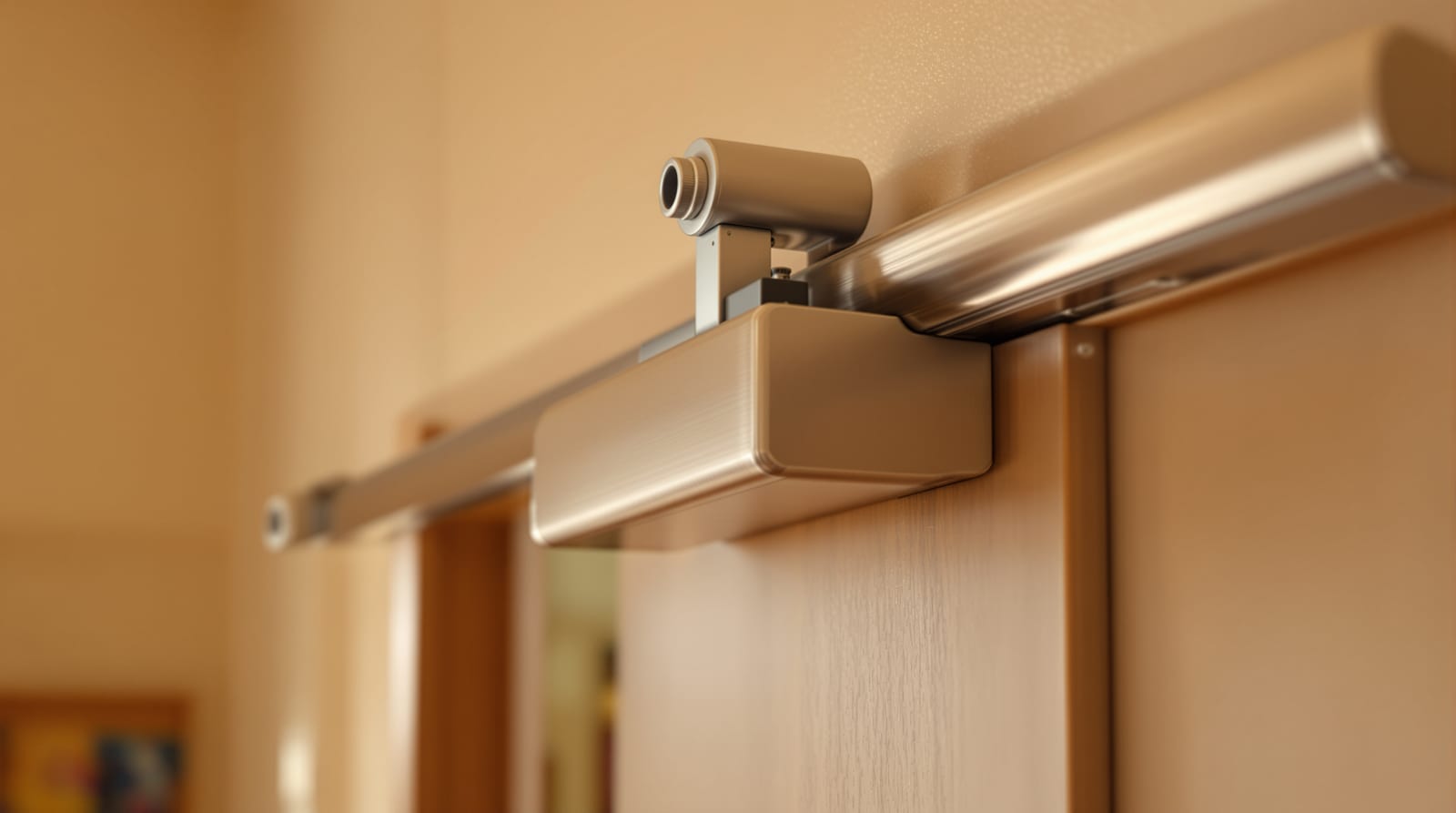
Door Closers in India: Overhead, Concealed & Floor Spring Guide (2026)
How hydraulic door closers work, how to size them by door width and weight to IS 3564, and what they cost for Indian homes.
A door closer is the small hydraulic device that pulls a door shut on its own and lets it down gently instead of slamming. In Indian homes it earns its keep three ways: it keeps the main door from banging in monsoon cross-draughts, it stops cooled air leaking out of an AC bedroom, and on a fire-rated door it is the part that makes the door actually self-close in an emergency. Choosing one is mostly about matching its closing strength to your door's width and weight, mounting it the right way, then adjusting two screws.
This guide goes deep on closers as a single component. For the broader picture of hinges, locks, handles and bolts, see the door hardware guide; for the floor-recessed type used under heavy glass doors, see floor springs.
What a door closer actually does
Inside the body is a spring and a chamber of hydraulic oil. When you open the door, the arm winds the spring and pushes oil through a small valve into a reservoir. Let go, and the spring drives the door back, forcing the oil to bleed back through adjustable needle valves. Those valves are what give you control: the oil resists the spring, so the door closes at a measured pace instead of snapping shut.
A good closer separates the swing into two zones, each on its own valve:
- Closing speed governs the main sweep, from full open down to roughly 10-15 degrees from the frame. You set this slow enough that the door does not bang and fast enough that it actually latches.
- Latching speed governs the final few degrees. A short, firm push here pops the latch bolt into the strike so the door seats and locks. Too slow and the door stalls short of closed; too fast and it slams the last bit.
Two more features appear on better closers:
- Backcheck is a hydraulic cushion that resists the door near the end of its opening swing, so a gust of wind or an over-enthusiastic shove cannot fling the door into the adjacent wall and crack the handle, the plaster or the closer body. On an exposed main door or a balcony door this is the feature worth paying for.
- Delayed action holds the door open for a few seconds before it begins to close, useful at a kitchen or utility door when you are carrying things through, and on accessible doors.
The three families: overhead, concealed, floor spring
Almost every closer you will be offered falls into one of three types. They differ in where they sit and what door they suit.
| Type | Where it mounts | Best for | Door weight range | Visibility | Indicative price (closer only, +18% GST) |
|---|---|---|---|---|---|
| Overhead hydraulic (surface) | On the door face + a bracket on the frame (or vice-versa) | Main doors, bedroom/AC doors, office and fire doors | Light to heavy, ~25-120 kg | Visible box + arm | ₹600-3,500 |
| Concealed (jamb / transom / slide-arm) | Hidden inside the door top or the frame head | Designer interiors, glass-vision panels, clean look | Light to medium, ~25-80 kg | Hidden when shut | ₹1,500-6,000 |
| Floor spring | Recessed in the floor under the bottom pivot | Heavy frameless glass, double-swing, shopfront-style entries | Heavy, ~80-150 kg+ | Almost invisible | ₹2,000-7,000 |
The overhead surface closer is the workhorse for residential timber and flush doors: cheap, easy to fit on site, and easy to adjust because both valves are accessible. The concealed closer trades a little adjustment access for a clean look and is popular on modern interior doors and at the top rail of glass doors. The floor spring is really the right answer for heavy toughened glass doors and double-action (push-both-ways) doors, where it also acts as the bottom pivot. If you are speccing a frameless glass entry, read floor springs alongside this.
Inside the overhead closer
Sizing: matching power to door width and weight
This is the part people get wrong. A closer that is too weak will not pull the door shut against a draught seal or a slight draught; one that is too strong slams, is hard for children or elderly users to open, and fails accessibility expectations. Closers are rated by power size, a number from roughly EN 1 to EN 7, where each step closes a wider, heavier door. The Indian standard for closers is IS 3564, and reputable Indian closers (and the imported ones from Dorma, Geze and the like) are marked to the equivalent EN power class.
Use door leaf width as the primary input and weight as a check. A rough guide for a standard 2100 mm tall door:
| Power size (EN) | Max door width | Approx. max door weight | Typical Indian use |
|---|---|---|---|
| EN 2 | up to ~850 mm | up to ~40 kg | Light interior, bathroom, store-room doors |
| EN 3 | up to ~950 mm | up to ~60 kg | Bedroom (900 mm), AC rooms, most flush doors |
| EN 4 | up to ~1100 mm | up to ~80 kg | Main door (1000-1100 mm), heavier teak leaf |
| EN 5 | up to ~1250 mm | up to ~100 kg | Wide main doors, heavy panelled teak |
| EN 6 | up to ~1400 mm | up to ~120 kg | Large entrance, light commercial |
Practical rules for Indian homes:
- A standard 900 mm bedroom door wants EN 3; a 1000-1100 mm main door in flush or moderate timber wants EN 4; a heavy carved teak main door at 1100-1200 mm often needs EN 5.
- Many residential closers are sold as adjustable EN 2-4 or EN 3-6, where you change the spring tension on site to suit. These are convenient because one SKU covers most doors in a flat, but set the tension to the door, do not leave it at the factory minimum.
- Round up, not down, if the door faces wind (balcony, terrace, an exposed main door) or carries a weather/brush seal, because the closer must overcome that drag in the latching zone. See door seals and weatherstripping for how much resistance a seal adds.
- For an accessible door, you want enough power to close reliably but a low opening force; pick a closer rated to the door and use the closing-force/delayed-action adjustment rather than over-sizing. The wheelchair-accessible doors guide covers the wider context.
Where each closer belongs in the home
- Main door: an overhead EN 4-5 with backcheck. The backcheck protects the wall and the closer when the door is flung open; the firm latching pulls a heavy leaf shut against the threshold. Many homeowners want the body hidden, so a concealed closer is an option, but accept that adjustment is fiddlier.
- AC bedrooms and master suites: an EN 3 overhead or concealed closer is one of the cheapest ways to cut your cooling bill, because it stops the door drifting open and dumping cold air into the corridor. Pair it with a door bottom seal and you have an energy-efficient door.
- Fire doors: any fire-rated door must be self-closing, so a closer is mandatory, not optional. Under NBC 2016 Part 4, fire and exit doors must close and latch on their own. Use a closer the manufacturer has certified with that door assembly; do not retrofit a random closer onto a fire-rated door or a fire-exit door.
- Kitchen and utility doors: a delayed-action closer lets you walk through with both hands full before the door begins to swing shut.
- Heavy glass entries and double-swing doors: a floor spring, covered in floor springs.
Adjusting a closer
Almost every complaint about a closer is really a mis-adjustment. Most overhead closers have two valves on the end face, sometimes a third for backcheck. Turn them in small steps, a quarter-turn at a time, and test:
1. Closing speed (sweep): turn one valve until the door swings shut smoothly in about 5-7 seconds from 90 degrees, without racing.
2. Latching speed: set the second valve so the last 10-15 degrees give a brisk, definite push that seats the latch. If the door creeps and stops short, speed this up.
3. Backcheck (if fitted): adjust so the door meets resistance near full open, but can still be opened fully by an adult.
4. Spring power (adjustable models): if the door will not close against its seal, increase tension; if it is too hard to open for a child or elderly user, reduce it to the lowest setting that still closes and latches.
Never unscrew a valve all the way out; oil will leak and the closer is effectively dead. If oil weeps from the body, the seals have failed and the closer should be replaced, not topped up. A closer that has started slamming in winter and crawling in summer is normal hydraulic behaviour (oil thins when hot), so re-tweak the closing valve seasonally rather than assuming it is broken.
Cost and brands in India
Indicative 2026 prices, closer only, before fitting labour and GST. Values vary by city and vendor.
| Item | Indicative price (₹, +18% GST) |
|---|---|
| Overhead hydraulic closer (EN 2-4, mid brand) | 600-1,800 |
| Overhead closer with backcheck (EN 3-6) | 1,500-3,500 |
| Concealed / slide-arm closer | 1,500-6,000 |
| Floor spring (single/double action) | 2,000-7,000 |
| Fitting labour (carpenter, per door) | 150-500 |
Common brands on the Indian market include Dorma and Geze (premium, strong on fire-rated and backcheck closers), Godrej, Hardwyn, Ozone, Hettich, Hafele, Yale, Dorset and Europa. For most homes a mid-tier overhead closer from a known brand at ₹1,000-2,000 is the sweet spot; for the main door and any fire door, spend up for a certified, backcheck-capable unit. Match finishes to the rest of your hardware using the door hardware finishes guide, and see the door hardware brands comparison before you buy a houseful. To budget the whole door, the door cost calculator helps.
A note on the cheapest no-name closers: they are fine on a light internal door, but their seals fail within a year or two and they cannot be reliably adjusted, so on the main door and AC rooms the small extra cost of a branded unit pays back quickly.
Frequently asked questions
What size door closer do I need for my main door?
For a typical 1000-1100 mm wide main door, an EN 4 closer is the baseline; a heavy carved or solid teak leaf at 1100-1200 mm often needs EN 5. If the door faces wind or carries a weather seal, round up one size. An adjustable EN 3-6 closer set to the right tension covers most main doors.
Why does my door slam shut even with a closer fitted?
Almost always the latching-speed valve is open too far, or the spring tension is too high for the door. Slow the latching valve a quarter-turn at a time until the door seats firmly without banging. If a valve has been wound fully out, the closer has likely lost oil and needs replacing.
Do I legally need a door closer on a fire door?
Yes in effect: under NBC 2016 Part 4, fire and exit doors must be self-closing and self-latching, which requires a closer. Use a closer certified with that fire-door assembly. See fire-rated doors for the full requirements.
Will a door closer help keep my AC room cool?
Yes. A closer stops the door drifting open and leaking cooled air into the corridor, which is one of the cheapest comfort and energy upgrades you can make. Combine an EN 3 closer with a door-bottom seal for the best result, as covered in energy-efficient doors.
Overhead, concealed or floor spring, which should I choose?
Overhead surface closers are cheapest and easiest to adjust, ideal for timber and flush doors. Concealed closers hide inside the door or frame for a clean look on designer interiors. Floor springs suit heavy frameless glass and double-swing doors, where they also act as the bottom pivot, as explained in floor springs.
Export this guide
Related Guides — Deep-dive reading
Fitting Door Closers: New Install Guide (India 2026)
Fit an overhead door closer from new — choose the mounting, template and drill the fixings, mount body and arm, set closing and latching speed.
Home Doors & EntrancesSwing Doors in India: Double-Action Café Doors, Self-Closing & How to Read Door Handing
Two-way swinging pass-through doors, self-closing AC-room doors, and a plain-English guide to door handing — left/right hand, inswing/outswing — so you order the right swing the first time.
Home Doors & EntrancesDoor Hardware Guide India 2026: Hinges, Handles, Locks, Closers and Every Fitting Explained
What each piece of door hardware actually does, where it belongs, which material (SS304, brass, zinc or iron) survives Indian conditions, the quality signals to check before you pay, and a buyer's checklist with 2026 prices.
Home Doors & EntrancesRelated Tools — Try Free
Door Cost Calculator
Estimate the all-in cost of a door — leaf, frame, hardware, fitting and GST — by type, material and size.
Door CalculatorDoor Weather Seal Calculator
Estimate weatherstrip seal length and cost for your doors — perimeter gasket plus bottom sweeps, by seal type.
Door CalculatorWindow Hardware Cost Calculator
Estimate window hardware cost — hinges, handles, locks, rollers and multipoint gears.
Window Calculator