
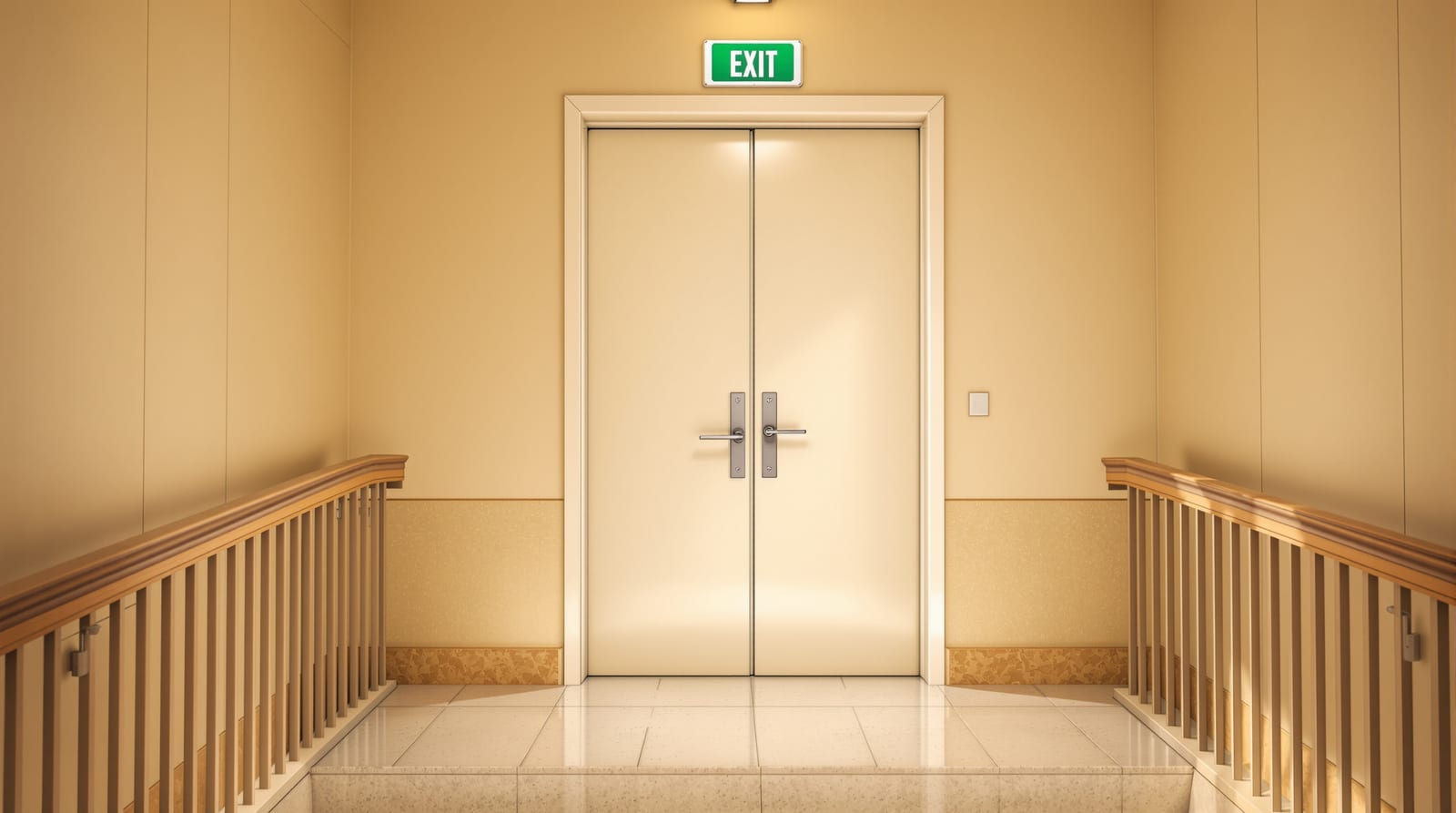
Fire Exit Doors in India: NBC 2016 Egress, Panic Bars & Costs (2026)
How fire exit and emergency egress doors must be sized, swung, hardware-fitted and signed to NBC 2016 Part 4 in Indian buildings, and what they cost.
A fire exit door is the one door in a building that is judged not by how it looks but by how fast a crowd can get through it in the dark with the power off. Under NBC 2016 (Part 4, Fire and Life Safety) an exit door is a regulated component of the means of egress: it has a minimum clear width, it must swing in the direction people are running, its hardware must open under a single shove with no thought and no key, and it must never be locked against someone inside trying to leave. Get any of those wrong and the building does not get its fire NOC, regardless of how good the rest of the doors are.
This guide is the egress-and-hardware deep-dive. It complements the material and rating side covered in fire-rated doors, the broader code reading in NBC door requirements, and the dedicated emergency exit door standards spoke. For the everyday residential dimensions that sit underneath all of this, see residential door standards.
Fire exit door vs fire-rated door: not the same thing
These two terms get used interchangeably on site and they should not be. A fire-rated door is about the leaf and frame resisting fire and smoke for a stated time (30, 60, 90 or 120 minutes to IS 3614 Part 1/2) so it can hold a compartment line. A fire exit door is about egress: the function of letting people out fast and safely.
The overlap is large, because most fire exit doors on a stairwell or a fire-compartment boundary are also fire-rated, and a fire-rated door used on an escape route inherits exit-door obligations. But a door can be one without the other. A panic-barred shutter straight to open ground may be an exit door without needing a long fire rating; a fire-rated cross-corridor door deep inside a building may not be a primary exit. When you spec, ask both questions separately: what fire rating does this opening need, and is this door part of the means of egress? If yes to the second, the egress rules below apply on top of the rating.
The seven non-negotiables under NBC 2016 Part 4
Every door on an escape route has to satisfy a short list of life-safety rules. These are the ones that get checked at the fire NOC stage.
| Requirement | NBC 2016 rule (Part 4 / Part 3 context) | What it means on site |
|---|---|---|
| Minimum clear width | Exit doorways generally not less than 1000 mm clear; min 1000 mm for an exit door serving occupants | A single leaf around 1000-1200 mm wide, measured clear of the open leaf, stops, and hardware |
| Opens in direction of egress | Doors on exits open outward, in the direction of escape travel | Leaf swings the way the crowd is moving (into the stair / outside), never back against the flow |
| Single-action release | Openable from the egress side without a key, special knowledge or effort | One push or one lever, no second latch, no keyed lock on the escape side |
| Panic / push hardware | Panic bars (panic hardware) required for assembly and high-occupancy occupancies | Horizontal bar across the leaf releases the latch when leant on |
| Self-closing + fire rating | Escape and compartment doors self-close; fire doors carry IS 3614 rating + closer | Closer fitted; door returns and latches; no wedges holding it open |
| Never locked against egress | Exits kept unobstructed and unlocked from the egress side at all times the building is occupied | No chains, no padlocks, no dead-bolt that needs a key from inside |
| Signage + illumination | Illuminated EXIT signage; emergency lighting on escape routes | Green running-man sign, lit and on backup power, visible along the route |
The single thread running through all seven is that a person reaching this door under stress, possibly in smoke, must be able to open it in one motion without instruction. Every rule is a way of guaranteeing that one motion.
Width is measured clear, not nominal
A 1000 mm exit width is the clear opening when the leaf is at 90 degrees, after you subtract the open leaf thickness, the door stops, the hinge offset and any projecting hardware. A nominal 1000 mm frame can deliver well under that clear, which is why exit doors on a serious escape route are usually specified as 1200 mm leaves or double leaves. Capacity is set per occupant load: NBC translates the number of people a route serves into a required aggregate exit width, and the door must not be the pinch point. When in doubt, run the occupant-load width through the NBC door requirements checklist and size up, never down.
Panic hardware: what a panic bar actually is
Panic hardware, often called a panic bar, crash bar or push bar, is a horizontal device spanning most of the leaf width. Pressing anywhere along it retracts the latch and opens the door. The point is that a person pushed against the door by a crowd, or fumbling in darkness, opens it by accident as much as by intent: there is no handle to find, no direction to figure out, no key.
NBC requires panic hardware on exit doors for assembly occupancies (Group D: cinemas, auditoria, banquet and function halls, places of worship, restaurants above threshold occupancy) and other high-occupancy uses where a crowd may surge. Two common variants:
- Touch bar / push pad (rim panic device): the bar sits proud and you push it. The latch is a rim latch on the door face. This is the standard single-leaf exit device.
- Touch bar with vertical rods (concealed or surface): for tall or double-leaf doors, the bar drives bolts top and bottom; pressing it withdraws both so a wide leaf releases cleanly.
For a pair of leaves you typically pair a panic device on the active leaf with a panic-with-vertical-rods or a constant-latching device on the inactive leaf, plus a mullion or astragal so the pair seals when shut but both open under a push. On a fire-rated assembly the panic device itself must be a fire-rated exit device (it has no mechanical hold-open) and is paired with a self-closer.
Diagram: outward-swinging exit door with panic bar
The never-locked-from-inside rule
The most common, and most dangerous, violation on Indian sites is a fire exit door locked, chained or padlocked to stop people loitering, sneaking out, or to control access. It is the rule that fire inspectors look for first, and the one behind a depressing number of fatalities in commercial fires.
The principle: while the building is occupied, every exit door must be openable from the egress (inside) side by a single action, with no key, no code and no special knowledge. Practical ways to satisfy both security and egress:
- Panic / exit device with no outside trim so it cannot be opened from outside (secure) but always opens from inside (egress-safe).
- Exit device with keyed outside lever for re-entry control: keyed outside, free push inside.
- Electromagnetic lock with fail-safe release tied to the fire alarm and a break-glass / request-to-exit, so the lock drops power and releases on alarm or on a single push. Fail-safe, never fail-secure, on an escape route.
- Alarm-monitored exit door (delayed-egress only where the code permits) that sounds locally if used, deterring casual exit without ever trapping anyone.
What is never acceptable: a manual deadbolt needing a key from inside, a slide bolt at the top out of reach, a chain-and-padlock, or furniture and stock stacked against the door. Self-closing and self-latching is required, but self-locking against egress is forbidden.
Residential apartment vs assembly: how the rules differ
The egress philosophy is the same everywhere, but the hardware burden scales with how many people use the door and how fast a crowd might surge.
| Aspect | Residential apartment (Group A) | Assembly occupancy (Group D) |
|---|---|---|
| Panic hardware | Generally not mandatory on a flat's own door; stairwell/lobby fire doors still self-close | Mandatory panic bars on exit doors serving the crowd |
| Door swing | Flat entry can swing in; common-area escape and stair doors swing in egress direction | Exit doors swing outward, in direction of egress |
| Minimum exit width | Apartment door commonly 1000-1200 mm; escape route min 1000 mm | Exit widths sized to occupant load; min 1000 mm, often double leaves |
| Fire rating on escape doors | Stair and lobby doors typically 60-120 min fire-rated, self-closing | Same, plus rated panic exit devices on rated leaves |
| Signage / emergency light | EXIT signs + emergency lighting in common escape areas | EXIT signs + emergency lighting throughout, denser provision |
| Locking | Flat door has normal lock; escape route never locked against egress | Never locked against egress while occupied; alarm-released maglocks if any |
In a typical Indian high-rise apartment block, the flat's own front door is a normal (often fire-rated to 60 min where it opens to a lobby) door with a regular lock. The doors that carry the full egress burden are the fire-check doors at the staircase and the refuge / lobby boundary: 60-120 min rated, self-closing, never wedged, and forming a smoke-protected escape. The panic-bar discipline really bites in assembly buildings (banquet halls, cinemas, function spaces) and in the commercial podium below residential towers.
Travel distance: why door placement matters
Exit doors do not stand alone; they are the end of an escape route whose length is capped. NBC limits travel distance (the path a person walks to reach an exit) by occupancy and whether the building is sprinklered, typically in the order of 22.5 m to 30 m for many occupancies, longer when sprinklered. The point for door spec: if a space is large, you need more than one exit door, placed so no occupant is ever beyond the travel-distance limit, and so two exits are remote from each other (you cannot lose both to one fire). A single beautiful exit door on the wrong wall fails the geometry even if the door itself is perfect. Coordinate door positions with the egress plan before you order leaves.
Costs in India (2026, indicative)
Prices are indicative and vary by city, brand and rating; add 18% GST and fitting labour. A fire exit door is usually a rated steel or rated flush leaf plus a fire-rated frame plus the exit device plus the closer plus signage.
| Component | Indicative price (2026) | Notes |
|---|---|---|
| Fire door set (leaf + frame, IS 3614, 30-120 min) | ₹6,000-25,000+ per set | Higher rating, vision panel and steel frame push the top end |
| Panic bar / exit device (rim, single leaf) | ₹2,500-12,000 | Fire-rated and branded devices (Dorset, Dorma/dormakaba, Godrej, Ozone, Hafele) at the upper end |
| Panic device with vertical rods (tall / double leaf) | ₹6,000-20,000 | For wide or paired leaves |
| Fire-rated door closer (IS 3564) | ₹1,500-6,000 | Mandatory; must self-close and latch |
| Illuminated EXIT sign (LED, backup) | ₹600-3,500 | Running-man pictogram, on emergency power |
| Maglock + fail-safe release (if used) | ₹3,500-12,000 | Tied to fire alarm; fail-safe only |
A complete single-leaf fire exit door, rated and panic-barred with closer and sign, commonly lands around ₹12,000-45,000 fitted depending on rating and brand. Double-leaf assembly exits run higher. Treat the exit device, closer and signage as non-optional line items, not extras to be value-engineered away. For the leaf and rating economics, cross-check fire-rated doors, and for whole-project door budgeting use the door cost calculator.
Specifying a compliant fire exit door: a short checklist
- Confirm the door is on the means of egress and note its required clear width from the occupant load.
- Order the leaf with the correct IS 3614 fire rating for the compartment line it sits on.
- Set the swing to open in the direction of escape travel (outward into stair / outside).
- Fit panic hardware for assembly / high-occupancy uses; single-action lever otherwise.
- Fit a fire-rated self-closer (IS 3564); confirm the door self-closes and self-latches.
- Ensure no key, code or second action is needed from the egress side; specify fail-safe maglock if access control is required.
- Provide an illuminated EXIT sign and emergency lighting along the route, on backup power.
- Keep the door swing and approach permanently clear; no wedges, chains or stored goods.
Verify the final scheme against the local fire department and the NBC door requirements reading before sign-off, since state fire rules and bylaws can add to the national baseline.
Frequently asked questions
Does every door on a fire escape route need a panic bar?
No. Panic hardware is mandatory for exit doors in assembly and high-occupancy occupancies where a crowd may surge. Lower-occupancy doors can use single-action lever hardware that opens with one motion. But every escape-route door, panic-barred or not, must open from the inside without a key, in a single action.
Can a fire exit door open inward in an Indian building?
For doors serving an exit on an escape route, NBC 2016 requires the door to open in the direction of egress, which means outward, in the direction people travel to escape. An individual flat's entry door can swing inward, but the common-area escape and staircase doors should swing in the egress direction. See emergency exit door standards.
Is it legal to lock a fire exit door for security?
You may secure it from the outside, never against people inside. While the building is occupied the door must open from the egress side by a single action with no key. Use an exit device with no outside trim, a keyed-outside lever, or a fail-safe maglock that releases on the fire alarm. Chains, padlocks and inside deadbolts are violations.
What is the minimum width of a fire exit door?
NBC 2016 sets a minimum exit doorway width generally not below 1000 mm clear, with the total exit width sized to the occupant load. Because clear width is measured with the leaf open, a nominal 1000 mm frame may need to be specified as a 1200 mm leaf or double leaves to deliver the required clear opening. Confirm via NBC door requirements.
How is a fire exit door different from a fire-rated door?
A fire-rated door resists fire and smoke for a rated time (IS 3614) to hold a compartment line. A fire exit door is about egress: width, outward swing, single-action and panic hardware, signage and never being locked against people. Most stairwell exit doors are both. See fire-rated doors for the rating side.
Export this guide
Related Guides — Deep-dive reading
Emergency Exit Planning in India (2026): Number of Exits, Travel Distance & Two-Way Escape
The building-scale means of egress that a home escape plan sits inside: why you need two independent, remote exits, how travel distance and exit width scale with occupant load, and why exits must open outward, discharge to safety, and never be locked.
SecurityEmergency Exit Door Standards in India: NBC 2016 Egress Rules
How exit door width, swing direction, panic hardware, fire rating and signage are governed by NBC 2016 Part 4 — and where homes differ from assembly and commercial buildings.
Home Doors & EntrancesStaircase Access Control in India (2026): Securing the Stair Without Locking In Escape
How to control who can enter a stair from a floor while guaranteeing that anyone inside can always walk out - free-exit egress hardware, fail-safe locks that release on fire and power loss, monitored doors, and coordinating the whole thing with your fire officer and the NBC.
SecurityRelated Tools — Try Free
Emergency-Egress Checker
A life-safety self-check that access-controlled doors on escape routes still let people out in an emergency.
Egress CheckDoor Cost Calculator
Estimate the all-in cost of a door — leaf, frame, hardware, fitting and GST — by type, material and size.
Door CalculatorFire Door Rating Checker
See the likely fire-door rating (30/60/90/120 min) and components a location needs per IS 3614 / NBC — guidance, confirm with your architect.
Compliance Tool