
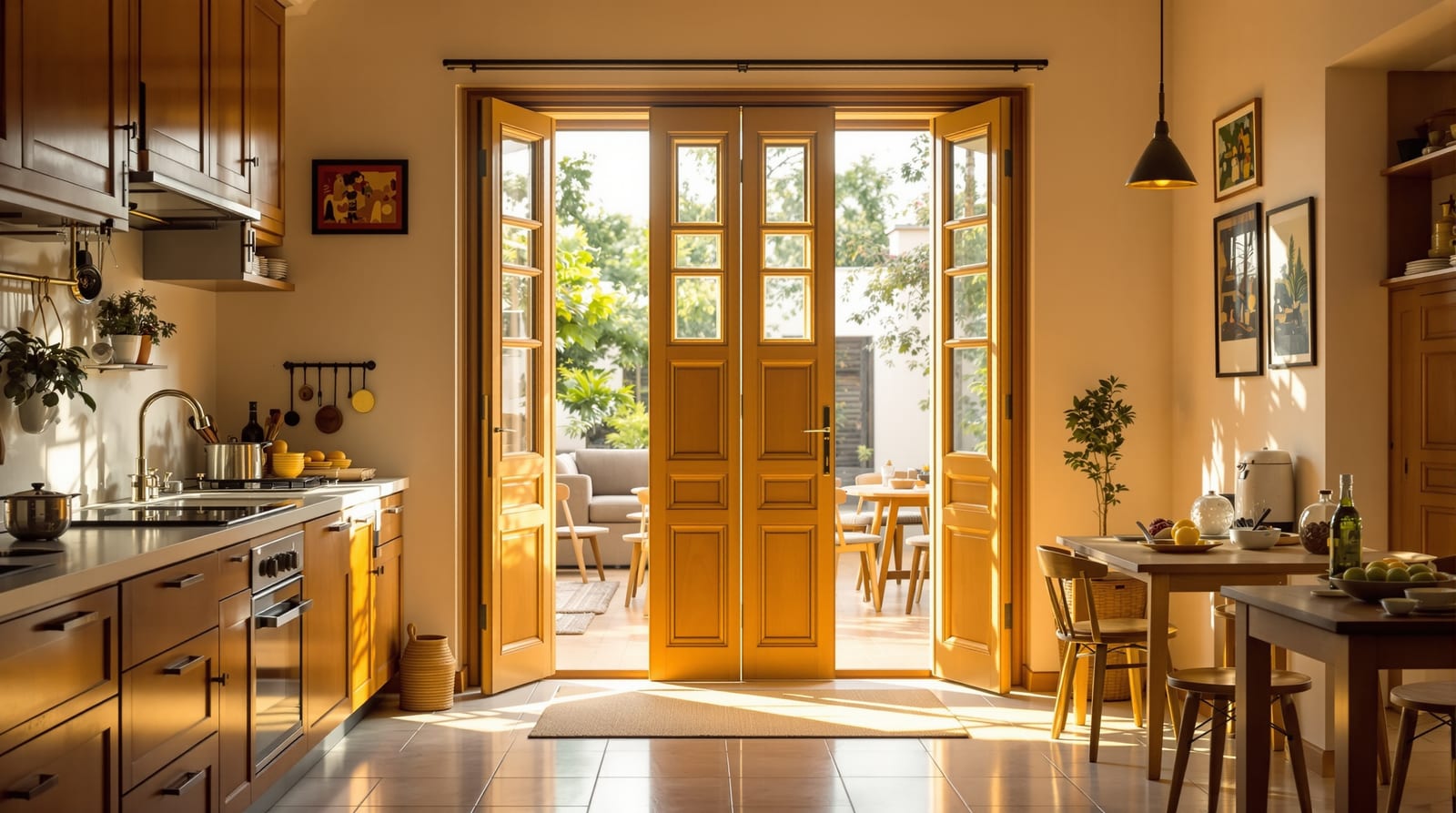
Swing Doors in India: Double-Action Café Doors, Self-Closing & How to Read Door Handing
Two-way swinging pass-through doors, self-closing AC-room doors, and a plain-English guide to door handing — left/right hand, inswing/outswing — so you order the right swing the first time.
Almost every door in your home is a swing door — it pivots on hinges along one edge and arcs open. But the phrase "swing door" usually means something more specific: a door that swings BOTH ways and closes itself, the kind that lets you shoulder through from the kitchen to the dining room with a tray in both hands and have it shut behind you. That double-action, self-closing behaviour is a small piece of hardware engineering, and getting it right — along with understanding "door handing" so you order the correct swing direction — is what this guide is about.
This is a spoke of the complete home doors guide. For the full menu of door styles see types of doors in India; for the springs, hinges and closers that make a door swing or self-close see the door hardware guide.
Single-action vs double-action: the core distinction
Strip away the jargon and there are two families of swinging door:
- Single-action — the ordinary door. It swings in ONE direction only, stopping flat against a rebate (the lip in the frame) when shut. Every bedroom, bathroom and main door in an Indian home is single-action. It can be inswing or outswing, left-hand or right-hand, but it goes one way.
- Double-action — the leaf has NO rebate stop and swings freely in BOTH directions past the closed (flush) position, returning to centre on its own. These are the classic "café doors", "saloon doors" or "pass doors". You push from either side and walk through; the door swings open, then a spring returns it to rest.
The double-action trick is entirely in the pivot hardware. Instead of normal butt hinges (which only allow one direction), the door hangs on double-action spring hinges or pivots on a floor spring — both of which are sprung to centre the leaf.
| Behaviour | Single-action | Double-action |
|---|---|---|
| Swing directions | One | Both (push either side) |
| Self-returns to closed? | Only if a closer is fitted | Yes, by design |
| Frame rebate / stop | Yes (door rests against it) | No (leaf passes flush) |
| Latch / lock | Usual mortise lock | Usually none — friction/magnet hold only |
| Typical hardware | Butt hinges (+ optional closer) | Double-action spring hinge OR floor spring |
| Where it shines | Rooms needing privacy & locking | Hands-full pass-throughs, high-traffic gaps |
A double-action door rarely takes a lock — the point is hands-free passage — so it suits openings where you never need to bolt the room, like a kitchen-to-dining pass-through.
Where two-way swing doors earn their place in Indian homes
Indian kitchens are busy, and meals in a joint family move a lot of food across a threshold. A two-way swing door solves problems an ordinary door creates:
- Kitchen-to-dining pass-through. Hands full of a hot kadhai or a stack of thalis, you nudge the door with a hip or shoulder, walk through, and it shuts behind you — keeping cooking smoke, oil aerosol and the whistle of the cooker out of the dining and living space. This is the single most useful place for a double-action door in an Indian home. Pair it with thoughts from the kitchen door guide.
- Clinic, home-office or consulting room. Doctors running a clinic from home, or anyone with a home office that sees walk-in traffic, benefit from a self-returning door that gives a soft barrier without needing a free hand to open and shut it. See the home-office door guide.
- Butler's pantry / utility-to-kitchen gaps where staff or family pass constantly with trays and baskets.
- Restaurant-style or tiffin-service home kitchens — increasingly common as people run food businesses from home — where a hygienic, hands-free barrier between cook zone and serving zone matters.
For the same hands-free benefit WITHOUT two-way swing, a single-action self-closing door (an ordinary door fitted with a door closer or single-action spring hinge) is often the smarter choice — especially for air-conditioned rooms.
Self-closing doors for AC rooms
The most common Indian reason to want a door that shuts itself is the air conditioner. A bedroom or living room door left ajar by a child or a guest bleeds cooled air and pushes your electricity bill up. A self-closing door fixes this automatically.
You do NOT need a double-action door for this. A normal single-action door fitted with one of these will self-close:
- Door closer (hydraulic / overhead). The arm-and-cylinder unit you see on office and clinic doors. Adjustable closing speed and a "latch" boost at the end so the door seats properly. Reliable, weatherproof versions exist for main doors.
- Single-action spring hinge. A hinge with a coil spring inside that pulls the leaf shut. Cheaper and tidier than an overhead closer, good for lighter internal doors, but less controlled (can slam).
- Concealed / floor spring. Premium, hidden in the floor; controls a heavy glass or timber leaf and is common on showroom-style glass entrances. See glass doors.
Tip for AC rooms: set the closer's latch speed gently and fit a draught seal so the leaf seals against the frame — a self-closing door that doesn't seat fully still leaks cool air.
The hardware: spring hinges vs floor springs
Two mechanisms make a door swing both ways and return to centre.
Double-action spring hinge — a sprung butt-style hinge (often a "Bommer"-pattern hinge) mounted in pairs on the leaf edge. Tension is adjustable. Easy to retrofit on a timber leaf, no floor cutting, and the lightest-cost route. Best for lighter internal leaves up to roughly 35–40 kg. This is the typical café-door solution.
Floor spring (with top pivot) — the leaf pivots on a spring-loaded box recessed into the floor, with a matching pivot at the top. It carries far more weight (heavy timber or toughened glass), gives smooth controlled closing with adjustable hold-open, and looks clean because there's no visible hinge. It needs the floor to be chased and the spring box set in screed — best decided BEFORE flooring is laid. Floor springs are rated by door weight, so match the spring to your leaf.
| Mechanism | Two-way? | Door weight suited | Floor work? | Indicative hardware cost (₹) | Best for |
|---|---|---|---|---|---|
| Double-action spring hinge (pair) | Yes | Light–medium (to ~40 kg) | No | 700–3,000 | Café / kitchen pass-through |
| Single-action spring hinge (pair) | No | Light internal | No | 400–1,500 | Self-closing bedroom/AC door |
| Overhead hydraulic door closer | No | Medium–heavy | No | 800–4,500 | AC rooms, clinics, main doors |
| Floor spring + top pivot | Yes (or held one-way) | Heavy timber / glass | Yes (recess) | 2,500–9,000+ | Glass entrances, heavy two-way |
Costs are indicative and vary by city, brand (Godrej, Hettich, Hafele, Dorma/dormakaba, Ozone, Enox) and finish; add ~18% GST and ₹800–2,000 fitting labour. A standard timber leaf for the door itself runs as per any flush door (≈ ₹1,200–4,000 a shutter) — see door cost in India; the swing magic is in the hardware above.
Safety: vision panels stop collisions
A double-action door swings out at YOU from the other side. In a busy kitchen-to-dining gap, two people approaching from opposite sides can't see each other — a recipe for a tray of hot food meeting a forehead. The fix is borrowed straight from restaurant practice:
- Fit a vision panel — a small toughened-glass window at standing eye-level (and a lower one if children use the door) so you can see whether someone is coming. Use toughened glass to IS 2553 spirit; never plain annealed glass in a door that takes knocks.
- Push plates / kick plates keep the leaf clean where shoulders and feet hit it.
- Avoid a hard latch — double-action doors hold by friction or magnet, not a lock, so nobody gets shut in.
- Mind the swing arc clearance. A two-way door needs clear floor on BOTH faces. Plan it like any swing — our how to measure a room lesson and the swing-clearance ideas below apply.
How to read door "handing" (and stop the confusion)
This is where most buyers and even carpenters get tangled, because it decides which way your single-action door opens — and whether the lock, closer and handle end up on the correct side. Order the wrong handing and the door opens into a wall or the latch lands wrong.
Two things describe a door: which side the hinges are on (the hand), and which way it swings relative to you (inswing / outswing).
The reliable method — stand on the OUTSIDE / approach side, facing the door (the security side, where the hinges are NOT visible):
- If the hinges are on your LEFT and the door pushes away from you, it is a Left-Hand (LH) door.
- If the hinges are on your RIGHT and it pushes away, it is a Right-Hand (RH) door.
- If the door pulls TOWARD you instead of pushing away, add "reverse": Left-Hand Reverse (LHR) or Right-Hand Reverse (RHR).
Inswing vs outswing is simpler: does the leaf open INTO the room you're entering (inswing) or OUT toward you (outswing)? In Indian homes most internal doors are inswing. NBC 2016 Part 4 requires doors on escape/exit routes to open OUT in the direction of egress, so some external and exit doors are deliberately outswing. Vastu tradition also favours the main door opening inward and clockwise — see Vastu for the main door (frame it as tradition plus the practical reasoning).
A quick way to remember: hinge side + push/pull direction = the handing. Photograph the opening and note which wall has the hinges before you order.
If you'd rather not eyeball it, plug your opening into the door swing planner tool — it visualises the arc and clearance for your room.
Choosing and specifying — a quick checklist
- Pick the behaviour first. Need privacy and a lock? A single-action door (optionally self-closing) — not a swing door. Need hands-free, two-way passage? Double-action.
- Match hardware to leaf weight. Light timber café leaf → double-action spring hinges. Heavy timber or glass → floor spring, decided before flooring.
- Always add a vision panel to any two-way door so people don't collide.
- Confirm handing on a single-action door by standing on the outside, hinges-not-visible side, and noting LH/RH and inswing/outswing before ordering the lock and closer.
- Cross-check clearances with the door swing planner so the arc doesn't foul furniture or another door.
- For AC rooms, a closer or spring hinge plus a draught seal beats a two-way door — you want a tight seal, not free passage.
Frequently asked questions
Is a swing door the same as a normal hinged door?
Loosely, yes — any hinged door "swings". But in practice "swing door" usually means a self-closing, often double-action (two-way) door like a café or kitchen pass-through door. An ordinary single-action door is the everyday variety; it just swings one way and only self-closes if you add a closer or spring hinge.
Can I make my existing kitchen door swing both ways?
Often yes, if the leaf is light and there's no rebate stopping it. Remove the existing butt hinges and the door stop, fit a pair of double-action spring hinges, and add a vision panel for safety. A heavier leaf is better re-hung on a floor spring, which means minor floor work — easiest before flooring is laid.
What's the difference between a left-hand and right-hand door?
Stand outside the door (the side where the hinges are hidden) facing it. Hinges on your left and the door pushes away from you = left-hand (LH); hinges on your right = right-hand (RH). If it pulls toward you instead, it's "reverse" (LHR / RHR). Getting this right ensures the lock, handle and closer end up on the correct side.
Do double-action swing doors have locks?
Usually not — the whole point is hands-free passage, so they hold shut by spring friction or a magnetic catch rather than a latch. If you need to lock the room, choose a single-action door with a mortise lock instead. See the door hardware guide.
How much does it cost to make a door self-closing or two-way?
The door leaf is priced like any flush or panel door; the swing behaviour is the hardware. Indicatively: single-action spring hinges ₹400–1,500 a pair, an overhead hydraulic closer ₹800–4,500, double-action spring hinges ₹700–3,000 a pair, and a floor spring with top pivot ₹2,500–9,000+. Add about 18% GST and ₹800–2,000 fitting labour; figures vary by city and brand. Estimate your whole door with the door cost calculator.
Export this guide
Related Guides — Deep-dive reading
Double Doors in India (2026): Two-Leaf Entrances, Proportions, Hardware & Cost
When a double-leaf door makes sense for Indian main entrances, pooja rooms and master suites, plus active/inactive leaf hardware, the Vastu note on even panels, security at the meeting stile and the rupee premium over a single door.
Home Doors & EntrancesUniversal Design Doors for Indian Homes: Inclusive Doors That Work for Everyone (2026)
How to design and specify doors that serve children, the elderly, pregnant women, the injured and wheelchair users by default - generous width, lever handles, near-flush thresholds, low-force closing, contrast and good lighting - without your home ever looking medical.
Home Doors & EntrancesHow to Measure a Door India: Opening, Leaf, Frame and Hand the Right Way
A homeowner's measuring guide for India — measure the structural opening, work out leaf versus frame size, find the door hand and swing, allow for floor finish, and order without the classic too-tight or wrong-hand mistakes.
Home Doors & EntrancesRelated Tools — Try Free
Window Hardware Cost Calculator
Estimate window hardware cost — hinges, handles, locks, rollers and multipoint gears.
Window CalculatorCross-Ventilation Analyzer
Estimate airflow and air changes per hour (ACH) from room size, window areas, layout, and local wind — with NBC 2016 Part 8 compliance check.
Ventilation CalculatorDoor Cost Calculator
Estimate the all-in cost of a door — leaf, frame, hardware, fitting and GST — by type, material and size.
Door Calculator