
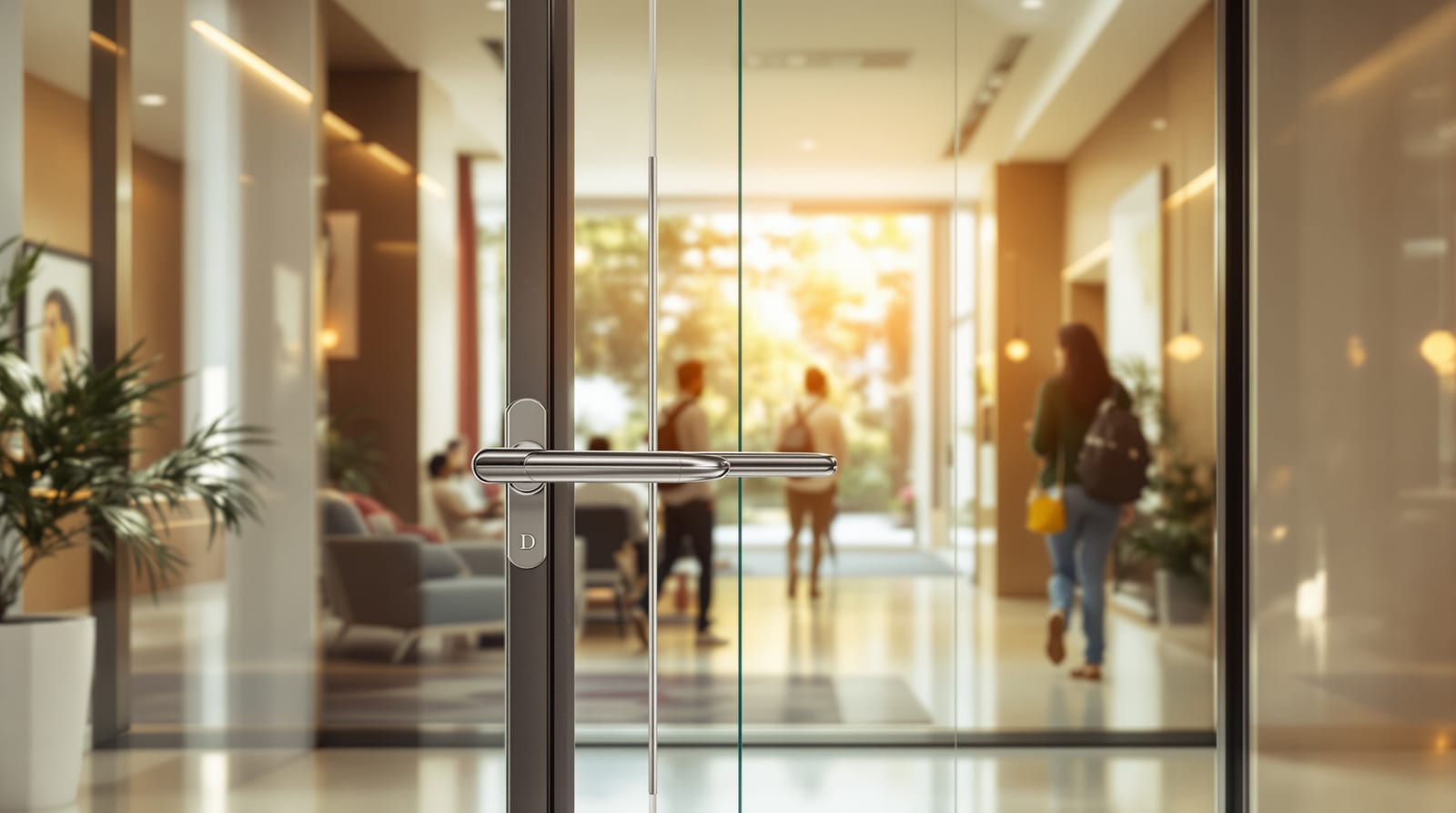
Frameless Glass Doors in India: 12 mm Toughened Glass, Patch Fittings & Floor Springs
How frameless glass doors work for Indian homes and offices — patch fittings, floor springs, patch locks, safety manifestation, planning holes before toughening, and what glass plus hardware really costs.
A frameless glass door has no surrounding frame and no visible hinge. A single sheet of 12 mm toughened glass swings on a floor spring buried in the floor, held by small stainless-steel "patch fittings" at the top and bottom corners. The result is the clean, almost invisible threshold you see at showrooms, clinics, office cabins and modern home entrances across India. But that minimalism is engineered: every hole, lock cut-out and fitting position must be planned and drilled before the glass is toughened, because toughened glass cannot be cut or drilled afterwards. Get the planning right and a frameless door lasts decades; get it wrong and the whole pane is scrap.
This guide explains how frameless glass doors actually work, where they suit Indian homes and offices, the hardware that does the load-bearing job, the safety steps that stop people walking into clear glass, and what the glass plus fittings really cost. For the broader glass-door overview see glass doors, and for the glass itself see toughened glass doors.
What "frameless" really means
In a framed glass door, an aluminium or wooden frame holds the glass and carries the door's weight through hinges. In a frameless door, the glass is the structure. There is no frame around the leaf. Instead:
- The weight of the leaf is carried by a floor spring (a hydraulic pivot box set into the floor) and a matching top pivot, OR by a top patch with an overhead pivot.
- Small patch fittings — stainless steel clamps at the top and bottom corners — grip the glass and connect it to the pivots.
- The door usually has no continuous edge protection, so the glass edges are polished smooth and the corners are slightly chamfered.
Because the glass must take the door's full self-weight and the stress of daily slamming, frameless leaves are almost always 12 mm toughened (tempered) glass conforming to IS 2553. Thinner 8–10 mm glass is used for lighter shower or partition leaves, but a full-height swinging entrance leaf in India is standard 12 mm. Toughening makes the glass four to five times stronger than ordinary float glass and — critically — makes it shatter into small blunt granules instead of dangerous shards if it ever breaks. See toughened glass doors for the toughening process in detail.
Where frameless glass doors are used in India
Frameless doors are common, but they are not for every opening. Their natural homes:
- Office cabins and conference rooms — the most common use. A frameless 12 mm leaf with a frameless glass partition on either side gives the "open yet private" look that Indian corporates want, while keeping daylight flowing through deep floor plates.
- Showroom and shop entrances — single or double frameless leaves on floor springs, with patch locks and long D-pull handles. The floor spring auto-closes the door, which suits high-footfall retail.
- Home main entrances (modern villas, apartments) — increasingly used as an inner door behind a security door or grille, so the glass gets the look while a steel security door or safety grill door carries the burglary risk. A frameless glass leaf as the only main door is a security and privacy compromise — pair it with a robust outer layer.
- Bathrooms and walk-in showers — frameless 8–10 mm enclosures and shower doors. This is a specialised sub-type; see shower glass doors.
- Interior partitions — frameless swing or fixed panels separating living and dining, or a study from a passage. See partition doors.
For a frosted or privacy-treated version of any of these, see frosted glass doors — the same frameless mechanics, with the glass sandblasted or filmed.
The hardware that does the work
In a frameless door the hardware is the design. Five components carry the load and control the swing.
Floor spring
The floor spring is the heart of a frameless swing door. It is a hydraulic box concreted into the floor at the bottom pivot point. It does three jobs: it bears the leaf's weight, it lets the door swing both ways (or single-action), and it closes the door slowly and smoothly with adjustable speed and a "back-check" that stops the leaf slamming. A good floor spring also has a hold-open position (often at 90°) so a busy office or shop door can be parked open. Floor springs are rated by glass weight/leaf width — match the rating to your leaf or the spring will sag and the door will drop. See floor springs for sizing and brands.
Top pivot
Directly above the floor spring, a top pivot locates the top of the leaf and lets it rotate. It carries no weight (the floor spring does) but keeps the leaf vertical and stable. It is fixed either to the door head/lintel or to the top patch of a fixed glass panel above.
Patch fittings — top and bottom
Patch fittings are the polished stainless-steel clamps that grip the glass at the corners and connect it to the pivots and locks. The common pieces:
- Patch bottom — clamps the bottom corner of the leaf and seats onto the floor-spring spindle.
- Patch top — clamps the top corner and engages the top pivot.
- Side/over panel patches — join a fixed glass fanlight or side panel to the structure.
Patch fittings need precise cut-outs and bolt holes in the glass, all of which must be specified before toughening.
Patch lock
A patch lock is a patch fitting with a built-in latch/dead-bolt mechanism, fitted at the lock-stile corner (usually the bottom or top of the leading edge). It engages a strike either in the floor, the lintel, or the adjacent fixed glass panel. For double doors, one leaf is bolted shut with a floor/header bolt and the active leaf locks into it. Patch locks are simpler than the mortise locks used in timber doors but offer less security — another reason a frameless leaf is rarely the sole main door.
Handles — D-pulls and push-pull bars
Because there is no stile to mortise a handle into, frameless doors use D-pull handles (or H-type/back-to-back pull bars) bolted through pre-drilled holes in the glass. Lengths run from 300 mm cabinet pulls to 600–1800 mm statement bars. There is no lever-and-spring latch — the floor spring returns the door, so handles are pure pull/push.
Component, role and cost
Prices are indicative and vary by city, brand and vendor; add 18% GST and fitting labour. 12 mm toughened glass is typically priced per square foot.
| Component | What it does | Indicative cost (₹) |
|---|---|---|
| 12 mm toughened glass leaf | The structural door panel (IS 2553) | 450–1,200 / sq ft |
| Floor spring (hydraulic, branded) | Bears weight, swings, auto-closes, hold-open | 2,000–7,000 each |
| Top pivot | Locates and stabilises the top of the leaf | 300–1,200 each |
| Patch top + patch bottom (set) | Clamp glass corners to pivots | 1,200–4,000 / set |
| Patch lock | Latch/deadbolt at the leading edge | 1,500–6,000 each |
| D-pull / pull-bar handle | Pull/push (no stile to mortise) | 600–8,000+ each |
| Over-panel / side patches | Join fixed fanlight or side panels | 600–2,500 each |
| Manifestation film / frosted band | Safety marking so people see the glass | 30–150 / sq ft |
| Glass edge polishing + corner cuts | Smooth, safe edges (part of fabrication) | included in glass rate |
As a rough all-in for a single home or cabin frameless door (≈ 3 ft × 7 ft = 21 sq ft of glass plus a mid floor spring, patches, a patch lock and a pull), budget roughly ₹18,000–40,000 supplied and fitted, rising sharply with premium hardware (Dorma, Geze, Ozone, Hafele, Hettich) and longer pull bars. For a structured estimate use the door cost calculator and compare against framed options in the glass door cost guide.
Safety: toughened is mandatory, and so is manifestation
Two safety rules are non-negotiable for frameless glass doors in India.
1. The glass must be toughened. A full-height swinging leaf in annealed (ordinary) float glass is dangerous and not permitted by good practice — if it breaks it produces large, knife-like shards. Always specify toughened glass to IS 2553, and ideally insist on a kite/IS mark etched into a corner. For very high-risk locations (large public entrances, glass near stairs), laminated-toughened glass is even safer because the interlayer holds the broken granules together. See toughened glass doors.
2. The glass must be visible — "manifestation". A clean, clear frameless door is genuinely hard to see, and people (especially children, elderly relatives and visitors) walk into it. This is a real injury cause, not a theoretical one. The fix is manifestation: a visible marking on the glass at eye level. Options:
- A frosted or sandblasted band roughly 100–150 mm tall at about 1,000–1,500 mm above floor (often a second band lower for children).
- A manifestation film, vinyl logo or etched pattern — common in offices, doubling as branding.
- Contrasting D-pull handles that themselves signal the door and its leading edge.
NBC 2016 and good safety practice expect full-height glazing in circulation areas to carry such markings. Treat manifestation as part of the door, not an afterthought.
For homes with elderly members or wheelchair users, also keep the threshold flush (the floor spring sits below floor level) and the clear opening generous — see accessible doors and door size standards.
Plan every hole before toughening
This is the single most important practical rule, and the most common, most expensive mistake. Toughened glass cannot be cut, drilled or notched after toughening — any attempt simply shatters the whole pane. So every cut-out and hole must be made in the float glass before it goes into the toughening furnace:
- Patch-fitting corner cut-outs (top, bottom, lock, over-panel).
- Holes for the D-pull / pull-bar bolts.
- The lock keep/strike hole if it passes through glass.
- Hinge-side and lock-side edge polishing.
That means you must finalise the exact hardware (which floor spring, which patch set, which patch lock, which handle, and their bolt patterns) and produce a dimensioned toughening drawing before ordering the glass. Change your mind about the handle after toughening and you buy a new pane. Reputable glass processors will ask for the hardware schedule and a CAD/manufacturing drawing precisely for this reason. Measure the opening carefully — see how to measure a door — and confirm site dimensions before the order, because frameless doors have very little site adjustability.
Frameless in the Indian climate
A few India-specific points:
- Monsoon: glass does not swell or warp like timber, so frameless doors avoid the seasonal sticking that plagues wooden doors. But the floor spring's pivot pocket can collect water at exposed entrances — specify a drained, sealed floor box and stainless (SS 304, or SS 316 near the coast) patch fittings.
- Coastal salt: insist on SS 316 patch fittings and floor-spring covers in Mumbai, Chennai, Kochi, Goa, etc. SS 304 will pit and stain in salt air. Brass-look PVD finishes should be over 316 for longevity. See door hardware finishes.
- Heat and glare: a clear glass entrance facing west or south can turn a lobby into a greenhouse. Consider tinted, reflective or low-E toughened glass, or a frosted band that also cuts glare. Compare with energy-efficient doors.
- Security: a patch lock and 12 mm glass deter casual entry but are not burglar-proof. For a main entrance, layer a security door, grille or multipoint locking behind or in front of the glass.
Frameless vs framed glass doors
| Factor | Frameless (patch + floor spring) | Framed (aluminium/uPVC + hinge) |
|---|---|---|
| Look | Minimal, "invisible", premium | Visible frame, more conventional |
| Glass | 12 mm toughened, structural | 5–10 mm in a frame |
| Weight handling | Floor spring | Frame + hinges |
| Cost | Higher (hardware + thick glass) | Lower |
| Site adjustability | Very low (holes pre-toughened) | Some (frame trims) |
| Weather sealing | Limited (gaps at edges) | Better (gaskets in frame) |
| Best for | Offices, showrooms, feature entrances, showers | Balconies, weather-exposed openings |
For weather-exposed or insulated openings, a framed glass door, sliding door or glass-panel door often makes more sense than frameless.
Frequently asked questions
Can I cut or drill a toughened frameless door after it is made?
No. Toughened glass shatters if you cut, drill or grind it after toughening. Every hole, cut-out and the lock position must be specified before the glass goes into the furnace. Always finalise the hardware and a dimensioned drawing first.
Are frameless glass doors safe for homes with children and elderly?
Yes, if done right: use 12 mm toughened (or laminated-toughened) glass, and add clear manifestation — a frosted band or film at eye level, plus a lower band for children — so no one walks into invisible glass. Keep the threshold flush for accessibility.
What holds a frameless glass door up if there is no hinge?
A floor spring set into the floor carries the door's full weight and controls the swing and auto-close, while a top pivot keeps the leaf vertical. Stainless-steel patch fittings clamp the glass corners to these pivots. See floor springs.
Is a frameless glass door secure enough for a main entrance?
On its own, not really — a patch lock and glass are easier to defeat than a mortise-locked timber or steel door, and the glass offers no privacy. Use a frameless leaf behind or in front of a security door or grille for a main entrance. See door security.
How much does a single frameless glass door cost in India?
Indicatively ₹18,000–40,000 supplied and fitted for a standard home or cabin leaf with a mid-range floor spring, patch fittings, a patch lock and a pull handle — more with premium brands or long pull bars. Costs vary by city and vendor; estimate yours with the door cost calculator.
Export this guide
Related Guides — Deep-dive reading
Toughened Glass Doors in India: Thickness, IS 2553, Safety & Cost
Why tempered glass is mandatory for large and low door panels, what thickness to specify, and the one rule you cannot break: it can never be cut after toughening.
Home Doors & EntrancesGlass Doors for Indian Homes: Toughened, Laminated, Framed vs Frameless (2026 Guide)
Where glass doors work in Indian homes - balconies, showers, partitions, offices - plus safety glass (IS 2553), privacy options, security, monsoon-proofing and 2026 ₹ costs.
Home Doors & EntrancesDoor and Window Security Assessment for Indian Homes
Go opening by opening and rate the hardware itself — leaf and frame, hinges and locks, strike plates, grilles, glazing and latches — so you can grade each door and window's real resistance while never trapping anyone behind it.
SecurityRelated Tools — Try Free
Door Security Rating Calculator
Score your main door out of 100 across leaf, frame, lock and hardware — and see the top upgrades.
Security ToolWindow Hardware Cost Calculator
Estimate window hardware cost — hinges, handles, locks, rollers and multipoint gears.
Window CalculatorGrill Door Cost Calculator
Estimate a safety grill door or collapsible gate cost by size, material, design and mesh add-on, with GST and fitting.
Door Calculator