
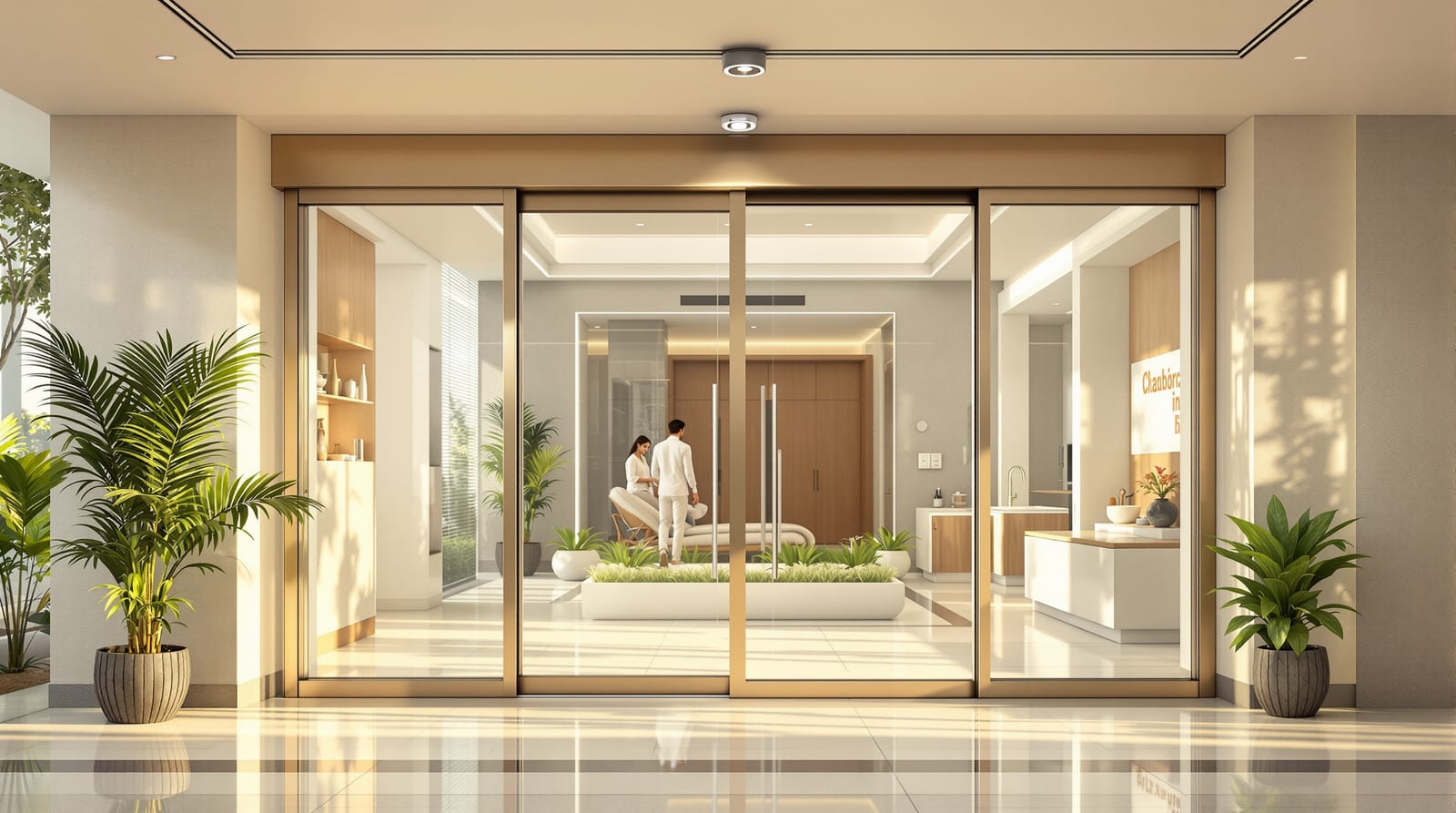
Automatic Sliding Doors in India: Sensors, Operators, Cost & Safety (2026)
How sensor-driven auto-slide doors work, where they belong in Indian homes and clinics, and what the operator, track and install really cost.
You walk up to a clinic in Pune carrying a child on one hip and a bag on the other, and the glass parts for you without a touch. That quiet convenience is an automatic sliding door, and it has quietly moved from malls and airports into villa porches, home clinics, boutiques and shop-cum-home frontages across India. Unlike a manual slider you push by hand, this is a powered system: a motor pulls the leaf, a sensor watches the approach, and a safety beam refuses to crush anyone standing in the gap. This guide explains exactly what you are buying, where it earns its keep in an Indian home or premises, and what the operator plus install honestly costs.
If you only want a manual hand-slid door, read sliding doors in India instead — this page is specifically about the automated, sensor-driven version.
What an automatic sliding door actually is
An automatic sliding door is not one product but a kit of parts working together. Understanding the parts is the whole game when you compare quotes, because cheap quotes usually drop a part you will later miss.
- The operator (the brain and muscle): a slim aluminium header beam, usually 120-180 mm deep, mounted above the opening. Inside sits a DC motor, a toothed belt, a control board and the carriage wheels that the leaf hangs from. This is the single most expensive and most important component — a Dorma, Geze or record-grade operator is what separates a door that runs silently for ten years from one that grinds and fails in eighteen months.
- The track and rollers: the leaf hangs from the header on rollers and is guided at the floor by a small bottom guide channel (a floor track that you can largely trip-free, unlike older floor-spring setups). Glass leaves run on patch-fitted carriages.
- The activation sensor: an overhead microwave-radar or PIR (passive infrared) sensor that detects an approaching person and tells the operator to open. Radar senses motion; PIR senses body heat. Many units combine both.
- The safety sensor (safety beam / presence sensor): an infrared beam or curtain across the opening that detects anyone standing in the doorway and stops the door from closing on them. This is the anti-trap feature, and it is non-negotiable.
- The leaves: single sliding (one leaf, parks to one side) or bi-parting (two leaves part from the centre to each side). Leaves are commonly 12 mm toughened glass (IS 2553) with patch fittings, but can be framed glass, aluminium or even a clad timber face.
How it works, step by step
The sequence is simple once you see it. A person enters the detection zone; the activation sensor signals the operator; the motor drives the belt and the leaf glides open within about 1-2 seconds; the door holds open for a set dwell time (often 2-5 seconds, adjustable); then it closes — but only after the safety beam confirms the opening is clear. If anyone breaks the beam during closing, the door reopens. Speed, dwell time, opening width and a "winter mode" (partial opening to save conditioned air) are all set on the control board or a small DIP-switch panel.
A good operator also has an electronic clutch / push-and-go so that if power fails or the motor is switched off, you can slide the leaf by hand without fighting the motor — important in India where outages are routine.
Where automatic sliding doors make sense in India
These doors are not for every doorway. They shine where hands are full, hygiene matters, or footfall is constant.
- Villa or bungalow entrance porch: a glass auto-slider at a covered porch looks premium and is genuinely useful when you arrive with groceries or a sleeping child. Keep it under the porch roof — direct monsoon rain on the operator shortens its life.
- Home clinic, dental or physiotherapy practice (shop-cum-home): touch-free entry is a real hygiene and accessibility win, and patients on crutches or in wheelchairs pass through easily. This is the single most common residential-adjacent use we see.
- Boutique, showroom or cafe frontage attached to a home: invites walk-ins and reads as modern retail.
- Internal lobby / vestibule between an air-conditioned hall and an entrance: an auto-slider as an inner door cuts dust and conditioned-air loss.
Where they make less sense: small budget homes (a manual slider or a good frameless glass door is far cheaper), bathrooms, and any exposed exterior wall that takes lashing coastal rain or blowing dust without a canopy.
Single sliding vs bi-parting, and leaf choices
A single sliding unit has one leaf that parks to one side — cheaper, needs side wall space equal to the clear opening for the leaf to park. A bi-parting (telescopic) unit has two leaves parting from the centre — gives a wider clear opening for the same header length, looks symmetrical (good over an entrance for Vastu balance and for visual centring), but costs more. Telescopic versions stack two leaves per side to squeeze a wide opening into a narrow header — these are the priciest.
For leaves, 12 mm toughened glass (IS 2553) is the default for entrances; it is strong, transparent and safe when it breaks (it crumbles, not shards). Frosted or ceramic-fritted glass adds privacy for a clinic. Framed aluminium leaves suit dustier or windier sites.
Costs in India (2026, indicative)
Prices below are for the system and are indicative and vary widely by city, brand, leaf size and glass spec; add 18% GST and fitting/civil work. Glass leaves, patch fittings and any toughened-glass cost are usually quoted separately from the operator.
| Automatic sliding system | Typical opening | Indicative ₹ (operator + basic fit) |
|---|---|---|
| Budget single slide operator (entry import / local) | up to 1000 mm clear | ₹35,000 - 60,000 |
| Branded single slide operator (Ozone, record-grade) | 900-1200 mm clear | ₹55,000 - 95,000 |
| Branded bi-parting operator (Geze, Dorma) | 1200-1800 mm clear | ₹90,000 - 1,80,000 |
| Telescopic / heavy-duty branded | 1800 mm+ clear | ₹1,50,000 - 3,00,000+ |
| Glass leaves (12 mm toughened) + patch fittings | per leaf | ₹450 - 1,200 / sq ft + ₹3,000-12,000 fittings |
| Battery / UPS power backup module | — | ₹8,000 - 30,000 |
| Annual maintenance contract (AMC) | — | ₹4,000 - 15,000 / yr |
A realistic all-in number for a smart villa or clinic entrance with a branded bi-parting operator, toughened glass leaves, safety sensor and backup is commonly in the ₹1.5 - 3.5 lakh range. Budget single-leaf clinic doors can land near ₹70,000 - 1,20,000 all-in.
Power backup, because this is India
An automatic door that dies during a power cut and locks people out (or in) is a liability. Three approaches:
1. Push-and-go manual mode (built into good operators) — on power loss the leaf can be hand-slid. Minimum acceptable.
2. Battery backup module / mini-UPS — keeps the door cycling for a set number of operations after an outage, then parks it open or closed per your setting. Strongly recommended for clinics and any door on an exit route.
3. Inverter / generator circuit — wire the operator onto your home inverter line so it simply keeps working.
If the door sits on an emergency exit path, NBC 2016 Part 4 life-safety logic applies: people must always be able to get out. Specify a fail-safe (break-out) mode where the leaves swing or break away manually in the egress direction during an emergency.
Safety and anti-trap — the part you cannot skip
The defining safety feature is the safety presence sensor / infrared beam that prevents the door closing on a person, pram or wheelchair in the opening. Demand it in writing. Other safety musts:
- Reduced closing force / soft stop so a leaf cannot injure a child.
- Finger-trap protection at the leading edges and the meeting stile of bi-parting leaves.
- Toughened glass only for leaves, with a manifestation strip (a frosted band at eye level) so people do not walk into clear glass — a common and serious accident.
- Push-and-go / break-out for outages and emergencies.
For broader entrance security against intruders (not the same as anti-trap), see door security in India — auto-sliders are about convenience and life-safety, not burglar resistance, so pair them with grilles, a shutter or an alarm where security matters.
Brands and where to buy
In India the established names are Dorma (now dormakaba), Geze and record for premium operators with long service life and proper safety sensors — these are what malls, hospitals and good clinics specify, and they have service networks in major cities. Ozone is a widely available, more affordable Indian-market brand that suits homes and small premises. Entry-level imported operators exist but check who will service them in your city before you buy — a cheap operator with no local service is a trap.
Buy through an authorised dealer who quotes the operator, sensors, glass and AMC as line items, and who handles the toughened-glass tempering and patch fittings. Insist the activation and safety sensors are both itemised; a missing safety sensor is the commonest corner cut.
Vastu and the main door
If the auto-slider is your main entrance, the usual main-door preferences still apply in spirit — a generous, well-lit, north/east/north-east opening, kept clean and unobstructed. A bi-parting glass door reads as a wide, welcoming, symmetrical entrance, which sits comfortably with Vastu ideas about an inviting threshold. Note that sliding doors do not "open inward and clockwise" the way a hinged door does, so traditionalists sometimes prefer a hinged main door and use the auto-slider at a porch or inner lobby. Treat this as tradition and personal comfort, not rule — see main door Vastu in India and entrance Vastu for the reasoning.
Related reading
- Sliding doors in India — the manual, hand-operated version and where it fits.
- Automatic glass doors in India — auto operators on swing and other glass configurations.
- Motorised gate automation in India — the same automation logic for your compound gate.
- Frameless glass doors in India — a cheaper toughened-glass entrance if you do not need automation.
- Estimate with the door cost calculator and the door size calculator.
Frequently asked questions
Will an automatic sliding door work during a power cut?
Yes, if specified correctly. A good operator has a push-and-go manual mode so you can hand-slide the leaf when power is off, and you can add a battery backup module or wire the operator to your home inverter so it keeps cycling. For clinics and exit-route doors, also specify a fail-safe break-out mode. Never buy an operator that locks rigid without power.
How much does an automatic sliding door cost in India?
Indicatively, a branded single-leaf operator runs ₹55,000-95,000 and a bi-parting operator ₹90,000-1,80,000, before glass leaves, fittings, GST and install. An all-in villa or clinic entrance with toughened glass and backup is commonly ₹1.5-3.5 lakh. Costs vary by city, brand and leaf size, so always get an itemised quote.
Is an automatic sliding door safe for children and elderly people?
It can be the safest entrance you own if it has a proper safety presence sensor (the anti-trap infrared beam), soft-stop closing, finger-trap protection and toughened glass with a visible manifestation strip. The touch-free, wide, low-threshold opening is excellent for wheelchairs, walkers and prams. Insist the safety sensor is itemised — it is the commonest corner cut.
Single sliding or bi-parting — which should I choose?
Choose single sliding for narrower openings and tighter budgets, provided you have side wall space for the leaf to park. Choose bi-parting for a wider clear opening, a symmetrical look over a main entrance, and easier passage. Bi-parting costs more but generally feels more premium and balanced.
Which brand of automatic door operator is best in India?
Dorma (dormakaba), Geze and record are the premium, long-life choices with proper safety sensors and city service networks, favoured for clinics and showrooms. Ozone is a more affordable Indian-market option suited to homes and small premises. Whatever you pick, confirm local service and an AMC before buying.
Export this guide
Related Guides — Deep-dive reading
Automatic Glass Doors in India: Sensors, Operators, Breakout & Cost (2026)
Sensor-driven frameless and framed glass auto-doors for Indian clinics, shops, offices and villa entrances — the operator, touchless sensor, safety beam, battery backup and breakout, with indicative costs.
Home Doors & EntrancesAutomatic Sliding Door Mechanism Explained (India 2026)
Inside the operator kit, sensors, breakout and battery backup that make an automatic sliding door open, cushion and stay safe.
Home Doors & EntrancesAutomatic Swing Door Operators: Retrofit Guide India 2026
How to retrofit a normal hinged door to open by itself — full-energy vs low-energy operators, activation, safety and cost for Indian buildings.
Home Doors & EntrancesRelated Tools — Try Free
Access-Control Battery-Backup Calculator
Size the standby battery so an access system keeps running through a power cut, with an egress life-safety note.
Battery BackupCross-Ventilation Analyzer
Estimate airflow and air changes per hour (ACH) from room size, window areas, layout, and local wind — with NBC 2016 Part 8 compliance check.
Ventilation CalculatorSecurity Backup Power Calculator
Size a UPS/inverter and battery to keep CCTV, NVR, router and alarm running through a power cut — load, Ah, VA and cost.
Backup Power