
Library Door in India: Quiet, Access-Controlled and Anti-Theft Reading-Room Entrances (2026)
Doors for public, college and corporate libraries in India - acoustic silence, RFID security gates, controlled single entry and a calm scholarly look, with zone-by-zone choices and costs.
In a library, the door has one job above all others: it must be quiet. The whole building exists to protect concentration, and nothing breaks a reading room like a door that slams, squeaks or bangs shut behind a latecomer. But silence is only the first demand. A modern Indian library - whether a city public library, a college or university library, or a corporate knowledge centre - also has to control who comes in and out through a single supervised point, stop books and journals walking out the door, stay open to wheelchairs and trolleys, and still let everyone escape fast in a fire. That is a lot to ask of doors, and it is why a good library uses different doors at different points rather than one type everywhere.
This guide ranks doors zone by zone for an Indian library, from the secure automatic entrance with its anti-theft gate to the hushed reading-room door, gives you the costs, and shows how acoustics, access control and egress fit together. It is the application companion to the mechanism and material guides - follow the links for how each door type actually works.
What a library door actually has to do
Six drivers decide every door in a library. Get the door wrong on any one of these and readers, librarians or auditors will notice:
- Acoustics - silence is the point. Reading rooms, study halls and quiet zones need doors that close softly and seal sound. That means a solid-core or acoustic door with proper edge seals and, above all, a closer or soft-close mechanism so it never slams. A library is the one building type where door noise is a primary design failure.
- Anti-theft at the entry. Books, reference volumes, journals and AV media are valuable and easy to pocket. The standard answer in India is an RFID (or older EM/electromagnetic) security gate at the single entry/exit, which alarms if a tagged item passes through un-issued. The door system has to funnel everyone through that gate.
- Controlled single entry and exit. Supervision works only if there is one staffed point in and out, past the issue/return counter and the security gate. Side doors become fire-exit-only (alarmed, not for daily use).
- Accessibility. A public or institutional library must be usable by wheelchair users and the visually impaired - clear width of at least 900 mm, lever handles, near-flush thresholds, and ideally a hands-free automatic entrance.
- Calm, scholarly aesthetic. Libraries read as places of quiet dignity. Doors should be clean, warm and understated - veneered or laminated solid timber, framed glass for supervision, nothing flashy or noisy.
- Fire and egress. Libraries are high fuel-load buildings (paper everywhere) and often have high occupancy in exam season. Fire-rated doors on stairs and compartments, and adequate fire-exit doors that open in the direction of escape, are non-negotiable under NBC 2016.
Zone-by-zone: the right door for each part of the library
Main entrance - automatic sliding glass through a security gate
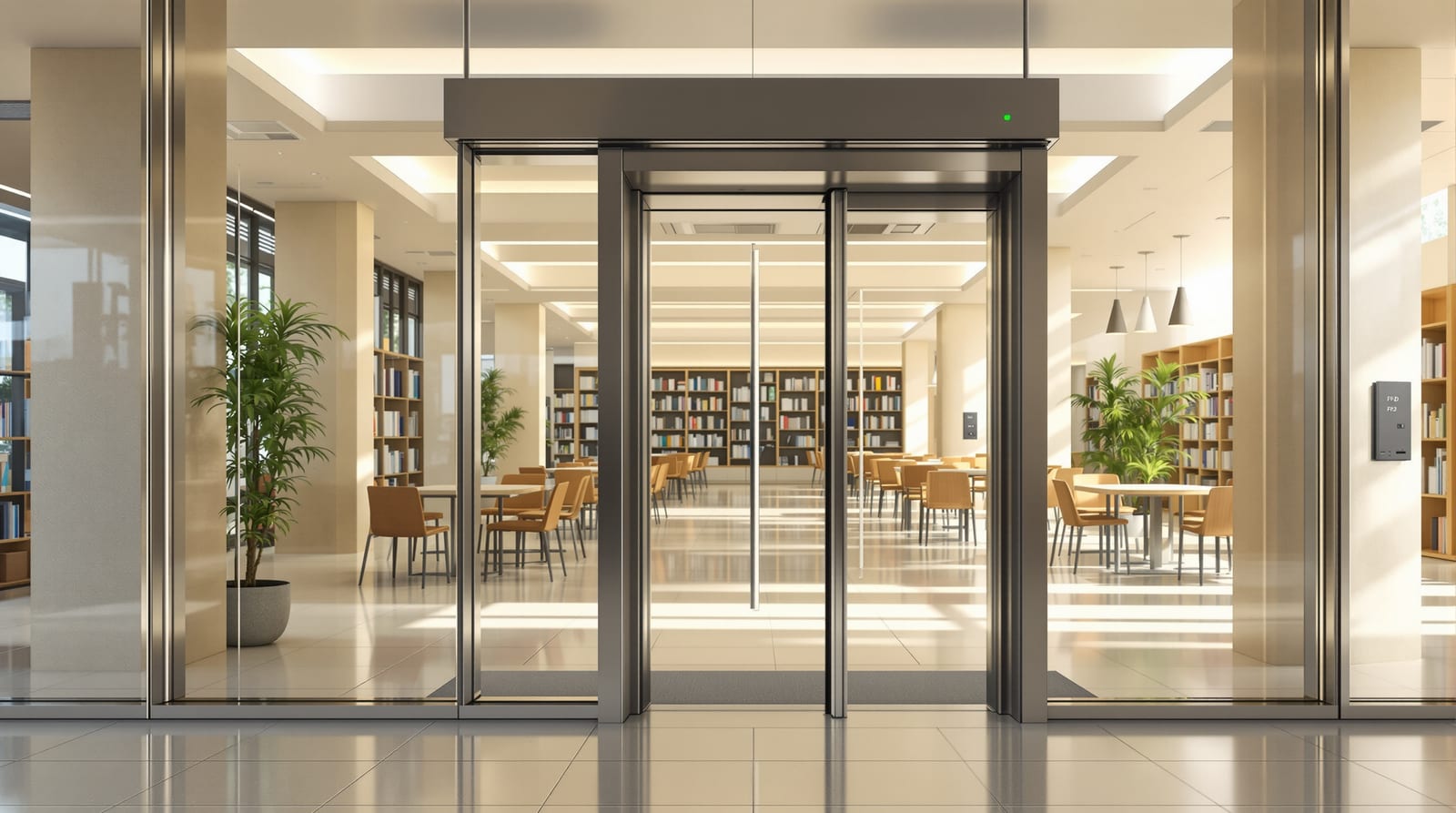
For the public face of the library, an automatic sliding glass door is the right choice. It is hands-free (accessible and trolley-friendly), it seals the air-conditioning against Indian heat the instant it closes, and it naturally channels everyone through the issue counter and the RFID security gate just inside. Specify break-out (manual swing-open) leaves and a fire-alarm interface so the doors release in an emergency, plus UPS backup for power cuts. Read the mechanism in automatic sliding doors for India and automatic glass doors for India. Smaller libraries can use a framed glass door on a closer instead.
The anti-theft RFID gate is not a door but it governs the entrance layout: the door, the staffed counter and the detection pedestals must line up so no reader can leave without passing between the pedestals. Tie the gate and the entrance into the building door access control for India system.
Reading rooms and quiet study halls - acoustic solid-core door, soft-close
This is the heart of the library and the door that matters most. Use a solid-core flush or acoustic door, hung on a controlled closer or soft-close mechanism so it cannot slam. The higher the quiet expectation (reference reading rooms, research carrels, exam halls), the higher the acoustic rating you should specify. For a dedicated quiet zone, an acoustic / soundproof door for India with full perimeter seals and a drop-down threshold seal will hold an STC in the high 30s to 40s - enough to keep corridor chatter out. The single most important spec is the door closer: a good adjustable closer with soft-latch action is what turns a slamming door into a silent one.
A small vision panel (a narrow glazed strip) in the reading-room door lets staff supervise and lets people see someone on the other side before pushing - reducing collisions and the startle of a door swinging into a quiet room.
Stack rooms, periodicals and book storage - flush or solid timber, durable
Doors to the stacks and storage take trolley traffic and need to be robust and easy to clean rather than acoustic. A laminated flush door on a closer, or a sturdy wooden door, is the workhorse choice. Where a stack room is also a fire compartment or holds rare/archival material, upgrade to a fire-rated door (see below).
Librarian offices, processing and cabins - panel or veneered solid-core
Staff cabins and the technical-processing room want a quiet, presentable door - a panel door or veneered solid-core flush door, with a lever handle and a mortise lock. A vision panel into the processing area is useful for supervision.
Rare-book / archive room - fire-rated, secured
A rare-book, manuscript or archive room is both a fire-protection and a security problem. Use a fire-rated door (often 60-120 minutes) with access control, and ideally environmental sealing to hold humidity stable. See fire-rated doors for India.
Fire exits and stairs - fire-rated, panic hardware, outward swing
Every library needs compliant escape routes. Fire-exit and stairwell doors must be fire-rated, self-closing, fitted with panic/push-bar hardware, and they must open in the direction of escape. These are alarmed and used only in emergencies, keeping the single supervised entry intact for daily use. See fire-exit doors for India and emergency exit door standards for India.
Library door recommendation and cost table
| Library zone | Recommended door | Why | Indicative cost (per door, ex-GST) |
|---|---|---|---|
| Main entrance | Automatic sliding glass + RFID security gate | Hands-free, accessible, AC-seal, funnels readers past anti-theft gate | 1,80,000 - 6,00,000+ (system) |
| Reading room / quiet study | Acoustic / solid-core flush + soft-close closer | Silence is the point - no slams, sound sealed | 12,000 - 45,000 (acoustic) / 4,000 - 12,000 (solid-core) |
| Stack room / storage | Laminated flush on closer | Durable, trolley-friendly, easy to clean | 3,000 - 9,000 |
| Librarian office / cabin | Panel or veneered solid-core | Quiet, presentable, lockable | 4,000 - 14,000 |
| Rare-book / archive | Fire-rated + access control | Protects irreplaceable collection, fire + theft | 12,000 - 45,000+ |
| Fire exit / stairwell | Fire-rated + panic bar, outward swing | Code egress, self-closing, alarmed | 12,000 - 45,000+ |
| Toilet / utility | PVC or flush | Wet-area durable, low cost | 1,800 - 5,000 |
Costs are indicative and vary by size, acoustic rating, finish, operator brand and city; add 18% GST. Size a quote with the commercial door cost calculator and the acoustic door selector.
How the library entrance lines up: door, gate and reading room
The logic of the plan is a single controlled spine: the automatic door admits the reader, the RFID gate and staffed counter sit immediately inside so nothing leaves un-issued, and the acoustic reading-room door beyond - on a soft-close closer - keeps the quiet zone silent. Side doors exist only as alarmed fire exits.
Hardware the library door needs
Library doors live or die on their hardware, not the leaf alone:
- Door closers / soft-close on every reading-room and corridor door so nothing slams - the single most important library door fitting. See door closers for India.
- Lever handles (not knobs) for accessibility, with mortise locks on offices and stores.
- Vision panels on reading-room, processing and stack doors for supervision and to prevent door-swing collisions.
- Panic / push bars on fire-exit doors.
- Access-control readers on staff-only, rare-book and after-hours doors, integrated with the access control system.
- RFID security pedestals at the entry, aligned with the door and counter.
- Floor springs for any frameless glass entrance leaf.
Standards and clearances to specify
- Accessibility (RPwD 2021): entrance and main reader-route doors with a clear opening width of at least 900 mm, lever handles, threshold no higher than 12 mm, and ideally hands-free automatic operation at the main entrance.
- NBC 2016 egress: libraries carry a high fire load; provide adequate fire-exit width for the occupant load, doors opening in the direction of escape, with panic hardware on assembly-type exits.
- Fire-rated doors (IS 3614): on stairwells, between fire compartments, on rare-book/archive rooms and server/electrical rooms, self-closing.
- Acoustics: specify a target STC for quiet zones (high 30s-40s for reading rooms) and detail full perimeter seals plus a soft-close closer.
- Glass safety: toughened or laminated glass with manifestation on all glazed entrance and vision panels.
To see how libraries sit alongside other education spaces, read college and institutional doors for India, and to pick the right door for any space, the doors by space guide for India.
Do and don't
- Do make the soft-close closer the non-negotiable fitting on every reading-room door - silence is the brief.
- Do line up the automatic entrance, the issue counter and the RFID security gate as one controlled spine.
- Do add small vision panels for supervision and to stop door-swing collisions in quiet rooms.
- Do keep daily traffic to a single supervised entry; make all other exits alarmed fire exits only.
- Don't use hollow, lightweight or untreated doors on reading rooms - they slam, rattle and leak sound.
- Don't forget fire-rated doors and panic hardware just because the building feels calm; paper is a heavy fuel load.
- Don't treat the anti-theft gate as an afterthought - the door and counter layout must enforce it.
Frequently asked questions
What is the best door for a library reading room in India?
A solid-core or acoustic flush door fitted with a soft-close closer. Silence is the primary brief, so the door must close quietly and never slam, with edge seals to keep corridor noise out. Add a small vision panel for supervision. For high-quiet zones, specify a rated soundproof door.
How do libraries stop books from being stolen at the door?
By funnelling everyone through a single controlled entry where an RFID (or EM) security gate stands just inside the entrance, beside the issue/return counter. Items not properly issued trigger an alarm as they pass between the detection pedestals. The automatic entrance door and counter are laid out so no reader can bypass the gate.
How much does a library entrance door system cost in India?
An automatic sliding glass entrance with sensors typically runs about 1,80,000 to 6,00,000 plus GST as a system; the RFID security gate is a separate spend. Acoustic reading-room doors run roughly 12,000 to 45,000 each, and solid-core flush doors 4,000 to 12,000. Costs vary by size, rating, finish and city; add 18% GST. Use the commercial door cost calculator.
Should a library entrance be automatic?
For public, college and corporate libraries, yes - an automatic sliding door is hands-free, wheelchair and trolley friendly, seals the air-conditioning, and naturally directs readers past the counter and anti-theft gate. Specify break-out leaves, a fire-alarm interface and UPS backup so people can always exit in a power cut or emergency. See automatic sliding doors for India.
Do library doors need to be fire-rated?
The reading-room and office doors generally do not, but stairwell, fire-compartment, rare-book/archive and server-room doors must be fire-rated and self-closing under NBC 2016 and IS 3614, and fire-exit doors need panic hardware and must open in the direction of escape. Libraries carry a high paper fuel load, so egress and compartmentation matter. See fire-rated doors for India.
Export this guide
Related Guides — Deep-dive reading
Universal Design Doors for Indian Homes: Inclusive Doors That Work for Everyone (2026)
How to design and specify doors that serve children, the elderly, pregnant women, the injured and wheelchair users by default - generous width, lever handles, near-flush thresholds, low-force closing, contrast and good lighting - without your home ever looking medical.
Home Doors & EntrancesAccessible Doors in India: Wheelchair & Senior-Friendly Door Design Guide
Clear width, lever handles, flush thresholds, swing vs sliding, lock reach and sensor doors - how to specify wheelchair- and senior-friendly doors to the RPwD Harmonised Guidelines 2021 and NBC 2016.
Home Doors & EntrancesWheelchair Accessible Doors for Indian Homes: Clear Width, Thresholds & Hardware (2026)
The exact specs that make a door usable from a wheelchair - clear opening width, near-flush threshold, lever hardware, approach clearance and low-force or auto operation, mapped to the RPwD Harmonised Guidelines 2021.
Home Doors & EntrancesRelated Tools — Try Free
Acoustic Privacy (STC) Visualizer
Indian healthcare acoustic visualizer — compare wall assemblies and noise sources, see received SPL after STC attenuation, and check FGI 2018 / IS 1950 / NABH speech-privacy compliance with live dual-canvas waveform.
Acoustic ToolAccess-Control Battery-Backup Calculator
Size the standby battery so an access system keeps running through a power cut, with an egress life-safety note.
Battery BackupWindow Hardware Cost Calculator
Estimate window hardware cost — hinges, handles, locks, rollers and multipoint gears.
Window Calculator