
Fire Rated Doors in India: IS 3614 Ratings, Cost & Where They're Required (2026)
What a fire-check door is, how the 30/60/90/120-minute ratings work to IS 3614, where the NBC makes them mandatory, and why the whole assembly must be certified.
A fire-rated door, called a fire-check door in Indian practice, is an engineered assembly designed to hold back flame, smoke and heat for a measured number of minutes so that people can escape and firefighters can reach the seat of the fire. It is not a thicker version of an ordinary door. It is a tested system, the leaf, the frame, the seals, the glass and every piece of hardware, that has been certified together to perform for 30, 60, 90 or 120 minutes. Specify any part of it loosely and the rating is void, which is the single most common and most dangerous mistake on Indian sites.
This guide goes deep on the fire-rated door as a certified assembly. For how a fire door fits into the broader rules a designer must satisfy, see residential door standards; for the dedicated escape route at the building's edge, see fire-exit doors.
What makes a door "fire rated"
An ordinary flush door burns through in a few minutes. A fire-rated door is built from the inside out to resist three things at once: flame penetration (the fire breaking through the leaf), integrity failure (gaps opening up that let flame and smoke pass), and insulation failure (so much heat conducting through that the unexposed face ignites whatever is leaning on it). A door tested to IS 3614 is rated against these and given a time in minutes that it survived the furnace.
The construction has five non-negotiable parts, and all five are part of the certificate:
- A fire-resistant core. Instead of the hollow or honeycomb core of a flush door, a fire door uses a dense, non-combustible or fire-treated core, typically a mineral or calcium-silicate board, a fire-grade chipboard/MDF treated to slow burn-through, or a steel skin over a mineral fill. The core is what buys most of the minutes.
- An intumescent seal. A thin strip of material set into a groove in the leaf edge or the frame that stays inert at room temperature but expands many times its size when heated (around 150-200 degC). As the door starts to char and gaps open, the seal swells and chokes the gap shut, holding integrity. A combined intumescent-plus-smoke (cold-smoke) seal also blocks smoke at normal temperatures.
- A certified frame. The frame is tested with the leaf, not assumed. It is usually pressed steel (to IS 4351) or a fire-grade hardwood/engineered frame, fixed to masonry with the anchors and the gap-fill (intumescent mastic or fire-grade mineral wool, never ordinary PU foam) specified in the certificate.
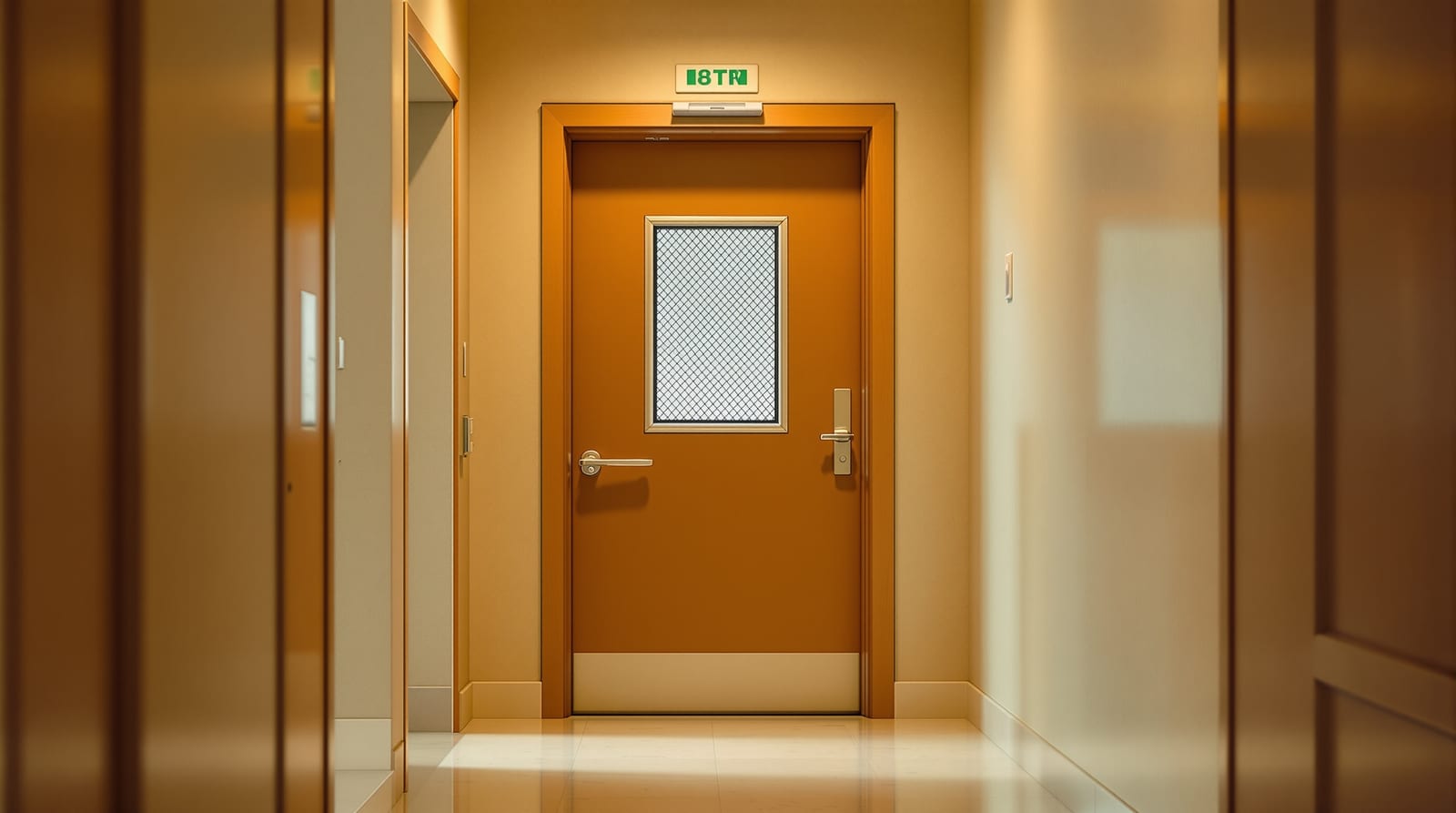
- A fire-rated vision panel, if any. Glazing in a fire door must be fire-rated glass (specially toughened or wired/ceramic glass), set in an intumescent glazing system and beads that were part of the test. You cannot cut a hole and drop in ordinary toughened glass.
- Certified hardware: a self-closer and fire hinges. A fire door must close and latch by itself, so an overhead door closer (or floor spring) is mandatory, along with fire-rated hinges, a fire-rated mortise lock/latch, and intumescent pads behind every cut-out (lock, hinge, letter-plate).
The ratings: 30, 60, 90, 120 minutes
The rating is the time, in minutes, the complete assembly resisted fire in a standard furnace test. In Indian documentation you will see it written as a fire-resistance rating (FRR) in minutes or, on older drawings, in hours (1 hr = 60 min, 2 hr = 120 min). The relevant standard is IS 3614, where Part 1 covers the older metallic fire-check door and Part 2 covers fire-resistance testing and the integrity/insulation criteria.
A point professionals must get right: a door rated "60/30" or quoted with two numbers describes integrity (E) for the higher figure and insulation (I) for the lower, borrowed from the EN classification you will also see on imported doors (for example EI60, E120). For most internal protected-route doors in Indian residential and commercial work, you are specifying by the headline minute figure that the NBC or the fire NOC requires.
| Rating | What it buys | Typical Indian application |
|---|---|---|
| 30 minutes (FD30 / 0.5 hr) | Short hold; flat-to-corridor protection | Flat entrance doors onto a protected corridor, service shafts, light internal compartmentation |
| 60 minutes (FD60 / 1 hr) | The residential workhorse | Stairwell/lift-lobby doors, basement-to-core doors, common flat-to-stair doors in mid-rise |
| 90 minutes (FD90 / 1.5 hr) | Higher compartmentation | High-rise stair cores, transformer/DG/electrical rooms, plant rooms, some basement parking |
| 120 minutes (FD120 / 2 hr) | Heaviest separation | Fire-pump rooms, major plant/hazard separations, large basements, severe high-rise demands |
The exact figure is not yours to guess: it is set by NBC 2016 Part 4 (Fire & Life Safety), the local fire service rules, and the building's approved fire scheme/NOC. As a designer, read the figure off the fire drawing and the local CFO requirement, then specify a certified door of that rating, never one notch lower.
Anatomy of a fire-rated door
Where the NBC requires a fire door
Fire doors are not a luxury upgrade; in many parts of a building they are a code requirement enforced through the fire NOC. Under NBC 2016 Part 4 and local fire rules, fire-rated doors are typically mandatory at the boundaries of protected escape routes and high-hazard rooms. The exact rating is set by the building's height, occupancy and the approved scheme, but the common Indian residential and mixed-use cases are:
| Location | Typical requirement | Why |
|---|---|---|
| Staircase enclosure (door into the stair) | Often FD60 (60 min), self-closing | The stair is the protected escape route; it must stay smoke- and fire-free |
| Lift lobby / lobby to stair in high-rise | FD60-FD90 | Keeps the lobby and lift shaft as a protected zone |
| Basement and basement parking to building core | FD90-FD120 | Basements are hard to ventilate and high-risk |
| Flat entrance onto a common protected corridor | FD30-FD60 | Contains a fire inside one flat for the escape window |
| Electrical / DG / transformer / fire-pump rooms | FD90-FD120 | Service rooms are ignition-prone and must be sealed off |
| Kitchen (in some commercial/assembly cases) | FD30-FD60 | Commercial kitchens are a leading ignition source |
For a private independent home (a single-family bungalow) the NBC does not generally force fire doors, but they remain a sensible upgrade at a few points: the door from an attached garage into the house, the door to a basement, and the kitchen door in a joint-family layout where the kitchen runs hot all day. Note the wider rule for the building's actual exits: an egress/exit door must be at least 1000 mm wide, must open in the direction of escape, and on assembly occupancies needs panic hardware, all covered in fire-exit doors and emergency exit door standards.
Why the whole assembly must be certified, not just the leaf
This is the heart of fire-door competence, and where most Indian sites go wrong. A fire-resistance rating belongs to a tested combination, not to the leaf alone. The leaf, the frame, the seals, the glass, the hinges, the lock and the closer were burned together in a furnace as one specimen, and the certificate covers that exact specimen with stated tolerances. Change any element and you have an untested door that may fail in minutes.
The classic site failures, all of which void the rating:
- Buying a certified FD60 leaf and hanging it in an ordinary wooden frame a local carpenter made, with no intumescent seal in the rebate.
- Fitting a standard chrome mortise lock or hinges instead of the fire-rated, intumescent-padded hardware the certificate names.
- Cutting a vision panel into a solid fire leaf on site and glazing it with ordinary toughened glass.
- Filling the frame-to-wall gap with PU expanding foam (which burns) instead of fire-grade mineral wool or intumescent mastic.
- Leaving an excessive gap under the door, or omitting the closer so the door is propped open, the single most common reason fire doors fail to do their job.
- Painting over or damaging the intumescent seal so it cannot swell.
So when you specify a fire door, you are specifying a doorset, delivered and installed by the manufacturer or a trained installer, with one certificate covering the lot. Do not let it be value-engineered into "a certified leaf plus whatever frame and hardware are cheapest." For the planning rules that surround this, read NBC door requirements and residential door standards; for the secure-but-non-fire equivalent at the main door, see steel doors.
Certification and marking: what to look for
A genuine fire door in India should come with a paper trail and physical marking. Insist on, and keep, the following:
- A test certificate / report from an accredited laboratory (CBRI Roorkee, NTH, or an NABL-accredited fire-test lab; many Indian doors also carry UL, BS 476 Part 22, or EN 1634-1 tested reports). The report must state the rating in minutes and describe the full assembly tested.
- A permanent label or plug on the leaf edge (often the hinge edge) stating the manufacturer, the rating, and a certificate/serial number. A door with no edge marking is a red flag.
- The intumescent seal in place in the groove, undamaged and unpainted, with the cold-smoke brush if smoke control is required.
- Matching hardware from the certificate: CE/IS-marked fire hinges, a fire-rated lock, and a self-closer rated for fire use (see door closers). Intumescent pads behind every cut-out.
- An installation method statement specifying the wall fixing, the gap (typically 3 mm leaf-to-frame, generous under-door allowance per the certificate) and the fire-grade gap-fill.
Be sceptical of a door sold purely as "fire door" with no rating in minutes, no certificate, and no edge label, it is common in the grey market and worthless in an audit or, far worse, in a fire.
Cost in India
Indicative 2026 prices for a complete certified fire doorset (leaf + certified frame + seals + fire hardware), before fitting labour and GST. Prices rise steeply with rating, vision panel, double-leaf and finish. Treat these as indicative and confirm with the vendor for your city.
| Door / rating | Indicative price (₹ per set, +18% GST) |
|---|---|
| FD30 single-leaf, steel frame, no vision panel | 6,000-12,000 |
| FD60 single-leaf (residential stair door) | 9,000-16,000 |
| FD60 with fire-rated vision panel | 14,000-22,000 |
| FD90 single-leaf | 15,000-25,000 |
| FD120 single-leaf / heavy service room | 20,000-35,000+ |
| Double-leaf fire door | add 60-100% over single |
| Certified self-closer (per door) | 1,500-3,500 |
| Fitting / installation labour (per set) | 800-2,500 |
Common suppliers of certified fire doors in India include Shakti Hormann, Navair, Promat, Sukrit, Pioneer, Godrej and several pressed-steel and FRP fire-door makers; many of these supply the matched closer and hardware as a kit. For the budget of the surrounding doors, the door cost calculator helps; for the non-fire security upgrades that often sit alongside, see door security.
The temptation to save by buying a certified leaf and sourcing the frame and hardware locally almost always destroys the rating and the value, the saving is a few thousand rupees against a door that no longer does the one job it exists to do.
Frequently asked questions
Is a fire-rated door legally required in my apartment building?
In most multi-storey apartments, yes, at the protected escape routes. Under NBC 2016 Part 4 and the local fire NOC, stairwell, lift-lobby and basement doors are typically required to be self-closing fire doors (commonly FD60), with higher ratings for high-rise cores and service rooms. The exact figure is set by your building's approved fire scheme, so read it off the fire drawing and the CFO requirement rather than guessing.
What is the difference between a fire-check door and a fire-exit door?
A fire-check (fire-rated) door is about resisting fire for a rated time to keep a route or room protected, governed here by IS 3614. A fire-exit door is about getting people out: it must be at least 1000 mm wide, open in the escape direction, and on assembly buildings carry panic hardware. The two overlap, an exit door is often also fire-rated, but the requirements differ. See fire-exit doors.
Can I add a vision panel to a fire door on site?
No. The vision panel, the fire-rated glass, the glazing system and the beads were all part of the tested assembly. Cutting a hole into a certified leaf on site and fitting ordinary glass voids the rating completely. Order the door with the certified vision panel built in.
How does an intumescent seal work?
The intumescent seal is inert at normal temperatures but expands many times its volume when it gets hot (around 150-200 degC). As the door begins to char in a fire and gaps open at the edges, the seal swells and seals those gaps, maintaining integrity so flame and smoke cannot pass. A combined intumescent-and-smoke seal also blocks cold smoke during everyday use.
Why does the whole assembly have to be certified and not just the leaf?
Because a fire-resistance rating belongs to the exact combination of leaf, frame, seals, glass, hinges, lock and closer that was burned together in a furnace test. Swapping in a local frame, ordinary hardware or non-fire glass creates an untested door that can fail far sooner than its label claims. Specify and install the complete certified doorset, and keep the test certificate and the edge label.
Export this guide
Related Guides — Deep-dive reading
Fire-Resistant Building Materials in India: A Specify-and-Select Guide (2026)
The difference between how a material reacts to fire and how long a rated assembly resists it, then the materials that deliver passive fire protection - non-combustible structure, mineral wool, fire-rated boards, intumescent coatings, spray fireproofing and fire-stopping - with a material-to-role selection table.
Building MaterialsEmergency Exit Door Standards in India: NBC 2016 Egress Rules
How exit door width, swing direction, panic hardware, fire rating and signage are governed by NBC 2016 Part 4 — and where homes differ from assembly and commercial buildings.
Home Doors & EntrancesFire Exit Doors in India: NBC 2016 Egress, Panic Bars & Costs (2026)
How fire exit and emergency egress doors must be sized, swung, hardware-fitted and signed to NBC 2016 Part 4 in Indian buildings, and what they cost.
Home Doors & EntrancesRelated Tools — Try Free
Door Cost Calculator
Estimate the all-in cost of a door — leaf, frame, hardware, fitting and GST — by type, material and size.
Door CalculatorWindow Hardware Cost Calculator
Estimate window hardware cost — hinges, handles, locks, rollers and multipoint gears.
Window CalculatorDoor Security Rating Calculator
Score your main door out of 100 across leaf, frame, lock and hardware — and see the top upgrades.
Security Tool