
Gym and Fitness-Centre Door in India: Access Control, Acoustics, Durability and Costs (2026)
How to spec gym and fitness-studio doors zone by zone - a 24x7 access-controlled entrance, street-selling glass frontage, acoustic studio doors that keep loud classes off the neighbours, sweat-and-moisture-proof locker and steam doors, equipment-wide openings, and code-compliant fire exits with panic bars.
A gym is not one room with one door. It is a chain of very different spaces stitched together - a glass shopfront that has to sell memberships to people walking past, a 24x7 access-controlled entrance that lets paying members in at 5 a.m. without staff, a cycling or HIIT studio with thumping music that the upstairs flat owner must never hear, a sweaty weights floor, a wet locker and shower zone, sometimes a steam room, and at least one fire exit that has to let a crowded room empty in seconds. Each of those spaces wants a different door, and the single most common mistake operators make is buying one generic door and using it everywhere.
This guide walks the gym zone by zone and gives you the right door for each, with the reasons, the Indian costs per door, the IS and NBC codes that apply, and the hardware each one needs. It is written for the people who actually build and run fitness centres - operators, fit-out contractors and architects. For door types and mechanisms in depth, it links out to the specific guides rather than re-explaining them here.
The six demands a gym puts on its doors
Before picking anything, be clear about what is being asked of each opening. A gym door has to answer some combination of six demands, and which ones dominate changes from zone to zone.
24x7 access control. The unstaffed-hours model is now standard for Indian chains and boutique studios alike. Members tap an app, RFID fob or biometric to get in when no one is at the desk. The entrance door is really an access-control problem with a door attached.
Studio acoustics. Loud music, dropped weights and shouted instruction are the number-one neighbour complaint that gets gyms shut down or sued, especially in mixed-use buildings. Group-class and spin studios need real sound isolation, not a token door.
Street visibility. Footfall is marketing. A frameless or large glass frontage turns the training floor into a live advertisement and pulls walk-ins. The entrance has to sell.
Moisture and sweat resistance. Locker rooms, showers and steam areas are wet, humid and chemically cleaned daily. A timber door rots; the door here must shrug off water, sweat and disinfectant.
Equipment clearance. Treadmills, multi-station rigs, leg-press machines and benches have to physically get in and be replaced over the years. Service and delivery openings must be wide.
Fire and egress. A gym is an assembly occupancy full of people who may be exhausted or in low light. Exits need panic hardware, outward swing and code-compliant widths under NBC 2016.
Zone-by-zone: the right door and why
| Gym zone | Recommended door | Key reasons | Indicative cost per door (incl. frame + fitting) |
|---|---|---|---|
| Street entrance / reception | Frameless or large toughened-glass door, automatic sliding for premium clubs, on access control | Sells the gym from the street, 24x7 entry, light, branded | 25,000 - 80,000 (auto sliding 1,50,000+) |
| Group-class / spin / Zumba studio | Acoustic door, STC 40-50, full perimeter + drop seals, airlock for top-floor sites | Stops music and dropped-weight noise reaching neighbours - the key complaint | 25,000 - 90,000 (airlock 80,000+) |
| Weights / cardio floor (internal) | Wide flush or glass partition door, vision panel, kick plate | Equipment moves through, supervision sightlines, durable | 12,000 - 35,000 |
| Locker room / changing | WPC, FRP or laminated solid-core, moisture-grade, lever handle | Constant humidity, sweat, daily wet cleaning | 6,000 - 18,000 |
| Showers / wet area | WPC, FRP or PVC, fully water-resistant | Direct water, no warp or rot, hygienic | 4,000 - 14,000 |
| Steam / sauna room | Toughened glass with heat-rated frame and gasket, outward swing, no lock latch | Heat, humidity, must open from inside instantly | 25,000 - 60,000 |
| Equipment delivery / service | Wide double-leaf or rolling shutter, >=1500 mm clear | Large machines in and out over the gym's life | 18,000 - 55,000 |
| Fire exit / staircase | Fire-rated steel door, panic push bar, self-closing, outward swing | NBC assembly egress, IS 3614 rating | 18,000 - 45,000 |
Costs are indicative for 2026, vary by size, finish, glass spec and city, and exclude 18% GST. The two openings that define a gym - and that this guide spends most time on - are the glass entrance and the acoustic studio door, so they get their own sections below.
The glass frontage entrance - selling the gym from the street
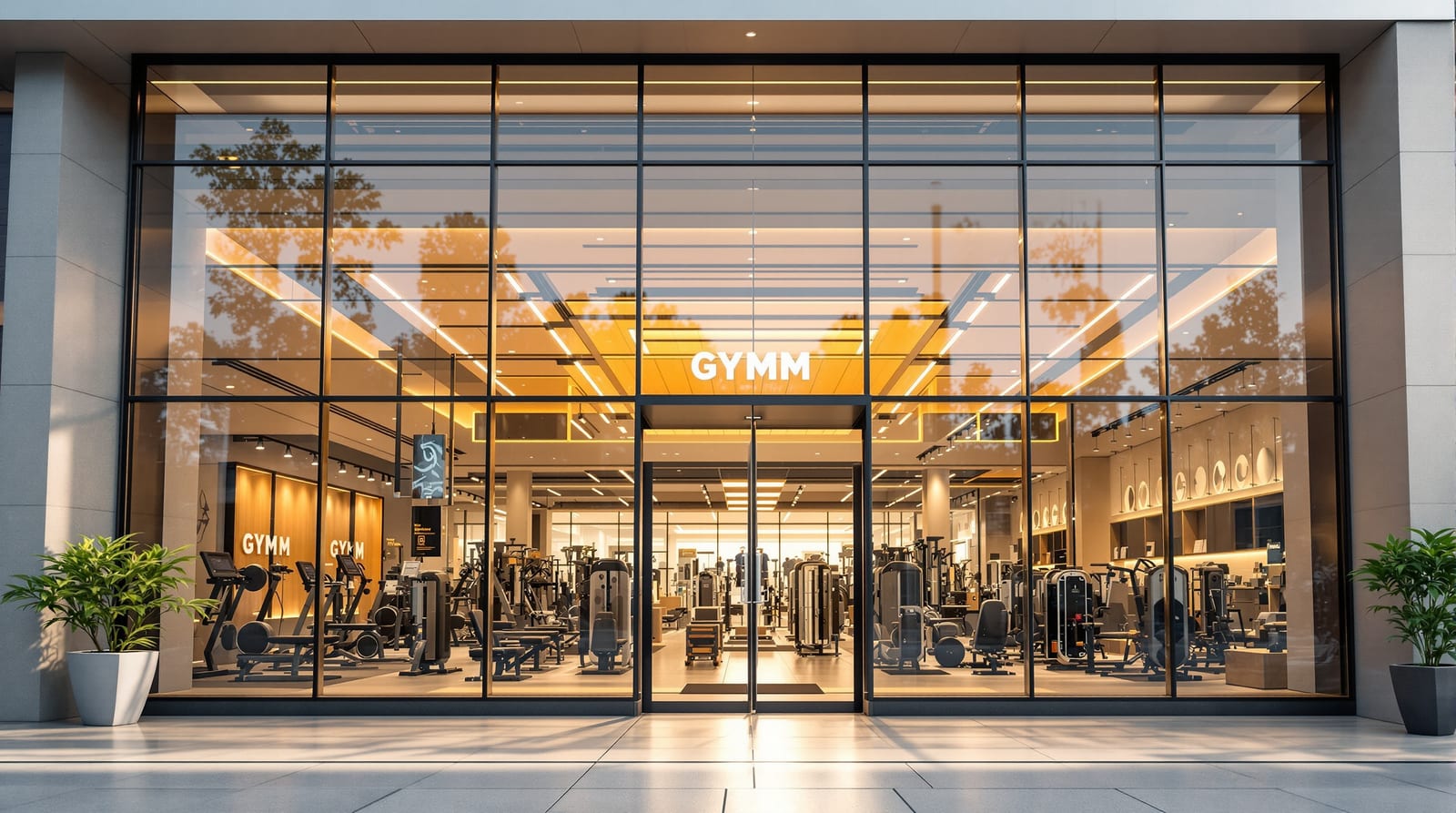
For most gyms the front door is a marketing asset before it is a door. A large frameless glass door, or a full glass-door storefront, turns the cardio line and the kettlebell rack into a moving billboard for anyone walking or driving past, which is why almost every successful boutique studio in India runs a glass front. Premium and high-traffic clubs go a step further with an automatic sliding glass door for hands-free, accessible, always-clean entry.
The catch is that this same door has to be locked to non-members and openable 24x7 to members. That is solved not at the leaf but with door access control - an electric strike or maglock on the glass door wired to an app, RFID/NFC reader or biometric, so a member can tap in at any hour with no staff present. This is the membership model made physical: the door is the turnstile. Pair the reader with a keyless entry system and a video door system so off-site staff can verify and buzz in trial visitors or deliveries.
Glass entrance doors run on patch fittings and a floor spring; spec them at glass door cost benchmarks of roughly 25,000 to 80,000 per door, more for automatic sliding. Make the clear opening at least 1000 mm, fit a door closer or floor spring tuned so the heavy leaf does not slam, and keep a manual override on any maglock so the door fails safe and opens in a power cut or fire.
The acoustic studio door - the complaint that closes gyms
This is the opening operators most often get wrong, and it is the one that generates the angry phone calls, RWA notices and, in the worst cases, closure orders. A spin, HIIT or Zumba studio runs music at 95-100 dB plus dropped weights and shouted cues. In an Indian mixed-use building - a gym on the ground floor with flats or offices above and beside - that energy leaks straight through an ordinary door into someone else's home. The door is usually the weakest link in an otherwise treated room.
The fix is a proper soundproof door: a heavy solid-core or purpose-built acoustic leaf with a full perimeter compression seal kit and an automatic drop-down bottom seal, specified as an assembly with a stated STC rating. Aim for STC 40-45 for a studio sharing walls inside the gym, and STC 50+ - which in practice means a double-door airlock, two sealed leaves with a small dead-air vestibule between them - for a studio directly under or beside a residence. The airlock costs more and eats floor space, but for a top-floor or basement studio it is the difference between staying open and being shut down.
The wet zones - lockers, showers and steam
The locker and shower block is a humid, sweaty, chemically cleaned environment where a timber door simply will not last. Use moisture-immune materials: a WPC door or FRP door for changing rooms and toilet cubicles, and a PVC door for low-cost shower-stall situations. All resist water, sweat and disinfectant, do not rot or swell, and wipe clean. Fit lever handles (easier with wet hands and code-friendly) and stainless or coated hardware that will not rust.
The steam or sauna room is a special case. Use a toughened-glass door with a heat-rated frame and gasket, hung to swing outward, with a simple push-to-open and no latching lock - anyone inside must be able to get out instantly even if they feel faint in the heat. Never put a keyed lock on a steam door.
Equipment clearance and service openings
Gyms forget that machines have to get in. A multi-station rig, a leg-press or a row of treadmills will not fit through a standard 900 mm leaf. Keep at least one service or delivery route with a clear opening of 1500 mm or more - a wide double door or, for a basement or service yard, a rolling shutter. Internal floor doors between zones should be at least 1000 mm and ideally fitted with a vision panel and a kick plate, because they take constant heavy traffic. Use the doors-by-space guide to coordinate widths across the whole fit-out.
Fire exits and egress - non-negotiable
A gym is an assembly occupancy under NBC 2016, which means real egress discipline. Provide fire-exit doors with panic push bars on every designated exit, hung to swing outward in the direction of escape, fitted with self-closers, and fire-rated to IS 3614 (typically 60-90 minutes) where they open onto a stairwell or fire compartment. Exit widths follow the occupancy load, so a busy 200-member floor needs wider or multiple exits than a small boutique studio - get this signed off against emergency-exit standards at design stage, not after a notice from the fire department. Critically, any access-controlled entrance must fail safe: in a power cut or alarm, the maglock releases and the door opens freely from inside without a tap, a fob or a key.
Do and do not
Do treat the entrance as an access-control system, not just a glass door, and make it fail safe. Do specify studio doors as rated acoustic assemblies with seals, and build an airlock for any studio under or beside a residence. Do use WPC, FRP or PVC in every wet zone and stainless hardware throughout. Do keep at least one 1500 mm-plus route for moving equipment. Do put panic bars and outward swing on every fire exit.
Do not hang one generic flush door everywhere. Do not put a timber door in a shower or steam room. Do not let an access-controlled door lock people in during a fire. Do not skimp on the studio door and assume wall panels will save you - the door is the leak. Do not block or narrow a fire exit with equipment or a heavy un-panic-barred leaf.
Matching the doors to your specific gym
A 24/7 boutique cycling studio, a full-service chain club and a hotel fitness room all weight these six demands differently. A top-floor spin studio lives or dies on the acoustic airlock; a ground-floor strip-mall gym lives on the glass frontage and footfall; a basement gym lives on egress and equipment access. Run your layout through the acoustic door selector tool to size the studio doors, and use the doors-by-space guide to coordinate the entrance, studio, wet zones and fire exits into one coherent door schedule.
Frequently asked questions
What door should a 24x7 gym use at the entrance?
A large toughened or frameless glass door - or an automatic sliding glass door for premium clubs - fitted with access control such as an app, RFID fob or biometric reader on an electric strike or maglock. This lets members in at any hour with no staff present, while keeping non-members out. Make sure the lock fails safe so the door always opens from inside in a power cut or fire.
How do I stop my spin studio's music disturbing the neighbours?
Treat the studio door as the weak link, because it usually is. Fit a rated soundproof door - a heavy acoustic leaf with full perimeter and drop-down bottom seals - at STC 40-45, and step up to a double-door airlock (STC 50+) for any studio directly under or beside a flat or office. This neighbour-noise complaint is the single most common reason mixed-use gyms get notices, so do not economise here.
What does a gym door cost in India?
It depends entirely on the zone. Wet-zone WPC, FRP or PVC doors run roughly 4,000-18,000 each; internal floor doors 12,000-35,000; a glass frontage entrance 25,000-80,000 (automatic sliding 1,50,000+); an acoustic studio door 25,000-90,000, more for an airlock; and a fire-rated panic-bar exit 18,000-45,000. All figures are indicative for 2026, vary by size, spec and city, and exclude 18% GST.
Which doors do fitness centres need for fire safety?
Every designated exit needs a fire-exit door with a panic push bar, outward swing in the direction of escape, and a self-closer; doors onto stairwells or fire compartments must be fire-rated to IS 3614. A gym is an assembly occupancy under NBC 2016, so exit width is set by member load - confirm it against emergency-exit standards and ensure any access-controlled entrance releases automatically on alarm.
What doors work best in gym locker rooms and shower areas?
Moisture-immune materials. Use WPC or FRP doors for changing rooms and cubicles and PVC for shower stalls - all resist water, sweat and daily disinfectant cleaning without rotting or swelling. Fit lever handles and stainless or coated hardware. For steam rooms, use a toughened-glass door that swings outward with no latching lock, so anyone inside can leave instantly.
Export this guide
Related Guides — Deep-dive reading
Soundproof Doors in India: How Doors Leak Sound, STC Ratings, Seals & Real Costs
A door is the weakest acoustic link in any wall - and it usually leaks through the gaps, not the panel - so here is how to actually quieten a bedroom, home theatre or street-facing room, from a 1,500-rupee seal kit to a proper acoustic door.
Home Doors & EntrancesFire Exit Doors in India: NBC 2016 Egress, Panic Bars & Costs (2026)
How fire exit and emergency egress doors must be sized, swung, hardware-fitted and signed to NBC 2016 Part 4 in Indian buildings, and what they cost.
Home Doors & EntrancesRecording Studio Door in India: Sound-Lock Airlock, STC/Rw Ratings and Costs (2026)
The highest acoustic-isolation door in any building - a very heavy lead-loaded or solid acoustic leaf with full perimeter gaskets, an automatic drop seal, a multi-pane vision window and, for true isolation, the double-door sound-lock with a dead-air vestibule.
Home Doors & EntrancesRelated Tools — Try Free
Acoustic Privacy (STC) Visualizer
Indian healthcare acoustic visualizer — compare wall assemblies and noise sources, see received SPL after STC attenuation, and check FGI 2018 / IS 1950 / NABH speech-privacy compliance with live dual-canvas waveform.
Acoustic ToolFire Door Rating Checker
See the likely fire-door rating (30/60/90/120 min) and components a location needs per IS 3614 / NBC — guidance, confirm with your architect.
Compliance ToolAcoustic Door Selector
Get the STC rating and door build you need for a quiet space — home theatre, studio, boardroom or hotel room.
Door Tool