
Folding Doors in India: Accordion & Concertina Partitions (2026 Guide)
How slim-slat folding and accordion doors work as space-saving partitions in Indian flats — materials, tracks, ₹ cost per sq ft and where they beat bi-fold.
A folding door is the most compact closure you can buy: dozens of slim slats hinged edge-to-edge that concertina sideways and stack against the jamb, taking almost no floor space. In an Indian flat where every square foot is fought over — a pooja corner that needs hiding, a balcony you want enclosed in monsoon, a hall that doubles as a dining room — the folding (accordion, concertina) door earns its keep precisely because it disappears when open. But it is a partition, not a security door, and the cheap PVC versions have a deserved reputation for sagging. This guide separates the genuinely useful from the flimsy, and clears up the most common confusion in showrooms: folding doors are not the same thing as bi-fold doors.
Folding vs bi-fold: clear up the confusion first
Vendors use "folding" and "bi-fold" loosely, but they are different products for different jobs.
A bi-fold door has 2 to 4 (sometimes 6) substantial leaves — typically aluminium-framed glass, WPC or solid panels — hinged in pairs that fold like a screen and run on a top track. It is a real opening closure: a wide balcony or patio aperture, or a hall-to-balcony wall. Each panel is heavy, the hardware is engineered, and it can be glazed and reasonably weather-sealed. See bi-fold doors in India for that product in full.
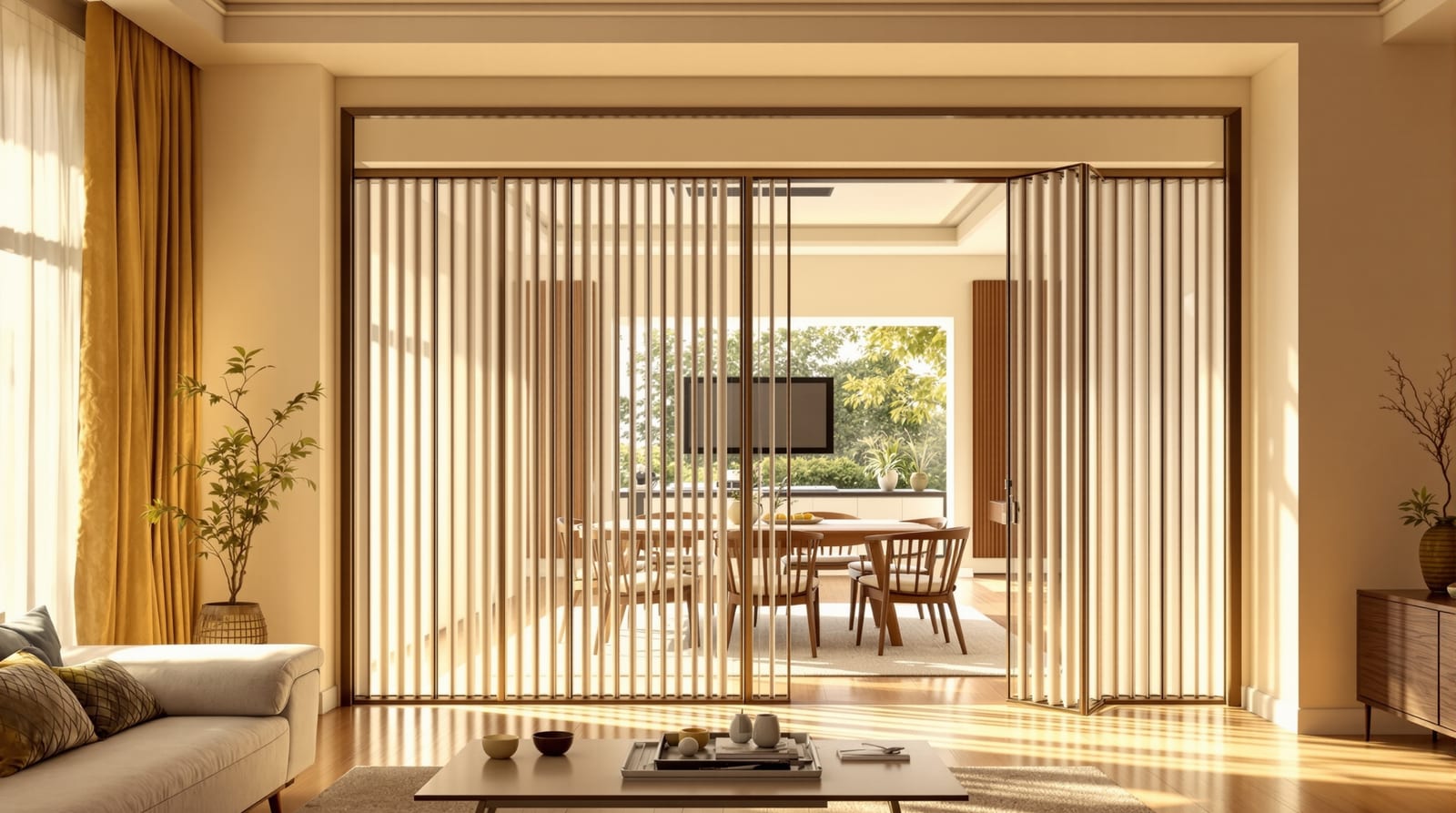
A folding (accordion / concertina) door is made of many slim slats — often 80-150 mm wide each — of PVC, thin aluminium or wooden lath, linked by continuous hinges or a fabric/vinyl web. It collapses to a very thin stack and is light enough to slide with one finger. It is a partition and visual screen, not a structural or security closure. Think of it as a soft wall you can pull across, not a door you would put on your flat's entrance.
If you want to enclose a wide opening with glass and decent sealing, you want bi-fold or sliding doors. If you want to cheaply and reversibly divide a room or hide a corner, the folding/accordion door is the right tool. For the full menu of options see types of doors in India.
Where folding doors actually work in Indian homes
- Pooja room screen. A folding door (often a decorative wooden-lath or jali-style panel) closes off a pooja niche or alcove cleanly, and tucks away during aarti. Pair it with a proper threshold and inward open if you follow Vastu; the dedicated pooja room door guide covers the ritual considerations.
- Balcony enclosure. PVC or aluminium folding doors are a budget way to shut a balcony against monsoon spray, dust and pigeons while staying openable. They are not airtight or cyclone-rated — for a sealed enclosure use glazed bi-fold or sliding.
- Hall–dining or living–kitchen partition. A full-height accordion partition lets a joint family open up for functions and close down for daily privacy, smell or AC zoning.
- Bathroom / utility / store in tight flats. Where a swinging leaf would foul a washing machine or a WC, a folding door uses zero swing clearance. FRP or PVC suits wet zones.
- Wardrobe and loft fronts. Slim folding fronts close large wardrobe runs without swing.
Materials: PVC, aluminium and wooden slat
| Material | Typical cost (₹/sq ft, make only)* | Best for | Watch-outs |
|---|---|---|---|
| PVC accordion (hollow slat, vinyl web) | ₹120–350 | Budget bathroom, utility, temporary partition | Sags and warps over years; brittle in sun; light-duty only |
| Aluminium-framed (slat or with acrylic/glass infill) | ₹400–900 | Balcony, living partition, semi-wet zones | Rattles if tracks are cheap; thin sections dent |
| Wooden slat / lath (sheesham, rubberwood, MDF lath) | ₹500–1,200+ | Pooja screen, decorative room divider, period interiors | Heavier — needs good top track; swells in damp unless sealed |
| WPC / composite slat | ₹350–700 | Wet zones, termite/borer-prone homes | Limited slim profiles; fewer vendors |
*Indicative make-only rates; varies by city and vendor. Add ₹800–2,000 fitting per opening, plus track and the standard +18% GST. A full-height living-room PVC accordion partition often lands around ₹6,000–15,000 fitted; a decorative wooden-slat pooja screen ₹8,000–25,000+. For benchmarking against every door type see the door cost guide for India, and for material choice in coastal or wet conditions, best door material.
Track types — this is what makes or breaks a folding door
Almost every folding-door complaint traces back to the track, not the slats.
- Top-hung (top track only). Rollers run in an aluminium top channel; the floor stays clear (no threshold to trip on or trap dirt). Best for partitions and accessibility. Needs a solid lintel/false-ceiling fixing because the whole weight hangs from it.
- Bottom-roller (top guide + bottom track). The weight sits on a floor channel; the top only guides. Steadier for heavy wooden panels but the floor track collects dust and breaks the floor line — bad in pooja and dining spaces.
- Telescopic / multi-fold carrier. Better hardware lets long runs (3–6 m) stack neatly; cheap single-carrier tracks let long runs sag in the middle.
Insist on a smooth aluminium track to IS 733/IS 1285-grade sections with nylon rollers, not bent GI. For top-hung partitions, confirm the ceiling can take a hanging load before you commit.
Accordion fold geometry (plan view)
This plan view shows why the door packs so small: the slim slats alternate fold direction and concertina into a thin stack at the jamb.
The takeaway: a 3 m opening of slim slats stacks into roughly 150–250 mm against the wall, which is why folding doors beat any swinging leaf where floor space is precious.
Durability and the sagging problem
The single biggest weakness of folding doors — especially cheap PVC accordions — is sagging and mis-alignment over time. Long runs droop in the middle, slats develop a permanent set, and rollers wear so the door no longer meets the closing jamb. To avoid it:
- Keep individual panel runs sensible; for openings over ~3 m, use a quality telescopic carrier or split into two stacks.
- Choose top-hung with a rigid lintel fixing over flimsy bottom tracks for partitions.
- Prefer aluminium-framed or wooden-slat over hollow PVC for anything you will use daily for years.
- In direct sun (balconies, west walls), PVC goes brittle and discolours — specify UV-stabilised PVC or go aluminium.
In monsoon and coastal homes, untreated wooden slats swell and bind; seal them and keep them off bottom floor channels that pond water. Termite-prone homes should lean WPC or aluminium, in line with door material comparison.
Soundproofing and privacy: manage expectations
Folding doors are visual and light dividers, not acoustic ones. The continuous hinge lines and edge gaps leak sound; a hollow PVC accordion blocks little more than a curtain. For genuine quiet between a home office and a living room, you need a solid leaf with seals — see soundproof doors in India. Use folding doors where you want flexible separation and a tidy look, not silence. They also do not lock securely — fit a simple slide bolt or magnetic catch for privacy only, never as a security barrier.
Cleaning and maintenance
- PVC / vinyl: wipe with mild soapy water; avoid solvents that dull the surface. Get into the hinge grooves where dust cakes.
- Aluminium: clean tracks regularly — grit in the top channel is the main cause of stiff operation. A drop of dry silicone on rollers restores glide.
- Wooden slat: dust along the grain, re-oil or re-polish yearly in dry climates; keep away from standing water.
- All types: check roller alignment annually and tighten the carrier screws before sag sets in. Most "broken" folding doors only need track cleaning and roller adjustment.
How folding compares to its closest cousins
| Feature | Folding / accordion | Bi-fold | Sliding partition |
|---|---|---|---|
| Construction | Many slim slats (PVC/alu/wood) | 2–4 heavier panels | 1–2 large panels |
| Stacked footprint | Tiny (thin band) | Moderate (panel-thick stack) | Sits on parallel wall |
| Weight per element | Very light | Heavy | Heavy |
| Best use | Partition, screen, wet zones, budget enclosure | Wide glazed openings, balcony walls | Room divider, wardrobe, openings with wall to slide onto |
| Sealing / weather | Poor | Good (glazed, gasketed) | Moderate |
| Soundproofing | Poor | Fair | Fair–good |
| Security | None | Lockable, decent | Lockable, moderate |
| Typical cost band | Lowest | Highest | Middle |
For the heavier options compare bi-fold doors and sliding doors directly.
Buying checklist
1. Decide the job: partition/screen (folding) vs glazed opening (bi-fold/sliding).
2. Pick material to suit the zone — PVC for budget/wet, aluminium for balconies, wooden slat for decorative and pooja.
3. Specify a quality top track and confirm the ceiling/lintel can carry a hanging load.
4. Keep panel runs under ~3 m per stack, or use a telescopic carrier.
5. Confirm UV-stabilised material for any sun-exposed location.
6. Get the rate written as make + track + fitting + GST, and ask what after-sales roller/track adjustment costs.
Frequently asked questions
Are folding doors and bi-fold doors the same thing?
No. Folding (accordion/concertina) doors are many slim PVC, aluminium or wooden slats that collapse to a thin stack — a lightweight partition. Bi-fold doors have 2–4 heavier glazed or panel leaves for closing real openings. See the bi-fold doors guide for the heavier product.
Do folding doors provide privacy and soundproofing?
They give visual privacy and light separation but very little sound blocking — the hinge lines and edges leak noise. They also do not lock securely. For real quiet, use a soundproof door instead.
How much do folding doors cost in India?
Make-only rates run roughly ₹120–350/sq ft for PVC, ₹400–900 for aluminium and ₹500–1,200+ for wooden slat, plus track, ₹800–2,000 fitting and 18% GST — indicative and varying by city. Benchmark against the door cost guide.
Will a PVC folding door sag over time?
Cheap hollow PVC accordions are prone to sagging, especially on long runs and in sun. Reduce the risk with a rigid top-hung track, panel runs under ~3 m, UV-stabilised PVC, or by stepping up to aluminium or wooden slat.
Are folding doors good for a pooja room?
Yes — a decorative wooden-lath or jali folding screen hides a pooja niche cleanly and tucks away during aarti, using no swing space. Follow the ritual and Vastu pointers in the pooja room door guide.
Export this guide
Related Guides — Deep-dive reading
Partition Doors in India: Sliding, Folding & Glass Room Dividers That Open Up or Close Off Space
How to use partition doors — sliding, folding/accordion, bi-fold, fixed glass with a door, Crittall-style framed glass and barn-door partitions — to split or join living-dining, a WFH nook, kitchen or one room into two, with privacy, acoustic limits and real ₹/sq ft.
Home Doors & EntrancesStacking Sliding Doors for Indian Homes: Multi-Panel Open-Wall Guide (2026)
How 3-6 panel stacking sliders create a near-full open wall to your balcony or garden, the multi-track aluminium systems, weight and glass limits, weather seals, costs, and how they compare to bi-folds.
Home Doors & EntrancesDining Room Door in India: Best Partition & Opening Choices (2026)
How to choose the right door for the dining area of an Indian home - kitchen-dining partitions that trap cooking smells and smoke while keeping flow, plus open dining-to-living and dining-to-garden options - ranked picks, drivers and indicative costs.
Home Doors & EntrancesRelated Tools — Try Free
Acoustic Privacy (STC) Visualizer
Indian healthcare acoustic visualizer — compare wall assemblies and noise sources, see received SPL after STC attenuation, and check FGI 2018 / IS 1950 / NABH speech-privacy compliance with live dual-canvas waveform.
Acoustic ToolDoor Material Comparison Tool
Compare 2–4 door materials on cost, durability, maintenance, security and moisture resistance.
Comparison ToolFalse Ceiling Cost Estimator
Live ₹/sqft across 8 ceiling types — POP, gypsum, designer, metal, PVC, wooden — with cove and spot lighting for 20 Indian cities.
Cost Calculator