
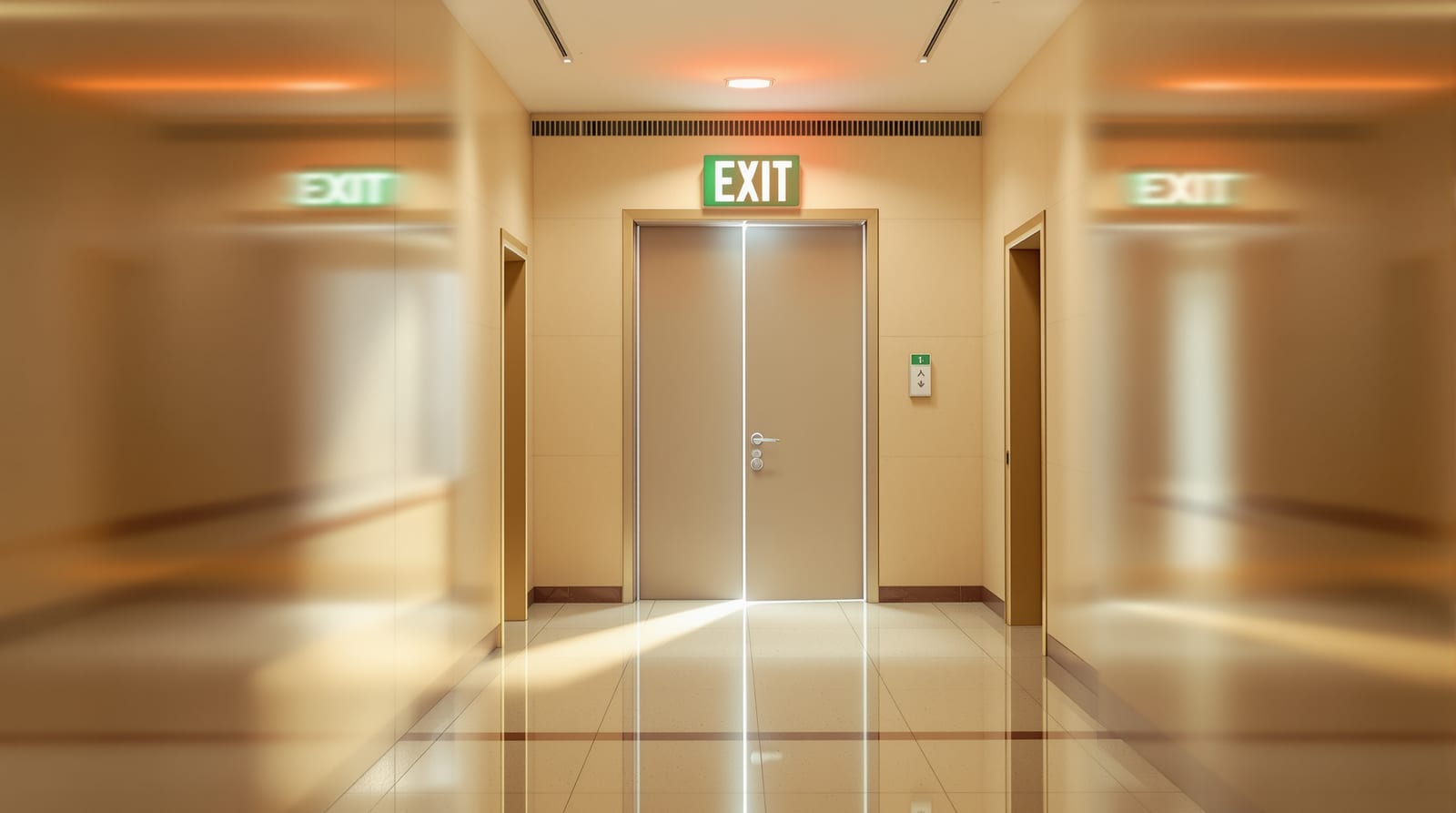
Emergency Exit Door Standards in India: NBC 2016 Egress Rules
How exit door width, swing direction, panic hardware, fire rating and signage are governed by NBC 2016 Part 4 — and where homes differ from assembly and commercial buildings.
An emergency exit door is the one door in a building that must perform flawlessly on the worst day — when the lights are out, the corridor is smoke-logged, and a crowd is pushing toward it. India's rules for that door live in the National Building Code (NBC) 2016, primarily Part 4 (Fire and Life Safety), supported by Part 3 for widths and exit access. Unlike a bedroom or main door, an exit door is not chosen for looks; every dimension, the direction it swings, the hardware on it and the sign above it are dictated by how many people must escape through it and how fast. This guide unpacks those egress rules for Indian buildings — and shows clearly where a single-family home is treated very differently from an assembly hall, school, hospital or commercial floor.
This is the standards-and-egress companion to our broader door-safety guides. For the door construction itself see fire-rated doors in India; for the specific staircase and corridor exit door see fire exit doors in India; for the full NBC dimensional picture see NBC door requirements in India.
What counts as an "exit" under NBC 2016
NBC 2016 Part 4 defines a means of egress as a continuous, unobstructed path from any point in a building to a safe place outside, made of three linked parts: the exit access (the route to the exit — corridors, the room door), the exit itself (a protected element such as an enclosed stairway, a horizontal exit, or a door directly to the outside), and the exit discharge (from the exit to a public way or open safe area). An emergency exit door is the engineered boundary between these parts. It must stay usable under fire conditions, which is why the Code constrains its width, swing, hardware, fire resistance and identification all at once — a wide door that locks from inside, or a fire door that swings the wrong way, fails the system even if each component looks compliant.
Crucially, the Code scales requirements by occupancy classification (Group A residential, C institutional, D assembly, E business, F mercantile, and so on) and by occupant load. A 1,000 mm exit door is a starting minimum; the real width is whatever the calculated occupant load demands.
Exit door width and how it scales with occupant load
The headline number people remember is the 1000 mm minimum clear width for an exit doorway in most non-residential buildings under NBC 2016. But that is a floor, not the answer. The actual required width is derived from the occupant load of the area the door serves, divided into unit exit widths.
NBC works on the principle that escape capacity is proportional to door and stair width. Occupant load is calculated from area per person factors (for example, denser figures for assembly seating, more generous figures for offices and residences), and the total occupants are then distributed across the available exits. Each exit must carry its share without exceeding the persons-per-unit-width the Code permits for doors versus stairways (stairs, being slower, carry fewer persons per unit width than level doorways). If the maths demands more width than the doors provide, you add doors or widen them — and a single leaf cannot exceed practical limits, so high loads force double-leaf or multiple exits.
Two design rules follow directly:
- No single exit serves an unlimited crowd. Beyond a threshold occupant load, NBC requires multiple, remote exits so that one blocked door does not trap everyone.
- The narrowest point governs. A 1200 mm door reduced to 900 mm clear by a slow-acting closer, a coat hook, or a door that only opens to 80 degrees has the egress capacity of 900 mm, not 1200 mm. Clear opening width is measured leaf-open, edge of leaf to stop.
Swing direction: exit doors open outward, in the direction of travel
For any door serving a significant occupant load, NBC 2016 Part 4 requires the door to swing outward in the direction of egress travel — that is, in the direction people are escaping. The reasoning is grim but simple: under panic, a crowd surges toward the exit and presses against the leaf. An inward-opening door cannot be pulled open against that pressure, and people have died crushed behind doors that opened the wrong way. Outward swing lets the crowd's own movement push the door open.
A second rule protects the path: the door, when fully open, must not reduce the required width of the landing, corridor or stairway by more than a permitted small amount, and must not project into the path of egress in a way that obstructs it. This is why exit doors at stair landings are detailed carefully — the open leaf must tuck against a wall, not block the descending crowd.
Single-family residential doors are the major exception. A home's front or back door may open inward (and almost always does in India, partly for Vastu reasons — see Vastu main door direction in India), because the occupant load is tiny and there is no crowd-crush risk. Outward swing becomes mandatory once you move into assembly, institutional and larger commercial occupancies.
Egress door anatomy
Panic and fire-exit hardware: it must open with a push
For exit doors serving assembly and high-occupancy spaces, NBC requires panic exit hardware — the horizontal push-bar (also called a crash bar or touch bar) that releases the latch when anyone pushes on it anywhere along its length. The design intent is that a person who cannot see, cannot read a sign, or is being shoved from behind can still get out by simply leaning into the door. Look for hardware tested to recognised panic/emergency exit device standards (the European EN 1125 panic device and EN 179 emergency exit device norms are widely specified in India by branded suppliers such as Dorset, Ozone, Godrey-distributed lines, Hafele and Hettich; ask the vendor for the test certificate).
Two hard prohibitions follow:
- No lock or fastening that needs a key, special knowledge, tool or effort to open from the egress side. You may secure an exit door against entry from outside, but from inside it must always release with a single motion. Padlocked, chained or keyed-shut fire exits are the single most common — and most lethal — violation found in Indian fire audits of pubs, banquet halls, coaching centres and factories.
- Single-action release. One operation, not "turn the knob then slide the bolt then lift the latch." Multiple manipulations are not permitted on a required exit.
For electrically controlled access doors on the egress path (common in offices and gated communities — see door access control in India), the system must fail-safe: power failure or fire-alarm activation must release the lock so the door becomes free-exiting. A maglock that stays locked when the power trips is non-compliant on an exit.
Self-closing, latching and fire rating
Where an exit door is part of a fire-rated assembly — typically the door into an enclosed staircase, a horizontal exit, or a fire compartment boundary — NBC and IS 3614 (Parts 1 and 2, fire-check doors) require it to be self-closing and self-latching so that it returns to the closed, latched position after every use and actually holds back fire and smoke. A fire door wedged open with a brick (another routine site sin) is just a hole in the compartment wall.
Fire-resistance ratings are specified by location and building risk, commonly 30, 60, 90 or 120 minutes, with the staircase enclosure and shaft doors usually demanding the higher ratings. The closer should be a tested device (IS 3564 for door closers) sized for the leaf, and the latch must engage automatically. Hold-open is permitted only with fail-safe electromagnetic hold-open devices linked to the fire-alarm system, which release the door on alarm. The deep construction detail — cores, intumescent seals, vision panels, certification — sits in our fire-rated doors in India guide.
Illuminated EXIT signage and lighting
An exit you cannot find is no exit. NBC 2016 requires clearly visible, illuminated EXIT signs at every exit and along the egress path, positioned so that from any point a person can see the way out or a directional sign pointing to it. The signage must remain lit (or be self-luminous / battery-backed) during a power failure, and the egress route needs emergency lighting that comes on automatically when normal power fails. Where the path bends or branches, directional arrows are required so the route is unambiguous in smoke. Many Indian buildings now use photoluminescent (glow-in-the-dark) signage and low-level path markings as a backup, which is good practice though the powered, maintained EXIT sign remains the primary requirement.
Number of exits, remoteness and travel distance
A compliant exit door is useless if it is the only one and the fire is in front of it. NBC 2016 therefore mandates:
- A minimum of two exits for most occupancies above small thresholds, increasing with occupant load and floor area, so there is always an alternative if one is blocked by fire.
- Remoteness — required exits must be placed remote from each other (a common rule of thumb is separated by at least about half the diagonal of the area served) so a single fire cannot compromise both at once. Exits should be independent, not funnelling into a single choke point.
- Travel distance — the maximum distance an occupant may have to travel from any point to reach an exit is capped, with shorter limits for higher-hazard and unsprinklered buildings and longer permitted distances where automatic sprinklers are installed. Dead-end corridors (where you can walk away from the only exit) are tightly limited.
These are why exit doors cannot simply be added to an existing wall wherever convenient — their placement is a planning decision made at layout stage, ideally checked with our door swing planner for swing clearance and the project architect for occupant-load maths.
Residential vs assembly and commercial: the key differences
| Parameter | NBC requirement — single-family home (Group A) | NBC requirement — assembly / institutional / large commercial |
|---|---|---|
| Exit door minimum clear width | Main door typically 1000–1200 mm leaf (functional, not capacity-driven) | ≥1000 mm minimum, then scaled up by occupant load and unit exit widths |
| Swing direction | May open inward (low occupant load; Vastu-common) | Must open outward in the direction of egress travel |
| Panic / push hardware | Not required; normal lockset | Panic exit device (push bar) required for assembly/high occupancy |
| Lock that needs a key from inside | Allowed (a home, low risk) | Prohibited — must release with a single push/motion from inside |
| Self-closing + fire rating | Generally not required on the entrance | Required on fire-compartment / stair-enclosure doors (IS 3614; 30–120 min) |
| Illuminated EXIT signage | Not required | Required, with battery/self-powered backup + emergency lighting |
| Number of exits | One adequate egress acceptable for a dwelling | Minimum two, remote and independent; more as load rises |
| Travel distance limits | Light-touch | Capped; shorter for higher hazard / no sprinklers |
| Governing references | NBC 2016 Part 3 (widths) | NBC 2016 Part 4 (fire & life safety) + Part 3 |
The practical takeaway for homeowners: your house door rules are gentle, but the moment a property becomes a commercial setting — a homestay above a defined occupancy, a clinic, a coaching class, a shop, a banquet space, a co-working floor — the assembly/commercial column applies, and retrofitting outward-swing fire exits with panic bars after the fact is expensive and disruptive. Build it in at design stage.
Standards note: NBC 2016 is a recommendatory code adopted with variations through state and municipal building bye-laws and fire-service NOC requirements, and figures above are indicative and vary by occupancy, city and edition. Always confirm the exact occupant-load factors, unit-exit-width values, travel-distance limits and fire ratings for your specific occupancy with the current NBC text, the local fire department, and a licensed fire/structural consultant before construction or a fire NOC submission.
For the dimensional baseline see door width standards in India and NBC door requirements in India; for accessible thresholds on the same path see door threshold standards in India and wheelchair accessible doors in India. The companion construction guides are fire exit doors in India and fire-rated doors in India.
Frequently asked questions
Does my single-family home need an emergency exit door with a panic bar?
No. A normal dwelling is a low-occupancy residential occupancy; its entrance and rear doors can open inward and use ordinary locksets. Panic hardware, outward swing and EXIT signage are triggered when you move into assembly, institutional or larger commercial occupancies — including a home converted to a clinic, coaching class, shop or commercial homestay.
What is the minimum width of an emergency exit door under NBC 2016?
The minimum clear width for an exit doorway in most non-residential buildings is 1000 mm, but that is a floor. The actual required width is calculated from the occupant load divided into unit exit widths, so high-occupancy spaces need wider or additional doors. Always size from occupant load, not from the minimum.
Why must exit doors open outward?
Because under panic a crowd presses toward the exit, and an inward-opening door cannot be pulled open against that pressure — people get crushed against it. Outward swing in the direction of travel lets the crowd's movement push the door open. The open leaf must also not block the required corridor, landing or stair width.
Can a fire exit ever be locked?
You may secure it against entry from outside, but from the inside (egress side) it must always release with a single push or motion, with no key, tool or special knowledge needed. Chaining, padlocking or key-locking a fire exit shut is illegal and is the most common cause of mass-casualty incidents in Indian fire audits.
Which codes govern emergency exit doors in India?
Primarily NBC 2016 Part 4 (Fire and Life Safety) for exits, panic hardware, signage, number of exits and travel distance, with Part 3 for widths and exit access. Fire-check door construction follows IS 3614 (Parts 1 and 2) and door closers IS 3564. These are adopted with variations through state and municipal building bye-laws and fire-NOC rules.
Export this guide
Related Guides — Deep-dive reading
Emergency Exit Planning in India (2026): Number of Exits, Travel Distance & Two-Way Escape
The building-scale means of egress that a home escape plan sits inside: why you need two independent, remote exits, how travel distance and exit width scale with occupant load, and why exits must open outward, discharge to safety, and never be locked.
SecurityStaircase Fire Safety in India (2026): The Protected Stair That Gets Everyone Down
The staircase is the primary vertical escape route in almost every Indian building, so a protected, smoke-free stair is the spine of egress: enclosed, fire-doored, non-combustible, and above all kept clear.
SecurityFire Exit Doors in India: NBC 2016 Egress, Panic Bars & Costs (2026)
How fire exit and emergency egress doors must be sized, swung, hardware-fitted and signed to NBC 2016 Part 4 in Indian buildings, and what they cost.
Home Doors & EntrancesRelated Tools — Try Free
Emergency-Egress Checker
A life-safety self-check that access-controlled doors on escape routes still let people out in an emergency.
Egress CheckAccessible Door Checker
Check a door against wheelchair-accessibility guidance — clear width, threshold, handle and closer force per RPwD 2021.
Compliance ToolDoor Access-Level Planner
Plan who can open which doors — an access matrix by role and zone, following least privilege.
Access Matrix