
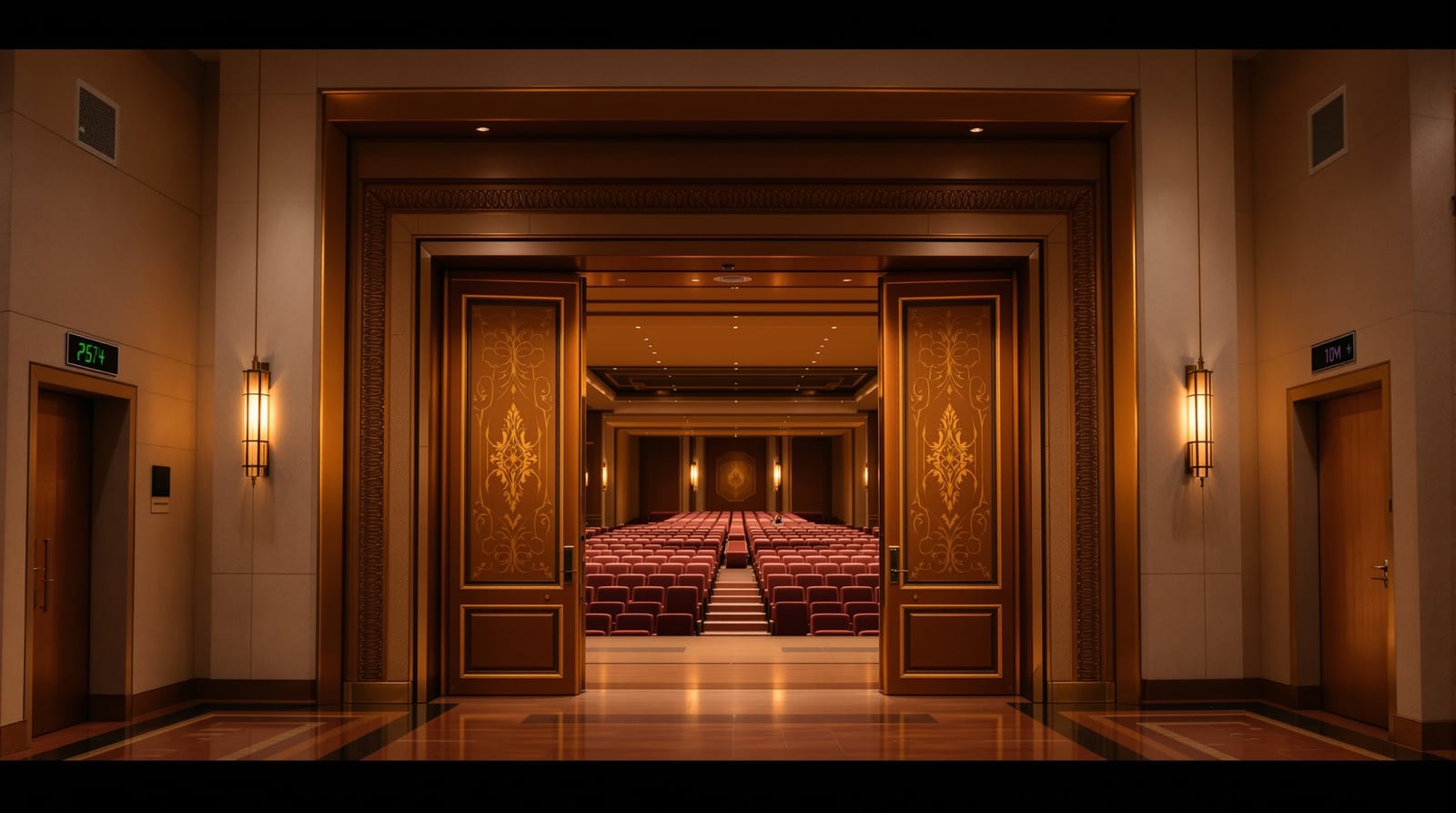
Auditorium Door in India: Acoustic Sound-Locks, Panic Exits and NBC Egress (2026)
Specifying doors for auditoriums, theatres and banquet halls - heavy STC 45-55 acoustic doors and sound-lock vestibules, outward-swing panic exits sized for huge crowds under NBC public-assembly rules, light-tight seals and divisible-hall operable partitions.
An auditorium door has to do two things that pull in opposite directions, and it has to do both perfectly. It must seal an entire hall acoustically - keeping the show's amplified sound and bass inside while shutting out lobby chatter, traffic and the clatter of the foyer bar - and at the same time it must be capable of releasing a packed house of several hundred to a few thousand people onto the street in seconds during a fire or panic. Get the acoustics wrong and every performance is compromised. Get the egress wrong and the consequence is not a refund - it is a coroner's inquiry. India has learned this the hard way: the assembly-occupancy fire and egress rules in the National Building Code exist because of real auditorium and cinema tragedies.
This is a professional specification guide for doors in auditoriums, theatres, cinemas, multipurpose halls and banquet halls. We will work zone by zone - audience entry, fire exits, projection and AV rooms, stage and back-of-house, and divisible banquet partitions - and for each we will set the real drivers: acoustic isolation in both directions and the sound-lock airlock that delivers it, NBC public-assembly egress and panic hardware (the legal core), light sealing for dark shows, divisible-hall partitions and accessibility. Costs are per door, indicative for 2026, plus 18% GST.
The two jobs, and why they need different doors
A common mistake is to treat every door in an auditorium the same. They are not. The acoustic doors at the audience entry and the panic fire exits are almost opposite specifications:
- The audience-entry door is about keeping sound in and light out. It is heavy, sealed, normally part of a two-door sound-lock vestibule, and used in a controlled way before and after shows. It can be slow and deliberate.
- The fire-exit door is about getting people OUT instantly. It swings outward in the direction of escape, is fitted with panic (crash-bar) hardware that opens under a single shove from a crowd, and is sized to the occupancy load. It is the legal heart of the building.
Many doors must be both - a sealed acoustic door that is also a panic-hardware fire exit - and that combination drives both cost and detailing. Keep the two jobs explicit when you write the door schedule; do not let the acoustic consultant and the fire consultant work in separate silos. For the underlying door types referenced throughout, lean on our soundproof doors guide, fire-exit doors guide and the doors-by-space guide.
Acoustic isolation: sealing the hall in both directions
Auditorium acoustics are bidirectional, and that is what makes the doors hard. You are containing the hall's own amplified programme - speech reinforcement, music, sub-bass for film - so it does not bleed into adjoining halls, foyers, offices or neighbours. And you are simultaneously blocking lobby and street noise from leaking into a quiet passage during a play or a recital. A single under-specified door undoes the wall around it.
Isolation comes from three things, and an ordinary door fails all three: mass (a hollow leaf is acoustically transparent, so you need a dense solid-core or purpose-built acoustic leaf), perimeter seals (head, jamb and meeting-stile compression gaskets), and the bottom edge (an automatic drop-down seal that lands on the floor only when the door is shut). Specify the whole door-frame-seal assembly to a stated STC, never the leaf alone - a lab-rated STC 50 door fitted into a sloppy frame with gaps delivers a fraction of its number.
Target STC by zone: a single sealed acoustic door reaches roughly STC 38-45; a sound-lock vestibule - two sealed doors with a small dead-air lobby between them - reaches STC 50-55 and is the standard for the main hall. For an auditorium that shares a wall with another hall, an office or a residential neighbour, the sound-lock is not optional.
The sound-lock vestibule and panic exit - illustrated
Egress and panic hardware: the legal core
This is the part you cannot value-engineer. Under the National Building Code 2016, an auditorium is an assembly occupancy (Group D), and assembly egress is the strictest residential-to-commercial spectrum there is, precisely because the rooms hold the largest crowds. The non-negotiables for exit doors serving the audience:
- Doors open in the direction of egress - outward, toward the escape route - so a panicking crowd pressing against them forces them open rather than jamming them shut. An inward-opening exit on a packed hall is a death trap and is non-compliant.
- Panic (crash) bar hardware on every assembly exit: a horizontal bar across the inside face that releases the latch under pressure from a body. No knob, no key, no thumb-turn that a crowd cannot find in the dark.
- No locks that trap occupants. Exit doors must be openable from the inside at all times without a key, special knowledge or effort, whenever the building is occupied. Chaining or padlocking assembly exits during a show is illegal and is the single most common cause of mass-casualty fires.
- Exit width sized to the occupancy load. The total clear width of exits is calculated from the number of people the hall holds (unit exit width per person), so a 1,000-seat auditorium needs far more exit-door width than a 200-seat hall. Distribute exits so no single door carries the whole crowd, and so travel distance to the nearest exit stays within limits.
- Fire rating where the exit is also a fire-compartment or stairwell door - typically a 60 or 120-minute fire door to IS 3614, self-closing, often combined with the panic hardware.
Treat NBC assembly egress and the local fire NOC as the design driver, not an afterthought. Our emergency exit door standards guide and NBC door requirements guide set out the width, swing and hardware rules in detail; bring the fire officer in early.
Light-locking: no leak during the show
A theatre, cinema or performance auditorium runs dark, and a sliver of foyer light around a door edge - or a glow under the bottom - is instantly visible to a full house and ruins the stage picture or screen contrast. The good news is that the same compression gaskets and automatic drop-down bottom seal that stop sound also stop light, so the acoustic door and the light-lock are one and the same when detailed properly. Confirm the seals are continuous around all corners, that the door face and surrounds are dark and matte (never glossy white that bounces follow-spot or projector spill), and that the sound-lock vestibule itself is the primary light trap - a patron entering mid-show passes through the outer door, the lobby light is contained, then the inner door, so the hall never sees the foyer. Avoid clear vision panels on hall doors; where a small viewer is needed for ushers, use a sealed, baffled or shuttered one.
Recommended doors by zone
Rank each zone by its dominant driver. The audience entry is acoustics plus light; the exits are egress and life safety; the AV room is acoustics again; partitions are flexibility.
| Zone | Recommended door | Why | Indicative cost per door (incl. frame, seals, hardware, fitting) |
|---|---|---|---|
| Main audience entry | Sound-lock vestibule: two heavy solid-core / purpose-built acoustic doors with full seal kits + auto drop seals, dark matte face | STC 50-55 in both directions; light-tight airlock; controlled patron flow | 90,000 - 3,00,000+ for the pair and vestibule works |
| Audience fire / panic exit | Outward-swing single or double leaf with panic crash-bar hardware, sized to occupancy; fire-rated (IS 3614) where it is also a compartment door | NBC assembly egress - the legal core; releases a crowd under a single push | 25,000 - 80,000+ per leaf by rating, size and hardware |
| Combined acoustic + panic exit | Heavy acoustic leaf with rebated meeting stiles, full seals AND fire/panic hardware, outward swing | Where an exit must also seal sound and light - both jobs in one door | 60,000 - 1,50,000+ per leaf |
| Projection / AV / control room | Sealed acoustic door (often STC 40-45) to keep projector and equipment fan noise out of the hall and hall sound out of the booth | Quiet control environment; protects mix and monitoring | 30,000 - 90,000 |
| Stage / back-of-house & scene dock | Wide acoustic-rated leaf or pair, robust, often 1,200 mm+ for scenery and equipment; fire-rated to stage compartment | Heavy traffic, large props, fire separation between stage and house | 40,000 - 1,20,000+ |
| Divisible banquet / multipurpose hall | Operable acoustic folding / sliding partition (movable wall) with seals, STC 45-52 | Splits one large hall into smaller bookable rooms with acoustic privacy | 12,000 - 30,000+ per running metre of partition |
| Accessible entry | One sealed acoustic leaf detailed for access: >=900 mm clear width, lever handle, threshold <=12 mm, manageable closer force | RPwD 2021 accessibility into the hall | within entry-door cost above |
Costs are indicative for 2026 and vary by size, core, STC target, hardware, brand and city; add 18% GST. A purpose-built acoustic leaf is heavier and thicker (often 54-70 mm) than a normal 35 mm door, so frames, hinges (four or more, ball-bearing) and the closer must all be upsized.
Divisible halls: operable acoustic partitions
Banquet halls, convention spaces and multipurpose auditoriums are routinely sold as one large room or several smaller ones, and the divider is a door-like element: an operable (movable) acoustic partition that stacks away to open the full hall and deploys to split it. The performance question is acoustics - an STC 45-52 operable wall lets a wedding in one half and a conference in the other run without bleed - and the practical questions are top-hung running gear, floor and ceiling seals, and a stacking pocket. These are a specialist supply; treat them like the folding doors and double doors family but at architectural scale, and never let a divisible-hall partition block or reduce the calculated exit width when it is closed - each sub-room still needs compliant exits.
Hardware and accessibility
Spec hardware around crowds and weight. Heavy acoustic leaves need four-plus ball-bearing hinges and a sturdy frame anchored solidly. Every assembly exit gets panic/crash-bar hardware; doors that must self-close (fire and acoustic) need correctly sized door closers - strong enough to compress the seals fully every time, yet not so heavy they defeat accessibility. For the accessible route, follow RPwD 2021: at least one step-free entry into the hall with a clear opening width of 900 mm or more, a lever handle, a threshold no higher than 12 mm, and wheelchair-accessible seating served by a compliant door. Where the main entry is part of the acoustic sound-lock, make sure the accessible patron is not forced through a heavy two-door airlock unaided - a powered or assisted leaf, or an alternative accessible acoustic entry, solves it.
Do and do not
Do treat NBC assembly egress and the fire NOC as the primary design driver, settled before the acoustics. Do swing every audience exit outward in the direction of escape and fit panic crash-bar hardware. Do size total exit width to the occupancy load and distribute exits so no single door is overloaded. Do build a sound-lock vestibule for the main hall - it is the only reliable way to hit STC 50-55 and a true light-lock together. Do specify each acoustic door as a stated-STC assembly, not just a leaf. Do keep the accessible route genuinely usable.
Do not, ever, lock, chain or padlock an assembly exit while the building is occupied - it is illegal and lethal. Do not hang an exit door that opens inward. Do not put a clear glazed vision panel in a hall door that needs to be dark. Do not let a closed divisible-hall partition reduce the required exit width of any sub-room. Do not let the acoustic and fire consultants design in isolation - the combined acoustic-plus-panic exit is where both their rules collide.
Frequently asked questions
What STC rating does an auditorium door need?
For the main hall, target STC 50-55, which in practice means a sound-lock vestibule - two sealed acoustic doors with a dead-air lobby between them - because a single leaf tops out around STC 38-45. Projection and AV room doors can sit at STC 40-45. Always specify the rating of the whole door-frame-seal assembly, and remember the requirement is bidirectional: you are keeping the hall's amplified sound and bass in, and lobby and street noise out.
Why must auditorium exit doors open outward with panic bars?
Because under the National Building Code's assembly-occupancy egress rules, a packed crowd must be able to get out instantly. An outward swing means a crowd pressing on the door forces it open; an inward swing jams shut under the same pressure. Panic (crash) bar hardware releases the latch under a single push from a body, with no knob or key, so people can exit even in darkness and panic. Locking or chaining these doors during a show is illegal.
What is a sound-lock vestibule and do we need one?
A sound-lock is a small lobby with two sealed acoustic doors in series and a dead-air gap between them, so the foyer's light and noise never reach the hall directly - a patron passes through one door into the lobby, then the second into the hall. It is the standard way to hit STC 50-55 and a true light seal at the same time, and it is effectively required where the hall adjoins another hall, an office or neighbours, or runs dark performances.
How much does an auditorium acoustic door cost in India?
Indicatively for 2026: a sound-lock vestibule (the pair plus works) runs about 90,000 to over 3,00,000 rupees; a panic-hardware fire exit 25,000 to over 80,000 per leaf; a combined acoustic-plus-panic exit 60,000 to over 1,50,000; a projection-room acoustic door 30,000 to 90,000; and operable banquet partitions roughly 12,000 to 30,000-plus per running metre. Figures vary widely by size, STC target, fire rating, hardware and city, and exclude 18% GST.
Can one door be both an acoustic door and a fire/panic exit?
Yes, and many auditorium exits must be. The leaf is a heavy acoustic core with full perimeter seals and a drop seal, fitted with fire-rated certification (IS 3614) where it is a compartment door and with panic crash-bar hardware, swinging outward. It is the most demanding and expensive door type in the building, so identify these dual-role openings early in the door schedule. Use our acoustic door selector tool to narrow the acoustic spec, then confirm the egress and panic requirements with the fire officer.
Export this guide
Related Guides — Deep-dive reading
Home Theatre Door in India: Acoustic Sealing, STC Ratings and Costs (2026)
Why a normal door ruins a media room - and how to spec a heavy solid-core acoustic door with full perimeter seals, a drop-down bottom seal, light-tight finish and (for serious rooms) a double-door airlock.
Home Doors & EntrancesFire Exit Doors in India: NBC 2016 Egress, Panic Bars & Costs (2026)
How fire exit and emergency egress doors must be sized, swung, hardware-fitted and signed to NBC 2016 Part 4 in Indian buildings, and what they cost.
Home Doors & EntrancesGym and Fitness-Centre Door in India: Access Control, Acoustics, Durability and Costs (2026)
How to spec gym and fitness-studio doors zone by zone - a 24x7 access-controlled entrance, street-selling glass frontage, acoustic studio doors that keep loud classes off the neighbours, sweat-and-moisture-proof locker and steam doors, equipment-wide openings, and code-compliant fire exits with panic bars.
Home Doors & EntrancesRelated Tools — Try Free
Acoustic Privacy (STC) Visualizer
Indian healthcare acoustic visualizer — compare wall assemblies and noise sources, see received SPL after STC attenuation, and check FGI 2018 / IS 1950 / NABH speech-privacy compliance with live dual-canvas waveform.
Acoustic ToolAccessible Door Checker
Check a door against wheelchair-accessibility guidance — clear width, threshold, handle and closer force per RPwD 2021.
Compliance ToolFire Door Rating Checker
See the likely fire-door rating (30/60/90/120 min) and components a location needs per IS 3614 / NBC — guidance, confirm with your architect.
Compliance Tool