
The First 30 Decisions Every Homeowner Must Make
The high-leverage choices — in the right order — that shape every Indian home project
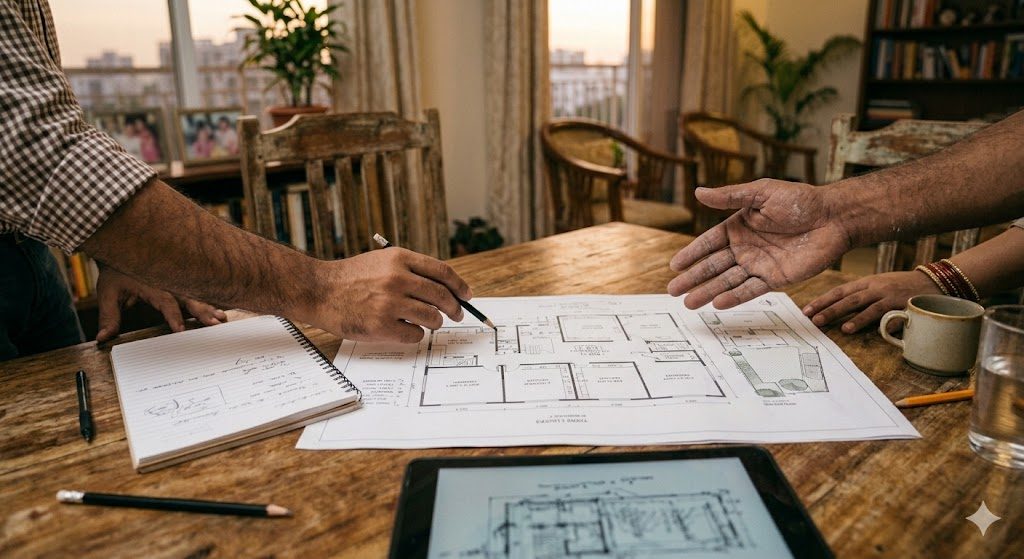
In Whitefield, Bengaluru, a couple named Ramesh and Divya saved for nine years to build their own house. They picked a beautiful 30 by 40 plot, hired a contractor a friend recommended, and told him "build us a nice 3BHK." Eighteen months and ₹68 lakh later, they had a home they mostly loved — and three regrets that no amount of money could now fix. The staircase ate the only spot a future lift could go. The kitchen faced west and turned into an oven by 4 pm. And because nobody had decided the electrical load up front, the second floor could never run two ACs and the geyser at once. None of these were finishing mistakes. Each was a decision taken too late, or never consciously taken at all.
This guide is about the thirty decisions that actually shape an Indian home — and, just as importantly, the order in which they must be taken. Most homeowners obsess over the visible choices: tile colour, sofa fabric, the front elevation. But the choices that determine whether a home works are made much earlier, often before a single line is drawn. If you are at the very start of this journey, read our pillar first — how to plan your dream home before you meet an architect — and treat this guide as the decision map that sits inside it.
A home is not an object; it is a sequence of decisions, and the early ones quietly constrain every choice that comes after. You cannot fix the orientation after the foundation is cast. You cannot add a pooja niche after the wall is tiled. You cannot raise the electrical load after the conduits are buried. The order of decisions matters as much as the decisions themselves — and getting the sequence right is the single highest-leverage thing a homeowner can do.
Why order beats opinion
Every decision in a home project belongs to a phase, and every phase hands a set of constraints to the next. Decide your budget ceiling, and you have quietly decided your built-up area, your finish grade, and whether a lift is even on the table. Decide your orientation, and you have decided which rooms get morning light and which become afternoon furnaces. Decide your kitchen type, and you have decided your plumbing runs, your chimney duct, and your utility door.
This is the core mental model: the project flows from strategy, to site and statutory, to spatial program, to systems, to finishes — A through E. Each phase is a gate. Walk through it carelessly and you carry the mistake forward, where it gets steadily more expensive to undo.
The trap most homeowners fall into is starting in the middle. They fall in love with a Pinterest kitchen (Phase C–E) before they have confirmed their budget ceiling (Phase A) or their plot's buildable envelope (Phase B). When reality arrives, the dream gets value-engineered into something nobody actually chose. Start at A, move down in order, and every later decision has a firm foundation to stand on.
The 30 decisions, in order
Here is the full sequence. Read the "What it locks" column carefully — that is where the leverage hides. The starred rows are the eight-to-ten highest-leverage decisions; if you get only these right, you have avoided most regret.
| # | Decision | Phase | What it locks | Tool / guide |
|---|---|---|---|---|
| 1 ★ | Buy ready vs build | A | Whether you control design at all, and your risk profile | Apartment vs villa |
| 2 ★ | Plot vs apartment | A | Land cost, freedom, maintenance, resale liquidity | Apartment vs villa |
| 3 ★ | Budget ceiling (all-in) | A | Built-up area, finish grade, whether lift/extra floor fit | Cost calculator |
| 4 ★ | Who leads — architect vs PMC vs contractor | A | Quality of drawings, accountability, coordination | Scope boundaries |
| 5 | Realistic timeline | A | Cashflow, rent overlap, monsoon scheduling | How to plan your dream home |
| 6 ★ | Financing & loan structure | A | Self-construction tranches, EMI start, contingency buffer | Budget allocation |
| 7 ★ | Plot orientation & facing | B | Daylight, heat gain, Vastu, room placement | East-facing house plan |
| 8 ★ | How much FAR/FSI to use | B | Total built area, future floors, ground coverage | FAR/FSI calculator |
| 9 | Setbacks & coverage | B | Usable footprint, parking, future extension room | Building plan approval |
| 10 | Soil test & foundation type | B | Structural cost, basement feasibility, safety | Building a house in India |
| 11 | Approval path & RERA status | B | Legality, loan eligibility, resale, penalties | RERA guide |
| 12 | Parking provision | B | Ground-floor plan, gate, ramp, future second car | Building plan approval |
| 13 | Water source — borewell/municipal/tank | B | Plumbing layout, sump size, overhead tank, treatment | Building a house in India |
| 14 ★ | Number of bedrooms & baths | C | Built area, plumbing stacks, resale band | 3BHK house design |
| 15 | Joint-family / multi-gen provisions | C | Ground-floor bedroom, second kitchen, privacy zoning | Multi-generational home design |
| 16 | Pooja room / niche | C | Wall position, plumbing avoidance, orientation | Vastu house plan |
| 17 ★ | Kitchen type — Indian + modular | C | Chimney duct, utility door, plumbing, gas line | Space planning principles |
| 18 | Dedicated utility / wash area | C | Drainage, washing-machine point, ventilation | Space planning mistakes |
| 19 ★ | Staircase position & type | C | Circulation, future lift shaft, light well | Building a house in India |
| 20 ★ | Future expansion / extra floor | C | Column sizing, foundation depth, terrace use | Future-proof home design |
| 21 ★ | Total electrical load & phase | D | AC count, geyser, kitchen appliances, EV charging | Building a house in India |
| 22 | Plumbing & drainage layout | D | Wet-wall positions, slopes, future leak risk | Space planning principles |
| 23 | Water-heating strategy | D | Solar feasibility, geyser points, gas vs electric | Building a house in India |
| 24 ★ | Ventilation & AC strategy | D | Window sizing, sleeve positions, cross-ventilation | Why your home feels dark |
| 25 | Smart-home conduiting | D | Network points, automation readiness, sensor runs | How to design a home that ages well |
| 26 ★ | Flooring (per zone) | E | Slab level, skirting, waterproofing, threshold heights | 25 interior mistakes |
| 27 | False-ceiling routing | E | AC ducting, wiring, downlights, beam concealment | Why your home feels dark |
| 28 | Wardrobe carcase & niche | E | Wall recesses, electrical points, room dimensions | Why wardrobes become inefficient |
| 29 | Waterproofing zones | E | Bathroom/balcony/terrace longevity, leak liability | Building a house in India |
| 30 | Storage strategy (built-in) | E | Loft heights, under-stair use, utility shelving | Smart storage ideas |
Thirty decisions, five phases. Notice how many of the highest-leverage ones (the stars) sit in Phases A and B — before a single brick is laid. That is not a coincidence. It is the whole point.
Phase A — Foundational and strategic (decisions 1–6)
These six are taken before any drawing exists, and they set the outer boundary of everything else.
Buy vs build, and plot vs apartment (1–2) is the fork in the road. Buying a ready flat trades design freedom for speed and lower risk; building gives you control but demands eighteen-plus months of attention. If you are weighing the two, our apartment vs villa tool lays out the trade-offs in money and lifestyle.
Budget ceiling (3) is the most consequential number you will ever set, and it must be a true all-in figure — land or registration, construction, statutory fees, interiors, and a 10–15% contingency. A realistic 2026 turnkey construction cost for a standard-grade independent house in a metro runs roughly ₹2,200–₹3,200 per sq ft for civil and basic finishes, and ₹3,500–₹5,000+ for premium. Set this number badly and every later decision becomes a painful subtraction. Run the cost calculator and then split the envelope with budget allocation.
Who leads (4) decides the quality of your drawings and who is accountable when something goes wrong. An architect gives you design and statutory drawings; a PMC (project management consultancy) gives you execution control; a contractor alone gives you neither unless you supervise. Our guide on scope boundaries between architect, designer and contractor explains who owns what.
Timeline and financing (5–6) are the quiet killers. A self-construction home loan releases money in tranches tied to construction stages — your cashflow plan must match the bank's disbursement schedule, or work stalls. Plan the rent-versus-EMI overlap honestly; most projects run three to six months longer than promised.
The budget ceiling is the only decision that re-prices all the other twenty-nine. Set it last, and you will spend the whole project apologising to it.
Phase B — Site and statutory (decisions 7–13)
Now the land speaks. These seven decisions are governed as much by physics and law as by preference.
Orientation (7) is irreversible the moment the plinth is set. In most of India, the kitchen and bedrooms should avoid the harsh west and south-west sun; living and entry zones can take the south. Get the east-facing house plan logic right and you reduce cooling bills for the life of the home. FAR/FSI use (8) decides how much you can build at all — every city sets a Floor Area Ratio, and using it wisely (or holding some back for a future floor) is a one-time choice. Model it with the FAR/FSI calculator.
Setbacks, soil, approvals, parking and water (9–13) are where legality and ground reality bite. NBC 2016 and your local building byelaws fix minimum setbacks and ground coverage; a soil test before foundation design can save lakhs in over-engineering or prevent a settlement disaster. Confirm the RERA status of any plot or project — for the rules, see our RERA guide — and decide your water source early, because a borewell, sump and overhead tank reshape your entire plumbing and ground-floor plan.

The matrix above is the fastest way to see which decisions deserve obsession. Anything in the red top-right zone — high impact and must-be-locked-early — is where your attention belongs first. Paint colour and light fittings can wait; orientation and load cannot.
Phase C — Spatial program (decisions 14–20)
This is where the home becomes a plan. The program is the list of rooms and how they relate — and small program errors create the "why does this home feel cramped?" feeling that no decor can rescue.
Bedrooms and baths (14) set the built area and the plumbing stacks; stacking wet areas vertically saves cost and leak risk. Joint-family provisions (15) — a ground-floor bedroom for elders, a second kitchen, acoustic privacy — must be designed in, not retrofitted; our multi-generational home design guide covers the patterns. Pooja (16) and kitchen type (17) are deceptively load-bearing: an Indian-plus-modular kitchen needs a chimney duct route, a gas line, a utility door and a dedicated wet zone, all of which ripple into the plan.
Staircase position (19) and future expansion (20) are the two most overlooked high-leverage program decisions. The staircase is your home's spine — placed wrong, it kills the future lift shaft and wastes circulation. If you might add a floor later, the columns and foundation must be sized for it now; retrofitting structural capacity is brutally expensive. For the long view, read future-proofing your home for a growing family and avoid the space-planning mistakes that make homes feel smaller.
Phase D — Systems (decisions 21–25)
Systems are invisible, buried in walls and slabs, and therefore the most unforgiving to change. These five must be decided before plastering.
Total electrical load and phase (21) is the decision Ramesh and Divya missed. Add up every AC, geyser, induction hob, microwave, water pump, washing machine and an allowance for EV charging, then size the sanctioned load and decide single- vs three-phase. Under-provision and you trip breakers for a decade; the upgrade later means re-wiring. Plumbing layout (22) and water-heating strategy (23) — solar, electric or gas — are equally one-shot; solar water heating needs roof orientation and tank space planned up front.
Ventilation and AC strategy (24) determines window sizes, AC sleeve positions and whether the home breathes naturally. A home planned for cross-ventilation needs less mechanical cooling forever — and avoids the dark, stuffy feeling that retrofits cannot cure. Smart-home conduiting (25) is cheap to lay now and ruinous to add later; even if you are not automating today, running spare conduit and network points future-proofs the home, a theme we explore in designing a home that ages well.
The timeline above makes the stakes concrete. A strategy decision changed in the pre-design phase costs you a conversation. The same intent changed after the slab is cast — or worse, after services are buried — costs you demolition, rework and weeks. Reversibility is a window that closes a little more with every phase.
Phase E — Finishes that must be decided early (decisions 26–30)
Most finishes can be chosen late. A handful cannot, because they affect dimensions, levels and routing that get fixed during structure and services.
Flooring (26) sets slab levels, skirting and threshold heights; if you switch from tile to a thicker stone late, doors and levels fight you. False-ceiling routing (27) must be coordinated with AC ducting and wiring before the ceiling closes. Wardrobe carcase and niches (28) need wall recesses and electrical points planned into the masonry — decide where wardrobes go before the electrician marks points. Waterproofing zones (29) and built-in storage (30) — loft heights, under-stair use — are structural-adjacent and belong on the early list. For the regret-avoidance view, our list of 25 interior mistakes Indian homeowners regret is the companion read, and why wardrobes become inefficient explains the carcase trap.
The eight that matter most
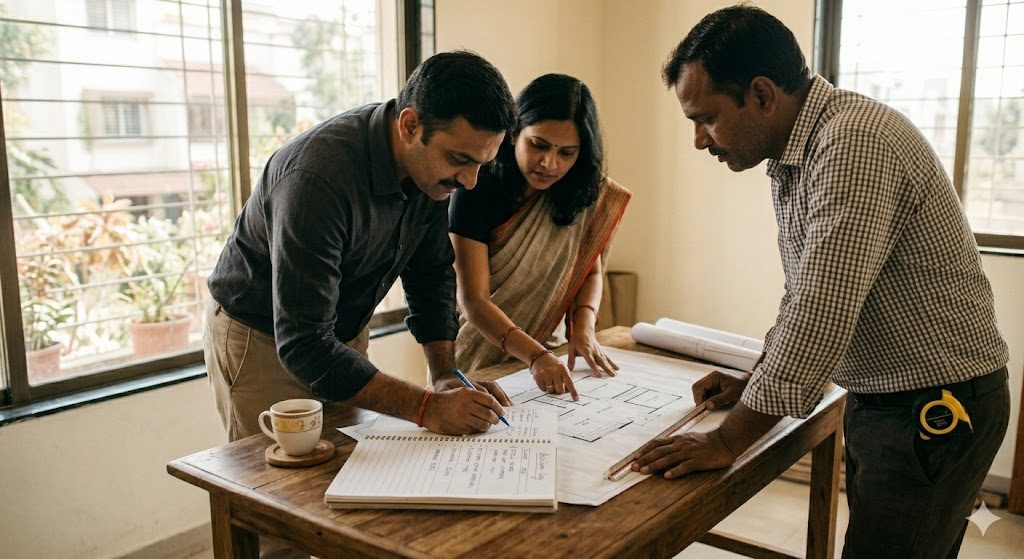
If you do nothing else, get these right, in this order. They are the highest-leverage decisions on the leverage matrix, and a mistake in any one of them is effectively permanent:
| Rank | Decision | Why it is non-negotiable |
|---|---|---|
| 1 | Budget ceiling (all-in) | Re-prices every other decision |
| 2 | Who leads the project | Determines drawing quality and accountability |
| 3 | Plot orientation | Irreversible after plinth; fixes light and heat |
| 4 | FAR/FSI use | One-time choice on total buildable area |
| 5 | Kitchen type | Cascades into plumbing, ducting, utility, gas |
| 6 | Staircase & future lift | Fixes circulation and future accessibility |
| 7 | Electrical load & phase | Buried; under-provision means re-wiring |
| 8 | Ventilation / AC strategy | Sets window and sleeve positions for life |
Get it right, in order
1. Set a true all-in budget ceiling with a 10–15% contingency using the cost calculator, then split it with budget allocation.
2. Decide who leads — architect, PMC or contractor — and put scope in writing before any drawing.
3. Read the land: orientation, soil, FAR/FSI, setbacks, RERA status and water source, validated with the FAR/FSI calculator.
4. Write your spatial program — bedrooms, kitchen type, pooja, utility, staircase and any multi-gen needs — before the architect drafts.
5. Lock structural future-proofing: column sizing for an extra floor, the lift shaft, and the staircase position.
6. Fix the systems early: electrical load, plumbing, water heating, ventilation and spare conduit, all before plastering.
7. Pin the early finishes: flooring levels, false-ceiling routing, wardrobe niches and waterproofing zones.
8. Keep a decision log — one row per decision, what it locks, and when it is final — so nothing is decided by accident.
The homeowners who end up happy are almost never the ones with the biggest budget. They are the ones who made each decision consciously, in the right order, and never let a Phase-E choice be made before a Phase-A one.
If translating all of this into an actual plan, brief and budget feels daunting, that is exactly what we built DesignAI for. Describe your plot, your family and your ceiling, and it drafts a phase-ordered plan, a structured brief you can hand to any architect, and a first-cut BOQ — so you walk into your first design meeting already knowing your thirty decisions, and the order they belong in.
References
1. Bureau of Indian Standards — National Building Code of India (NBC) 2016, Parts 3, 8 and 11 (setbacks, building services, approach to sustainability).
2. Ministry of Housing and Urban Affairs — Real Estate (Regulation and Development) Act, 2016 (RERA) and state RERA portals.
3. Council of Architecture (CoA) — Conditions of Engagement and Scale of Charges for architectural services in India.
4. IS 1893 and IS 456 — Bureau of Indian Standards codes for earthquake-resistant design and plain and reinforced concrete.
5. Francis D. K. Ching — Architecture: Form, Space, and Order (program, circulation and spatial sequence).
6. Local Development Authority building byelaws (e.g. BBMP, MCGM, DDA) for FAR/FSI, ground coverage and parking norms.
Continue with the Home Planning cluster: read building a house in India, avoid the space-planning mistakes that make homes feel smaller, and design for the long run with future-proof homes for Indian families.
Export this guide
Related Guides — Deep-dive reading
Bathroom Planning for New Homes in India: Get It Right Before You Build
The bathroom decisions you cannot undo once the slab is cast — location and stacking, sunken vs non-sunken slabs, waterproofing, and the plumbing, electrical and ventilation you must coordinate with the civil work, stage by stage.
BathroomsHow to Plan a Home for Multi-Generational Living
Designing for grandparents, parents and children under one roof — privacy, accessibility and harmony
Home PlanningThe Trade-Offs Every Homeowner Has to Make
No one gets everything — every home is a stack of compromises. This is about the sacrifices: the cost-quality-time triangle, the recurring homeowner trades, and how to make your cuts on purpose instead of having them forced by a blown budget.
Planning Your ProjectRelated Tools — Try Free
Cross-Ventilation Analyzer
Estimate airflow and air changes per hour (ACH) from room size, window areas, layout, and local wind — with NBC 2016 Part 8 compliance check.
Ventilation CalculatorRainwater Tank Sizer
How big should your rainwater tank be? Computes annual harvest, recommended tank capacity in litres, water-bill savings, and payback — for 10 Indian cities.
RWH CalculatorMonsoon-Readiness Checklist
Pre-rain home audit across 9 categories — terrace, drains, waterproofing, electrical, HVAC, pest, vehicles, documents.
Seasonal Audit