
How to Design a Home That Ages Well
Designing for the next 20 years — timeless layout, durable materials, and graceful evolution
In 2014, a couple in Whitefield, Bengaluru poured their savings into a glossy, on-trend home — high-gloss acrylic kitchen shutters, a dark feature wall in PU paint, a "floating" wooden floor in the living room, chrome taps everywhere, and a double-height void that looked spectacular in photos. By 2024 the acrylic had hairline crazing and showed every fingerprint, the dark wall had faded in streaks where the afternoon sun hit it, the floor planks near the kitchen had swollen and lifted, the chrome was pitted white from Bengaluru's hard water, and that grand void leaked heat and noise across the whole house. None of it was "cheap" work. It just did not age. Ten years in, they were quoting a renovation that cost more than the original interiors.
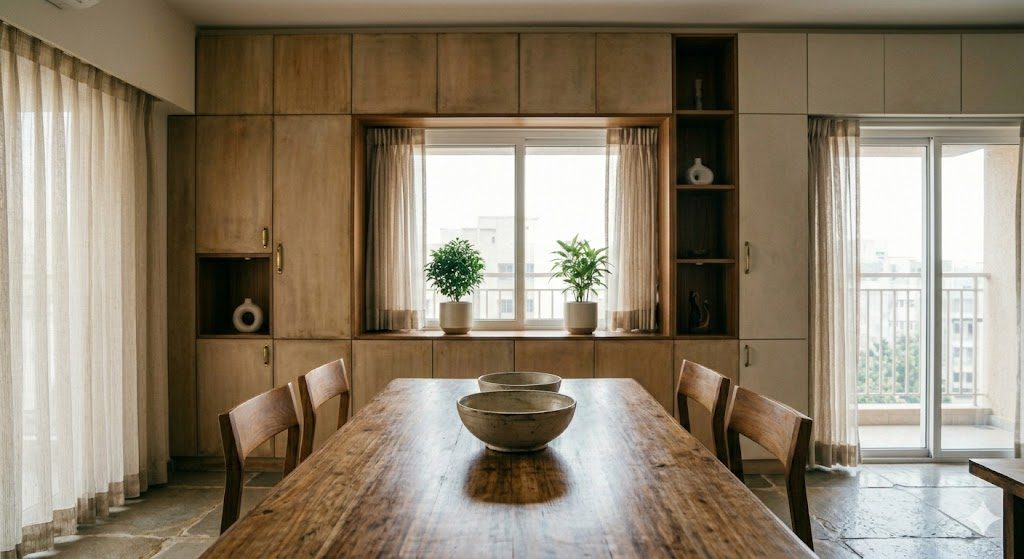
A few streets away, a quieter home built the same year still looks calm and current: honed Kota and granite floors, a neutral matt-emulsion shell, marine-ply joinery in the wet zones, brass taps that have dulled to a soft patina, and trends parked entirely in the cushions, curtains and one repaintable accent wall. The family swapped the soft layer twice in a decade for the price of a weekend. The bones never moved. This is what it means for a home to age well — and it is mostly a planning decision, not a budget one. If you are still at the dreaming stage, anchor this alongside the broader sequence in our pillar guide to planning your dream home before the architect.
A home ages on two axes at once: physical durability (does the material survive Indian sun, monsoon, dust and hard water?) and timelessness (does the layout and look still work and still feel right in 20 years?). The single most powerful idea is to separate the permanent shell from the changeable layer — spend permanence, money and care on the things you will live with for 30 years, and keep everything fashionable in cheap, easy-to-swap layers.
The two axes of ageing: durability and timelessness
Most homeowners worry about only one axis. "Build it strong" people over-spend on granite and steel but pick a layout that is hopelessly dated in 15 years. "Make it beautiful" people chase a Pinterest look that photographs well and falls apart by year five. A home that ages well needs both.
A genuinely durable home is one where the materials patina (improve or hold steady with use) rather than degrade (visibly fail). A genuinely timeless home is one where the layout, proportions and palette still read as calm and intentional long after the trend that birthed them has passed. The failures of the Whitefield house above were half material (acrylic, chrome, floating floor) and half conceptual (dark feature wall, dramatic void) — and both kinds were locked in at the planning stage, when they were almost free to avoid.
Permanence is not how much you spend — it is how rarely you have to touch it again. The cheapest home over 30 years is the one you got right once.
The rest of this guide gives you the framework, the material calls and the future-proofing provisions to get both axes right before a single bag of cement is ordered.
The core framework: permanent shell vs changeable layer
Think of your home as three nested layers, each changing on a different clock. The architect Stewart Brand called this "shearing layers" — different parts of a building move at different speeds, and trouble starts when you tie a fast-changing thing to a slow-changing one. In an Indian home it looks like this:
| Layer | Changes every | What lives here | Design rule |
|---|---|---|---|
| Permanent shell | 30–60 years | Structure, column grid, room layout, floor levels, plumbing/drainage routes, wall and window openings, orientation, staircase | Make it timeless and generous. Errors here are near-impossible to fix without demolition. |
| Semi-fixed | 8–15 years | Flooring, modular kitchen carcass, wardrobes, bathroom fittings and tiling, doors, counters | Choose durable and neutral. You will refresh it once, maybe twice. |
| Changeable decor | 1–5 years | Wall paint, curtains, rugs, cushions, loose furniture, light fixtures, art | This is where ALL your trends belong. Cheap and fast to swap. |
The principle that falls out of this is simple and ruthless: the more permanent a layer is, the more neutral and timeless it must be; the more changeable a layer is, the more freely it can be trendy. A bold teal wall is a wonderful idea (it is paint, the cheapest changeable thing). A bold teal vitrified floor is a trap (it is semi-fixed, and you will hate it by 2032). The same colour, on two different layers, is either smart or a mistake purely because of how hard it is to undo.
This is the deeper, whole-home version of the principle our specific finishes guide covers — read which expensive interior choices age poorly for the finish-by-finish detail. Here we apply it to the entire home, shell included.
Where homeowners get the layers backwards
The most expensive mistakes come from putting a fast-fashion idea on a slow layer — a double-height void or sunken living room chosen for drama (permanent, dated, hard to cool), a statement archway or curved partition wall (permanent, reads "2020s" forever), heavily-veined feature floor tile (semi-fixed, the first thing renovators rip out), or built-in themed joinery like a fixed bar unit you no longer use. The corresponding wins come from putting personality on fast layers: paint, textiles, lighting, art, plants and loose furniture carry 100% of your taste and cost a fraction to change.
A neutral, durable shell — then layer your taste on top
If you take one operating instruction from this guide, take this: build a quiet shell. A neutral architectural shell — honed neutral floors, off-white or warm-grey matt walls, simple ceiling lines, restrained joinery in calm tones — is not boring. It is the canvas that lets the changeable layer do the talking, and lets you change your mind for free.
A quiet shell ages well for three reasons. Neutral palettes do not "expire" the way a strong colour trend does — beige, warm grey, off-white, natural stone and natural wood have read as tasteful for a century. A calm shell makes the home feel larger and more restful, which matters more as you live with it daily (the opposite problem is covered in why Indian homes feel cluttered). And it is forgiving — a neutral shell hides the wear, dust and small repairs that any Indian home accumulates.
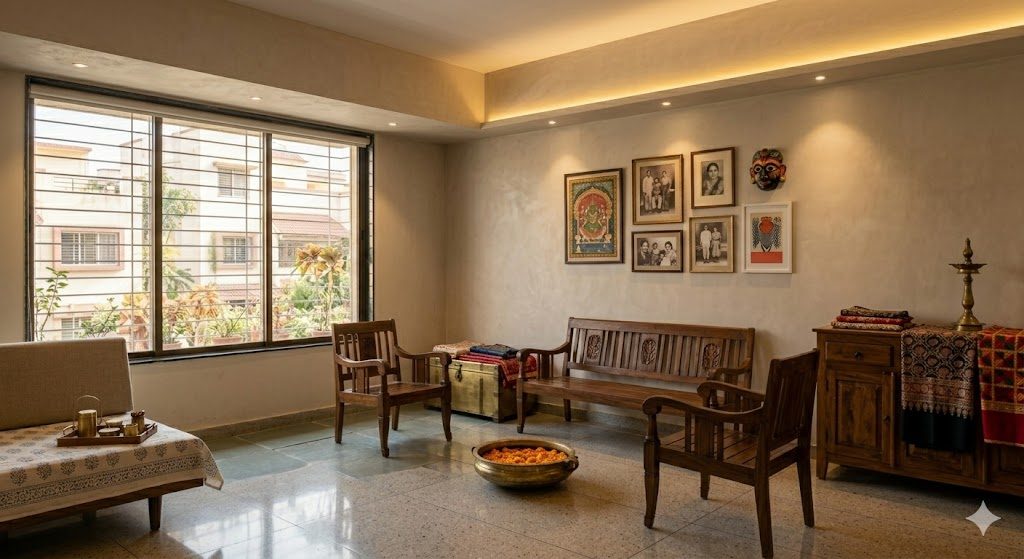
Timeless does not mean featureless. Get your richness from things that genuinely improve with age — solid wood, natural stone, brass, lime plaster, handmade tile — and from proportion and light, not from a finish that was fashionable the year you built. A well-proportioned room with good natural light and one honest material will outlast any "feature wall" by decades. For the architectural-shell decisions specifically, our modern house design guide shows how a restrained envelope reads as contemporary far longer than a heavily styled one.
Timeless vs trendy: a decision table
When you are not sure whether something belongs in the permanent shell or should be kept changeable, run it through this. The test is always: "If I get tired of this, how painful is it to change?"
| Decision | Timeless choice (lock in) | Trendy choice (keep changeable / avoid in shell) | Why it ages |
|---|---|---|---|
| Floor | Honed neutral stone or matt large-format porcelain | Glossy/coloured/heavily-patterned tile | Neutral matt hides wear and never dates |
| Wall colour | Warm white / greige matt emulsion | Dark feature wall, bold accent | Paint is changeable — be bold here, not in tile |
| Kitchen shutters | Matt laminate or PU in muted tone | High-gloss acrylic, on-trend colour | Gloss shows every mark; muted matt stays calm |
| Layout shape | Orthogonal, rectilinear rooms | Curved walls, diagonal partitions, sunken zones | Geometry is permanent; quirks date and waste space |
| Ceiling | Flat or simple cove, generous height | Elaborate multi-tier false ceiling | Heavy gypsum ceilings scream their decade |
| Hardware/taps | Brushed brass / steel, ceramic-disc | Cheap chrome, novelty finishes | Quality metal patinas; chrome pits in hard water |
| Statement | One repaintable accent wall, art, textiles | Fixed themed joinery, mirror-clad walls | Personality belongs on swappable layers |
| Lighting | Warm 2700–3000K, layered, dimmable | Cool-white, RGB strips everywhere | Warm light always flatters; cool/RGB dates fast |
The pattern is consistent: put your money and permanence into neutral, honest, well-proportioned bones — and put your fashion into paint, fabric, light and movable objects. If you want help separating the two for your own brief, the style finder tool is built to surface a durable palette you will still like in a decade rather than a fad you will regret.
Durable materials by zone — what patinas, what degrades
India is brutal on materials in specific, predictable ways: 8–10 hours of hard sun, a violent monsoon, year-round dust, and — across most of the peninsula and the north — hard water that scales and corrodes. A material that ages beautifully in a magazine shot from a dry European climate can fail within five years here. Choose by zone and by what the climate actually does.

| Zone | Choose (ages gracefully) | Avoid (degrades fast) | The India-specific reason |
|---|---|---|---|
| Living/bedroom floor | Double-charged vitrified, honed granite, Kota, matt porcelain | High-gloss tile, laminate "wood" floor | Gloss shows every scratch and dust mote; laminate swells in humidity |
| Kitchen carcass | BWP/marine plywood (IS 710) | MDF, HDF, particle board | MDF swells permanently the first time water reaches a cut edge |
| Kitchen counter | Honed granite, quartz, honed quartzite | Polished marble (in cooking zones), cheap laminate top | Marble etches with lemon/curd; laminate edges lift with steam |
| Kitchen shutters | Matt laminate, muted PU, membrane | High-gloss acrylic | Gloss shows fingerprints and oil film; acrylic crazes over years |
| Bathroom fittings | Brass/SS body, ceramic-disc cartridges | Cheap chrome-plated zinc | Hard water pits chrome white and seizes rubber-washer taps |
| Bathroom grout/tiling | Epoxy grout, anti-skid matt tile | White cement grout, glossy tile | Cement grout yellows and grows mould; glossy floor is a fall risk |
| Façade | Exposed brick/stone, textured render, anodized aluminium | Dark flat paint, ACP cladding, untreated MS | Sun fades dark paint in streaks; ACP delaminates; MS rusts in rain |
| Woodwork | Treated teak/sal, with periodic oiling | Untreated softwood, raw engineered veneer | Termites and humidity; engineered veneer peels at edges |
| Interior walls | Neutral matt emulsion, lime/mineral plaster | Textured 3D panels, PU-gloss walls | Texture traps dust forever; gloss highlights every wall undulation |
Two India-specific reflexes worth building in:
- Hard water is a material decision, not just a plumbing one. If your area has hard water (most of Bengaluru, Chennai, Hyderabad, Pune, Delhi-NCR, much of Rajasthan and Gujarat), plan a softener or at least point-of-use treatment, and choose fittings and surfaces that tolerate scaling — ceramic-disc brass taps, matt surfaces that hide spotting, and tiles you can actually clean. Glossy black anything will broadcast every water spot.
- Patina is a feature — design for it. Brass, copper, solid wood, terracotta, lime plaster, Kota and natural stone all look better with age and honest wear. High-gloss, mirror, chrome and pure-white surfaces only ever look worse. Bias your permanent and semi-fixed layers toward materials that earn their character. To pressure-test the lifetime cost of a "cheap now" material against a "lasts" one, the cost calculator lets you model the difference across a 20-year horizon.
Match these calls to your climate, too — what survives the coastal salt of Chennai is not what survives the Delhi summer or the Western Ghats monsoon; our guide on choosing a house plan by India climate zone sets the regional baseline.
Timeless layout and proportion — the part you cannot repaint
Finishes you can change. Layout, mostly, you cannot. A poorly proportioned room or a circulation mistake is baked into the structure, and it will quietly annoy the family for the entire life of the house. Timeless layout rests on a few durable principles that long predate any trend:
- Right-sized, rectilinear rooms. Rooms close to a pleasing rectangle (between a square and a 1:1.6 ratio) furnish well and never feel like a leftover offcut. Long thin "corridor" rooms and odd diagonal-walled spaces date instantly and waste area.
- Honest circulation. Clear, short paths and a "public to private" gradient — living and guest spaces near the entry, bedrooms deeper in. Avoid passing through one bedroom to reach another, and corridors that eat more than about 12–15% of floor area.
- Comfortable height and openings. A 3.0–3.3 m floor-to-floor reads generous without waste; windows sized for cross-ventilation (NBC 2016 recommends openable area of at least one-tenth of floor area for habitable rooms) age far better than sealed glass-box rooms that need the AC running to be liveable.
- Flex-ready rooms over hyper-specialised ones. A fixed "home theatre" or "gym" dates and gets abandoned; a well-proportioned spare room that can be a study, nursery, guest room and later a ground-floor bedroom serves the family across every life stage.
Get the bones right and the home will tolerate decades of changing taste on the layers above. Get them wrong and no amount of expensive finish will rescue it. This is exactly why we push homeowners to settle the first 30 decisions before falling in love with finishes — and why a quiet, well-proportioned shell, not a dramatic one, is the surest bet for a home that still works in 2046.
Designing for the next 20 years: flexible, ageing-in-place, low-maintenance
A home ages well only if the family inside it can keep living in it. In India, where homes routinely serve three generations and parents often move in, this is not a nice-to-have — it is the difference between a home you grow old in and one that quietly evicts you the moment you cannot manage the stairs.
Ageing-in-place checklist (cheap to build, costly to retrofit)
Almost every item below is nearly free during construction and painfully expensive — sometimes impossible — to add at 70. Build the provision now even if you never use it; it costs little and adds resale value.
| Provision | Build in now | Why it matters at 65+ |
|---|---|---|
| No-step entry | At least one level, threshold-free door | A single step ends independent entry after a fall or surgery |
| Ground-floor bed + bath | Reserve one bedroom and a full bath on the entry level | Lets a senior live entirely without stairs |
| Wide doorways | 900–1050 mm clear openings | A standard 750 mm door will not pass a wheelchair or walker |
| Turning space | 1500 mm clear circle in key rooms/bath | Needed to turn a wheelchair; impossible to add later |
| Curbless shower | Level-in, anti-skid, with a fall to drain | Removes the most common bathroom fall hazard |
| Grab-bar blocking | Ply backing inside bath/WC walls | Lets bars be added in a day, no demolition, when needed |
| Comfort-height WC | 450 mm seat height | Far easier to sit and stand with weak knees |
| Lever handles + rocker switches | Throughout | Arthritic hands cannot manage round knobs or tiny toggles |
| Reachable controls | Switches/sockets at 900–1100 mm | No bending to floor sockets or reaching above the head |
| Anti-scald mixers | Thermostatic in showers | Slowed reactions make hard-water scald a real risk |
| Future-lift provision | Stack a 1.2 × 1.2 m space across floors (closets work) | Converts to a home lift later without touching structure |
| Even, glare-free light | Layered warm lighting, lit night-paths | Ageing eyes need more light and hate glare and dark patches |
The companion guides on future-proofing your home for an Indian family and multi-generational home design go deeper on flexibility and joint-family living respectively — this checklist is the durable, accessibility-focused core they share.
Flexible rooms beat fixed function
The single best future-proofing move is to design rooms that can change role without changing walls. A 3.0 × 3.6 m room with a window and a nearby toilet can be, over 30 years: a nursery, a kids' study, a guest room, a work-from-home office, and finally a ground-floor bedroom for an ageing parent. Provide the plumbing rough-in, the power and the door width once, and the room flexes for free across the family's whole life. Hyper-specialised rooms — a fixed home theatre, a built-in bar — are the first things to feel dated and abandoned.
Low-maintenance by design
A home that demands constant upkeep does not get it, and an un-maintained home ages fastest of all. Design out the maintenance: deep roof and window overhangs (chajjas) to keep sun and rain off walls so paint lasts; matt and textured surfaces that hide dust between cleans; honed floors that do not show every scuff; accessible service routes (a plumbing duct you can actually reach beats a buried pipe you must break a wall to fix); and easy-to-clean detailing — fewer ledges, grooves and gloss surfaces that broadcast India's relentless dust.
Future-proof your services — the hidden permanent layer
The least glamorous, most regretted shortcut is under-providing the services buried in the walls. Wiring, plumbing and conduits are deep in the permanent shell — changing them later means breaking finished surfaces. Provision generously now while it is cheap:
| Service | Future-proof move | What it saves later |
|---|---|---|
| Electrical | Spare conduits/empty pipes wall-to-ceiling; sub-circuits; ample points | No wall-chasing to add a point or an AC line |
| Load | Size the board and incoming load for EV charging + future AC/induction | Avoids a costly upgrade as the family electrifies |
| Plumbing | Reachable shafts; provision for a softener, RO and solar water heater | Treats India's hard water; adapts to future fittings |
| Data/network | CAT6 + conduit to key rooms; a small comms cupboard | Wired backbone outlasts every Wi-Fi fad |
| Solar/backup | Roof conduit route + inverter/battery space reserved | Solar and storage retrofit cleanly, not as an afterthought |
| Ventilation | Provision for exhaust, future duct routes, openable windows | Keeps the home liveable without total AC dependence |
Spending a little extra on conduits, a slightly larger board and reachable shafts is the highest-return future-proofing in the entire house — because it protects the one layer you can never reach again without demolition.
Get it right, in order
1. Lock the shell first. Settle layout, room proportions, levels, orientation and circulation before any finish discussion. These are permanent and nearly impossible to undo — get them generous and rectilinear.
2. Default the shell to neutral and quiet. Choose timeless floors, warm-white matt walls and restrained joinery. Resist the urge to make the permanent layer dramatic.
3. Choose materials by zone and by climate. Use the durability matrix — matt over gloss, solid over engineered in wet zones, brass/steel over chrome in hard-water India, and surfaces that patina over surfaces that degrade.
4. Build in every ageing-in-place provision now. No-step entry, a ground-floor bed-and-bath, wide doors, grab-bar blocking, a stacked future-lift space. They are free now and priceless later.
5. Make rooms flexible, not fixed. Provision plumbing, power and door width so spare rooms can change role across the family's whole life. Avoid hyper-specialised, themed builds.
6. Over-provision the buried services. Spare conduits, a larger board, reachable shafts, water treatment and a solar/EV route — the cheapest insurance against tomorrow's demolition.
7. Park all your trends on the changeable layer. Pour personality into paint, textiles, lighting, art and loose furniture — the things you can swap in a weekend for the price of a dinner out.
8. Design out the maintenance. Overhangs, matt surfaces, honed floors and accessible services so the home stays easy to keep, and so ages slowly and gracefully.
DesignAI can turn these principles into a working draft for your home — it generates a permanent-vs-changeable layer map for your brief, suggests a durable, zone-by-zone material palette tuned to your city's climate and water, flags layout choices that tend to date, and drafts an ageing-in-place checklist and a rough BOQ so you walk into your architect conversation already knowing what to make timeless and what to keep swappable.
References
- Bureau of Indian Standards, National Building Code of India (NBC) 2016 — Part 4 (fire and life safety), Part 8 (building services), and habitable-room ventilation and dimension provisions.
- Bureau of Indian Standards, IS 710: Marine Plywood and IS 303: Plywood for General Purposes — grades and water-resistance for wet-zone joinery.
- Real Estate (Regulation and Development) Act, 2016 (RERA) — carpet-area, specification-disclosure and quality-of-construction provisions relevant to durable builds.
- Stewart Brand, How Buildings Learn: What Happens After They're Built — the "shearing layers" model of building change over time.
- Francis D. K. Ching, Architecture: Form, Space & Order — proportion, room geometry and circulation principles underpinning timeless layout.
- Council of Architecture (CoA) and the National Institute of Design — guidance on accessible and universal design provisions for Indian homes.
Build the bones to last and keep the fashion swappable. Continue with future-proofing your home for an Indian family, multi-generational home design, which interior choices age poorly, and the pillar guide to planning your dream home before the architect.
Export this guide
Related Guides — Deep-dive reading
How to Plan a Home for Multi-Generational Living
Designing for grandparents, parents and children under one roof — privacy, accessibility and harmony
Home PlanningAging-in-Place Home Design in India
Provision the bones now so your home can care for you (and your parents) for the next 30 years.
Future-Ready HomesDesigning Adaptable & Universal-Design Homes
Accessibility, Aging-in-Place, and the Multi-Stage Family — Code, Anthropometrics, and Plan-Stage Discipline for Indian Residential Architects
Room PlanningRelated Tools — Try Free
Cross-Ventilation Analyzer
Estimate airflow and air changes per hour (ACH) from room size, window areas, layout, and local wind — with NBC 2016 Part 8 compliance check.
Ventilation CalculatorBrise-Soleil Visualizer
Interactive horizontal-louvre cut-off angle calculator — sun altitude, louvre depth, and spacing inputs with a live shadow preview. Computes θ = arctan(spacing/depth) for façade shading, ECBC envelope compliance, hospital daylight design, and tropical sun-control detailing.
Sun Shading ToolFalse Ceiling Cost Estimator
Live ₹/sqft across 8 ceiling types — POP, gypsum, designer, metal, PVC, wooden — with cove and spot lighting for 20 Indian cities.
Cost Calculator