
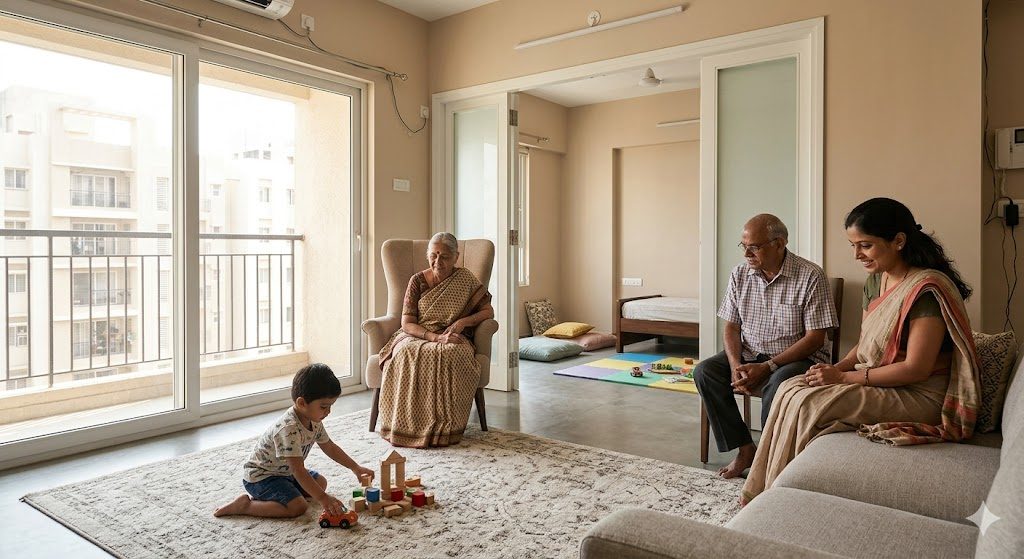
Future-Proof Home Design for Indian Families
Designing today for the family you will be in 10–20 years — flexibility, services and adaptability
When the Reddy family in Hyderabad moved into their freshly built independent house in 2014, it fit them perfectly. A bedroom for the couple, one for their newborn, a small study where the husband occasionally answered office emails, and a single covered parking spot for the family hatchback. For about five years, it was ideal. Then the cracks — not structural, but spatial — began to show. A second child arrived and the two kids could no longer share. The pandemic made work-from-home permanent, and the "study" had to host two adults on back-to-back video calls. The husband's parents moved in after his father's knee surgery, and the only bedroom available was on the first floor, up a steep staircase. They bought an electric car and discovered the meter board had no spare load to charge it. Inside eight years, a home that had been built "just right" needed three separate, dusty, expensive renovations to keep up.
This guide is about avoiding the Reddys' problem. It is not about choosing finishes that last or a style that stays handsome — that is the subject of our companion guide on how to design a home that ages well. This guide is about something different and more structural: designing a home that can adapt to the family you will become over the next ten to twenty years, without ripping it apart to do so. Future-proofing is the discipline of provisioning — building in the points, conduits, columns and clear rooms today, while it is cheap, so that tomorrow's changes are a plug-in instead of a demolition.
If you take one idea from this page, take this. The cheapest day to add a plumbing point, an electrical circuit, a network conduit or a column for a future floor is the day before the slab is cast. Every day after that, the same change costs five to ten times more and comes with dust, breakage and disruption. Future-proofing is not about predicting the future perfectly — it is about leaving doors open so the future is cheap to walk into. Before you finalise a single layout, it pays to do this thinking inside the broader pre-architect planning roadmap so adaptability is baked into the brief and not bolted on later.
A family is not a fixed thing — and your home should not pretend it is
The fundamental mistake behind most rigid homes is treating the family as a snapshot. You design for who sits at the dinner table on possession day. But a family is a moving system. Children are born, grow, claim their own rooms, study late into the night, and eventually leave. Parents age, and at some point many Indian families fold them back into the household. Careers shift from office-bound to hybrid to fully remote and back. The number of vehicles, appliances and connected devices only ever climbs.

Look at the arc above and a clear pattern emerges. Spatial demand is low at the start, rises to a sharp peak somewhere between years eight and eighteen when children need their own rooms and a working adult needs a quiet office, then shifts — not vanishes — as children leave and ageing parents move in. A home sized only for the start is cramped at the peak. A home sized only for the peak is wasteful at the ends. The smart answer is neither: it is a home whose rooms can be re-tasked without rebuilding, and whose services were provisioned generously from day one.
Build for the family you are on possession day and the house fits for about five years. Build for the family you will become and it fits for forty.
The convertible room: one space, five lives
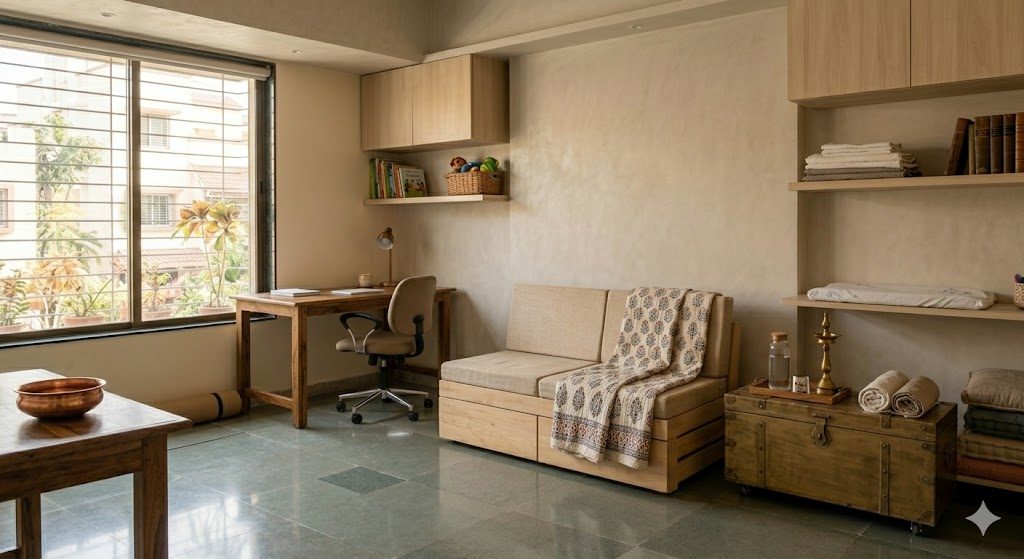
The single most powerful future-proofing move in an Indian home is the deliberately neutral, convertible room. Instead of designing a "baby room" with a fixed cot nook, or a "study" with built-in desks for two, you design a plain, well-proportioned room — roughly 3.3 m x 3.3 m (about 11 ft x 11 ft) — with a window, good ventilation, a standard door, two or three generous electrical points, and an attached or immediately adjacent toilet rough-in. That single room can serve as a guest room in the early years, a nursery when the first child arrives, a children's study through the school years, a home office when work goes remote, and finally a ground-floor grandparent's bedroom when parents move in. Nothing is demolished; only the furniture changes.
The discipline that makes this work is restraint. Resist the urge to build heavy fixed joinery into every room. A wall of bolted-in cabinetry locks a room into one function forever. Movable, modular furniture — a bed that can be swapped for a desk, a freestanding wardrobe instead of a built-in, a folding partition instead of a brick wall — keeps the room agile. This connects directly to a problem we explore in why Indian homes feel cluttered: over-fixing a space to today's use is what makes it fail tomorrow.
| Life stage | What the convertible room becomes | What you do |
|---|---|---|
| Years 0–3 | Guest room | Bed, light wardrobe |
| Years 3–8 | Nursery / play | Cot, soft flooring, child-safe points |
| Years 8–15 | Kids' study / bedroom | Desk, storage, study lighting |
| Years 15–20 | Home office | Desk, network point, soundproofing |
| Year 20+ | Grandparent's bedroom | Low bed, grab bars, ensuite use |
Structure: the one thing you genuinely cannot change later
Everything above assumes you can move walls and re-task rooms. Whether you actually can depends on a decision made at design stage that most homeowners never consciously make: load-bearing construction versus framed (RCC column-and-beam) construction.
In a load-bearing house, the walls hold the building up. Knocking one out to merge two rooms, or to widen a doorway for a wheelchair, is structurally dangerous and often impossible without expensive steel propping. In a framed structure, the RCC columns and beams carry the loads, and internal walls are mere partitions you can remove, shift or add at will. For any home you expect to adapt over decades — and especially any independent house or villa — a framed structure is the future-proof default. It costs a little more upfront and is worth every rupee in flexibility. Our broader guide on building a house in India covers the structural decision in depth.
Within a framed home, go one step further: ask your architect and structural engineer to mark planned knock-out walls — internal partitions deliberately built as non-structural and lightly finished, so a future merge of two bedrooms into one master, or a kitchen-into-dining opening, is a one-day job. Document these on the as-built drawings so a future contractor knows exactly which walls are safe to remove.
Vertical expansion: the most expensive thing to retrofit
If there is any chance you will add a floor — a top-floor flat for the kids, a rental unit, or simply more space as the family grows — the time to prepare is now, during foundation design. Footings and columns sized for a single floor cannot safely carry a second one. Adding a floor onto an under-designed structure later may require jacketing every column and strengthening the foundation, which is hugely expensive and sometimes simply not permitted.
| Provision for a future floor | Do it now | Retrofit later |
|---|---|---|
| Footing / foundation capacity | Sized for +1 floor at design | Column jacketing, foundation work — very costly |
| Column reinforcement | Heavier bars cast in | Often not feasible |
| Roof slab starter bars | Left projecting for future columns | Chip and dowel — weak joint |
| Staircase | Rises to terrace, mid-landing ready | Demolish and rebuild |
| FAR / FSI headroom | Confirmed against by-laws | Cannot exceed permitted FAR |
Two caveats specific to India. First, your right to add a floor is governed by the permissible Floor Area Ratio (FAR / FSI) for your plot under the local development control rules — confirm there is unused headroom before you provision for it, using our FAR / FSI calculator and the local by-laws. Second, the structural design for the extra floor must be done by a licensed structural engineer per IS 456 (concrete) and IS 1893 (seismic) at the original design stage; you cannot honestly future-proof a structure with a back-of-envelope guess.
Provision now, install later: the cheapest insurance you will ever buy
Here is the heart of future-proofing. A large class of changes are trivially cheap to provide for while walls are open and slabs are being cast, and brutally expensive to add once the home is plastered, tiled and occupied. The gap is not small — it is routinely a factor of five to ten.

The logic is simple. While the wall is open, adding a capped water line or a conduit with a draw-wire is a few hundred to a few thousand rupees of pipe and labour. After the wall is closed, the same addition means chiselling out finished plaster and tiles, running the line, re-plastering, re-tiling, re-painting and living with dust for days. You are not paying for the pipe — you are paying to undo and redo the finished house around it.
| What to provision now | Provision-now cost (typical 2026) | Retrofit-later cost | Why it is worth it |
|---|---|---|---|
| Capped water + drain stub for a future toilet / utility sink | ₹2,000–5,000 | ₹40,000–90,000 | Adds a powder room or staff toilet later with no wall-breaking |
| Spare electrical circuit + 2–3 points per room | ₹1,500–4,000 | ₹25,000–60,000 | Future AC, geyser, appliance load without overloading old wiring |
| Concealed conduit with draw-wire (room to network cabinet) | ₹8,000–20,000 | ₹60,000–1,50,000 | Pull CAT6, fibre or smart-home cable later with no chasing |
| Neutral wire at every switch box | Negligible | ₹15,000–40,000 | Smart switches need a neutral; old boxes often lack one |
| Roof-to-wall DC conduit for solar | ₹3,000–8,000 | ₹30,000–70,000 | Solar panels and inverter connect cleanly years later |
| Footing / column provision for an extra floor | ₹1,00,000–3,00,000 | Often not feasible | The only safe way to add a floor later |
| Backing plates in toilet walls for grab bars | ₹1,000–3,000 | ₹20,000–40,000 | Grab bars screw into solid backing, not crumbling tile |
The rule of thumb worth memorising: if breaking a finished wall or floor would be needed to add something later, provision for it now. Plumbing stubs, electrical circuits, conduits and structural capacity all fail this test if you skip them — so don't.
Electrical headroom, EVs and solar: provisioning for the energy future
Of all the systems in an Indian home, electrical is the one most likely to be embarrassed by the next decade. The sanctioned load that comfortably ran a 2014 home — a few fans, lights, one or two ACs and a fridge — cannot carry today's reality of multiple inverter ACs, an induction hob, a dishwasher, a microwave, a water purifier, and an EV charger drawing 3 to 7 kW on its own.
Three moves protect you:
- Size the sanctioned load and main board with headroom. Ask for a connected-load estimate that includes appliances you do not yet own, and a distribution board (DB) with spare ways. A DB that is full on day one is a renovation in waiting.
- Provision a dedicated EV charging point now. Run a dedicated 16A or 32A circuit from the meter to the parking spot, with its own MCB and an empty slot in the DB. NBC 2016 and amendments to the model building by-laws now require new residential buildings to make provision for EV charging infrastructure, and many state by-laws mandate charging-ready parking — so this is increasingly not optional. Even a simple capped conduit and a spare way saves you tens of thousands later.
- Make the home solar-ready. Keep a shade-free zone on the roof (do not site the overhead water tank or a future floor's footprint there), run a DC conduit from the roof down to a wall niche near the DB where an inverter and battery can sit, and ensure the main board can accept a net-metering connection. When you install a rooftop system in year five, it becomes a clean plug-in rather than a wiring nightmare.
Leave physical space, too. A small dedicated niche or ventilated cupboard near the entrance or utility area for an inverter, battery and stabiliser is worth designing in — retrofitting a place for them later usually means an ugly box bolted to a wall.
The digital spine: network and smart-home conduiting
Smart-home technology will change beyond recognition over twenty years, and chasing cables through finished walls every time is miserable. The future-proof answer is not to buy gadgets now — it is to lay a neutral, flexible digital spine that any future system can use.
That means a central network or media cabinet (a deep recessed enclosure with power and ventilation), a concealed conduit from that cabinet to every bedroom, the living area and the entrance, with at least a CAT6 cable plus a draw-wire so you can pull fibre or coax later. Add a neutral wire at every switch box (smart switches need one and old boxes rarely have it), conduits to the gate and main door for video doorbells and cameras, and a couple of ceiling points where a future projector, access point or sensor might live. None of this commits you to a particular brand or ecosystem — it simply means whatever you adopt in 2031 connects through walls that were built to receive it.

Water: tanks, pressure and rainwater harvesting
Water demand only grows — more occupants, more bathrooms, a washing machine, a dishwasher, a future garden. Two provisions matter. First, size the overhead and underground tanks generously and provision plumbing for a possible second bathroom and a utility area from the start; upsizing a tank or running a fresh supply line later is far harder than over-providing now. Second, build in rainwater harvesting — recharge pits and a storage provision — which is mandatory in most Indian cities for plots above a threshold size under local building by-laws, and a genuine asset as groundwater falls. Lay the roof drainage and recharge piping during construction; bolting it on later is clumsy and expensive.
Accessibility: design now for the parents who will move in, and the older you
Almost every multi-generational arrangement in India eventually places an older person in the home — your parents, then in time, you. A home that ignores this forces a frantic, expensive retrofit at exactly the moment the family is least able to cope with construction. Provisioning for ageing is cheap; retrofitting is not. This overlaps heavily with our dedicated guide on multi-generational home design, which is worth reading alongside this one.
The non-negotiable provision in any house with stairs is one bedroom and one full bathroom on the ground floor, so an older person (or anyone with a temporary injury) never has to climb. Beyond that, a set of low-cost provisions made now save real money and disruption later:
| Accessibility provision | Provision now | Why |
|---|---|---|
| Ground-floor bedroom + full toilet | Plan it into the layout | Avoids stairs entirely for elders |
| 900 mm clear doorways | Spec wider door frames | Walker and wheelchair access |
| Backing plates in toilet walls | Embed during construction | Grab bars screw into solid support |
| Curb-free / level shower | Slope the floor, single drain | No step to trip on, wheelchair-ready |
| Anti-skid flooring in wet areas | Choose the right tile now | Falls are the top home injury for elders |
| Stair width / adjacent wall for a future lift or chair-lift | Keep the run wide, plan a clear wall | A home lift becomes possible later |
| Rocker switches at reachable height, lever taps | Standard spec | Easier for arthritic hands |
NBC 2016 Part 3 and the harmonised guidelines on barrier-free design (drawn from the CPWD and the Rights of Persons with Disabilities framework) set out the dimensions; you do not need to implement every feature on day one, but you should provision so each can be added without breaking walls.
Modular and movable: let the furniture flex, not the building
The final layer of future-proofing is the lightest. Where the building gives you flexible shells and generous services, furniture is what re-tasks a room in an afternoon. Favour modular, movable pieces over heavy built-ins wherever a room's use might change: freestanding or modular wardrobes instead of bolted-in ones, folding or sliding partitions instead of brick walls, a sofa-cum-bed in the guest-convertible room, height-adjustable desks. This keeps every room a candidate for re-tasking and avoids the trap, explored in modern house design for India, of a home so fixed that living differently means renovating. Movable furniture is also kinder to your wallet across moves and life stages — you adapt the room, not the structure.
Get it right, in order
1. Decide the structure first. For any home you expect to adapt, choose a framed RCC structure over load-bearing, and have the engineer mark planned knock-out walls on the drawings.
2. Confirm your expansion headroom. Check permissible FAR / FSI with the FAR / FSI calculator and local by-laws, and if a future floor is plausible, design footings and columns for it now.
3. Walk the 20-year family timeline. Map how rooms will be re-tasked across life stages and design at least one truly neutral, convertible room with a toilet rough-in.
4. Provision every cheap-now, costly-later point. Capped plumbing stubs, spare electrical circuits and points, neutral wires, conduits with draw-wires — go down the provisioning table room by room.
5. Future-proof the energy system. Size the load and DB with headroom, run a dedicated EV charging point, and make the home solar-ready with conduits and an inverter niche.
6. Lay the digital spine. Central network cabinet, CAT6 plus draw-wire to every room, conduits to gate and door.
7. Provision for ageing. Ground-floor bed and full bath, wider doors, grab-bar backing, level showers, anti-skid floors.
8. Cost it honestly. Price the provisioning premium with the cost calculator — it is usually a small single-digit percentage of the build, and the cheapest insurance you will buy.
Future-proofing is not gold-plating. It is the quiet discipline of leaving doors open while they are cheap to leave open. The Reddys paid for three renovations because nobody asked, at design stage, what the home would need to become. A page of provisioning would have saved them lakhs and years of dust.
If you want a head start, DesignAI can help you draft a future-ready brief and a starter layout — flagging convertible rooms, provisioning points and expansion options for your plot and family stage — which you then refine with your architect. It turns the thinking on this page into a working document in minutes, so adaptability is in the brief before the first line is drawn.
References
- Bureau of Indian Standards, National Building Code of India 2016 (NBC 2016) — Parts 3 (Development, Land Use, Open Spaces), 8 (Building Services) and barrier-free provisions.
- Bureau of Indian Standards, IS 456: Plain and Reinforced Concrete — Code of Practice and IS 1893: Criteria for Earthquake Resistant Design of Structures — for structural and future-floor design.
- Ministry of Housing and Urban Affairs, Model Building Bye-Laws — EV charging infrastructure provisions and rainwater harvesting requirements for new residential buildings.
- Central Public Works Department (CPWD), Handbook on Barrier-Free and Accessibility — dimensions and provisions for ageing-in-place and accessible homes.
- Bureau of Energy Efficiency / Ministry of New and Renewable Energy — rooftop solar and net-metering guidelines for residential connections.
- Francis D. K. Ching, Architecture: Form, Space and Order — principles of flexible, adaptable spatial planning.
Plan the whole journey: start with the pre-architect planning roadmap, pair this with designing a home that ages well and multi-generational home design, and ground the build in our guide to building a house in India.
Export this guide
Related Guides — Deep-dive reading
Designing Adaptable & Universal-Design Homes
Accessibility, Aging-in-Place, and the Multi-Stage Family — Code, Anthropometrics, and Plan-Stage Discipline for Indian Residential Architects
Room PlanningHow to Plan a Home for Multi-Generational Living
Designing for grandparents, parents and children under one roof — privacy, accessibility and harmony
Home PlanningBathroom Planning for New Homes in India: Get It Right Before You Build
The bathroom decisions you cannot undo once the slab is cast — location and stacking, sunken vs non-sunken slabs, waterproofing, and the plumbing, electrical and ventilation you must coordinate with the civil work, stage by stage.
BathroomsRelated Tools — Try Free
Rainwater Tank Sizer
How big should your rainwater tank be? Computes annual harvest, recommended tank capacity in litres, water-bill savings, and payback — for 10 Indian cities.
RWH CalculatorApartment Furniture Size Chart
Standard furniture dimensions for Indian apartments — sofas, beds, tables, dining, storage.
Reference ChartHome Building & Interior Cost Calculator — 20 Cities
Construction + interior costs for 20 Indian cities across kitchen, wardrobes, flooring, painting, ceiling.
Cost Calculator