

Scope Boundaries — Architect, Interior Designer & Contractor
The Architects Act 1972, the IIID Code, BOCW 1996 & RERA 2016 — Stage-by-Stage Role Map, Hot Boundary Zones, Liability Matrix, and the Tri-Party Contracting Discipline for Indian Residential Practice
Indian residential architecture is practised in a triangle. At the apex sits the architect — the only role with a statutory identity under the Architects Act 1972 and the only signature that authorises a building plan. Adjacent are two roles whose presence is no less material to the finished building: the interior designer, whose discipline is governed by no statute and no compulsory register, and the contractor, whose practice is regulated under labour and tax law but not under any design-credentialing framework. The three roles overlap, intersect, and — in poorly contracted projects — collide. The architect who wishes to practise residential architecture in India in 2026 with predictable outcomes must hold an unambiguous map of where the architectural scope ends and the other two scopes begin.
This guide is the architect's working map. It is the practitioner's-side counterpart to the homeowner-facing How to Choose the Right Architect or Interior Designer guide; that guide tells the prospective client how to pick among the three roles, this guide tells the architect already on the project how to negotiate scope, draft contracts, supervise execution, and allocate liability across the boundary lines. The orientation throughout is towards Indian residential practice — independent houses, villas, apartment renovations, small redevelopments — at scales typical of independent-architect and small-studio engagements.
The treatment is operational. The Architects Act 1972 (with the COA Code of Conduct of Architects, 1989), the Indian Institute of Interior Designers (IIID) charter, the Building and Other Construction Workers (Regulation of Employment and Conditions of Service) Act 1996, the Real Estate (Regulation and Development) Act 2016, the Indian Contract Act 1872, and the relevant Indian Standards form the underlying authority; this guide describes how they intersect in residential projects where two or three of these roles are simultaneously engaged.
"In Indian residential architecture, the most consequential drawings are not the plans — they are the scope-of-work tables in the engagement letters. Most disputes are not design failures; they are boundary failures the contracts did not foresee." — Common observation in construction-arbitration practice
1. Why the Boundary Question Matters
The boundary question matters because failure of boundary discipline is the second-most-common cause of residential project failure in India, behind only undisclosed budget constraints. The project-failure causal map traces twelve recurring failure modes; six of them — scope-creep without change orders, undocumented design-build conversion, simultaneous-execution conflicts, FF&E gaps at handover, waterproofing-spec disputes, and false-ceiling-MEP collisions — are direct consequences of unmapped role boundaries.
The boundary problem in 2026 has three structural causes:
- Statutory asymmetry. The architect is a statutorily-defined profession (Architects Act 1972, §37 — only a registered architect may use the title and authenticate building plans). The interior designer has no equivalent statutory definition — IIID membership is voluntary, and design-school qualifications (NID, CEPT, Pearl, Symbiosis, JJ School) are recognised by employers but not by law. The contractor sits outside design law entirely, regulated instead under BOCW 1996, GST, MSME, and (where applicable) RERA 2016.
- Market overlap. All three roles offer overlapping services to the homeowner. An architect may offer interior fit-out. An interior designer may offer "design-build" with an in-house construction team. A contractor may offer "turnkey" with an in-house designer. The homeowner — typically not equipped to distinguish — chooses on price and word-of-mouth.
- Convention drift. Indian residential conventions have drifted from the international norm of architect-coordinated tri-party engagement towards two ends — the cheaper contractor-led end (especially in tier-2 cities) and the interior-designer-led end (especially in metro apartment renovations). In both, the architect's coordinating role is reduced or absent, and statutory accountability becomes ambiguous.
The architect's professional response is not to lobby for monopoly but to bring boundary discipline to whatever pattern the project is contracted under. The map below is the discipline.

2. The Three Roles — Statutory and Functional Definitions
2.1 The Architect
| Dimension | Architect (statutory) |
|---|---|
| Statutory framework | Architects Act 1972; Council of Architecture Rules 1989; COA Code of Conduct 1989; State amendment notifications |
| Title protection | Yes — §37 reserves the title "Architect" to COA-registered persons |
| Plan authentication | Mandatory — only an architect may sign and submit building plans for sanction across most Indian states |
| Minimum qualification | B.Arch (5 years) from a COA-recognised institution; mandatory COA registration |
| Continuing professional development | COA CPD framework |
| Code of conduct | COA Code of Conduct 1989 — specifies professional duties, advertising restrictions, fee minimums (advisory), conflict-of-interest |
| Professional indemnity | Voluntary; recommended; many state-government projects mandate |
| Tax registration | GST (services HSN 998321 — architectural services) |
| Liability horizon | 10 years for major structural defects under tort + Architects Act §22; lifetime for fraud |
The architect's scope of services is canonically defined in the COA Conditions of Engagement and Scale of Charges 2020 across nine stages from concept to post-construction. The full canonical scope is outside this guide; what matters here is what the architect alone is empowered to do, which is plan authentication, statutory submissions, and structural design oversight (in coordination with the structural consultant).
2.2 The Interior Designer
| Dimension | Interior Designer (functional) |
|---|---|
| Statutory framework | None — no Indian statute defines, registers, or regulates interior designers |
| Title protection | No — anyone may call themselves an "Interior Designer" |
| Plan authentication | Cannot sign building plans for sanction; can sign FF&E specifications and interior layouts as project documents |
| Voluntary professional body | IIID — Indian Institute of Interior Designers (since 1972); membership signals professional commitment |
| Typical qualifications | B.Des (Interior Design), B.Arch with interior specialisation, NID PG Diploma, CEPT Interior Design, Pearl Academy, Symbiosis, JJ School of Art; some practising designers are self-taught with strong portfolios |
| Code of conduct | IIID Code of Ethics (voluntary, applies only to members) |
| Tax registration | GST (services HSN 998391 — interior decorating services) |
| Liability horizon | Contract-based (typical 3–5 year defect liability), and tort-based for negligence; no statutory minimum |
The absence of a statutory framework means the interior designer's scope is whatever the contract says it is. This is freedom and risk in equal measure: the role can be tightly scoped to FF&E and finishes, or broadly scoped to include layout, MEP coordination, and even (in design-build firms) construction management. The architect's discipline is to ensure the scope is named, not assumed.
2.3 The Contractor
| Dimension | Contractor (regulated, not credentialed) |
|---|---|
| Statutory framework | BOCW Act 1996 (workers); Indian Contract Act 1872; CGST/SGST Acts; State Shops & Establishments; RERA 2016 (where promoter-status applies); state Builders' Licensing Acts (Karnataka, Maharashtra, others) |
| Title protection | No design-related title protection; "Builder" is regulated only where state Builders' Licensing applies |
| Plan authentication | Cannot — must execute per architect-authenticated plans |
| Voluntary professional bodies | CREDAI (developers), Builders' Associations (state-level) |
| Typical qualifications | No formal requirement; civil engineering background common at the engineer level; site-supervisor diplomas (NTC, NSDC) common |
| Tax registration | GST mandatory above ₹20 lakh turnover; MSME registration recommended; PF/ESI for workers; labour cess (1% of project cost) under BOCW |
| Liability horizon | Contractual defect-liability period (typical 12–24 months for residential); 10 years tort liability for major structural defects |
The contractor's scope is execution — building the structure that the architect has designed and the IDs has finished, in compliance with the IS codes, NBC, and contract specifications. Where the contractor offers "design-build" or "turnkey," the contractor is contracting on behalf of an architect (whose seal must still authenticate the plan submission) and an interior designer (whose finishes selection is being delegated). The architect's discipline is to confirm those internal credentials before agreeing to be the plan-signing architect for a contractor-led design-build engagement — see §7.3.
3. The Stage-by-Stage Scope Map
The most useful single artifact in this guide is the stage-by-stage role table. The table answers, for each project stage, three questions: who is primary (deliverable owner), who is secondary (input/coordination), and who is out of scope.

Stage 0 — Brief & Site Due Diligence
| Activity | Primary | Secondary | Out of Scope |
|---|---|---|---|
| Client brief capture | Architect | Interior Designer (if interior scope present) | Contractor |
| Site survey, soil investigation | Architect (commissions) | — | Contractor |
| Title verification, regulatory due diligence | Architect (or client's lawyer) | — | Designer, Contractor |
| Budget feasibility | Architect | Interior Designer (FF&E layer) | Contractor (rates input only) |
| Programme & scope-of-services agreement | Architect | Designer (own scope), Contractor (own scope) | — |
Boundary discipline: The architect's brief must include the interior designer's brief and the contractor's brief, as separate but linked documents. Scope confusion at Stage 0 propagates through all later stages.
Stage 1 — Concept Design
| Activity | Primary | Secondary | Out of Scope |
|---|---|---|---|
| Concept massing, plan parti | Architect | — | Designer, Contractor |
| Spatial brief — room sizes, adjacencies | Architect | Interior Designer (input on functional FF&E volumes) | Contractor |
| Material vocabulary (early) | Architect | Interior Designer (interior surfaces) | Contractor |
| Concept renderings | Architect (exterior + spatial) | Interior Designer (interior moodboards) | Contractor |
Boundary discipline: Even when an interior designer is engaged from Day 1, the spatial brief is the architect's deliverable; the IDs's input is on FF&E-driven volume requirements (e.g., a walk-in wardrobe of specific dimensions, a kitchen layout that works with a specific appliance set).
Stage 2 — Schematic Design & Statutory Submission
| Activity | Primary | Secondary | Out of Scope |
|---|---|---|---|
| Schematic plans, sections, elevations | Architect | — | Designer, Contractor |
| FAR/setback compliance, plan sanction | Architect | — | Designer, Contractor |
| Statutory submissions (BBMP / MCGM / equivalent) | Architect | — | Designer, Contractor |
| Structural concept | Architect (commissions structural engineer) | Structural Engineer | Contractor |
| Interior space-planning input | Interior Designer (input) | Architect (incorporates) | Contractor |
Boundary discipline: The plan-sanction package is the architect's exclusive responsibility. Interior designers must not "tweak the plan" after sanction without architect-authored revisions — every post-sanction plan modification must be revisioned and re-submitted where required (see OC/CC and Plinth Verification).
Stage 3 — Working Drawings & Detailed Design
| Activity | Primary | Secondary | Out of Scope |
|---|---|---|---|
| GFC architectural drawings | Architect | — | Designer, Contractor |
| Structural GFC | Structural Engineer (under architect coordination) | Architect | Contractor |
| MEP GFC | MEP Consultant (under architect coordination) | Architect, Interior Designer (FF&E loads) | Contractor |
| Interior detail drawings | Interior Designer | Architect (compliance review) | Contractor |
| FF&E specification | Interior Designer | Architect (compliance review) | Contractor |
| Specification & material schedules (architectural) | Architect | Interior Designer (interior layer) | Contractor |
| Bill of Quantities (BoQ) | Architect (or QS engaged by architect) | Interior Designer (interior items) | Contractor (rates input only) |
Boundary discipline: Working drawings must be coordinated. Architect and interior designer must not produce conflicting drawings of the same space — the architect's reflected ceiling plan and the IDs's reflected ceiling plan, for example, must be reconciled into a single drawing under one author. Working Drawings Documentation explains the discipline; the practical rule is one author per drawing, with the other role signing off on coordination.
Stage 4 — Tender, Procurement & Contract Award
| Activity | Primary | Secondary | Out of Scope |
|---|---|---|---|
| Main contractor tender | Architect | — | Designer |
| Specialist contractor tender (interior, FF&E) | Interior Designer | Architect (compliance review) | — |
| Contract drafting | Architect (with client's lawyer) | — | Contractor (proposes only) |
| Risk allocation & contingency | Architect | — | — |
| FF&E procurement | Interior Designer | — | Contractor |
Boundary discipline: Risk allocation is the architect's contractual responsibility. The Contingency, Provisional Sums & Risk Allocation guide details the eight Indian-specific risks and the model contract clauses; the boundary point here is that the architect cannot delegate risk allocation to the contractor without losing professional control of the project economics.
Stage 5 — Construction Supervision
| Activity | Primary | Secondary | Out of Scope |
|---|---|---|---|
| Site visits & inspection | Architect | Interior Designer (interior stages) | Contractor (executes) |
| Quality control of structural work | Architect (with structural engineer) | — | Contractor |
| RA bill verification & certification | Architect | — | Contractor (raises) |
| Material approval (architectural) | Architect | Interior Designer (interior layer) | Contractor (proposes) |
| Material approval (interior) | Interior Designer | Architect (compliance review) | Contractor (proposes) |
| Coordination of site clashes | Architect | All roles | — |
Boundary discipline: The architect retains the certification role for RA bills; the interior designer may certify the interior fit-out RA layer separately, but the architect's final certificate covers the whole project. The Site Supervision Checklist covers the 200+ inspection items the architect and IDs share.
Stage 6 — Interior Fit-Out, FF&E Installation
| Activity | Primary | Secondary | Out of Scope |
|---|---|---|---|
| False ceiling, lighting, AV | Interior Designer | Architect (compliance review), MEP Consultant | Contractor (executes) |
| Modular kitchen, wardrobe installation | Interior Designer | Architect (electrical/water-point compliance) | Contractor (provides infra) |
| Furniture (built-in) | Interior Designer | — | Contractor |
| Furniture (loose) | Interior Designer | — | — |
| Soft furnishings, curtains, art | Interior Designer | — | — |
| Final finish coordination | Interior Designer | Architect (sign-off) | Contractor (executes) |
Boundary discipline: Stage 6 is the IDs's stage. The architect's role narrows to compliance review — confirming that interior modifications do not violate statutory or structural conditions. Stage-6 decisions made without architect review are the most common origin of post-handover disputes (cf. §6 hot-boundary zones).
Stage 7 — Handover & Post-Occupancy
| Activity | Primary | Secondary | Out of Scope |
|---|---|---|---|
| Snagging & punch list | Architect (master) + Interior Designer (interior layer) | Contractor (rectifies) | — |
| OC application | Architect | — | Designer, Contractor |
| BWSSB / BESCOM / equivalent connections | Architect | — | Designer, Contractor |
| Handover of as-built drawings | Architect | Interior Designer (interior as-built) | Contractor (input) |
| Defect-liability period management | Architect | Interior Designer (interior layer) | Contractor (rectifies) |
| Post-occupancy review (12 months) | Architect | Interior Designer | — |
Boundary discipline: The architect retains the OC and statutory close-out responsibility. Snagging and punch list are joint architect-IDs deliverables — see the Snagging & Punch List Standards guide (forthcoming companion) for the detailed protocol.
4. Five Hot-Boundary Zones
The stage map above is the normal case. In every Indian residential project, however, there are five recurring zones where the boundaries blur and where most boundary disputes originate. The architect's discipline is to name these five zones explicitly in the engagement letter — not as exceptions but as standard scope items.
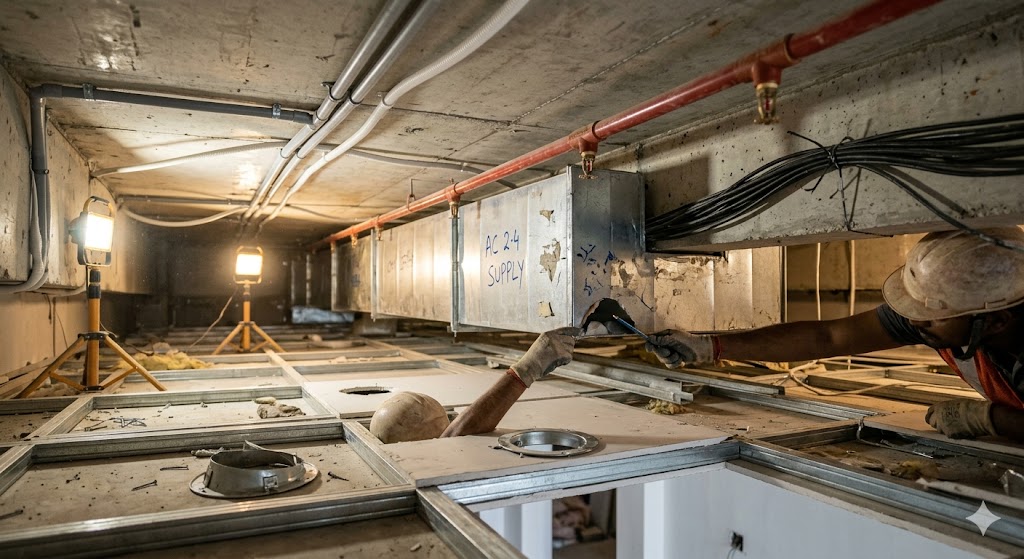
4.1 False Ceilings, Lighting, AV
The zone: The 100–300 mm depth between structural slab soffit and finished ceiling — where AC ducting, electrical conduits, sprinkler runs, recessed lighting housings, AV cabling, and structural beams compete for space.
The boundary problem: The interior designer designs the visible ceiling pattern (cove lights, recessed downlights, decorative bulkheads) without site-coordination access to the MEP layouts; the MEP consultant runs ducts to the most efficient path without seeing the IDs's lighting plan; the architect signs off on the reflected ceiling plan but rarely re-coordinates after IDs revisions.
The discipline: Reflected ceiling plan is one drawing, not three. The architect or IDs is the single author; the other reviews. The MEP consultant's services drawings overlay the RCP. Site-stage clash resolution is the architect's call — not the contractor's improvisation.
Liability: Cracks at gypsum-MS joints from improperly distributed ceiling loads, AC condensation drips through over-cut lighting cut-outs, and sprinkler activation through poor duct-light coordination are all liability events. The architect carries primary liability if the RCP was not coordinated; the IDs carries shared liability if the IDs revised the plan post-coordination without re-review.
4.2 Modular Kitchens & Wardrobes
The zone: The interface between built-in modular furniture (kitchens, wardrobes) and the surrounding architecture — wall finishes, electrical points, water/drainage points, exhaust outlets, ventilation.
The boundary problem: The IDs (or the modular vendor — IKEA, Sleek, Häfele, Godrej Interio) designs the modular layout late in the project; the architect's electrical and plumbing GFC was finalised based on a different layout; site-stage rework includes chasing walls for additional points, drilling cores for chimney exhausts, or relocating water lines.
The discipline: Modular kitchen and wardrobe layouts must be locked at GFC stage, not at fit-out stage. If the homeowner has not finalised the modular vendor by GFC, the architect provides a generic kitchen and wardrobe brief with provisional points and a 10–15% contingency for relocation. The IDs's brief includes a deadline for vendor finalisation matched to the GFC milestone.
Liability: Late-stage relocation of plumbing or electrical points that compromises waterproofing, structural rebar, or fire-stopping is a serious liability event. The IDs carries primary liability if the relocation was IDs-instructed without architect review; the architect carries shared liability if the GFC was permitted to proceed with insufficient kitchen/wardrobe definition.
4.3 Wet-Area Waterproofing & Sanitary Fittings
The zone: Bathroom, kitchen, balcony, terrace — wherever water and finishes meet.
The boundary problem: Three roles overlap here. The architect specifies the waterproofing system (membrane type, IS code reference — IS 12200, IS 8543, IS 13182 — bond-coat, fall-direction). The interior designer specifies the sanitary fixtures, tile pattern, and finish details. The contractor executes both. When water leaks appear at month 18, the question is whose specification was inadequate or whose execution failed.
The discipline: The waterproofing specification is the architect's, not the IDs's, even if the tile and fixture choices are the IDs's. The architect's drawings must show waterproofing extent (typically 1.8 m vertical in showers, full floor + 300 mm vertical elsewhere), membrane brand/grade, fall direction, and bond-coat detail. The IDs's drawings must show tile coursing, niche locations, and fixture positions but cannot override the waterproofing specification.
Liability: Refer to the waterproofing guide; the liability split is architect-specification, contractor-execution. The IDs carries liability only if IDs-led changes to fixture or tile layout compromised the specification (e.g., a niche cut into a waterproofed wall without re-membraning).
4.4 Façade Lighting & Landscape
The zone: Exterior building face, terrace gardens, courtyards, driveways.
The boundary problem: Architects design the façade and the major landscape; interior designers sometimes propose façade lighting (especially for premium residential where the IDs's brief includes "exterior ambience"); landscape consultants — when engaged — operate as a fourth role with their own drawings; contractors execute. Lighting on the façade interacts with electrical safety codes (IS 732, NBC Part 8) that the IDs may not be familiar with.
The discipline: Façade and landscape are within the architect's scope by default. If the IDs's contract includes façade lighting, the IDs's design must be reviewed and approved by the architect for code compliance and aesthetic coherence with the architectural intent. A separate landscape consultant, when engaged, is contracted by the architect or by the client through the architect's coordination — never separately to the IDs.
Liability: Electrical hazards from non-IS-732-compliant outdoor wiring are architect-and-contractor liability events. Aesthetic inconsistency between IDs-led façade lighting and architectural intent is a contractual disagreement, not a liability event.
4.5 FF&E (Furniture, Fixtures & Equipment) at Handover
The zone: Loose furniture, soft furnishings, art, plants, kitchen appliances, electronics, curtains.
The boundary problem: FF&E is unambiguously the IDs's scope when an IDs is engaged. When no IDs is engaged, FF&E falls into a gap — the architect's contract typically excludes FF&E, the contractor's scope ends at fit-out, and the homeowner is left to source independently. The result, in many no-IDs projects, is a finished house at 95% completion that "doesn't feel finished" because curtains, lighting fixtures, and furniture are missing or mis-scaled.
The discipline: The architect's engagement letter must explicitly state whether FF&E is in scope, partially in scope, or out of scope. If out of scope, the architect must advise the client to engage an IDs for FF&E or to budget time and expertise for self-procurement. The architect's scope is not extended implicitly into FF&E by the absence of an IDs.
Liability: None — FF&E is contractual, not liability-driven. The risk is reputational (an architect's project that "feels unfinished" reflects on the architect's reputation regardless of the contracted scope).
5. The Liability Matrix
Liability across the three roles is allocated by a combination of statute, common-law tort, and contract. The matrix below summarises the primary, secondary, and shared liability for the recurring failure modes.
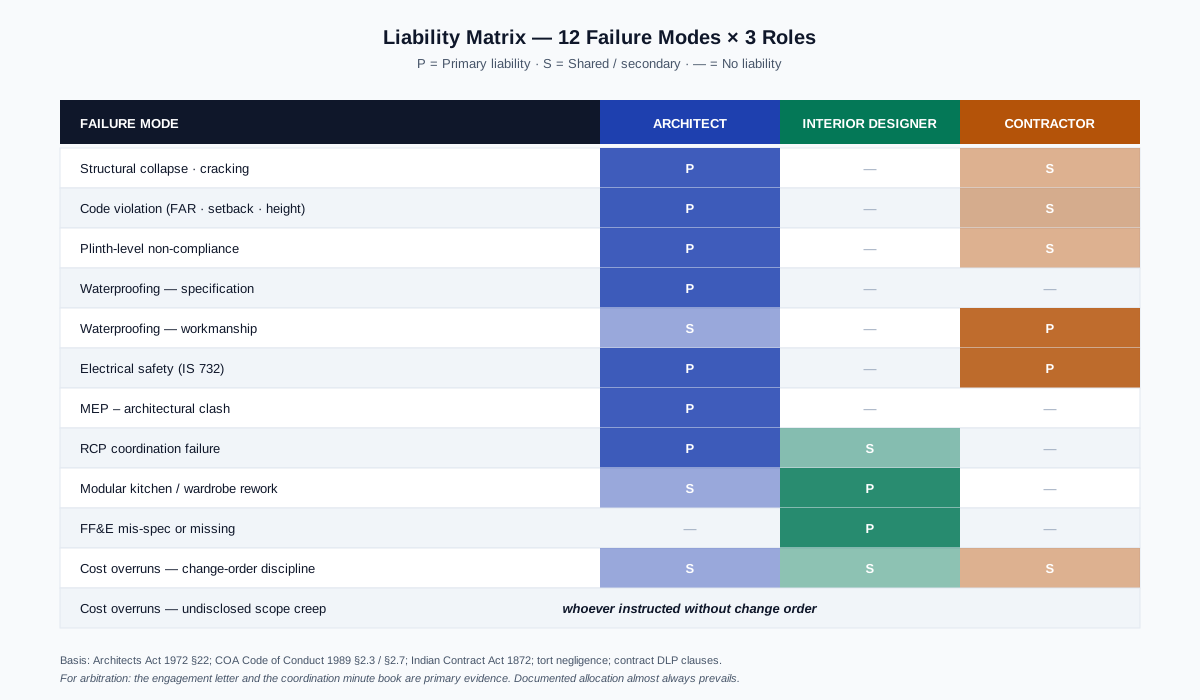
| Failure Mode | Primary | Shared | Basis |
|---|---|---|---|
| Structural collapse, major cracking | Architect (with structural engineer) | Contractor (workmanship) | Architects Act §22, COA Code §2.3, tort negligence |
| Code violation (FAR, setback, height) | Architect | Contractor (if executed beyond plan) | Statutory; municipal action |
| Plinth-level non-compliance | Architect | Contractor | Architects Act, BBMP/MCGM bye-laws |
| Waterproofing failure (specification) | Architect | — | Contract; IS 12200 reference |
| Waterproofing failure (workmanship) | Contractor | Architect (supervision) | Contract; defect-liability period |
| Electrical safety (IS 732 non-compliance) | Architect (specification) + Contractor (execution) | — | Statutory; tort |
| MEP-architectural clash | Architect | MEP Consultant | Contract; coordination clause |
| RCP coordination failure | Architect | Interior Designer (if IDs-revised) | Contract; coordination clause |
| Modular kitchen / wardrobe rework | Interior Designer | Architect (if GFC inadequate) | Contract |
| FF&E mis-spec or missing | Interior Designer (if engaged) | — | Contract |
| Cost overruns (legitimate) | Shared per change-order discipline | — | Contract; Contingency guide |
| Cost overruns (scope creep, undisclosed) | Whoever instructed without change order | — | Contract; tort (breach of fiduciary duty) |
The matrix is not exhaustive but covers the twelve most common failure-allocation questions in residential arbitration. The architect's discipline is to internalise this matrix at engagement — not to memorise it but to ensure that the engagement letter and the contract framework reflect it.
6. Four Contractual Patterns
Indian residential projects are typically contracted under one of four patterns. Each has implications for boundary clarity, coordination cost, and liability allocation.
6.1 Single-Point Architect (architect-led)
The architect is contracted by the client for the full scope — architecture, interior design, contractor selection, and supervision. The IDs and contractor are sub-contracted by the architect (or by the client through the architect's coordination).
| Aspect | Single-Point Architect |
|---|---|
| Client contracts | Architect only |
| Coordination | Architect coordinates IDs and contractor |
| Liability | Concentrated on architect (deepest pocket exposure) |
| Fees | Architect ~10–15% of project cost; IDs and contractor sub-fees within architect's umbrella or separately quoted |
| Best for | Premium residential where the client values single-point accountability |
| Risk | Architect's single-point liability is high; PI insurance essential |
6.2 Tri-Party (parallel engagement, architect-coordinated)
The client contracts each of the three roles independently. The architect's contract includes a coordination clause that gives the architect coordination authority across the IDs and contractor scopes without contractual privity.
| Aspect | Tri-Party |
|---|---|
| Client contracts | Architect, IDs, Contractor — all separately |
| Coordination | Architect coordinates by clause, not contract |
| Liability | Distributed; each role liable for own scope |
| Fees | Architect ~6–10%; IDs ~4–8%; Contractor PMC ~3–5% |
| Best for | Mid-to-large residential where client wants distributed accountability |
| Risk | Coordination friction; architect's coordination authority must be contractually anchored |
This is the most common pattern for sophisticated residential clients in 2026 and the pattern this guide implicitly assumes. The coordination clause is the linchpin — see §7.
6.3 Design-Build (turnkey)
A single firm — typically a contractor with in-house design or an IDs with in-house construction — offers full delivery. The architect, where present, is engaged by the design-build firm (not the client) and signs the building plan submission.
| Aspect | Design-Build |
|---|---|
| Client contracts | Design-build firm only |
| Coordination | Design-build firm coordinates internally |
| Liability | Concentrated on design-build firm; architect liable for plan compliance only |
| Fees | Bundled; opacity of fee split is a known concern |
| Best for | Budget-driven small residential where client wants single-vendor simplicity |
| Risk | Architect's plan-signing without design control is professionally hazardous; only legitimate if the architect has full design authority within the design-build firm and is a credentialed in-house architect, not a hired-signature |
Architects approached to "sign the plan only" for design-build firms should refuse — see the plan-signature-only prohibition under COA Code of Conduct §2.7 (professional services to be performed personally; no certificate to be issued for work not personally supervised).
6.4 PMC Overlay (Project Management Consultant)
The architect, IDs, and contractor are engaged separately (as in tri-party), and a PMC is added as a fourth role with formal coordination authority across all three.
| Aspect | PMC Overlay |
|---|---|
| Client contracts | Architect, IDs, Contractor, PMC — four parties |
| Coordination | PMC coordinates by formal contract authority |
| Liability | Distributed; PMC liable for coordination failures |
| Fees | Adds 3–5% of project cost as PMC fee |
| Best for | Large residential (₹5+ crore) where coordination complexity warrants a dedicated role |
| Risk | Cost overhead; risk of architect/PMC scope conflict; only justified at scale |
Recommendation. For most residential projects in 2026, tri-party with a strong coordination clause is the optimal pattern. The architect's coordination authority is contractually anchored; the IDs and contractor maintain their own liability horizons; the homeowner has tri-party visibility without a four-party coordination overhead.
7. The Coordination Clause — Drafting Discipline
The coordination clause is the contractual instrument that anchors the architect's authority to coordinate across the IDs and contractor scopes in a tri-party engagement. A weak coordination clause leaves the architect with responsibility but no authority — the worst contractual position. A well-drafted clause defines what the architect can do, what the architect cannot do, and what happens when the IDs or contractor disagrees.
Minimum elements of a coordination clause:
1. Recital of tri-party engagement — naming the IDs and contractor and acknowledging that all three are engaged separately by the client.
2. Scope of architect's coordination — RCP coordination, MEP-IDs clash resolution, schedule integration, RA bill review, change-order review, defect-liability coordination.
3. Architect's reasonable instructions — IDs and contractor agree to comply with architect's reasonable instructions on coordination matters; reasonable defined as consistent with the architect's authenticated drawings and specifications.
4. Dispute resolution — disagreement between IDs and architect or contractor and architect on coordination is referred to the client; the client's decision binds both, and the architect's coordination role continues unaffected.
5. No usurpation of design authority — the architect's coordination authority does not extend to override the IDs's design choices within the IDs's scope, or the contractor's execution methods within accepted standards.
6. Coordination meeting cadence — weekly during construction, fortnightly during fit-out, monthly during DLP.
7. Coordination documentation — architect maintains the coordination minute-book; minutes are circulated to all three roles within 3 working days.
8. Compensation for coordination scope creep — additional coordination demands beyond the agreed scope (e.g., daily site presence) trigger a documented variation.
The full draft language is outside this guide's scope; the Contract Template utility generates a compliant template, and the Risk Index flags coordination-clause weaknesses.
8. Twelve-Test Diagnostic — Before Signing the Engagement
Before the architect signs the engagement letter for any multi-role residential project, the following twelve tests should pass. Failing any test is not necessarily a deal-breaker, but the failure must be remedied or formally accepted before scope-of-services is locked.
| Test | Question | Pass Criterion |
|---|---|---|
| 1 | Is the contractual pattern explicitly named? | Single-point / tri-party / design-build / PMC overlay — chosen and documented |
| 2 | Is the IDs engaged, named, and qualified? | If yes — IDs's qualifications and contract scope reviewed; if no — FF&E scope explicitly stated |
| 3 | Is the contractor selected, and on what basis? | Selection criteria, qualifications, and contract scope reviewed |
| 4 | Has the COA registration of the architect and CoA-recognised education been verified? | COA verification confirmed for record |
| 5 | Is the coordination clause drafted and accepted by IDs and contractor? | Clause language reviewed; signed acknowledgment recorded |
| 6 | Is the FF&E scope explicitly named (in / partial / out)? | Engagement letter contains explicit FF&E clause |
| 7 | Is the fee split agreed and acknowledged by the client? | Fee schedule and stage milestones documented |
| 8 | Is the change-order discipline named (cf. Contingency guide)? | Change-order process documented; contingency provisions stated |
| 9 | Is the coordination meeting cadence agreed? | Weekly / fortnightly / monthly cadence stated |
| 10 | Is the defect-liability period agreed across all three roles? | DLP terms documented; rectification protocol stated |
| 11 | Is professional indemnity insurance confirmed for the architect and (where applicable) the IDs? | PI policy active and disclosed |
| 12 | Is the scope-creep escalation path defined? | Architect / IDs / contractor → client → arbitration sequence stated |
Architects who sign engagements with three or more failing tests have an above-average probability of project disputes. The Red Flag Checklist operationalises this diagnostic.
9. Indian Regulatory Anchors — Quick Reference
| Source | Authority over | Relevance |
|---|---|---|
| Architects Act 1972 | Architects (statutory) | Defines the profession; reserves the title; requires COA registration |
| COA Code of Conduct 1989 | Architects | Professional duties; advertising restrictions; conflict of interest; minimum service standards |
| COA Conditions of Engagement and Scale of Charges 2020 | Architects | Canonical scope of services across nine stages; fee minimums (advisory) |
| IIID Code of Ethics | Interior Designers (members only) | Voluntary professional code; not statutorily binding on non-members |
| BOCW Act 1996 | Construction workers and contractors | Worker registration, labour cess (1% of project cost), safety standards |
| RERA 2016 | Real-estate promoters | Promoter registration (above 500 sqm or 8 units); applies to multi-unit residential, not owner-occupier homes |
| Indian Contract Act 1872 | All contracted parties | Foundational law of contract; coordination clause enforceability |
| NBC 2016 | All construction | National Building Code; structural, fire, plumbing, electrical, lifts |
| IS 12200 / IS 8543 / IS 13182 | Waterproofing | Specification basis for wet-area waterproofing |
| IS 732 | Electrical | Code of practice for electrical wiring installations |
| IS 4963 / NBC Part 3 §13 | Universal design | Accessibility specifications; cf. Universal Design guide |
| State Builders' Licensing Acts | Contractors (in some states) | Karnataka Builders' Licensing, Maharashtra equivalent — registration and class-of-work limits |
10. Common Boundary Disputes — Resolution Patterns
| Dispute | Pattern That Resolves It |
|---|---|
| IDs revised RCP without architect re-review; ducts now clash | Coordination minute referencing original RCP; IDs to bear cost of resolution since revision was unilateral |
| Contractor executed wall slot for kitchen exhaust without architect review; structural concern raised | Contractor to bear cost; architect's site-supervision clause invoked; structural engineer review required before further work |
| Client added FF&E demands mid-project; IDs claims out-of-scope | Engagement-letter FF&E clause referenced; if FF&E was named partial or out, client must engage IDs for the additional scope or accept architect-coordinated procurement assistance as a variation |
| Modular kitchen vendor finalised post-GFC; rework needed | Architect's GFC-deadline clause referenced; client / IDs to bear rework cost; architect's compliance review of revised points required |
| Waterproofing failure at month 18 | Investigation: was specification adequate (architect liable) or workmanship (contractor liable)? Contract DLP clause invoked; investigation by independent third-party recommended |
| Cost overrun, IDs blames architect's GFC quality, architect blames IDs's scope creep | Coordination minute book and change-order log reviewed; whichever role instructed work without documented change order bears the cost |
| Façade lighting design by IDs violates IS 732 | Architect's compliance-review veto; IDs to revise; cost of revision borne by IDs |
The pattern is consistent: the engagement letter and the coordination minute book are the primary evidence in any boundary dispute. Architects who maintain disciplined documentation almost always prevail in arbitration; architects who rely on informal coordination almost always lose contested positions.
11. Operational Workflow — A Day in the Life of Boundary Discipline
Boundary discipline is not a one-time engagement-letter event. It is a daily practice. The following workflow reflects what disciplined boundary-aware practice looks like in a typical residential project at month 8 — fully into construction, with fit-out planning underway.

Monday 09:30 — Weekly site coordination meeting. Architect chairs; IDs's representative, contractor's project manager, MEP consultant attend. Agenda: prior-week site progress, current-week schedule, RA bill status, material approvals pending, RFIs (Requests for Information), change orders pending. Architect's site engineer takes minutes; minutes circulated by EOD Tuesday.
Tuesday 11:00 — Architect reviews IDs's revised RCP for the master bedroom (IDs proposed a cove-light addition). Architect identifies clash with AC duct routing; sends to IDs with redlined drawing requesting revision. Coordination minute logged.
Wednesday 14:00 — Site visit. Architect observes contractor has pre-cast a wall slot for the kitchen exhaust per IDs's modular-kitchen-vendor's specification. Slot was not on the architect's GFC. Architect halts work, calls structural engineer for review. Notice issued to contractor. Meeting scheduled with IDs and modular vendor for Friday.
Thursday 10:00 — Change-order review. Three change orders pending — IDs-instructed cove-light addition (cost ~₹35,000), client-instructed marble upgrade in living room (cost ~₹2,40,000), and contractor-instructed substitution of cement brand (cost neutral but specification deviation). Architect reviews each, updates the change-order log, computes contingency drawdown. Client copy circulated.
Friday 15:00 — Friday review with client. Architect summarises week's coordination, flags the kitchen-exhaust slot incident, presents change orders for client decision. Client approves cove-light, defers marble upgrade pending budget review, approves cement substitution. Decisions logged in the change-order register.
This is the pattern. Boundary discipline is a paperwork discipline. The architect who maintains the coordination minute book, the change-order register, and the RFI log is the architect whose projects close on time with predictable economics. The architect who delegates these to the contractor or the IDs has, in effect, delegated authority and retained only liability — the worst position.
12. Companion Studio Matrx Guides
- How to Choose the Right Architect or Interior Designer in India — homeowner-side counterpart to this guide
- The Architect's Scope of Services in India — canonical COA scope reference
- Architect Fee Structures in India — fees by stage, comparator with IDs and PMC
- Working Drawings Documentation in India — single-author drawing discipline
- Site Supervision Checklist for Indian Architects — site-stage inspection items
- OC/CC and Plinth Verification in India — statutory close-out
- Contingency, Provisional Sums & Risk Allocation in Indian Construction Contracts — risk allocation matrix
- Where Projects Fail — A Causal Map for Indian Architects — boundary failures in context
- The Architect's Compliance Map — Bengaluru — city-specific authority chain
- The Architect's Compliance Map — Mumbai — city-specific authority chain
Companion Studio Matrx Tools
- Contract Template — coordination clause and tri-party engagement letter
- Red Flag Checklist — twelve-test diagnostic operationalised
- Risk Index — boundary-risk scoring across the four contractual patterns
- Approval Roadmap — city-by-city authority chain
- Construction Approval Checklist
- Site Inspection — daily site-stage checklist
- Pre-Possession Checklist — handover-stage checklist
13. References
Primary Statutes and Codes
- Architects Act 1972 (Act No. 20 of 1972) — establishment of the Council of Architecture; reservation of the title; registration framework.
- Council of Architecture (Professional Conduct) Regulations 1989 — Code of Conduct of Architects; advertising; minimum standards.
- COA Conditions of Engagement and Scale of Charges 2020 — canonical scope of services and fee schedule.
- Building and Other Construction Workers Act 1996 — worker registration; labour cess.
- Real Estate (Regulation and Development) Act 2016 — promoter registration; project disclosures.
- Indian Contract Act 1872 — foundational contract law.
- National Building Code of India 2016 — Parts 3, 7, 8 — structural, building safety, plumbing, electrical.
Indian Standards Referenced
- IS 12200 — Code of practice for waterproofing.
- IS 8543 — Methods of test for waterproofing materials.
- IS 13182 — Code of practice for waterproof barrier in basements and other places.
- IS 732 — Code of practice for electrical wiring installations.
- IS 4963 — Recommendations for buildings and facilities for the physically handicapped.
Voluntary Professional Codes
- Indian Institute of Interior Designers (IIID) Code of Ethics — voluntary; applies to members.
- Indian Institute of Architects (IIA) Best Practices Manual — practice guidance for architect members.
Practice Notes and Commentary
- COA Bulletins — periodic notifications from the Council of Architecture on professional conduct, fee revisions, and disciplinary cases.
- CREDAI Industry Reports — developer-side perspective on contractor scope and RERA compliance.
- Construction Law Reporter (Sweet & Maxwell India) — case digests on residential disputes and arbitration awards.
- Architecture - Time, Space & People — Council of Architecture monthly journal, peer-reviewed editorial board.
Peer-Reviewed Academic References — Indian Construction Practice
The empirical Indian construction-management literature is the strongest source for understanding why boundary-coordination failures recur and how they are most reliably mitigated. The studies below are widely-cited foundations.
- Iyer, K. C., & Jha, K. N. (2005). Factors affecting cost performance: Evidence from Indian construction projects. International Journal of Project Management, 23(4), 283–295.
- Doloi, H., Sawhney, A., Iyer, K. C., & Rentala, S. (2012). Analysing factors affecting delays in Indian construction projects. International Journal of Project Management, 30(4), 479–489.
- Doloi, H. (2013). Cost overruns and failure in project management: Understanding the roles of key stakeholders in construction projects. Journal of Construction Engineering and Management, 139(3), 267–279.
- Jha, K. N., & Iyer, K. C. (2007). Commitment, coordination, competence and the iron triangle. International Journal of Project Management, 25(5), 527–540.
- Mahalingam, A., & Levitt, R. E. (2007). Institutional theory as a framework for analyzing conflicts on global projects. Journal of Construction Engineering and Management, 133(7), 517–528.
- Iyer, K. C., & Jha, K. N. (2006). Critical factors affecting schedule performance: Evidence from Indian construction projects. Journal of Construction Engineering and Management, 132(8), 871–881.
Peer-Reviewed Academic References — Coordination, Dispute & Risk
International scholarship on construction disputes, risk allocation, and coordination — the conceptual basis for the liability matrix and the four contractual patterns in this guide.
- Mitropoulos, P., & Howell, G. (2001). Model for understanding, preventing, and resolving project disputes. Journal of Construction Engineering and Management, 127(3), 223–231.
- Cheung, S. O., & Yiu, T. W. (2007). A study of construction mediator tactics. Construction Management and Economics, 25(7), 691–700.
- Chan, D. W. M., & Kumaraswamy, M. M. (1997). A comparative study of causes of time overruns in Hong Kong construction projects. International Journal of Project Management, 15(1), 55–63.
- Loosemore, M., & McCarthy, C. S. (2008). Perceptions of contractual risk allocation in construction supply chains. Journal of Professional Issues in Engineering Education and Practice, 134(1), 95–105.
- Chan, A. P. C., & Chan, A. P. L. (2004). Key performance indicators for measuring construction success. Benchmarking: An International Journal, 11(2), 203–221.
- Bresnen, M., & Marshall, N. (2000). Partnering in construction: A critical review of issues, problems and dilemmas. Construction Management and Economics, 18(2), 229–237.
Peer-Reviewed Academic References — Interior Design as a Profession
The scholarship anchoring the functional (non-statutory) basis of the interior-design profession and the boundary with architectural practice.
- Guerin, D. A., & Martin, C. S. (2010). The interior design profession's body of knowledge and its relationship to people's health, safety, and welfare. Journal of Interior Design, 36(2), v–xv.
- Martin, C. S., & Guerin, D. A. (2006). Using research to inform design solutions. Journal of Facilities Management, 4(3), 167–180.
- Anderson, B. G., Honey, P. L., & Dudek, M. T. (2007). Interior design's social compact: Key to the quest for professional status. Journal of Interior Design, 33(2), v–xiii.
Standard Treatises and Commentaries
- Murdoch, J., & Hughes, W. (2015). Construction Contracts: Law and Management (5th ed.). Routledge.
- Bunni, N. G. (2003). Risk and Insurance in Construction (2nd ed.). Spon Press.
- Atkin, B., & Borgbrant, J. (Eds.). Performance Improvement in Construction Management. Spon Press.
- Pollock, F., & Mulla, D. F. The Indian Contract and Specific Relief Acts (current edition). LexisNexis.
- Hudson, A. A. Hudson's Building and Engineering Contracts (current edition). Sweet & Maxwell.
- Furst, S., & Ramsey, V. Keating on Construction Contracts (current edition). Sweet & Maxwell.
Indian Legal Periodicals
- National Law School of India Review (NLSIR) — peer-reviewed law journal; articles on RERA jurisprudence, construction-arbitration enforceability, and Indian Contract Act §73 damages computation in construction disputes.
- NUJS Law Review (West Bengal NUJS) — peer-reviewed; articles on consumer-protection overlap with RERA in residential transactions.
- Indian Journal of Arbitration Law (IJAL) — peer-reviewed student-edited journal at NLU Jodhpur; construction-arbitration commentary.
- Indian Council of Arbitration — ICA Arbitration Quarterly — case digests on Indian construction arbitration awards.
Companion Studio Matrx Guides
See §12 above for the full cross-reference list.
Author's Note: The architect who masters boundary discipline is the architect whose residential practice is sustainable across project sizes, client types, and contractual patterns. Boundary failures are not glamorous — they are not the dramatic structural failures that make news, nor the elegant design moves that win awards. They are the quiet, recurring, fully-preventable disputes that consume project margin, client trust, and professional reputation. The architect's discipline is not to avoid the boundary — interior designers and contractors are essential collaborators whose scopes the architect needs and respects — but to name the boundary, document it, and re-affirm it weekly through the coordination minute book. Boundary discipline is the architect's most underrated competitive advantage in Indian residential practice. The map in this guide is the discipline, and its daily practice — through the coordination meeting, the RFI log, the change-order register, and the engagement-letter scope-clause — is what separates the architect whose projects close cleanly from the architect whose projects close in arbitration.
Disclaimer: This article is for informational and educational purposes only. It does not constitute legal advice or a substitute for engagement-specific contract drafting. The Architects Act 1972, the COA Code of Conduct 1989, the IIID guidelines, and the state-level Builders' Licensing frameworks are subject to amendment and to state-specific notifications. Architects must verify the current text of all referenced statutes and codes at the time of any specific engagement, and engage qualified construction-law counsel for the drafting and negotiation of engagement letters and coordination clauses for projects of significant scale. Studio Matrx, its authors, and contributors accept no liability for decisions based on this guide.
Interactive · Architect / Designer / Contractor scope Venn
Architect only · 5 items
Architect only
Statutory and design-leadership scope. No one else can sign these.
Items in this zone
- ▸Statutory drawings & municipal sanction submission
- ▸Structural concept (in coordination with structural engineer)
- ▸Building envelope design — facades, openings, sections
- ▸Concept design & 3-D massing
- ▸Vastu / passive design integration into form
Where boundaries break
If the contractor or designer drafts these, you have lost design accountability.
The boundary differs by appointment letter — get it in writing for your project. Default to this allocation only when the contract is silent.
Export this guide
Related Guides — Deep-dive reading
Snagging & Punch List Standards for Handover
RERA 2016 §14, the COA Stage-8 Discipline, IS 13311 / IS 1542 / IS 14687 / NBC 2016 Part 6, RICS Snagging Standards — Three-Tier Severity Classification, the Eight Defect Zones, Tolerance Tables, the Punch-List Document Protocol, Retention-Tranche Discipline, and the Architect-Led Handover Workflow for Indian Residential Practice in 2026
ConstructionBathroom Planning for New Homes in India: Get It Right Before You Build
The bathroom decisions you cannot undo once the slab is cast — location and stacking, sunken vs non-sunken slabs, waterproofing, and the plumbing, electrical and ventilation you must coordinate with the civil work, stage by stage.
BathroomsDesign/Build vs. Hiring Separately: What Indian Homeowners Should Know
The procurement-model decision behind every home project — one turnkey firm that designs and builds, or an independent designer and a separately appointed contractor — and how to choose the one that fits your time, budget, and appetite for control.
Planning Your ProjectRelated Tools — Try Free
Pre-Possession Inspection Checklist
Inspect your flat before registration — 10 categories, 70+ checkpoints across legal, carpet area, structure, finishes, and deviations.
Homebuyer ChecklistFalse Ceiling Cost Estimator
Live ₹/sqft across 8 ceiling types — POP, gypsum, designer, metal, PVC, wooden — with cove and spot lighting for 20 Indian cities.
Cost CalculatorFull-Room BOQ — Living, Bedroom, Kitchen, Bath
Room-wise BOQ across living, bedrooms, kitchen, utility, and bathrooms with line-item pricing.
Full-Room BOQ