
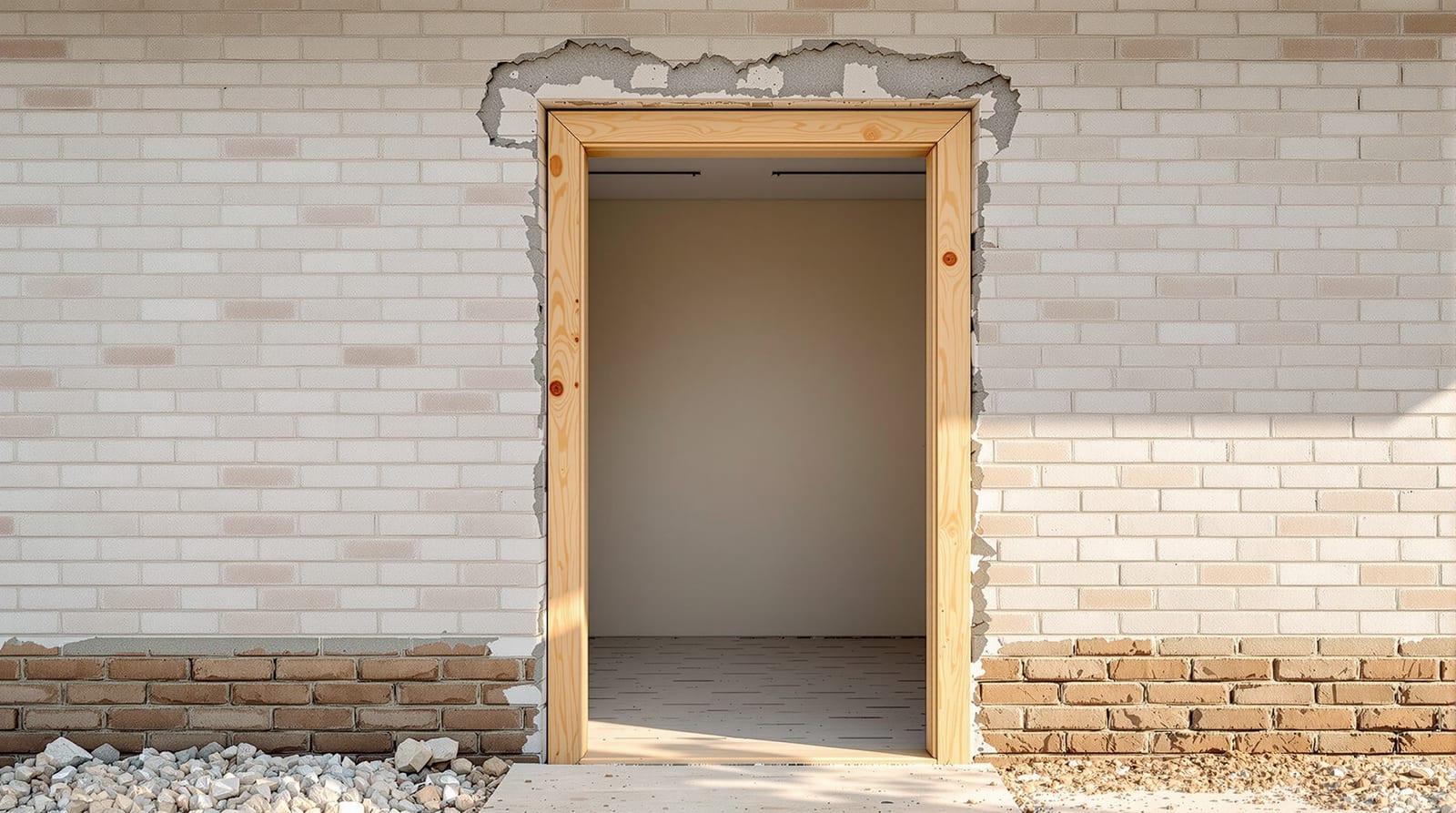
Door Frames (Chowkhat): The Complete Guide India 2026
What a door frame is, its parts, every material choice, sizing, fixing and finishing — and how it ties into thresholds and installation.
The door frame — what most Indian carpenters call the chowkhat — is the timber, steel, WPC or cement surround that lines the wall opening and carries the door leaf on its hinges. It is the single most under-thought part of a door: people obsess over the leaf finish and the handle, then wonder why the door won't latch, drags on the floor, or rots at the base after one monsoon. Almost every door problem on site traces back to the frame — its material, its size, how square it was set, and how it was fixed into the masonry. This guide is the gateway to the whole door frames cluster: it explains the parts, the material choices, sizing, fixing and finishing, and points you to the deep dives on each. For the larger picture, start from the complete door guide.
What a door frame is and what it does
A frame does four jobs. It transfers the leaf's weight into the wall through its jambs. It gives the leaf something true and plumb to shut against — the rebate. It separates the door assembly from the rough masonry so the gap can be sealed against air, water, sound and pests. And it carries the hardware loads — hinges, lock strike, closer — without flexing. A frame that is the wrong material for its location (untreated timber in a bathroom), the wrong section for its leaf weight, or set out of plumb will fail at one or more of these jobs. Everything else in this guide flows from those four functions.
Anatomy: the parts of a chowkhat
Learn the vocabulary and the rest of the cluster reads easily. The deep version is in door frame anatomy.
| Part | What it is | Notes |
|---|---|---|
| Head | Top horizontal member | Spans the opening, sits under the lintel |
| Jambs (posts) | The two verticals | Carry hinge and lock loads |
| Sill | Bottom member | Often omitted on internal doors; vital on external |
| Rebate (check) | Recess the leaf shuts into | Depth = leaf thickness; width ~12–15mm |
| Horn | Jamb projection embedded in floor/wall | ~10–15cm; cut off for internal frames |
| Transom | Horizontal divider under a fanlight | For doors with a glazed top light |
| Mullion | Vertical divider | For door-plus-sidelight combinations |
The rebate is the heart of the frame — see door frame rebate. A single rebate suits one leaf; a double rebate suits double doors or better weather-sealing. The cross-sectional shape (plain, rebated, with planted stops or grooves) is the frame profile — explained in door frame profiles.
Frame materials: choosing the right one
The biggest single decision is material, because India's termites, monsoon damp and wet bathrooms punish the wrong choice. The full comparison is in door frame materials; each material has its own deep dive.
| Material | Indicative cost | Best for | Watch-outs |
|---|---|---|---|
| Seasoned hardwood (sal/sheesham) | ₹250–600/rft | Internal doors, dry areas | Needs anti-termite + DPC at foot |
| Teak | ₹700–1,200/rft | Main doors, premium | Cost; verify it is genuine teak |
| WPC frame | ₹180–400/rft | Bathrooms, wet areas | Lower screw-holding than timber |
| uPVC frame | profile-priced | uPVC door systems | Match to the door system |
| Aluminium frame | profile-priced | Glass/aluminium doors | Thermal bridging; needs gaskets |
| Pressed/GI steel frame | ₹1,200–3,000/frame | Commercial, fire, security | Rusts if not galvanised; grouted in |
| RCC / precast cement | ₹600–1,500/frame | Budget, wet areas | Brittle; hard to re-screw |
As a rule of thumb: teak or seasoned hardwood for the main door, WPC, RCC or aluminium for bathrooms and balconies (never untreated timber on a wet floor), and steel where fire rating or security matters. Dive deeper via wooden door frames, WPC door frames, and steel door frames. To narrow it down quickly, the door frame material selector walks you through location, budget and exposure.
Whatever the material, the corners must be joined properly: timber uses mortise-and-tenon (often dowel-pinned, haunched at the head), steel is welded, uPVC is welded or mechanically jointed. Weak joinery means a frame that racks out of square — see door frame joinery.
Sizes and openings
Get the size right at the masonry stage and everything downstream is easier. Standard leaf sizes (width × height) run: main door 900–1200 × 2100mm, internal 750–825 × 2000–2100mm, bathroom 600–750 × 1980–2100mm. India uses a modular designation where 1M = 100mm, so a 10×21 frame is 1000×2100mm. IS 4021 covers timber frames, IS 4351 covers steel frames.
Crucially, the rough (structural) opening is the frame's outer size plus roughly 10–12mm of packing/grout gap on each side, and you must provide a lintel or RCC header over it with at least 150–200mm bearing each side. Full numbers are in door frame sizes, the opening itself in door rough opening, and the header in door lintel requirements. The door rough opening calculator does the arithmetic for you. NBC 2016 sets minimum egress widths and the RPwD Act 2016 with the Harmonised Guidelines 2021 governs accessible widths and thresholds — never specify a sub-standard width on a main circulation door.
Fixing the frame into the wall
A frame is only as good as its anchoring. Timber frames are traditionally fixed with M.S. holdfasts — flat clamps embedded in the masonry with cement concrete, typically three per jamb for a 2.1m frame — or with lugs/cramps, or with modern screws and rawl-plug fasteners. Steel frames are built into the wall and grouted, back-filled with 1:3 cement mortar. The golden rule on any frame: pack solidly behind the hinge and lock points so the jamb cannot bow when the hardware is loaded.
| Method | Use on | Key detail |
|---|---|---|
| M.S. holdfasts | Timber in masonry | 3 per jamb, set in cement concrete |
| Lugs / cramps | Timber, steel | Built in as the wall is raised |
| Screws + fasteners | Retrofit, drywall | Pack behind every fixing point |
| Grouting | Steel frames | 1:3 cement mortar back-fill |
The deep dives are door frame fixing methods, anchoring to masonry, and grouting steel frames. Fixing into hollow block or drywall is a special case — see drywall frames. This is where a skilled carpenter or site engineer earns their fee: a frame set out of plumb by even 3–4mm will give you a door that won't latch or that swings open on its own.
Thresholds, sills and damp
The bottom of the frame is where India's water problems live. An external door needs a sloped sill with a throating/drip groove to shed monsoon water, plus a weather bar at the leaf base; granite saddles are the durable Indian standard. For accessibility, the RPwD/Harmonised Guidelines want thresholds ≤12–13mm — bevelled if over 6mm, preferably flush, with an external drainage channel. Traditionally a raised main-door umbara (threshold) is considered auspicious in Vastu, and practically it blocks water and dust. The frame foot must always sit on a DPC and never on a wet floor. Learn more in door thresholds, zero-threshold doors, and damp-proofing the frame.
Finishing and sealing
Once the frame is hung, an architrave/casing (timber, MDF or WPC, ₹40–150/rft, mitred at the corners) covers the frame-wall junction. The gap behind it is filled with low-expansion PU foam or packers, and the visible joint is sealed — paintable acrylic caulk inside, silicone outside and in wet areas. Frames are finished with enamel paint, melamine/PU polish, or laminate to match the leaf. See architraves and trim, gap filling, and frame finishing. GST on hardware and joinery is generally 18%.
For costs across the whole job, the existing door frame cost guide and the door frame timber calculator help you budget the section before you buy.
Frequently asked questions
What does "chowkhat" mean?
Chowkhat is the common Indian (Hindi/Urdu) word for the door frame — the surround of head, jambs and (sometimes) sill that lines the opening and carries the leaf. It is the same thing as a door frame or casing.
Which frame material is best for a bathroom?
Never untreated timber. Use a WPC, RCC/precast cement, aluminium or uPVC frame, because these resist water and termites. WPC is the popular middle path; RCC is the cheapest and fully waterproof but brittle and hard to re-screw. Always sit the frame on a DPC and slope the threshold away.
How many holdfasts does a timber frame need?
As a rule of thumb, three M.S. holdfasts per jamb for a standard 2.1m frame, embedded in the masonry with cement concrete, plus solid packing behind the hinge and lock points so the jamb cannot bow. IS 4021 covers timber frame fixing.
What is the rebate on a door frame?
The rebate (or check) is the L-shaped recess in the frame that the door leaf shuts into. Its depth equals the leaf thickness and its width is typically 12–15mm. A single rebate takes one leaf; a double rebate suits double doors or weather-sealed external doors.
Does a raised threshold conflict with accessibility?
It can. A high traditional umbara helps with Vastu and water control but is a trip and wheelchair barrier. The RPwD Harmonised Guidelines want thresholds ≤12–13mm, bevelled or flush, on accessible routes. The fix is a low, bevelled granite saddle with an external drainage channel rather than a tall step.
Can I install a door frame myself?
You can fit a simple internal frame with care, but setting a frame truly plumb, level and square — and packing it so the leaf latches and the gaps are even — is skilled work. For main doors, heavy leaves, wet areas and steel frames, use an experienced carpenter or site engineer; a frame out of plumb by a few millimetres causes most door faults.
Export this guide
Related Guides — Deep-dive reading
Door Frame Fixing Methods: Holdfasts & Anchors (India 2026)
How to fix a chowkhat to masonry with M.S. holdfasts, lugs, screws and frame anchors — numbers, spacing and packing that keep the frame true.
Home Doors & EntrancesDoor Frame Anchoring to Masonry: Holdfasts (India 2026)
How to anchor timber, steel and WPC door frames into brick, concrete block, AAC and RCC walls — fixings, edge distance, loads and India site realities.
Home Doors & EntrancesConcrete Door Frames in India: RCC Chowkhat Guide (India 2026)
Why precast cement-concrete door frames win on cost and durability in budget housing and wet areas, and where they fall short.
Home Doors & EntrancesRelated Tools — Try Free
Door Material Comparison Tool
Compare 2–4 door materials on cost, durability, maintenance, security and moisture resistance.
Comparison ToolWindow Hardware Cost Calculator
Estimate window hardware cost — hinges, handles, locks, rollers and multipoint gears.
Window CalculatorWindow Material Comparison Tool
Compare uPVC, aluminium, wood, steel and composite windows on cost, life, upkeep and insulation.
Compare