
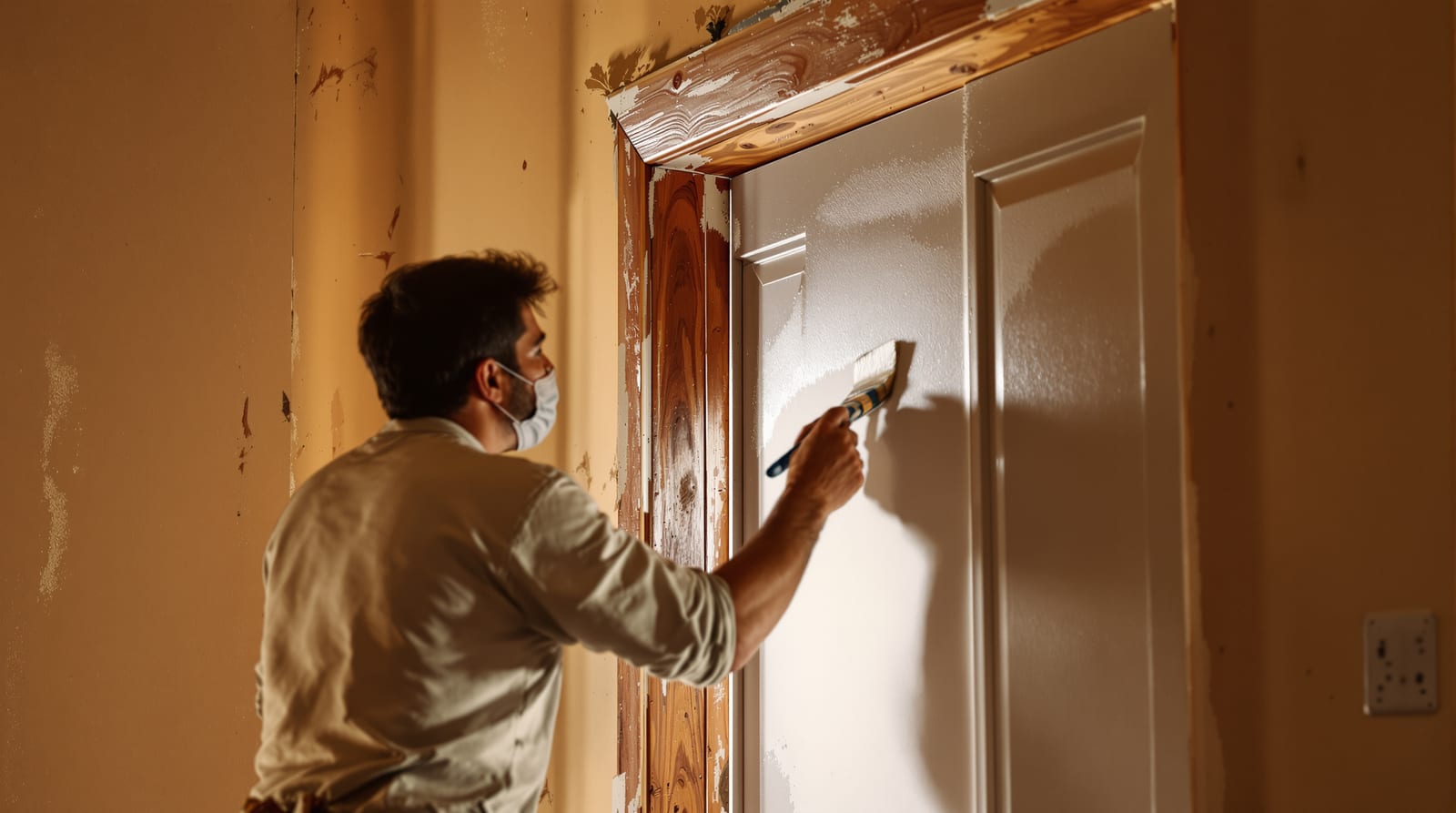
Door Frame Finishing in India: Paint, Polish & PU (India 2026)
How to finish the chowkhat to match your door leaf — primer-enamel, melamine and PU polish, laminate, veneer and WPC coatings, with surface prep, durability and ₹ bands.
Most homeowners obsess over the door leaf and forget the chowkhat — yet a beautifully polished leaf hung in a chalky, half-painted frame looks unfinished and ages badly. Door frame finishing is the coat that protects the frame (head, jambs and rebate) from handling marks, monsoon damp and termite-prone ground contact, and it is what makes the frame read as one piece with the leaf. This guide walks Indian homeowners through every realistic option — primer-and-enamel paint, melamine or PU polish on seasoned timber, laminate or veneer to match the leaf, and PU coating on WPC and uPVC frames — with honest notes on surface prep, durability and ₹ cost bands. For the frame itself, see the door frames phase pillar; for the whole door system, the complete door guide.
Why the frame finish matters
The frame takes more abuse than people expect: shoulders brushing the jamb, the rebate edge catching the leaf, mop-water at the base, and — in bathrooms and entrances — relentless damp. IS 4021 (timber door, window and ventilator frames) assumes seasoned, treated timber, but the finish is the only thing standing between that timber and India's two enemies: moisture and termites. A frame foot that wicks water from a wet floor will rot from the bottom up no matter how good the topcoat; this is why finishing and damp-proofing go together, and why the frame should sit on a DPC or stone block, never a bare wet screed.
A finish does three jobs at once: it seals the timber against moisture, it protects against knocks and abrasion, and it matches the frame to the leaf so the opening looks intentional. Get one of those wrong and the whole door reads as a builder's afterthought.
The finishing options at a glance
| Finish | Best for | Look | Durability | ₹ band (per frame, material + labour) |
|---|---|---|---|---|
| Primer + enamel paint | Painted leaves, budget, repaintable | Opaque, any colour | 4-7 yrs, easy to refresh | ₹400-900 |
| Melamine polish (timber) | Showing the grain, internal frames | Matt/satin natural wood | 3-5 yrs, re-coats well | ₹600-1,400 |
| PU polish (timber) | Premium teak, high-traffic, wet-prone | Deep, tough, glossy or matt | 6-10 yrs, hardest film | ₹1,000-2,500 |
| Laminate / veneer | Matching a laminated/veneered leaf | Identical to leaf face | 8-12 yrs (laminate) | ₹500-1,500 |
| PU coat on WPC/uPVC | Bathroom, balcony, water zones | Solid colour or wood-look | Long; frame itself is waterproof | ₹300-800 |
Bands are indicative — "as a rule of thumb" — and vary with timber species, frame size and city labour. GST is 18% on hardware and most joinery materials. Always finish the frame to the same family as the leaf: a PU-polished teak door deserves a PU-polished teak frame, not a painted one.
Surface preparation — the part everyone skips
Ninety percent of a good frame finish is prep. Skip it and even the costliest PU peels within a monsoon.
For timber frames (paint or polish)
1. Sand along the grain — 120 grit to knock off mill marks, then 180-220 for the final pass. Round sharp arrises slightly so the finish doesn't thin at the edges.
2. Fill nail holes, knots and joinery gaps with wood putty (matched to stain) or, for paint, white putty; let it cure, then sand flush.
3. De-dust with a tack cloth; never coat over sanding dust.
4. Knot-seal resinous species (sal, pine) with shellac/knotting so resin doesn't bleed through.
5. Anti-termite the frame foot and any ground-contact face before finishing — see termite-proofing doors. The visible faces get the decorative finish; the embedded/back faces get a coat of primer or bituminous paint, not bare timber.
For WPC, uPVC and metal frames
WPC and uPVC need a light scuff sand (320 grit) and a solvent wipe so the PU or PU-acrylic top coat keys properly — they are slick by nature. Pressed-steel frames need de-rusting, a zinc-rich/red-oxide primer, then enamel; galvanised (GI) steel needs an etch primer first. RCC/precast cement frames take cement primer + exterior emulsion or enamel.
Matching the frame to the leaf
This is the design decision that separates a finished opening from a fitted one.
- Painted flush/panel leaf → prime and enamel the frame in the same colour (or a deliberate contrast — many Indian homes paint the frame white against a coloured leaf, or vice-versa). Use the same sheen.
- Melamine/PU-polished timber leaf → polish the frame in the same stain and sheen. Bring a leaf offcut to the polisher to match the shade — site mixing rarely matches a factory leaf exactly.
- Laminated leaf → wrap the frame in the same laminate (or a co-ordinating edge laminate), glued and edge-banded. This is the cleanest match for the popular laminated flush-door look.
- Veneered leaf → veneer the frame in the matching species and PU-finish it; treat the frame and leaf as one batch so grain and tone agree.
For full method on the painted and polished routes, see the dedicated door painting guide and door polishing and refinishing guide. Whatever you choose, the architrave/trim around the frame should follow the same finish — see architraves and door trim.
The finish-layer stack
Choosing by location and durability
| Location | Frame material | Recommended finish | Why |
|---|---|---|---|
| Main entrance | Teak / hardwood | PU polish (matt or satin) | Hardest, UV-fair, premium match to leaf |
| Internal rooms | Hardwood / WPC | Melamine polish or enamel | Cost-effective, easy re-coat |
| Bathroom / wet | WPC / uPVC / RCC | PU-acrylic colour coat | Frame is waterproof; coat resists damp |
| Balcony / external | Teak / aluminium | Exterior PU or powder coat (metal) | UV and rain resistance |
| Budget / rental | Hardwood / steel | Primer + enamel | Cheapest, fully repaintable |
Durability honesty: PU is the toughest film and the most water- and abrasion-resistant, which is why it suits entrances and high-traffic frames; melamine is softer and gives a more "natural", lower-sheen wood look but needs re-coating sooner. Enamel paint is the easiest to refresh — a quick scuff-sand and two coats and it looks new — but chips show. In bathrooms, no timber finish saves an untreated timber frame standing on a wet floor; the right answer is a WPC or RCC frame with a colour coat, not a heavier polish.
Cost, time and getting it right
Finishing a single frame typically costs ₹400-2,500 depending on route, and adds 1-3 days (multiple coats need cure time between them — never rush a topcoat over a tacky undercoat). Spray-applied PU on site needs masking, ventilation and a skilled polisher; brush enamel is DIY-friendly. A few hard-won rules:
- Match sheen, not just colour — a satin frame against a glossy leaf looks mismatched even in the same shade.
- Finish the rebate too — the recess the leaf shuts into is visible when the door is open and abrades against the leaf edge.
- Don't finish over hardware — mask or remove hinges and strike plates; paint-clogged hinge knuckles bind the door.
- Mind the clearances — heavy paint/polish build-up on the rebate or stop can make the leaf rub; if the door starts catching after finishing, see fixing a door rubbing the frame.
- Seal the frame-wall junction separately with paintable acrylic caulk (internal) or silicone (wet/external) — covered in sealing around door frames.
To scope materials and budget before you start, the door frame material selector helps pick the right frame for the zone, and the door frame cost calculator gives a quick ₹ estimate including the finish. When in doubt — especially for spray PU or a laminate wrap — a skilled carpenter-polisher earns their fee in a clean, durable, leaf-matched result.
Frequently asked questions
Should the door frame match the door leaf exactly?
Ideally yes — same finish family, stain and sheen — so the opening reads as one piece. The simplest matches are a painted frame with a painted leaf, or a laminate-wrapped frame with a laminated leaf. A deliberate contrast (white frame, coloured leaf) is a valid design choice, but it should look intentional, not accidental.
Can I just paint over an old polished frame?
Not directly. Polish is a sealed, slick film — paint won't key to it. Scuff-sand thoroughly (or strip), apply a bonding/wood primer, then enamel. Skipping the sand-and-prime step is the commonest reason a repaint peels within a year.
What is the best frame finish for a bathroom in India?
The finish matters less than the frame material. Use a WPC, uPVC, RCC or aluminium frame — all waterproof and termite-proof — with a PU-acrylic colour coat or factory finish. An untreated timber frame on a wet bathroom floor will rot regardless of how good the polish is; if timber is unavoidable, treat the foot, sit it on a stone/RCC base and DPC, and PU-finish all faces.
Melamine or PU polish for a timber frame?
PU is harder, more water- and scratch-resistant and lasts 6-10 years, making it the better pick for entrances and high-traffic or damp-prone frames. Melamine is softer, gives a more natural matt look, costs less and re-coats easily — fine for internal, low-traffic frames.
How much does finishing a door frame cost in India?
As a rule of thumb, ₹400-900 for primer-and-enamel, ₹600-1,400 for melamine polish, and ₹1,000-2,500 for PU polish per frame (material plus labour), with laminate/veneer wraps around ₹500-1,500. Add 18% GST on materials and allow a day or two for coats to cure.
Export this guide
Related Guides — Deep-dive reading
Door Painting Guide for Indian Homes (2026): Prep, Paint, Coats & Cost
How to paint a door the right way — remove hardware, clean, sand, fill and prime, then choose enamel, PU or acrylic for wood, flush, metal or WPC doors, brush vs roller vs spray, the correct panel-door painting order, coats and monsoon drying caveats, with ₹ for a DIY repaint vs a painter.
Home Doors & EntrancesConcrete Door Frames in India: RCC Chowkhat Guide (India 2026)
Why precast cement-concrete door frames win on cost and durability in budget housing and wet areas, and where they fall short.
Home Doors & EntrancesBest Door Material in India (2026): The Right Choice for Every Room & Climate
A situation-by-situation verdict on the best door material for Indian homes - teak or steel for the main entrance, WPC or uPVC for bathrooms and coasts, engineered flush for bedrooms - with a by-location decision table and budget-vs-premium picks.
Home Doors & EntrancesRelated Tools — Try Free
Door Paint Calculator
Estimate paint and primer litres and cost to paint your doors by size, number of doors, coats and paint type.
Door CalculatorDoor Material Comparison Tool
Compare 2–4 door materials on cost, durability, maintenance, security and moisture resistance.
Comparison ToolPainting Prep & Quality Checklist
Painting audit — 10 categories, 65+ checkpoints across surface prep, putty, primer, emulsion coats, enamel, external, ceilings, defects, final QC.
Painting QC