
Architraves & Door Trim: Casing & Beading Guide (India 2026)
What architrave does, the right material and profile, clean mitred corners, fixing, finish and ₹/rft cost for Indian homes.
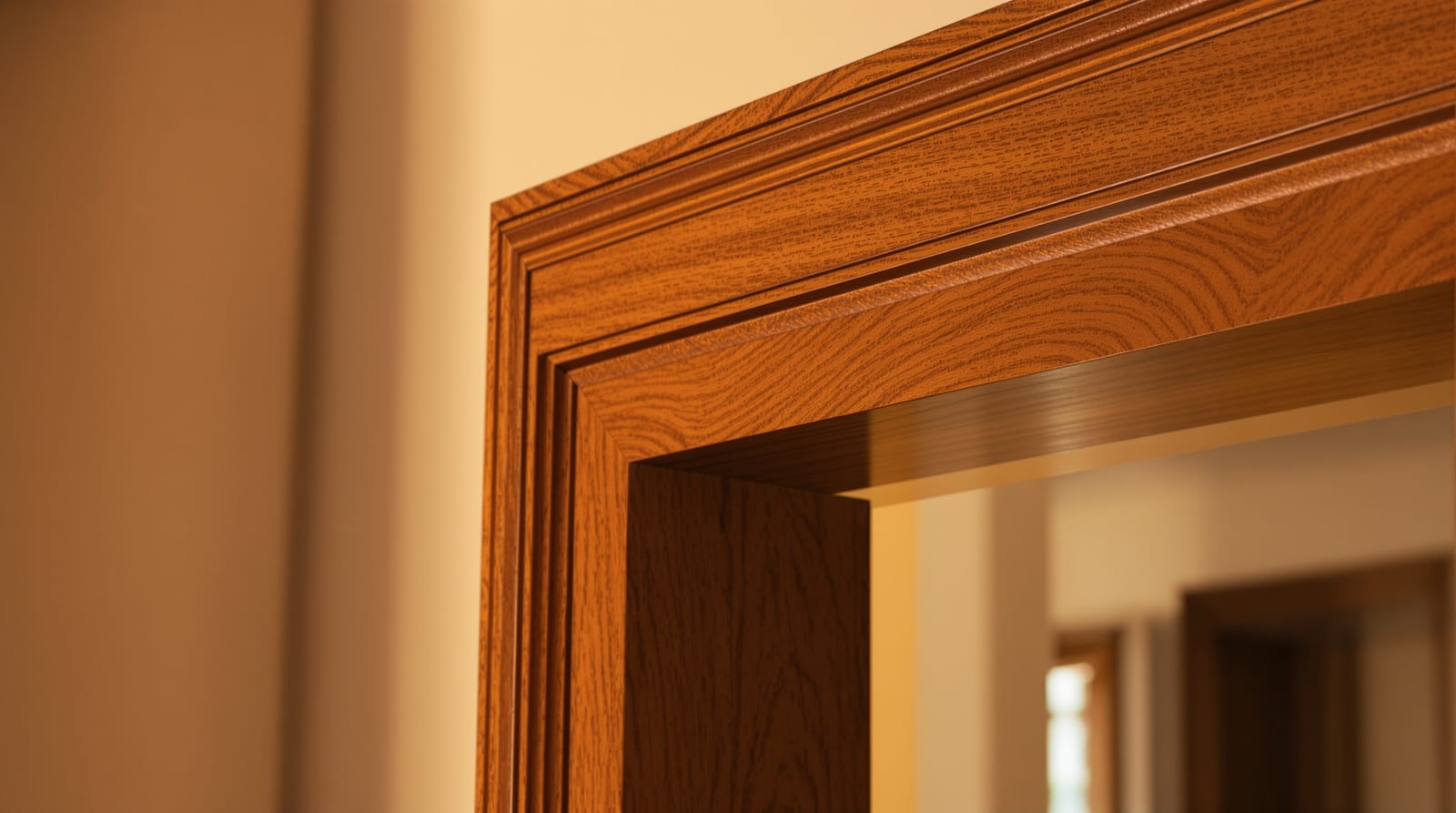
The architraves door trim is the decorative moulding that runs around the inside face of a door opening, framing the leaf and covering the always-imperfect joint where the frame (chowkhat) meets the plastered wall. Also called casing or beading, it is the last 5% of a door installation that decides whether the whole fitting looks crisp or cheap. A door can be hung true and the leaf can be flawless, but if the architrave is over-mitred, mismatched or caulked into a fat smear, the eye reads the door as badly built. This guide explains what architrave actually does, which material to choose for Indian conditions, how to size and profile it, how to cut clean mitres, how to fix and finish it, and what it costs per running foot.
What an architrave actually does
When a frame is set into a masonry opening there is always a packing gap of 10-12mm each side, filled with PU foam, mortar grout or packers. The plaster is then floated up to the frame, but the line between timber and plaster is never perfectly straight and tends to crack as the building moves and timber shrinks. The architrave is a cover strip that hides this junction, takes the knocks of foot traffic and furniture, and gives the opening a finished reveal. It is cosmetic and protective — it is not structural and never holds the frame in place; the holdfasts, grout or screws do that. Fit architrave only as the final step, after the frame is fixed, the leaf is hung and gaps swing evenly, and the wall is painted or ready.
A related term is beading — a slim quadrant or half-round fixed in the rebate or at the glass/panel edge. Architrave is the wider face moulding around the whole opening; beading is the small trim within it. Both are covered here.
Architrave materials for Indian homes
India's heat, monsoon damp and termites punish the wrong material, especially near bathrooms, kitchens and external walls. Choose by location.
| Material | Best for | Strengths | Watch-outs | Cost band (₹/rft) |
|---|---|---|---|---|
| Seasoned hardwood (sal/sheesham) | Premium dry interiors | Strong, takes polish, repairable | Termite/damp risk, needs seasoning | 120-300 |
| Teak | Heritage/luxury, polish finish | Stable, beautiful grain, durable | Expensive | 250-600 |
| MDF (primed) | Painted interiors, value | Cheap, smooth, dead-straight | Swells if it gets wet — dry rooms only | 40-90 |
| WPC (wood-plastic composite) | Bathrooms, wet/external walls | Waterproof, termite-proof, paints well | Softer screw-hold, can sag if thin | 60-150 |
| PVC / polymer | Wet areas, budget | Fully waterproof, low cost, light | Looks plasticky, limited polish | 40-110 |
| Polyurethane (PU) moulding | Ornate/classical profiles | Light, rot-proof, deep mouldings | Premium, paint-only finish | 90-200 |
As a rule of thumb: MDF for dry painted interiors, WPC or PVC anywhere near water or an external wall, hardwood/teak where you want a polished timber look. Never run untreated timber architrave around a bathroom or external door — it will swell, mould and lift within a couple of monsoons.
Profiles and sizing
Architrave is sold by profile (the cross-section shape) and by width. Common Indian profiles are square/plain (modern, flat with a tiny chamfer), ogee (a classic S-curve, the most common traditional casing), lamb's-tongue/bullnose (a soft rounded edge), and Victorian/torus (a deeper rounded bead for heritage interiors). Profiles taper from a thicker outer edge to a thin inner edge that sits over the frame.
| Element | Typical size (India) | Note |
|---|---|---|
| Architrave width | 50-75mm (2-3 in) | 65-75mm reads well on a 7 ft door |
| Architrave thickness | 12-18mm | Thicker = stronger shadow line |
| Margin / reveal | 6-10mm | The strip of frame left visible inside the trim |
| Beading (rebate/glazing) | 10-15mm | Quadrant or square |
| Corner | 45 degree mitre | For symmetrical profiles |
The margin (also called the reveal) is the small step of bare frame deliberately left showing between the frame edge and the inner edge of the architrave — usually 6-10mm, kept equal all round. Setting the architrave flush to the frame edge looks heavy and makes the mitre fragile, so always leave a margin and mark a pencil line on the frame as a setting-out guide.
A standard 750-900mm wide internal door needs roughly 5.2-5.6 running metres (17-18.5 rft) of architrave per side for the two jambs and head, before mitre waste — buy about 10% extra.
The mitred corner — where trim is won or lost
The head and jamb pieces of a symmetrical architrave meet at the top corners with a 45 degree mitre, the two cuts forming a clean diagonal joint. This is the make-or-break detail.
For a sharp mitre, cut both pieces in a mitre box or chop saw set to exactly 45 degrees, dry-fit before fixing, and shave with a block plane if the joint shows a hairline gap. Where walls are out of square (common in Indian masonry), the corner won't be a true 90 degrees, so adjust both cuts slightly off 45 to keep the joint tight on the face. Glue the mitre faces (PVA or PU adhesive), then pin a fine brad through the corner to lock it. A modern square/plain profile can instead be butt-jointed — the head simply running over the two jambs — which is more forgiving on uneven walls and easy to refit.
Fixing the architrave
1. Mark the margin line on the frame head and both jambs with a pencil and combination square.
2. Cut and fit the two jamb pieces first, standing on the floor, mitred at the top, square-cut at the bottom (or running into a plinth block).
3. Cut the head piece to length between the two mitres and dry-fit the whole frame of trim.
4. Fix with panel pins / brad nails into the frame and into any timber grounds, or with adhesive (grab adhesive / construction sealant) on a smooth wall. Pin every 250-300mm, near both edges.
5. Punch nail heads below the surface and fill; glue and pin the mitres.
On WPC and PVC, use stainless or galvanised pins (they won't rust-stain) and don't over-drive — the material is soft. On masonry without grounds, grab adhesive plus a few pins into the frame is usually enough; architrave carries no load.
Finishing, sealing and cost
For a paint finish, prime then two coats of enamel or acrylic — MDF and primed WPC take paint beautifully. For timber, melamine or PU polish shows the grain. Fill mitres and pin holes with a matching filler, sand flush, then run a thin bead of paintable acrylic caulk along the inner edge (architrave-to-frame) and outer edge (architrave-to-wall) to close hairline cracks; use silicone instead in wet areas. Keep the caulk line thin — a fat smear is the tell-tale of rushed trim.
| Item | Indicative cost | Note |
|---|---|---|
| MDF architrave (primed) | ₹40-90/rft | Dry interiors only |
| WPC architrave | ₹60-150/rft | Wet/external, termite-proof |
| Hardwood/teak architrave | ₹120-600/rft | Polish finish |
| PU ornate moulding | ₹90-200/rft | Classical profiles |
| Carpenter labour | ₹150-350/door | Cut, fit, mitre both sides |
| Caulk + filler + pins | ₹40-90/door | Consumables |
GST is generally 18% on mouldings and hardware. As a rule of thumb, budget ₹600-1,800 per door for trim both sides including labour in a painted interior, more for teak or ornate PU.
How architrave fits the bigger picture
Architrave is the final finishing step of door installation — see the door installation checklist and the door fitting guide for the steps before it. It works hand-in-hand with gap filling around door frames and sealing around door frames, and complements overall door frame finishing. Match the material logic in door frame materials. For the full picture see the complete door guide and the phase pillar on door frames. To estimate quantities and spend, use the architrave trim calculator and the door fitting cost estimator.
Frequently asked questions
Do I really need architrave around a door?
Not structurally, but practically yes for a clean look. The architrave hides the frame-wall junction, which always has a packing gap and tends to crack. A modern alternative is a shadow-gap / plaster-stop bead detail where the plaster returns neatly into a recess with no trim at all — but that needs precise plastering and is unforgiving. For most Indian homes, architrave is the easier, more repairable finish.
Which architrave material is best for bathrooms?
WPC or PVC. They are fully waterproof and termite-proof, take paint well and won't swell. Never use MDF or untreated timber near a bathroom or external wall — damp will ruin it within a season or two.
Should the corners be mitred or butt-jointed?
Mitre symmetrical profiles (ogee, torus, bullnose) at 45 degrees for a continuous moulding line. Plain/square profiles can be butt-jointed — the head running over the jambs — which is more forgiving on out-of-square Indian walls and easier to refit. Glue and pin either joint.
What is the margin or reveal?
The small step of bare frame, usually 6-10mm, left visible between the frame edge and the inner edge of the architrave. Keep it equal all round — mark a pencil line first. Running architrave flush to the frame looks heavy and weakens the mitre.
How much architrave do I need per door?
Roughly 17-18.5 running feet (about 5.2-5.6 m) per side for a standard internal door — both jambs plus the head. Buy about 10% extra for mitre waste. The architrave trim calculator does the maths from your door size.
Can I fix architrave myself?
Yes, on a smooth wall with grab adhesive and a few pins, if you can cut a clean 45 degree mitre in a mitre box. The hard part is tight mitres on out-of-square walls — that is where a skilled carpenter earns the ₹150-350 per door labour. Punch and fill the pin holes, then a thin caulk bead, for a professional finish.
Export this guide
Related Guides — Deep-dive reading
Door Fitting Guide: Step-by-Step Installation (India 2026)
The complete step-by-step door fitting guide for India — set the frame plumb, fix it with holdfasts, grout, hang the leaf on three hinges, fit the lock, trim and seal — with the tools and checks a homeowner needs.
Home Doors & EntrancesDoor Frame Rebate Explained: Depth, Width & Seal (India 2026)
What the rebate (check) in a chowkhat actually is, how deep and wide it should be, and why it decides whether your door draught-proofs, sound-proofs and locks securely.
Home Doors & EntrancesVeneer Doors in India (2026): Natural Wood Looks, Finishing, Cost & Care
Why a thin slice of real wood over a flush door gives the warmest premium internal-door look in Indian homes — and what it takes to keep it that way.
Home Doors & EntrancesRelated Tools — Try Free
Bathroom Sealant Calculator
How many tubes of silicone sealant a bathroom needs and the cost — by joints to seal, lengths and bead size, with an anti-fungal note.
Bathroom CalculatorInterior Budget Planner
Live room-wise and component-wise cost breakdown in ₹ with contingency, GST, and PDF summary.
Budget CalculatorDoor Material Comparison Tool
Compare 2–4 door materials on cost, durability, maintenance, security and moisture resistance.
Comparison Tool