
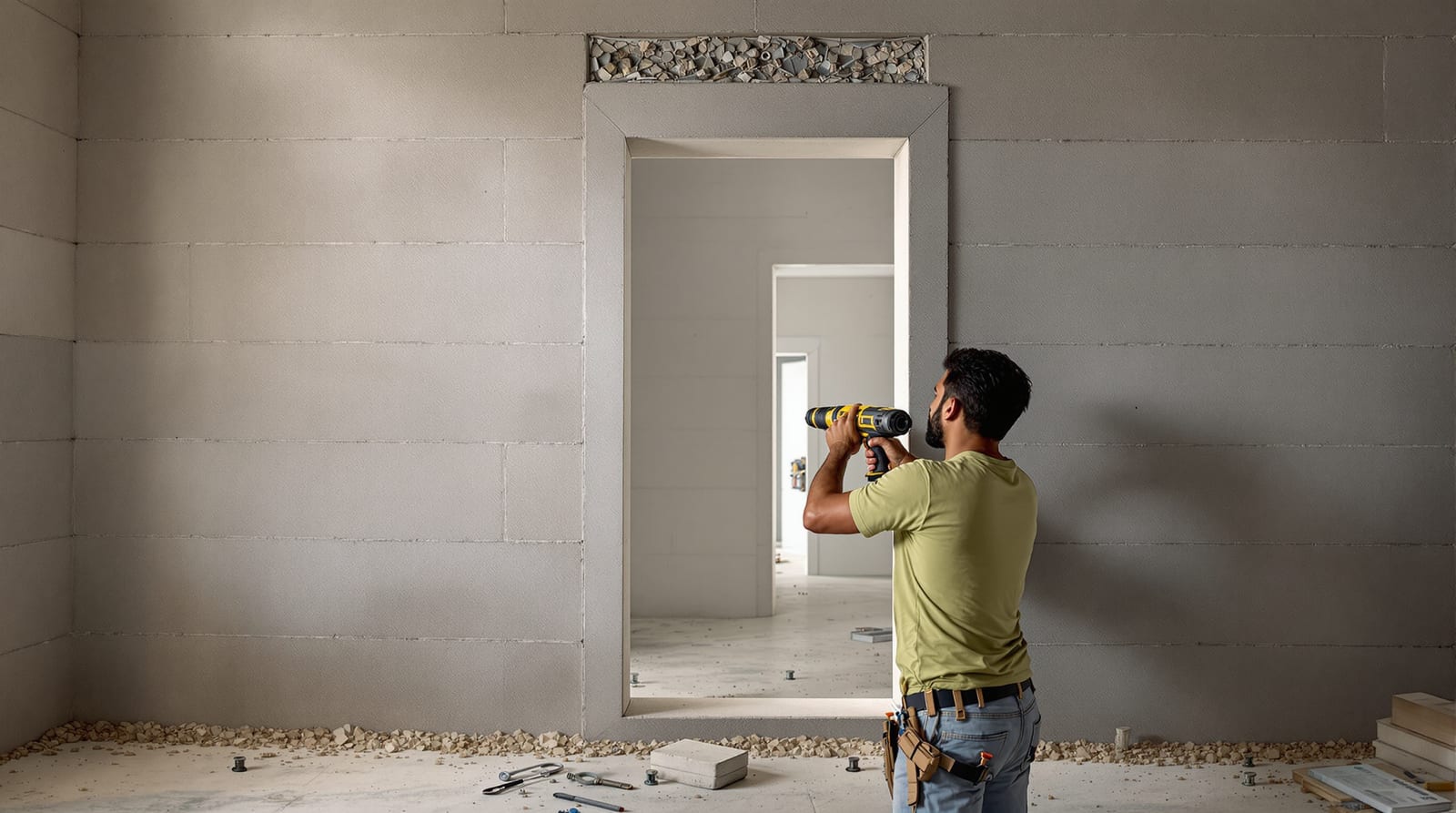
Door Frame Anchoring to Masonry: Holdfasts (India 2026)
How to anchor timber, steel and WPC door frames into brick, concrete block, AAC and RCC walls — fixings, edge distance, loads and India site realities.
Get the leaf, the hinges and the polish perfect and you can still end up with a door that rattles, bows or self-swings — because the door frame anchoring to masonry was wrong. The chowkhat is the structural bridge between a hung leaf and the wall; every time the door slams, an impact load travels through the jamb into the masonry. On Indian sites the wall behind that jamb is rarely the same from job to job — it might be table-moulded brick, a hollow concrete block, a lightweight AAC block, or a poured RCC jamb. Each substrate wants a different fixing, a different edge distance and a different expectation of pull-out strength. This guide is the fitter's and site engineer's reference for getting that interface right the first time, in line with IS 4021 (timber frames), IS 4351 (steel frames) and NBC 2016.
Why the anchor matters more than the leaf
A door frame fails at the wall, not in the timber. The two recurring site faults are (1) the jamb bows inward at the hinge or lock point because nothing packs it back to the masonry, so the leaf catches or won't latch; and (2) the whole frame works loose over a monsoon or two because the fixing relied on a plug in soft or hollow material. Good anchoring resists the static weight pulling the hinge jamb forward, the repeated slam impact, and the lever forces when someone leans or forces the door. The rule of thumb is 3 fixings per jamb for a 2.1m frame — roughly 200mm from each end and one near the mid-height — landed as close as practical to the hinge and lock positions where load concentrates. Always pack solid behind the hinge and lock points with shims or grout so the jamb cannot deflect.
Substrate decides the fixing
The single biggest decision is reading the wall. Solid, dense substrates (RCC, well-grouted brick) take expansion anchors happily; hollow blocks and lightweight AAC do not and need different hardware or embedded holdfasts.
| Substrate | Typical fixing | Holds well? | Watch-outs |
|---|---|---|---|
| Burnt-clay brick | M.S. holdfast in mortar pocket; or sleeve/wedge anchor; nylon frame plug | Good if brick is sound | Avoid fixing into a perp (vertical) joint; weak in old lime mortar |
| Solid concrete block | Sleeve anchor; concrete screw; holdfast | Good | Check it is solid, not hollow |
| Hollow concrete block | Holdfast cast in a filled pocket; toggle/sleeve into the web | Moderate | Never expand an anchor into a void — it spins free |
| AAC (autoclaved aerated) block | Dedicated AAC anchor (helical / large-diameter nylon); chemical anchor | Low base strength | Standard wedge anchors crush AAC and pull out |
| RCC / concrete jamb | Sleeve/wedge anchor; concrete screw | Excellent | Mind rebar; maintain edge distance from the corner |
Brick and solid block
For traditional Indian construction the classic and still-reliable method is the M.S. holdfast (hold-fast clamp): a flat mild-steel strap, one end screwed to the back of the jamb, the other tailed and embedded in a cement-concrete pocket built into the brickwork as the wall rises. Because the holdfast is cast into the masonry, it does not depend on friction in a drilled hole — it is the strongest, most forgiving option in brick. Where the frame goes in after the wall is built, a sleeve or wedge anchor or a long nylon frame plug + screw through the jamb into a drilled hole works well, provided you hit solid brick and not a mortar joint.
Hollow block — never expand into a void
Hollow concrete block is the classic trap. A wedge anchor set in the hollow web has nothing to grip and spins free. Either land the fixing in the solid face shell with a metal toggle / hollow-wall anchor, or — better — fill the cavity at the fixing zone with grout (or cast in a holdfast as the wall is built) and treat it as solid.
AAC block — special anchors only
AAC is light, well-insulated and increasingly common, but its compressive strength is a fraction of brick, so a standard expansion anchor simply crushes the cells and pulls out. Use purpose-made AAC fixings: large-diameter nylon frame anchors, helical (screw-in) AAC anchors, or a chemical/resin anchor with a sieve sleeve that bonds across a wider footprint. Drill without hammer action (rotary only) so you don't blow out the hole. As a rule of thumb, expect a fraction of the pull-out you'd get in brick and add a fixing point rather than over-torque the ones you have.
RCC and steel frames
A poured RCC jamb is the strongest base — sleeve anchors or concrete screws bite hard — but keep clear of reinforcement and respect edge distance from the corner. Steel frames (IS 4351) are a different game: they are usually built into the wall as it rises and grouted solid with 1:3 cement mortar / concrete, with the frame's integral lugs or anchor tabs embedded. A hollow, ungrouted steel frame drums, rusts and bows — back-fill it completely.
Edge distance, spacing and embedment
Anchors fail not in the steel but in the masonry around them: set a wedge anchor too near an edge and it spalls a cone of brick out instead of holding. Treat the figures below as conservative site rules of thumb — always defer to the anchor manufacturer's data and, for loaded fixings, to the site engineer.
| Parameter | Brick / concrete block | AAC block | RCC / concrete |
|---|---|---|---|
| Min edge distance | ~75-100mm from a free edge | ~100mm+ (low strength) | ~6x anchor dia, min ~50mm |
| Min spacing between anchors | ~100-150mm | ~150-200mm | ~10x anchor dia |
| Typical embedment | 50-75mm into solid material | 50-80mm (longer to compensate) | 50-75mm |
| Fixings per jamb (2.1m) | 3 | 3-4 (extra to share load) | 3 |
| Hole prep | Rotary-hammer, blow clean | Rotary only, no hammer | Rotary-hammer, blow clean |
Two cautions that catch people out: never fix into a mortar joint (it has no pull-out value — aim for the solid brick or block face), and always blow and brush the drilled hole clean before setting an expansion or chemical anchor, or you lose much of the rated load. For loaded or external main-door frames, prefer a GI/zinc-plated or stainless anchor; plain mild steel rusts and jacks the masonry over time.
Putting it together on site
The sequence matters as much as the hardware. Set the frame, then anchor, then grout — not the other way round.
1. Set the frame plumb, level and square in the rough opening on wedges and packers; check both jambs plumb and the diagonals equal before any fixing goes in.
2. Land the anchors at hinge and lock heights — 3 per jamb — solid into the substrate (or into cast-in holdfasts), packing behind each fixing so the jamb stays straight.
3. Grout / foam the gap: steel frames get 1:3 cement mortar packed solid; timber frames get low-expansion PU foam or mortar with packers (high-expansion foam will bow a timber jamb — avoid it).
4. Re-check plumb and reveal before the grout sets — this is the last chance to correct.
5. Hang the leaf, fit the lock, confirm even gaps and a clean latch.
6. Seal the junction: acrylic caulk internally, silicone externally/wet.
For the rough opening dimensions feeding step 1, see door rough opening and run the numbers through the door rough opening calculator. To choose the right frame material for the wall and exposure first, the door frame material selector is a useful starting point.
India realities to design around
Damp and DPC. A jamb foot standing on a wet floor will rot or corrode the anchor. Sit the frame base on a DPC / stone or RCC base block, especially at external and ground-floor openings, and treat the timber foot against termites — ground-contact timber is the first thing white ants find. In bathrooms, skip timber frames entirely for WPC / PVC / RCC / aluminium, which don't rot and accept their own appropriate fixings.
Monsoon and corrosion. Plain mild-steel anchors in an external wall rust, expand and crack the masonry. Specify GI, zinc-plated or stainless fixings on main doors and any wet-zone frame.
Skilled labour. A true fix — frame dead plumb, packed, anchored and grouted without bowing — is a carpenter-and-mason job. Fixing into mortar joints, high-expansion foam on timber, and no packing behind hinges are the mistakes that turn a good leaf into a sticking door. See door frame repair.
Related guides and tools
This page sits in the frames-and-installation cluster. For the broader fixing options compare it with door frame fixing methods; for the frame parts referenced above see door frame anatomy; for back-filling, door frame grouting and door frame gap filling; and for fixing into a non-masonry wall, door frame to drywall. The full installation walkthrough is door frame installation. See the phase pillar door frames and the cluster pillar complete door guide.
Frequently asked questions
How many holdfasts or anchors per door jamb?
As a rule of thumb, three per jamb for a standard 2.1m frame — roughly 200mm from the top and bottom and one near mid-height, landed close to the hinge and lock points where load concentrates. Heavy main doors or AAC walls may warrant a fourth to share the load.
Can I use a normal wedge anchor in AAC blocks?
No. AAC is low-strength and a standard wedge anchor crushes the cells and pulls out. Use purpose-made AAC fixings — large nylon frame anchors, helical AAC screws or a chemical/resin anchor — and drill rotary-only (no hammer) so the hole doesn't blow out.
Why does my door frame keep coming loose from the brick wall?
The usual causes are fixing into a mortar joint (no pull-out value), an anchor expanded into a hollow block void, a dirty drilled hole, or no packing behind the hinge/lock so the jamb bows and works the fixing loose. Re-fix into solid material, clean the hole, and pack solid.
What edge distance should an anchor keep from the corner of the masonry?
Keep roughly 75-100mm from a free edge in brick or block and about six anchor diameters (min ~50mm) in concrete, more in AAC. Too close and the anchor spalls a cone of masonry instead of holding. Always defer to the anchor maker's data and the site engineer for loaded fixings.
Are steel frames anchored the same way as timber?
No. Steel frames (IS 4351) are usually built into the wall as it rises and grouted solid with 1:3 cement mortar, with their integral lugs embedded — not screwed in afterwards. An ungrouted hollow steel frame drums, rusts and bows, so back-fill it completely.
Should anchors be galvanised?
For external main doors and any wet or coastal location, yes — use GI, zinc-plated or stainless anchors. Plain mild steel rusts in the monsoon, expands and can crack the surrounding masonry over time.
Export this guide
Related Guides — Deep-dive reading
Door Frame Fixing Methods: Holdfasts & Anchors (India 2026)
How to fix a chowkhat to masonry with M.S. holdfasts, lugs, screws and frame anchors — numbers, spacing and packing that keep the frame true.
Home Doors & EntrancesDoor Frame Installation: Set a Chowkhat True (India 2026)
Step by step on setting a door frame into the opening — propping, bracing, plumb, level and square, fixing and grouting — so the leaf hangs perfectly.
Home Doors & EntrancesDoor Opening Preparation Before Fitting (India 2026)
How to prep a door opening before the chowkhat goes in — checking size, plumb and square, confirming the lintel, laying DPC and marking holdfasts.
Home Doors & EntrancesRelated Tools — Try Free
Door Security Rating Calculator
Score your main door out of 100 across leaf, frame, lock and hardware — and see the top upgrades.
Security ToolHealing View Impact Calculator
Evidence-Based Design dashboard quantifying the recovery impact of nature view + daylight factor on analgesic use, length of stay, and HCAHPS patient-experience uplift. Calibrated against Ulrich 1984 (Science), Park & Mattson 2008, and the CHD EBD evidence base.
EBD CalculatorWindow Hardware Cost Calculator
Estimate window hardware cost — hinges, handles, locks, rollers and multipoint gears.
Window Calculator